By: Diane Ring
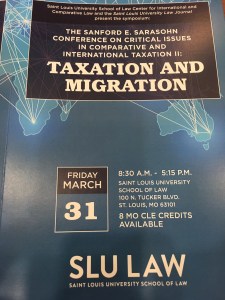 Today St. Louis University School of Law hosted the Sanford E. Sarasohn Conference on Critical Issues in Comparative International Taxation II: Taxation and Migration. This event offered a much needed forum to explore the intersection between international tax law and questions of migration and refugees. Topics addressed included using the tax system to remedy migration challenges (see, for example, Matthew Lister, “A Tax-Credit Approach to Addressing Brain-Drain” suggesting a tax transfer from jurisdictions on the receiving end of a brain drain to the countries losing skilled labor; and see Cristina Trenta, “Migrants and Refugees: An EU Perspective on Upholding Human Rights Through Taxation and Public Finance” advocating an EU-wide tax to finance members’ commitments to refugee human rights). Other papers considered the burdens that tax-induced migration creates for the society the migrant leaves and for some members of the jurisdiction the migrant joins (see, for example, Allison Christians, “Buying In: Citizenship and Residence by Investment”). The full set of 15 conference papers will be published in the St. Louis University Law Journal and will provide a valuable resource on the breadth of taxation and migration questions.
Author: Diane Ring
When your job is predicting the future
 By: Diane Ring
In a post earlier this week, I considered how the international tax conference I was attending (the annual worldwide meeting of the International Fiscal Association, IFA) had something in common with the Japanese anime and manga conference hosted in the adjacent venue. Soon the anime event ended and the tax conference continued, but with a new neighbor – the Meteorological Technology World Expo 2016. No costumes – but some interesting, though puzzling, equipment outside in the courtyard. I thought about the big task of meteorology—predicting the future. Turns out that in-house tax advisors have the same job, it’s just that instead of rain, they predict the tax implications of business decisions for the C-suite. But the tax advisors do it without the tech, and there is a lot to keep them up at night . . . Continue reading “When your job is predicting the future”
International tax meets Japanese anime
By: Diane Ring
On Sunday, international tax lawyers and advisers from private sector, government officials, tax representatives from international organizations, in-house counsel, and tax academics converged on the convention center in Madrid for the annual conference of the International Fiscal Association (IFA).
But we were not alone.
An adjacent exhibition hall hosted “Japan Weekend 2016” a celebration of Japanese anime and manga. I had no trouble finding my place – I was unlikely to confuse international tax lawyers with the costumed crowd that channeled Alice in Wonderland meets the Flash. Once the tax conference got underway, though, I began to contemplate similarities between the two events, in particular, the meaning and role of reality and its construction. . . Continue reading “International tax meets Japanese anime”
Court Says No to Uber Class Action Settlement: What does that mean for worker classification?
By: Diane Ring
A major question in the sharing economy is the status of workers – are they employees or independent contractors? Of course, no single answer would apply across the entire sector but the debate has been most prominent in ridesharing. At the center of this debate are two litigations against Uber in California and Massachusetts (in January 2015 the Massachusetts case was transferred to the Northern District of California). The suits, brought on behalf of Uber drivers in the two states, “alleged [among other claims] that Uber misclassified its drivers as independent contractors rather than employees.” Reclassification as an employee would entitle drivers to various protections and potential compensation under state labor law. Three years into the litigation, the plaintiffs agreed on a settlement with Uber, which would provide for monetary relief of $84 million (plus an additional $16 million contingent on an initial public offering). The bulk of this payment would be split into two funds, with approximately $5-6 million for Massachusetts drivers, and approximately $56-66.9 million for California drivers. Payouts to drivers would be based on miles driven under a formula. Continue reading “Court Says No to Uber Class Action Settlement: What does that mean for worker classification?”
Emerging Trend for Uber in Europe?
By: Diane Ring
Uber, one of the most prominent faces of the sharing economy, has not always been welcome in the EU. Similarly, Airbnb has experienced legal, regulatory, and public policy resistance across European countries. However, two recent developments in the EU suggest that, on balance, Europe might be staking out a regulatory path for the sharing economy that is intended to demonstrate the region’s support for the new sector. . . . Continue reading “Emerging Trend for Uber in Europe?”
Flying, an Alpaca Farm and Baseball Cards – What do they have in common?
By: Diane Ring
In teaching Basic Income Tax, I have found that teaching students about the lines between engaging in a trade or business, profit seeking, and hobbies helps them become comfortable using facts in tax analysis and argument. It confirms for students that tax law is a type of law demanding factual and legal analysis – facts do matter and they are not self-evident. Thus, in anticipation of my next class, I have been collecting (thanks to Tax Notes and the BNA Daily Tax Report) new examples of taxpayer failures to convince a court that their activity was, in fact, for profit. It turns out the pool is quite large, but some personal favorites have risen to the top . . . Continue reading “Flying, an Alpaca Farm and Baseball Cards – What do they have in common?”
The EU, Robots, and Star Trek
By Diane Ring
Even in the midst of great turmoil surrounding the Brexit vote, I was intrigued by recent reports that the EU is contemplating taxing robots on their “labor.” My initial reaction was that this focus on “sophisticated autonomous” robotic forms was Star Trek meets employment taxes, reminiscent of an episode in which the ship’s android officer, Data, asserts and argues for status as a sentient being rather than a piece of shipboard machinery to be disposed of at will. See generally Episode 9, Season 2 (“The Measure of a Man”) of Star Trek: The Next Generation.
While my sci-fi vision of EU legislation was enticing, it turns out that the motivations for this proposal were grounded in much more immediate concerns . . . Continue reading “The EU, Robots, and Star Trek”
Minnesota Dogs Breathe (Woof) a Sigh of Relief: Pet Trusts Now Legal
By Diane Ring
 Perhaps you heard a chorus of joyous barking across the state of Minnesota recently — now you know why. Until just over two weeks ago, every state in the U.S., plus Washington, D.C., recognized statutory pet trusts, except Minnesota. But on May 22, 2016, the Minnesota Governor signed legislation approving pet trusts. The legislation, which had been sponsored in the House by Rep. Dennis Smith and in the Senate by Sen. Scott Dibble, allows the creation of a legally enforceable trust that provides for the care of an animal that was alive during the grantor’s lifetime. The terms of the trust can be enforced by a person appointed in the trust, or if no one is appointed, the court may appoint someone. Moreover, anyone having an “interest in the welfare of the animal” may petition the court to appoint someone to enforce the trust or remove the person so designated in the trust document. The trust would terminate on the death of the last surviving animal (or 90 years if shorter). Any remaining proceeds would be distributed pursuant to the trust’s terms, or if the trust fails to specify, then to the “grantor’s heirs-at-law determined as if the grantor died intestate domiciled in [Minnesota] at the time of distribution.”
This all seems pretty straightforward, so why was Minnesota the last state? Continue reading “Minnesota Dogs Breathe (Woof) a Sigh of Relief: Pet Trusts Now Legal”
Uncle Sam as Danish Tax Collector
By: Diane Ring
Who says that real global tax cooperation is dead? During a very interesting conference on international tax held in Boston a couple of weeks ago, a recent U.S. tax case was discussed and caught my attention: Torben Dileng v. Commissioner (D.Ct. N. Ga., Jan. 15, 2016). In that case, a U.S. District Court ruled that the IRS could collect $2.5M of Danish taxes owed by a Danish citizen who was resident in the U.S.
IRS as Danish tax collector– what was this all about? Continue reading “Uncle Sam as Danish Tax Collector”
Will New Data on the Volume of Sharing Economy Workers Prompt Tax Reform?
By: Diane Ring
Sharing economy and other platform workers are frequently classified as independent contractors and bear many of their own costs. Thus, these workers whom we don’t think of as “small businesses”—and don’t really think of themselves as small businesses—are thrust into the exciting world of quarterly reporting and calculation of proper deductions. Exciting if you are a tax lawyer, but less so if you are making limited income and are facing daunting tax compliance requirements. Despite these compliance challenges, there has not been much movement in responding to the tax challenges faced by sharing economy workers. These observations about the sharing economy sector have been around for a while; they were the focus of two forthcoming articles by my co-author, Shu-Yi Oei, and me (Can Sharing Be Taxed? and The Tax Lives of Uber Drivers: Evidence from Internet Discussion Forums).
Yesterday, a new report coming out of American University echoed our observations and findings. Caroline Bruckner of the Kogod Tax Policy Center presented testimony (and a supporting report) to Congress regarding the size and scope of worker participation in the sharing economy. Her goal was not to provide a definitive calculation nationwide of sharing and platform workers, but to offer a solid sense of the scale of participation in the sector (more than 2.5 million individuals) and note important growth trends. Based on the percentage of the American workforce active in the sharing/platform sector, she urged more government attention to reform that would address the tax compliance and administration challenges in this sector.
Will Congress and Treasury/IRS respond? Continue reading “Will New Data on the Volume of Sharing Economy Workers Prompt Tax Reform?”
Can EU-wide Corporate Consolidation Be Revived?
By: Diane Ring
On Tuesday, Shuyi mentioned the EU’s Common Consolidated Corporate Tax Base proposal (CCCTB) in her post, noting some interesting parallels between maritime/bankruptcy coordination and international tax efforts at coordination. This motivated me to take a look at the recent developments that have happened around the CCCTB proposal. The CCCTB would provide a single set of rules for calculating the income of businesses operating in the EU – and would allow for such businesses to file a single consolidated return for their EU activities. The group’s income would then be allocated across the member states. Under this scheme, individual EU member states would still be able to tax their portion of the group’s income at their own country-specific tax rate. But I was curious–the CCCTB proposal is not new; it has been around for more than a decade. What has been happening on this stalled cooperation front? And, more importantly, will the EU’s announced re-launch of the proposal have a greater chance of success than previous attempts? Continue reading “Can EU-wide Corporate Consolidation Be Revived?”
A Hot News Week for Krispy Kreme
By: Diane Ring
The big news this week about Krispy Kreme is that they are going to be acquired for $1.35 billion. As reported in the WSJ last night, JAB Holding Co. (a European investment fund, which the WSJ noted holds an interesting mix of assets including Caribou Coffee, Jimmy Choo shoes, and Durex condoms) is about to add glazed donuts to its asset pool. But this was not the Krispy Kreme news of the week that caught my eye. I was fascinated instead to read that this week the Missouri Supreme Court ruled on Krispy Kreme’s request for a refund of sales tax it had remitted on sales of donuts and other related items from 2003 through 2005.
Krispy Kreme had collected sales tax at the 4% rate applicable to food sold that would be immediately consumed. In contrast, food sold at grocery stores generally bore only a 1% state sales tax. Essentially, as the media described it, Krispy Kreme argued that its donuts were like grocery store food, and thus should bear only the sales tax rate applicable to such food. I may not follow the healthiest of diets but even I do not think that donuts are the equivalent of broccoli from the produce aisle. What were they thinking? But then my tax brain kicked in. I immediately understood. . .
EU State Aid Debate Lit Up the ABA Teaching Tax Session in DC
By: Diane Ring
As I blogged last week, the ABA Tax Section Teaching Tax Committee held a panel discussion Friday on the EU State Aid investigations on advance tax rulings. As I’ll discuss below, the panel was every bit as interesting as forecast. But first, a quick overview of what EU State Aid is all about:
EU State Aid Doctrine and Recent Controversy
Under Art. 107(1) of the Treaty on the Functioning of the European Union (as interpreted by the ECJ), if a member state provides state aid that distorts competition in the EU then the member must recover that aid from the benefiting entity to undo the distortive effects. Although this competition doctrine developed outside the tax context, it has previously been applied to tax benefits granted by a member state to a taxpayer. The European Commission oversees the investigation of state aid cases and issues the decisions.
Recently, though, application of the state aid doctrine to tax rulings issued by member states to multinationals has become a subject of tremendous controversy. In the past two years, the EC has been investigating tax rulings granted by member states to multinationals, including U.S. multinational taxpayers. The concern is that the multinationals receiving these rulings are not getting “mere” clarification of the law, but rather are securing a distinct advantage that creates distortion in the market. The U.S., along with various commenters, has expressed concern that these investigations might be disproportionately targeting U.S. businesses. Others have questioned whether the state aid rules are the most appropriate tool for combatting transfer pricing and/or double nontaxation situations that the EU finds problematic.
The Panel Discussion
During the discussion, it became apparent that there was a notable gap between the way many (but not all) in the U.S. view the European Commission’s recent state aid investigations involving U.S. taxpayers, and the EC’s vision of the role of the state aid doctrine in addressing potential harm caused by tax rulings granted to U.S. multinationals with very low effective tax rates. Thus, I was not surprised to hear these divergent positions characterized during the panel as “ships passing in the night”. What I did not anticipate was hearing the phrases “legal science fiction” (applied to certain suggested challenges to EC state aid decisions) or “a horror movie” (applied to the unfolding state aid investigations and decisions).
But the energy in the room was only part of the story. The panel provided very rich insights into the many complicated issues surrounding the current state aid investigations. I could not do them all justice here but thought I would highlight those that were mentioned by various panelists that really caught my attention:
Continue reading “EU State Aid Debate Lit Up the ABA Teaching Tax Session in DC”
Is the Global Trend Toward Tax Transparency and Disclosure a Surprise to Many Multinationals?: Insights from the ABA Tax Section Meeting in DC, May 6, 2016
By: Diane Ring
As I mentioned in my post earlier this week, I am in DC for the ABA Tax Section Meeting and am very much looking forward to this afternoon’s session on the EU State Aid Investigations. But at this morning’s session of the Administrative Practice Section, much of the conversation during the panel on the post-BEPS world focused on the array of new mechanisms that have emerged–or are being contemplated–at all levels (domestic tax law, international agreements, etc.) to provide increased transparency regarding multinational taxpayers and their tax treatment. Among the key examples were FATCA, BEPS-based country-by country-reporting, and new rules in the EU.
The fact that this was a topic at the ABA was not surprising, nor was the specific list of transparency and disclosure measures noted during the discussion. What did surprise me was the observation made during the panel that for many multinationals (not the really large ones, but the next tier down) this emerging trend was not on their radar. The point was made that these businesses did not have the staff to monitor the activities of the major international organizations such as the OECD and JITSIC in the same way that the very largest businesses did. Thus, despite the fact that the current world of transparency and disclosure was in fact foreseeable and reflects a perceptible evolution that has been taking place since the 1990s, it nonetheless took some of these taxpayers by surprise.
I am not sure what to make of this–but one point it suggests is that there was a general sense among these multinational businesses that although institutions such as the OECD played a role in international tax, it was a limited and predictable role that did not warrant ongoing and extensive monitoring by such businesses. I imagine institutions such as the OECD are getting more scrutiny from these businesses now.
ABA Tax Section May Meeting — Teaching Tax Panel: Government Speakers Will Debate EU-US Controversy Over State Aid (Friday, May 6, 3:00 pm)
By: Diane Ring
It’s already time for the May Meeting of the ABA Tax Section, in DC. and I wanted to highlight the session organized by the Teaching Tax Committee – it should prove to be immensely interesting.
As those who follow international tax know, there has been a been a controversy brewing between the U.S. and the EU regarding European Commission investigations into whether tax rulings that certain multinationals (most of which are U.S. corporations) received from EU member states constitute forbidden state aid. The U.S. has expressed concern that the investigations inappropriately target U.S. businesses, while the EU considers the inquiry a legitimate look at important tax rulings.
The panel discussion this Friday at 3:00pm will include the following government officials: Bob Stack, U.S. Deputy Assistant Secretary, International Affairs; Gert-Jan Koopman, Deputy Director-General State Aid, Directorate-General for Competition, European Commission; and Pierpaolo Rossi-Maccanico, European Commission.
I will be blogging about the panel later – but even better than reading about it will be attending and then reading the blog post!
For more information:
 The Surly Subgroup