More Merger Mayhem: Tax Lawyers Testifying

By: David J. Herzig

Great news, the awesome clerks at the Delaware Courts were nice enough to help me get my hands on the trial transcript.  I guess I have some heavy reading to do now.  My goal is to first look through the transcript to see if anything jumps off the pages.  My longer goal is to try to create a tax opinion using the transcript and any depositions if necessary. I would like to see whether I agreed with Cravath or L&W.   After all, the judge did not decide whether the transaction withstood a should opinion.  Rather, he plotted the various opinions and decided that there was not a sufficient cluster to consider a should opinion was warranted.

[As a quick aside, I can’t believe that all the documents are not readily available for free on the court web site.  The judge (chancellor) references the trial transcript in his opinion, yet, the supporting document is not available on-line for free.  I have free lexis access as an academic and can find portions of documents but not the docket or the document.  As a member of society, this certainly raises an access to justice problem. Thankfully, the clerks are super helpful and accommodated me.]

I also have received some thoughtful responses and theories about the case.  I will be wrapping them up into my opinion post later (sorry you have to follow me on twitter (@professortax) to know when it hits or better yet keep checking surlysubgroup.com).  But some of the best initial thoughts take into account some of my concerns.

First, I am still not sure why there was an out in the deal base on the should opinion. Continue reading “More Merger Mayhem: Tax Lawyers Testifying”

Updates on the Williams/ETE Merger

By: David J. Herzig

On Saturday, I posted about a merger gone bad that I thought only a couple partnership tax people would find interesting.

Essentially, a $38 Billion merger was torpedoed because neither, Latham, Morgan Lewis nor Gibson Dunn could conclude that the merger qualified as tax-free under 721.[1]  The fight between the the tax attorneys was whether the transaction was truly a partnership formation eligible under 721 with a 731 distribution or if the transaction was a disguised sale under the anti-Otey regulations (Treas. Reg. § 1.707-3).[2]  Chancery Court Vice Chancellor Sam Glasscock [http://courts.delaware.gov/opinions/list.aspx?ag=court%20of%20chancery%5] ruled, since there was enough uncertainty that the proposed transaction could not be eligible for 721 treatment under a should opinion standard, Energy Transfer Equity (ETE) could back out of the deal.  Williams stated that they will appeal.

I honestly thought no one would care about the post.  But, it looks like people care, so I will try to keep up with the case and post updates here.  I actually have some other thoughts on the transaction that I will post as they become more developed.

To some of the updates, here is a link to a letter to the shareholders of the Williams Continue reading “Updates on the Williams/ETE Merger”

State Tax Reform Amidst Cajun Sausage Making

Steven Sheffrin
Professor of Economics & Director of the Murphy Institute, Tulane University

It was not quite Cajun boudin being prepared in Baton Rouge this winter and spring, but the sausage being concocted in the Louisiana Legislature was equally spicy. With low oil prices and years of “creative” budgets under Governor Bobby Jindal, the new Governor, John Bel Edwards, and the Legislature faced an initial budget shortfall of roughly 16 percent of the state general fund for the next fiscal year. Three separate legislative sessions later, they did reach a balanced budget, although with less revenue than the Governor had wanted. The revenue raisers included a dizzying array of sales tax changes that only temporarily limited exemptions, temporary limits on the refundability of business credits, and various other “haircuts” for business. Not exactly the purest of tax reforms.

But buried in this avalanche of legislation were some serious reforms of the Louisiana corporate tax along the lines that my colleagues and I had recommended to the Legislature last year.

Continue reading “State Tax Reform Amidst Cajun Sausage Making”

Tax Lawyers Kill $38 Billion Merger

By: David J. Herzig

I remember one of my first days at GT we were advising on a corporate merger.  At the end of the process (of course), the M&A group asked tax to sign off on the deal.  Everything was done and this was supposed to be a rubber stamp.  Well, as you can guess by now, the tax consequences of the deal as structure were disastrous and the whole deal had to be restructured.  I remember vividly the corporate lawyers saying as they walked out the door, this is why we never ask tax anything!

Today, a judge killed the proposed $38 billion merger between Energy Transfer Equity (“ETE”) and the Williams Companies. Chancery Court Vice Chancellor Sam Glasscock ruled that ETE could back out of the deal because of taxes. [UPDATE: The link is not consistently working so here is the web link to the court: http://courts.delaware.gov/opinions/list.aspx?ag=court%20of%20chancery%5D  Latham & Watkins, actually, tax lawyers at three top firms (L&W, Gibson Dunn and Morgan Lewis and one law professor) could not opine that the deal was tax neutral under 721 despite one law professor and Cravath saying the deal worked.  This opinion is a rather big deal for M&A lawyers.  Usually, conditions precedent like this won’t allow one side to back out of a transaction.

This is a tax blog not a M&A blog, so, I thought I could show how a $38 billion deal was structured and some lessons that could be learned by examining the deal post-mortem. The post is rather long but I hope super interesting to partnership tax people.

As a total aside, the tax side sounds to me like cover. The $6B payout to Williams shareholders as part of the deal was bridge financing.  This bridge financing dried up when the value of the assets dropped to about half after the agreement because of a drop in energy prices. From the opinion, “In light of its obligation to deliver $6.05 billion in cash, the Partnership and its Chairman Kelcy Warren have become increasingly troubled with its potential overall debt levels.”  But failure to conduct a proper thought experiment regarding the guaranteed payment by the tax lawyers created the controversy.

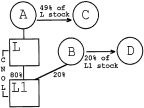
According to the ruling, “The Proposed Transaction is an unusual structure, accommodating Williams’ desire for its stockholders to continue to be holders of publicly traded common stock (as opposed to partnership units) and to receive a substantial cash payment, in return for Williams’ assets being acquired by the Partnership.”

L&W was asked by ETE to issue a should opinion that “ETC and the Partnership “should” be treated by the tax authorities as a tax-free exchange under Section 721(a) of the Internal Revenue Code (the “721 Opinion”).” L&W could not issue the opinion and the Chancellor allowed, quite unusually, ETE to pull out of the deal.

Now, it was not like Williams was without adequate counsel.  Cravath, Swaine & Moore LLP was deal and tax counsel to them and Gibson, Dunn & Crutcher LLP was additional deal counsel.  For that matter, Morgan, Lewis & Bockius LLP  (tax counsel) and Wachtell, Lipton, Rosen & Katz (deal counsel) also served as counsel to to ETE.

According to the opinion here was the proposed deal:

Continue reading “Tax Lawyers Kill $38 Billion Merger”

Follow-up Friday: Messi and McDonald’s

By David J. Herzig

In what I’m dubbing follow-up Friday, I wanted to give a quick update to two stories I am following regarding tax avoidance structuring.  One on the corporate side: the French Tax Authority Raids on Multinationals; and, one on the individual side: the Messi Tax Fraud Trial. Both stories are heating up.

French Tax Raids

imgres

It was reported overnight that McDonald’s French headquarters was raided by French taxing authorities.  Unlike the Google raid that was reported in real time, this raid appeared to take place on May 18.

Much like the Google raid this investigation is centered on tax avoidance.  McDonald’s problems seem to have started in December when a lawsuit was brought against the company for understating earnings.  Apparently, in France, workers are entitled to a share of profits. A February 2015 report stated that McDonald’s avoided almost 1 billion euros of taxes using its Luxembourg subsidiary.

I guess Diane Ring was correct in her comment that all multinationals should be preparing for tax raids in France.  If you don’t have a plan in place, you should be working on one now.  Finally, Professor Byrnes at Texas A&M wrote an interesting story on his blog about routes for the United States to increase its involvement.

Messi Tax Fraud Trial

The most trustworthy news outlet, World Soccer Talk, is reporting that Lionel Messi will testify on June 2 for in his tax fraud trial.  As I previously reported, the trial is due to start on May 31.

A fascinating wrinkle that the article points out is that although there is potential jail time (22 months) if Messi is convicted of tax fraud, often that sentence is suspended.  “However, any such sentence would likely be suspended as is common in Spain for first offences carrying a sentence of less than two years.”

As I keep looking into sports figures tax avoidance planning, more and more amazing items come to light.  In January, Kelly Phillips Erb, reported in Forbes about another FC Barcelona player, Javier Mascherano, pled guilty to not paying tax for 2011 and 2012.  How fun would it be if two players of the NY Yankees were convicted of tax fraud.

These stories are why I love Europe!

French Tax Authorities Raid Google

By: David J. Herzig

Don’t ever say that The Surly Subgroup is not on some breaking news.  It is being reported starting at 5 am French time some 100 French authorities conducted a “ultra secrète” raid on Google’s Paris headquarters.  This past February, Google was assessed a deficiency of some 1.6 Billion euros in back taxes.

5825007_google-paris_545x460_autocrop


Une perquisition a lieu ce mardi au siège de Google à Paris.  LP/F. DUGIT

There is nothing really new about the Google tax story.  Members of the European Union are in constant complaint about the use of tax strategies used by multinationals.  With awesome names such as the Double Irish with a Dutch Sandwich, multinationals that have portable revenue generation items, e.g., algorithms, can house those assets in low tax EU jurisdictions such as Ireland.  By then using EU laws to their advantage, e.g., EU tax law protects companies from paying tax in a non-permanent establishment country, they can avoid or mitigate tax.

In January this year, Google settled similar claims with the United Kingdom.   Continue reading “French Tax Authorities Raid Google”

Can EU-wide Corporate Consolidation Be Revived?

By: Diane Ring

On Tuesday, Shuyi  mentioned the EU’s Common Consolidated Corporate Tax Base proposal (CCCTB) in her post, noting some interesting parallels between maritime/bankruptcy coordination and international tax efforts at coordination. This motivated me to take a look at the recent developments that have happened around the CCCTB proposal. The CCCTB would provide a single set of rules for calculating the income of businesses operating in the EU – and would allow for such businesses to file a single consolidated return for their EU activities. The group’s income would then be allocated across the member states. Under this scheme, individual EU member states would still be able to tax their portion of the group’s income at their own country-specific tax rate. But I was curious–the CCCTB proposal is not new; it has been around for more than a decade. What has been happening on this stalled cooperation front? And, more importantly, will the EU’s announced re-launch of the proposal have a greater chance of success than previous attempts? Continue reading “Can EU-wide Corporate Consolidation Be Revived?”

Tax Policy and Puerto Rico’s Fiscal Crisis: An Insolvency Primer and Some Tax Things to Read

By: Shu-Yi Oei

I’ve been following the story of Puerto Rico’s default on its public corporation debt repayment obligations, which has been unfolding over the last several months. The latest happened on Monday, May 2 (well, technically Sunday), when Puerto Rico missed a major debt payment that was due to the bondholders of its Government Development Bank (GDB).

The topic has been well covered from the sovereign debt/insolvency angle over on Credit Slips, so I won’t go into that in detail here. As I understand it, the main points are these:

(1) Puerto Rico owes around $70 billion total outstanding debt to its creditors, of which a significant chunk is public corporation debt. Public corporations are corporations owned by the government of Puerto Rico. For example, the GDB is a public corporation.

(2) Unlike U.S. municipalities such as Detroit, Puerto Rico entities aren’t considered debtors for purposes of Chapter 9 of the U.S. Bankruptcy Code. They therefore don’t have access to the Chapter 9 municipal bankruptcy process. See 11 U.S.C. § 101(52). This is a bit of a head scratcher.

(3) In 2014, Puerto Rico’s legislature passed a law, the Puerto Rico Public Corporation Debt Enforcement and Recovery Act, which created a mechanism analogous to Chapter 9 bankruptcy by which Puerto Rico public corporations can restructure their debt. See Puerto Rico Passes New Municipal Reorganization Act: Puerto Rico Public Corporation Debt Enforcement and Recovery Act, 2014 P.R. Laws Act. No. 71, 128 Harv. L. Rev. 1320 (2015).

(4) Some bondholders filed a lawsuit, contending that Chapter 9 of the U.S. Bankruptcy Code preempts the Recovery Act. The First Circuit ruled that the Recovery Act is preempted. Franklin California Tax-Free Trust v. Puerto Rico, 805 F.3d 322 (1st Cir. 2015). The Supreme Court granted cert and heard oral arguments on March 22, 2016. No decision yet. For one scholar’s take on the issue, see Stephen J. Lubben, Puerto Rico and the Bankruptcy Clause, 88 Am. Bankr. L.J. 553 (2014).

(5) In light of all this, some have called for U.S. Congressional action, and there’s been legislation drafted to address Puerto Rico’s fiscal crisis that will allow for both restructuring and reform going forward. The House Committee on Natural Resources put forth a draft bill, the Puerto Rico Oversight, Management & Economic Stability Act (“PROMESA”). See also here for a helpful executive summary that accompanied an earlier draft. So far, that legislation has stalled, but they’re still trying.

There are many important issues in play, about which various stakeholders and commentators disagree. Some big ones are: (a) whether the draft PROMESA legislation raises retroactivity issues that make it unfair to bondholders (including mutual funds and their investors) who may be subject to restructuring ex post without having had notice of that possibility ex ante; (b) relatedly, whether creating a bankruptcy-like restructuring process for Puerto Rico is bad for bondholders because it prevents holdout creditors from holding up restructuring negotiations, (c) how much oversight and sovereignty Puerto Rico should cede (for example, different stakeholders feel differently about the installation of an oversight board); (d) the extent to which austerity measures are feasible and should be imposed [fn1], and (d) and what substantive reforms should be put enacted going forward.

So where does tax come in?

Continue reading “Tax Policy and Puerto Rico’s Fiscal Crisis: An Insolvency Primer and Some Tax Things to Read”

SRLY, SRSLY: A Tale of Loss and Longing to Belong

By: Shu-Yi Oei

Over the past few days, we here at Surly Subgroup have received several requests for a post explaining our blog name. So, here’s a Very General primer for non-tax readers, and for our tax readers who maybe don’t spend all of their waking hours staring at the consolidated return rules.

Old lawyerly disclaimer habits die hard, so I’ll just say that the following discussion is Very General and mostly for fun. Others have written about this far more exhaustively. See, e.g., Martin J. McMahon, Jr., Understanding Consolidated Returns, 12 Fla. Tax Rev. 125 (2012) and four whole BNA Tax Management Portfolios.

Here are the key points:

Everybody Wants to Belong…

The general idea behind the consolidated return is that where there’s an affiliated group of corporations, a rule that requires each corporation in the group to file its own separate tax return may create frictions and transaction costs and may give rise to weird incentives and disincentives in the case of transactions between corporations in the group.

Enter the consolidated income tax return.

Continue reading “SRLY, SRSLY: A Tale of Loss and Longing to Belong”