Tax Evasion and the Fraud Diamond

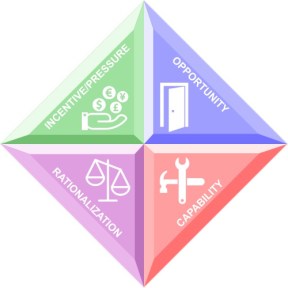
By: Leandra LedermanFraud Diamond image
There is an extensive set of literatures on tax compliance and evasion, often discussing the traditional economic model (the deterrence model) and/or behavioral theories such as social norms or tax morale. (For recent examples summarizing the theories, see this article by Kathleen Delaney Thomas, this one by Adam Thimmesch, or this one by yours truly.) There is also a separate accounting literature on fraud.

A key concept in this accounting literature is the “Fraud Triangle.” Yet despite the important role this theory plays within the accounting literature, the Fraud Triangle does not seem to have permeated the tax compliance literature, particularly the relevant legal literature.

For example, a search in “Secondary Materials” in Lexis for “‘fraud triangle’ w/50 tax!” turns up only one article, which is not a tax article but does cite a 2006 Tax Notes article authored by three CPAs. That article is James A. Tackett et al., “A Criminological Perspective of Tax Evasion” (paywalled). Yet, the Fraud Triangle should not be overlooked by scholars outside of accounting. It provides a powerful tool with which to conceptualize tax evasion. And, as discussed below, it helps provide a framework that both supports the deterrence model and allows other factors to coexist with deterrence.

The Fraud Triangle and the Fraud Diamond

The Fraud Triangle derives from three factors that criminologist Donald R. Cressey originally identified in a 1951 article in the Journal of Accountancy, “Why Do Trusted Persons Commit Fraud?: A Social-Psychological Study of Defalcators.” As discussed in his 1951 article and his 1953 book, “Other People’s Money: A Study in the Social Psychology of Embezzlement,” Cressey developed the factors that became the Fraud Triangle out of in-depth interviews with inmates who had been convicted of trust violations such as embezzlement. The three factors were labelled the “fraud triangle” by Steve Albrecht in the early 1990s. The elements of the Fraud Triangle, as discussed by Albrecht and others, are “perceived pressure” (usually financial), “perceived opportunity” to commit the fraud, and “rationalization” that the actions are justifiable or appropriate in the context of the situation. Albrecht and his coauthors of a 1979 KPMG study of convicted perpetrators of fraud “found that the decision to commit fraud is determined by the interaction of all three forces.” Continue reading “Tax Evasion and the Fraud Diamond”

The § 199A Regulations: Looking Toward Finalization

By: Leigh Osofsky
Professor of Law, UNC School of Law

As the holiday season approaches, tax practitioners and commentators are waiting for the arrival of a much-anticipated event: the finalization of the § 199A regulations. The Treasury Department has indicated that it is trying to finalize the regulations before the end of the year or shortly thereafter. Treasury has moved expeditiously with this monumental regulatory project for good reason: with the New Year comes the first tax filing season that will require application of § 199A (though those filing estimated returns may have already tried to apply the section). While the proposed regulations indicate that taxpayers may rely on the proposed regulations until the date that the final regulations are published in the Federal Register, it is nonetheless beneficial to have a bit more certainty regarding the operation of the provision as soon as possible going into filing season.

So, what can we expect of the final regulations? Much of what we saw in the proposed regulations – the basic regulatory approach – will likely stay the same. As Shuyi Oei and I catalogued in a recent article, Beyond Notice-and-Comment: The Making of the § 199A Regulations, Treasury put significant work into formulating the proposed regulations. Treasury engaged in extensive dialogue with interested constituencies prior to the release of the proposed regulations in addition to going through OIRA review. The proposed regulations offer a lengthy and detailed presentation of why Treasury chose particular approaches such as, for instance, a narrow reading of the critical “reputation or skill” clause from the statute. These types of fundamental decisions from the proposed regulations are thus unlikely to radically change.

This is not to say there will be no changes at all in the final regulations. Treasury has signaled it may make some changes to parts of the aggregation rules. And S Corp banks lobbied extensively both as part of the notice-and-comment period and outside of it to increase the de minimis threshold for the specified service trade or business (“SSTB”) characterization. If their lobbying effort is successful, the threshold will go up in the final regulations and allow more S Corp banks and similarly situated businesses to avoid classification in the undesirable SSTB category. This would be a real win for such banks, especially given that the statute itself does not explicitly provide for a de minimis exclusion from the SSTB category. Many other taxpayers pleaded for greater clarity, and, in particular, clearer exclusion from SSTB categorization, including in a slew of requests made as part of the notice-and-comment process. Shuyi Oei and I documented much of this dynamic in our recent work. However, Treasury is unlikely to grant the certainty requested by all, as the taxpayers making the requests are surely aware.

So, who will get a present in finalization and who will get a lump of coal? We will all find out soon enough. But my money is on few major changes and a lot of little ones around the edges.

A Series of Series? Tax, Regulation, and Faculty Workshops at Boston College Law School

I do love a good faculty workshop. Reading and spiritedly discussing the work of other academics always fills me with energy and inspiration for my own projects. Plus, it’s great to be able to spend time with new and old friends and find out what’s been baking in their brains.

Here at BC Law, I’m fortunate to be involved in two exciting workshop series: the BC Tax Policy Workshop and the BC Regulation and Markets Workshop. Both kicked off this week: On Tuesday, we hosted Professor Jens Dammann from the University of Texas at Austin and heard about his paper, “Deference to Delaware Corporate Law Precedents and Shareholder Wealth: An Empirical Analysis.” Today, we welcomed Professor Ajay Mehrotra (Northwestern Law; Executive Director, American Bar Foundation) and had a lively discussion of his book project, “The VAT Laggard: A Comparative History of U.S. Resistance to the VAT.” Tomorrow, BC Law will have its first Faculty Colloquium of the semester. Professor Guy-Uriel Charles (Duke Law; visiting at Harvard Law) will present “The American Promise: Rethinking Voting Rights Law and Policy for a Divided America.”

You can never have too many workshops!

Below are the dates and speakers for the remainder of the semester. If you’re a Boston-area law professor and are interested in attending or would like to be on our workshop email list, just let me know.

Tax Policy Workshop (Fall 2018):

Thursday September 13, 2018
Ajay Mehotra (Northwestern, and American Bar Foundation):
The VAT Laggard: A Comparative History of US Resistance to the VAT
(co-sponsored with BC Legal History Workshop)

Tuesday November 6, 2018
Andrew Hayashi (UVA): title TBD

Tuesday Nov. 13, 2018
Cliff Fleming (BYU): title TBD

Tuesday November 27, 2018
Emily Satterthwaite (University of Toronto): title TBD
(co-sponsored with BC Regulation and Markets Workshop)

Continue reading “A Series of Series? Tax, Regulation, and Faculty Workshops at Boston College Law School”

The Stages of International Tax Reform (Insights from this Weekend’s ABA Tax Section Meeting)

By: Diane Ring

Since December 2017, tax conferences in the United States have focused substantially on the H.R. 1 tax reform legislation. No surprise there — the 2017 changes are among the most significant in the past thirty years. But over the past five months, through attending numerous tax conferences featuring international tax practitioners, I’ve observed some interesting developments in the nature of the discussions and debates at these conferences. These changes are pretty revealing about the process of absorbing the true impact of the new tax law, particularly in international tax. This weekend’s ABA May Tax Section Meeting in Washington, D.C. highlighted some of these trends.

Continue reading “The Stages of International Tax Reform (Insights from this Weekend’s ABA Tax Section Meeting)”

The Gig Economy Battles Continue: 9th Circuit Weighs In on Seattle Uber Driver Ordinance

By: Diane Ring

Today the 9th Circuit weighed in on the validity of a Seattle ordinance that requires businesses contracting with taxi-drivers, for-hire transportation companies, and “transportation network companies” to bargain with drivers if a majority of drivers seek such representation. The legislation, which effectively enables Uber and Lyft drivers to unionize, drew objections from Uber, Lyft and the Chamber of Commerce— which sued the City of Seattle. In an August 2017 post, I reviewed the ruling of the U.S. District Court for the Western District of Washington, which concluded that the Seattle ordinance was an appropriate exercise of the city’s authority and did not violate the Sherman Act (because of state action immunity) and was not preempted by the National Labor Relations Act (NLRA).  So what did the 9th Circuit say?

Continue reading “The Gig Economy Battles Continue: 9th Circuit Weighs In on Seattle Uber Driver Ordinance”

Call for Papers: New Voices in Tax Policy and Public Finance (2019 AALS Annual Meeting, New Orleans, LA)

The AALS Tax Section committee is pleased to announce the following Call for Papers:

CALL FOR PAPERS
AALS SECTION ON TAXATION WORKS-IN-PROGRESS SESSION
2019 ANNUAL MEETING, JANUARY 2-6, 2019, NEW ORLEANS, LA
NEW VOICES IN TAX POLICY AND PUBLIC FINANCE
(co-sponsored by the Section on Nonprofit and Philanthropy Law and Section on Employee Benefits and Executive Compensation)

The AALS Section on Taxation is pleased to announce the following Call for Papers. Selected papers will be presented at a works-in-progress session at the 2019 AALS Annual Meeting in New Orleans, LA from January 2-6, 2019. The works-in-progress session is tentatively scheduled for Saturday, January 5.

Eligibility: Scholars teaching at AALS member schools or non-member fee-paid schools with seven or fewer years of full-time teaching experience as of the submission deadline are eligible to submit papers. For co-authored papers, both authors must satisfy the eligibility criteria.

Due Date: 5 pm, Wednesday, August 8, 2018.

Form and Content of submission: We welcome drafts of academic articles in the areas of taxation, tax policy, public finance, and related fields. We will consider drafts that have not yet been submitted for publication consideration as well as drafts that have been submitted for publication consideration or that have secured publication offers. However, drafts may not have been published at the time of the 2019 AALS Annual Meeting (January 2019). We welcome legal scholarship across a wide variety of methodological approaches, including empirical, doctrinal, socio-legal, critical, comparative, economic, and other approaches.

Submission method: Papers should be submitted electronically as Microsoft Word documents to the following email address: tax.section.cfp@gmail.com by 5 pm on Wednesday, August 8, 2018. The subject line should read “AALS Tax Section CFP Submission.” By submitting a paper for consideration, you agree to attend the 2019 AALS Annual Meeting Works-in-Progress Session should your paper be selected for presentation.

Submission review: Papers will be selected after review by the AALS Tax Section Committee and representatives from co-sponsoring committees. Authors whose papers are selected for presentation will be notified by Thursday, September 28, 2018.

Additional information: Call-for-Papers presenters will be responsible for paying their own AALS registration fee, hotel, and travel expenses. Inquiries about the Call for Papers should be submitted to: AALS Tax Section Chair, Professor Shu-Yi Oei, Boston College Law School, oeis@bc.edu.

Call for Papers: “Reshaping Work in the Platform Economy”

By: Diane Ring

Last October, the international conference “Reshaping Work in the Platform Economy” was held in Amsterdam. I blogged about the two-day event that explored a wide range of legal, business and social issues here and here.  The call for papers for the Fall 2018 conference (October 25 & 26, 2018, Amsterdam) has just been issued:

call for papers 2018 2_Page_1

call for papers 2018 2_Page_2


Stephanie McMahon, “Tax as Part of a Broken Budget: Good Taxes are Good Cause Enough”

By: Leandra Lederman

IMG_5084
Left to right: David Gamage, Leandra Lederman, Stephanie McMahon, Matt Metz (JD/MPA student)

On February 28, Prof. Stephanie McMahon from the University of Cincinnati College of Law gave a faculty workshop at the Indiana University Maurer School of Law. She presented her paper titled “Tax as Part of a Broken Budget: Good Taxes are Good Cause Enough.” The thesis of the paper is that Treasury regulations are needed to effectuate the statutory tax laws consistent with Congress’s budgeting expectations, and that given the importance of the revenue raised by taxes to the functioning of the U.S. federal government, tax regulations should be excused from the Administrative Procedure Act’s pre-promulgation notice-and-comment process under the APA’s “good cause” exception. The paper thus tackles two arguments that Prof. Kristin Hickman has advanced in her work: post-promulgation notice and comment is insufficient for tax regulations, and there is no reason for “tax exceptionalism” in administrative procedures. Stephanie’s paper also contains a detailed explanation of the tax legislative process.

Given the importance of tax rulemaking and the difficulties the IRS has suffered with its well-known budget cuts, it is very nice to see a paper defending Treasury’s rulemaking strategy. Moreover, Stephanie’s argument is creative and thoughtful. However, the argument seems to depend on regulations being a critical part of the revenue-raising process, as the need for revenue is what Stephanie relies on to justify application of the good-cause exception. But are regulations needed for that? In explaining the budget process, Stephanie’s paper points out that regulations are not scored as part of that process. I think she agrees that tax statutes can raise revenue even in the absence of regulations. Instead, she argues that regulations help effectuate, albeit imperfectly, Congress’s scoring of the tax legislation. But some Internal Revenue Code sections do not expressly call for regulations. Others do, but some of the latter never actually see regulations promulgated. Yet, the tax laws are applied despite these “spurned delegations.” And given President Trump’s anti-regulation Presidential Executive Order on Reducing Regulation and Controlling Regulatory Costs, we may see more tax statutes operating without regulations. Continue reading “Stephanie McMahon, “Tax as Part of a Broken Budget: Good Taxes are Good Cause Enough””

More on Section 199A and Worker Classification (**Threaded Tweet Alert!)

Shu-Yi Oei

Last Friday, Diane and I posted a new paper called “Is New Code Section 199A Really Going to Turn Us All into Independent Contractors?” on SSRN. This was something that started as a blog post but then grew too long and so became a short paper. We plan to develop the ideas in it more robustly in future work.

On Saturday, I made one of those goofy academic tweet threads summarizing the paper, and then it occurred to me that I really liked my goofy tweet thread! Therefore, I’ve taken the liberty of posting the tweets here for the marginal reader who is just interested enough in the topic to read the tweets but possibly not interested enough to read the actual paper.

Diane and I look forward to continuing conversation on this.

Is New Code Section 199A Really Going to Turn Us All Into Independent Contractors? (New Paper on SSRN)

By: Diane Ring

Shu-Yi and I started a blog post on new Section 199A that morphed into a seven-page essay that ultimately found its proper home on SSRN. Here is the abstract:

Is New Code Section 199A Really Going to Turn Us All Into Independent Contractors?

Abstract

There has been a lot of interest lately in new IRC Section 199A, the new qualified business income (QBI) deduction that grants passthroughs, including qualifying workers who are independent contractors (and not employees), a deduction equal to 20% of a specially calculated base amount of income. One of the important themes that has arisen is its effect on work and labor markets, and the notion that the new deduction creates an incentive for businesses to shift to independent contractor classification. A question that has been percolating in the press, blogs, and on social media is whether new Section 199A is going to create a big shift in the workplace and cause many workers to be reclassified as independent contractors.

Is this really going to happen? How large an effect will tax have on labor markets and arrangements? We think that predicting and assessing the impact of this new provision is a rather nuanced and complicated question. There is an intersection of incentives, disincentives and risks in play among various actors and across different legal fields, not just tax. Here, we provide an initial roadmap for approaching this analysis. We do so drawing on academic work we have done over the past few years on worker classification in tax and other legal fields.

What’s Up with the Sharing Economy? (Report from the 13th International Human Rights Researchers Workshop)

By: Diane Ring

Sometimes we do get what we are seeking. In some of my recent work on the sharing economy I have advocated for more discussion and analysis across legal boundaries, so that the rules we develop have outcomes that more closely match our goals and don’t bring unexpected—and undesired—surprises. The two-day conference on “Sharing Economy: Markets & Human Rights” that I have been attending at the College of Law and Business in Ramat Gan, Israel has provided just such an opportunity. The papers presented cover a wide range of legal fields and issues from taxation to discrimination, and will ultimately be published together in the Law & Ethics of Human Rights Journal. Although we are all benefiting from the discussion of our drafts and will continue to revise our work, some interesting themes have emerged already . . .


Continue reading “What’s Up with the Sharing Economy? (Report from the 13th International Human Rights Researchers Workshop)”

Cary Martin Shelby (DePaul) Presents “Closing the Hedge Fund Loophole: The SEC as the Primary Regulator of Systemic Risk” at Boston College Law School

Professor Cary Martin Shelby (DePaul) is presenting “Closing the Hedge Fund Loophole: The SEC as the Primary Regulator of Systemic Risk” at BC Law School’s Regulation and Markets Workshop today.  The abstract:

The 2008 financial crisis sparked a flurry of regulatory activity and enforcement in an attempt to reign in activity by banks, but other institutions have also been identified as potentially threatening to the stability of the financial markets. In particular, several empirical studies have revealed that systemic risk can be created and transmitted by hedge funds. In response to the risk created by hedge funds, Congress granted the Financial Stability Oversight Council (“FSOC”) authority under the Dodd-Frank Act of 2010 to designate hedge funds as Systemically Important Financial Institutions (“SIFIs”). Such a designation would automatically result in stringent capital constraints and limitations on liquidity risk on these non-bank institutions. Yet in over six years since FSOC has been granted this authority, it has failed to identify even one hedge fund as a SIFI. In the face of massive resistance and deregulatory initiatives introduced under the Trump administration, it is highly unlikely to do so in the near future. The inability of FSOC to regulate systemically harmful funds is particularly troubling because several post-financial crisis studies have revealed that systemic risk can still be created and transmitted by hedge funds. Given FSOC’s inability to close this hedge fund loophole, this Article argues that Congress should explore appointing the SEC as the primary regulator of hedge funds because: (1) hedge funds can still pose a systemic threat to the economy; (2) the transparency framework inherent in the federal securities laws can supply a more effective means for mitigating systemic risk than the prudential framework currently mandated for SIFIs; and (3) appointing the SEC in this regard would reduce the fragmentation of the current regulatory structure which has been extended and complicated by the creation of FSOC. Although the federal securities laws are typically used to promote investor protection, this Article posits that enhancing transparency to hedge fund counterparties and investors can decrease systemic risk by empowering such market participants to better protect themselves against risk. Enhancing protection in this manner could in-turn weed out systemically harmful funds from the marketplace, without imposing the severe capital constraints that would be mandated under FSOC’s model.

If you’re an academic in the Boston area and would like to join us, please send me an email.


The Senate Tax Bill’s “Clarification” of Independent Contractor Status: Tax and Employment Law Tradeoffs

By: Diane Ring

Shu-Yi Oei and I have been tracking the recent tax reform developments as well as a couple of proposed tax bills that deal with worker classification, information reporting, and tax withholding. Based on a description prepared by the Joint Committee on Taxation, it looks like the Senate Tax Bill is going to include a new safe harbor provision guaranteeing worker classification as an independent contractor and will make changes to independent contractor withholding and information reporting. We posted our analysis of this proposal and its potentially serious implications on TaxProf Blog: The Senate Bill and the Battles Over Worker Classification.

Our main points:

1. Not just tax: This worker classification safe harbor is not just about tax, it will likely have impacts on employment/labor law outcomes and protections as well.

2. Not just gig workers: Based on the Joint Committee description, the proposal is not limited to gig economy workers —anyone who meets the safe harbor requirements (which are pretty easy to satisfy in many cases) can be classified as an independent contractor. This may have the effect of encouraging employers to push workers into work relationships that come within the safe harbor. Or, in certain cases, it may facilitate the strategic movement of higher-income workers into independent contractor status — see point 4 below.

Continue reading “The Senate Tax Bill’s “Clarification” of Independent Contractor Status: Tax and Employment Law Tradeoffs”

International Sharing Economy Conference: Day 2 Takeaways

By: Diane Ring

Yesterday I blogged about Day 1 of the international sharing economy conference, titled “Reshaping: Work in the Platform Economy.” Today the Conference resumed in Amsterdam and included a fascinating roundtable with representatives from some of the platform firms alongside some sharing economy workers. Each offered their experience/perspective on the sector, posed questions to each other, and took questions from the audience.

Not surprisingly, just as there are a range of business models and niches in the sector, there are also a variety of reasons why workers participate in and do platform work. What workers seek from the platforms (beyond good pay) may differ from worker to worker. For example, a sharing economy worker may desire contact with other workers, a sense of community, predictability, or worker dignity. Building on the Day 1 discussions, several themes emerged by the close of the Conference:

Continue reading “International Sharing Economy Conference: Day 2 Takeaways”

International Sharing Economy Conference: Day 1 Takeaways

By: Diane Ring

Today the “Reshaping: Work in the Platform Economy” Conference got underway in Amsterdam. In contrast to many academic conferences, the explicit goal here is to bring together a truly wide array of actors in the sharing economy (policy makers, academics, actual gig workers, platform businesses, research institutes, and media) in a mixed format setting that includes academic presentations, panel presentations by gig workers, small group active round tables, and research-poster sessions. The international dimension, with participants and presenters from a variety of jurisdictions, contributes to the breadth of discussion.

I thought I would offer a few of my takeaways from day one: Continue reading “International Sharing Economy Conference: Day 1 Takeaways”