Call for Papers: 18th Global Conference on Environmental Taxation (Tucson, AZ, Sept. 27-29, 2017)

Here’s another call for papers:

Please plan ahead for the 18th Global Conference on Environmental Taxation! The deadline for submitting abstracts in response to the Call for Papers is May 1, 2017 and early submissions are welcome. For information about the conference and the Call for Papers, click here.

This year the conference’s focus is: Innovation Addressing Climate Change Challenges: Local and Global Perspectives

We are in a pivotal and defining time for global discourse on public/private sector response at all levels of government (national, state, indigenous, provincial, municipal, city, and local), to the impacts of climate change. And, GCET18 is well-positioned in its role as the leading global forum for innovative exchanges on principles, practices, and policies with respect to environmental taxation and market-based instruments.

The conference will explore various topics :

  • Climate change policy, biodiversity protection, environmental stewardship, pollution control, water conservation, land degradation, renewable energy, mining and rehabilitation
  • Market instruments such as carbon pricing, emissions trading schemes, other environmental taxes, subsidies, direct action or spending programs and tax concessions both positive and perverse.

Selected papers from the Global Conferences are published in Critical Issues in Environmental Taxation.

The conference this year will be hosted by the University of Arizona, James E. Rogers College of Law, and the Conference Chair is Mona Hymel. If you have questions, please contact her at law-gcet18@list.arizona.edu.

We hope to see you in Tucson!

Prof. Janet E. Milne
Director, Environmental Tax Policy Institute
Co-editor, Handbook of Research on Environmental Taxation
Vermont Law School, USA

 

When a Tax Strategy Benefits a Subnational Government

2014-polo-ao5-1-million-lineBy: Leandra Lederman

Usually we think of tax shelters and other tax strategies as the province of private parties. These shelters may involve accommodation parties, even foreign government infrastructure, such as transportation systems, but we tend to think of private parties as getting the tax benefits. We may not think as often about a subnational government bolstering its tax revenues at the expense of the national government, particularly via a cooperating private party’s transaction structure. But that’s what happened a few years ago in Spain.

There is a Volkswagen (VW) plant in Pamplona, a city in the autonomous community of Navarra. From 2007-2011, Navarra reportedly collected approximately 1.5 billion Euros in value-added tax (VAT) from Volkswagen for its cars manufactured at the plant there. If VW-Navarra (which is a subsidiary of SEAT) had shipped the cars directly from Navarra to Germany, presumably Navarra would have had to refund that VAT. (Cars shipped to Germany leave Spain “clean of VAT* (translation mine)).

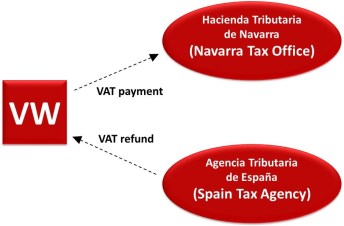
Instead, according to an interview with Prof. Fernando de la Hucha in this El Diario article, the basic structure was that VW-Navarra sold the cars (although without physically moving them there) to a related Barcelona company, VAESA (Volkswagen-Audi España S.A.), which is located in the Catalunya region, not Navarra. VAESA then sold them to SEAT with the very low mark-up of 5 Euros per car. SEAT, which is also in Catalunya, then sold them to VW-Germany—the transfer abroad triggering entitlement to a refund. But because the cars were sold from a city outside the Navarra region, VW’s refund claim did not go to Navarra. Instead, the Spanish national government was the one that issued the refund, which is how Navarra benefitted. (Catalunya did not issue the refund because, unlike Navarra, does not have a fiscal agreement with Spain that allows it to administer and collect taxes—only Navarra and the Basque regions do). The result was that Volkswagen was refunded the taxes it paid but Navarra profited at the expense of the Spanish government. (Spain has a credit-invoice VAT. Technically, the amount that Navarra retained was the VAT that VW-Navarra paid, which was the VAT on its sales to VAESA minus the VAT its suppliers had paid.)

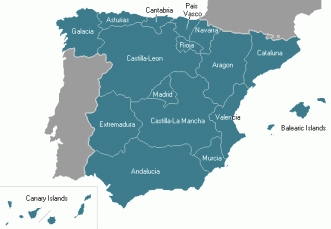
Here is a simple diagram of the transaction, along with a map of Spain’s regions. (Navarra is in the north, bordering France; Catalunya—that’s the Catalan spelling—is in the northeast, also bordering France.)
Spain Tax Blog Post Diagram--LLmap_spain

Continue reading “When a Tax Strategy Benefits a Subnational Government”

TaxSlayer: Technically Acceptable for VITA Returns?

Adam C. Mansfield
Staff Attorney, Legal Services for Students, University of Kansas

The first time I logged into the TaxSlayer training lab I knew that this tax season was going to be a problem. It became obvious when I typed “1040NR” into the form lookup box in the upper left corner of the TaxSlayer screen and the search came up empty. Next I tried “1042-S” and “8843.” Same result. Now I’m not some old fuddy-duddy that doesn’t like change.  I love working with new gadgets, software, or operating systems—as long as it does what it is supposed to do.

I work for Legal Services for Students at the University of Kansas. The main target population for our Volunteer Income Tax Assistance (VITA) grant is nonresident alien (NRA) students and scholars.  Every tax year we help hundreds of international students and researchers determine their residency status, calculate any applicable tax treaty benefits, and prepare their federal and state returns. In the past, TaxWise has worked just fine for this purpose.  I had no problem preparing a return for the student from Bangladesh who had income in both Kansas and Missouri or the Chinese student who has multiple 1042-S forms for scholarships and awards but still needs to apply treaty benefits to his or her wages. This year, TaxSlayer is just not up to the task.

I feel bad for Whitley, a member of TaxSlayer’s customer support squad, who is left with the task of informing me that they are aware of the “issue” that prevents their software from properly applying and reporting a tax treaty benefit on a nonresident alien return.  She proceeded to tell me that they could only handle “simple” state returns in conjunction with an NRA return.  This means that I can’t make any adjustments to the state return in order to properly apportion income. They are “working diligently to iron out the wrinkles.”  Not being able to prepare a pretty basic nonresident alien return is a little more than just a wrinkle. Continue reading “TaxSlayer: Technically Acceptable for VITA Returns?”

When Leaks Drive Tax Law (a.k.a. our new paper!)

Shu-Yi Oei

Diane Ring and I just posted our new article, Leak-Driven Law, on SSRN. I had previously blogged about this paper as part of Leandra Lederman’s 2017 Mini-Symposium on Tax Enforcement and Administration, The abstract is here:

Over the past decade, a number of well-publicized data leaks have revealed the secret offshore holdings of high-net-worth individuals and multinational taxpayers, leading to a sea change in cross-border tax enforcement. Spurred by leaked data, tax authorities have prosecuted offshore tax cheats, attempted to recoup lost revenues, enacted new laws, and signed international agreements that promote “sunshine” and exchange of financial information between countries.

The conventional wisdom is that data leaks enable tax authorities to detect and punish offshore tax evasion more effectively, and that leaks are therefore socially beneficial from an economic welfare perspective. This Article argues, however, that the conventional wisdom is too simplistic. In certain circumstances, leak-driven lawmaking may in fact produce negative social welfare outcomes. Agenda-setting behaviors of leakers and media organizations, inefficiencies in data transmission, suboptimally designed legislation, and unanticipated behavioral responses by enforcement-elastic taxpayers are all factors that may reduce social welfare in the aftermath of a tax leak.

This Article examines the potential welfare outcomes of leak-driven lawmaking and identifies predictable drivers that may affect those outcomes. It provides suggestions and cautions for making tax law, after a leak, in order to best tap into the benefits of leaks while managing their pitfalls.

In this paper, we wanted to explore how leaks of taxpayer data in the offshore context have shaped international tax law and policy, both in the US and other countries. We especially were interested in the possibility that—while leaks might appear useful on the surface from a tax enforcement and informational standpoint—there are unexplored pitfalls and downsides to relying on leaks to direct lawmaking and policy priorities.

In the non-tax world, of course, leaks have suddenly become very salient, in terms of both their usefulness and their dangers. But (non-tax lurkers take note!) tax law has been dealing with leaks of taxpayer information and what they mean for tax enforcement for at least the past ten years. Of course, tax leaks have some distinctive characteristics that make them different from other types of leaks. For example, the tax leaks that are the subject of this paper are usually (though not invariably) leaks of private taxpayer data, rather than leaks about governments from government sources.

We do think that the framework we introduce in our paper for analyzing the upsides and downsides of leak-driven lawmaking can be applied to explore how non-tax leaks and reactions to them may be socially beneficial but could also lead to less than ideal results. In both tax and in other fields, the meta-issue is not just how governments and private actors can use leaked information to sanction bad behaviors, make decisions, or design laws. Rather, the issue is how the actions and responses of leakers, governments, journalists, international organizations and the public work together to create and promote certain outcomes. Once we understand the underlying dynamics, then we can consider how the outcomes they create should be evaluated, supported, or resisted.

If you’re working on leak-related scholarship in either tax or other fields, we’d love to chat.

Leak-Driven Lawmaking

Shu-Yi Oei
Hoffman F. Fuller Professor of Law, Tulane Law School

Over the past decade, a steady drip of tax leaks has begun to exert an extraordinary influence on how international tax laws and policies are made. The Panama Papers and Bahamas leaks are the most recent examples, but they are only the tip of the leaky iceberg. Other leaks include (in roughly chronological order) the UBS and LGT leaks; the Julius Baer leak; HSBC “SwissLeaks”; the British Havens leaks; and the LuxLeaks scandal.

These tax leaks have revealed the offshore financial holdings and tax evasion and avoidance practices of various taxpayers, financial institutions, and tax havens. In so doing, they have been valuable in correcting long-standing informational asymmetries between taxing authorities and taxpayers with respect to these activities. Spurred by leaked data, governments and taxing authorities around the world have gone about punishing taxpayers and their advisers, recouping revenues from offshore tax evasion, enacting new domestic laws, and signing multilateral agreements that create greater transparency and exchange of financial information between countries.

Thus, it is clear that leaked data has started to be a significant driver in how countries conduct cross-border tax enforcement and make international tax law and policy. But using leaks to direct and formulate tax policy responses comes with some potentially serious pitfalls.

In a new paper—coming soon to an SSRN near you[fn.1]Diane Ring and I explore the social welfare effects of leak-driven lawmaking. Our argument, very generally, is that while data leaks can be socially beneficial by virtue of the behavioral responses they trigger and the enforcement-related laws and policies generated in their wake, there are under-appreciated downside hazards and costs to relying on leaked data in deterring tax evasion and making tax policy.

Continue reading “Leak-Driven Lawmaking”

Apple, Ireland, and State Aid: The EC Decision

By: Sam Brunson

In August, the European Commission announced that Ireland had illegally granted state aid to Apple, and that it would be required to recoup over $13 billion in back taxes from Apple. (Surly coverage here.)

All of the analysis at the time was tentative, though, because, before it could release its decision, the EC had to redact it. And on Monday, it released the redacted version.[fn1] All 130 pages of the redacted version. So now we get to dig into its content.  Continue reading “Apple, Ireland, and State Aid: The EC Decision”

The Art of the (Budget) Deal

By Daniel Hemel and David Herzig

Who Holds the Trump Card on Reconciliation?

Republicans on Capitol Hill are reportedly planning to use the filibuster-proof budget reconciliation process to repeal the Affordable Care Act and overhaul the tax code. Against that background, Sam Wice says that “the most powerful person in America” in 2017 will be Senate Parliamentarian Elizabeth MacDonough, the nonpartisan official who will “determine” how much of their agenda Republicans can pass through reconciliation. This, of course, is an exaggeration: like it or not, the most powerful person in America in 2017 will be Donald J. Trump, who will wield all the power of the imperial presidency. But Wice’s post helpfully directs our attention to the budget reconciliation process, the rules of which quite likely will determine whether the Republican leadership on Capitol Hill can repeal the ACA and reform the tax laws.

Yet while one should not underestimate the importance of reconciliation, one should also not overestimate the power of the Parliamentarian in the reconciliation process. As a formal matter, the Parliamentarian’s role is advisory; and as a practical matter, the Parliamentarian has little say over significant aspects of reconciliation. Other actors—most notably, Senate Budget Committee Chairman Mike Enzi (R-Wy.)—wield at least as much influence as the Parliamentarian. Most importantly, Enzi—not MacDonough—will determine whether the provisions in any reconciliation bill violate various rules against deficit-increasing legislation being passed via reconciliation. And unlike the Parliamentarian, the Budget Committee Chairman is very hard to fire.

Reconciliation measures can begin in either or both chambers. However, since the ultimate vote on the budget measure occurs in the Senate, we’ll focus on the Senate side of the reconciliation process for purposes of this discussion. On the House side, the Rules Committee Chair and the Budget Committee Chair will wield outsized influence as well. We expect Pete Sessions (R-Tex.) to stay on as House Rules Committee Chair; as for the House Budget Committee Chair, the race is on for a replacement to Tom Price, the Georgia Republican recently tapped as Trump’s Health and Human Services Secretary.

To understand why the Budget Committee Chair is as powerful as he is, a bit of background on reconciliation may be helpful. Continue reading “The Art of the (Budget) Deal”

ClassCrits IX: The New Corporatocracy and Election 2016

Surly bloggers Sam Brunson, David Herzig and I (and Leslie Book over at Procedurally Taxing) are attending the ClassCrits IX conference hosted by Loyola University Chicago School of Law today and tomorrow. From the call for papers back in March:

As the U.S. presidential election approaches, our 2016 conference will explore the role of corporate power in a political and economic system challenged by inequality and distrust as well as by new energy for transformative reform.

There are some notable tax-related panels happening at the conference, along with other interesting panels relating to corporations and democracy:

Taxation, Social Justice and Development (Friday 10/21/16)

Doron Narotzki, University of Akron Business Administration
Corporate Social Responsibility and Taxation: The Next Step of the Evolution

Rohan Grey, Binzagr Institute for Sustainable Prosperity & Nathan Tankus, Modern Money Network
Corporate Taxation in a Modern Monetary Economy: Legal History, Theory, Prospects

Karl Botchway, CUNY Technology & Jamee Moudud, Sarah Lawrence Economics
Capacity Building, Taxation and Corporate power in Africa

Martha T. McCluskey, SUNY Buffalo Law, Corporatocracy and Class in State and Local “Job-Creation” Subsidies

Distributing Wealth, Law and Power (Friday 10/21/16)

Goldburn P. Maynard, Jr., University of Louisville Law
A Plea for Courts to Abolish the Judicially Created Right of the Wealthy to Avoid Estate Taxes

Victoria J. Haneman, Concordia University Law
The Collision of Holographic Wills and the 120-Hour Rule

Doron Narotzki, University of Akron Business Administration
Dark Pools, High-Frequency Trading and the Financial Transaction Tax: A Solution or Complication?

Robert Ashford, Syracuse University Law
Why Working But Poor?

Critical Perspectives on Tax Law (Saturday 10/22/16)

Shu-Yi Oei, Tulane University Law
The Troubling Case of Offshore Tax Enforcement

Les Book, Villanova University Law
Bureaucratic Oppression and the Tax System

Samuel Brunson, Loyola University Chicago Law
Avoiding Progressivity: RICs, Pease, and the AMT

David Herzig, Valparaiso University Law
Let Prophets Be (Non) Profits

Make Way for Ducklings?

Shu-Yi Oei 

Professor Charlotte Crane (Northwestern) presented Integrating a Fragmented Corporate Income Tax at BC Law School’s Tax Policy Workshop yesterday. Briefly, the paper is focused on recent proposals to integrate the corporate income tax, in particular, the yet-to-be-released Orrin Hatch proposal from the Senate Finance Committee. I’m no corporate tax expert, but the workshop afforded me the excuse to wade like a duckling through the recent literature…a nice break from other projects.

The corporate integration debate refers to the question of whether to eliminate the corporate double tax (i.e., the tax on both the corporation and its shareholders on the same underlying income) and replace it with a single layer of tax. Many have argued that this would reduce tax burdens, minimize economic distortions, and bring us closer to tax neutrality in investment decisions. Others have argued that corporate integration achieved through shifting the corporate tax to the shareholder level will enhance progressivity and fairness.

The integration debate has raged for decades, with important Treasury and ALI studies in 1992 and 1993, and a surge of recent academic and policy interest. There are various design possibilities, including: integration via a shareholder credit (a.k.a. imputation), integration via a dividend deduction paired with a shareholder withholding tax, integration via a shareholder dividend exclusion, flow-through taxation, and others. A couple of recent proposals: Toder and Viard have suggested eliminating the corporate tax and replacing it with taxation of shareholder dividends and gains at ordinary rates, with gains taxed on a mark-to-market (accrual) basis. And Gruber and Altshuler even more recently proposed pairing a lowered (15%) corporate tax rate with ordinary income taxation of shareholder dividends and capital gains (including an interest charge on deferred shareholder liabilities designed to minimize behavioral distortions).

Continue reading “Make Way for Ducklings?”

When your job is predicting the future

rainBy: Diane Ring

In a post earlier this week, I considered how the international tax conference I was attending (the annual worldwide meeting of the International Fiscal Association, IFA) had something in common with the Japanese anime and manga conference hosted in the adjacent venue. Soon the anime event ended and the tax conference continued, but with a new neighbor – the Meteorological Technology World Expo 2016. No costumes – but some interesting, though puzzling, equipment outside in the courtyard. I thought about the big task of meteorology—predicting the future. Turns out that in-house tax advisors have the same job, it’s just that instead of rain, they predict the tax implications of business decisions for the C-suite. But the tax advisors do it without the tech, and there is a lot to keep them up at night . . . Continue reading “When your job is predicting the future”

International tax meets Japanese anime

By: Diane Ring

On Sunday, international tax lawyers and advisers from private sector, government officials, tax representatives from international organizations, in-house counsel, and tax academics converged on the convention center in Madrid for the annual conference of the International Fiscal Association (IFA).

But we were not alone.

An adjacent exhibition hall hosted “Japan Weekend 2016” a celebration of Japanese anime and manga. I had no trouble finding my place – I was unlikely to confuse international tax lawyers with the costumed crowd that channeled Alice in Wonderland meets the Flash. Once the tax conference got underway, though, I began to contemplate similarities between the two events, in particular, the meaning and role of reality and its construction. . . Continue reading “International tax meets Japanese anime”

Ireland, Apple, and State Aid

EUMaybe you heard: Apple owes up to €13 billion in back taxes, plus interest, to Ireland. And maybe you also heard that Ireland doesn’t want Apple to pay. So what’s up?

appleFirst a caveat: I don’t have any particular expertise in European Union law, so I’m going off of news reports[fn1] and the European Commission’s press release. (As of when I’m writing this on Tuesday afternoon, the actual opinion isn’t up on the EC’s website. I’ll add a link when it’s available.)

In short: members of the EU can establish their own tax systems; the EU doesn’t have any authority over those systems. Over the last two years or so, though, the EC has been looking at special tax deals member countries have been giving to companies; where it finds that a country has provided special tax treatment to one particular company (and not granted similar tax treatment to other companies), it has held that the country provided “state aid” to that company. The EU treaty prohibits state aid and, when a member country provides such aid, the EC can require that country to recover the taxes it should have collected from the company in question. Though this Apple ruling is the most recent, last year the EC determined that Luxembourg and the Netherlands had used tax rulings to provide state aid to Fiat and Starbucks, and it is still looking into tax rulings provided by Luxembourg to McDonald’s and Amazon. Continue reading “Ireland, Apple, and State Aid”

Walmart and Puerto Rico

By: David J. Herzig

Everyone knows by now the dire financial problems facing Puerto Rico.  (My co-blogger Shu-Yi Oei wrote about the default in Surly here.)  In order to generate liquidity to pay debt and run government operations, Puerto Rico began to look to the deepest pockets for help.  If you are looking for a deep pocket, look no further than Walmart.  The question facing Puerto Rico was how to get more money out of Walmart without actually targeting the corporation (that would be unconstitutional.)

The territory, instead, tinkered with an old law to created a tax hikes which on the face seemed neutral.  However, the law, according to Walmart, targeted primarily the large retail corporation. The after-tax effect of the corporate alternative minimum tax change was to raise Walmart’s Puerto Rican tax liability to over 90% of its income.

How did we get here? Last year, Puerto Rico enacted Act 72-2015 (Act 72) into law. The key component of the act was an increase in the Tangible Property Component (TPC) of the corporate AMT.  According to prior reporting, “The TPC piece of the AMT imposes a tax on the value of property transferred to an entity doing business in Puerto Rico from a related party outside of Puerto Rico.”

Then last December, Walmart filed suit styled, Wal-Mart Puerto Rico Inc. v. Zaragoza-Gomez, 15-cv-3018, U.S. District Court, District of Puerto Rico (San Juan) challenging Act 72.  According to Walmart, the tax was unconstitutional violating the commerce clause.  Moreover, the new tax raised the company’s estimated income tax to “an astonishing and unsustainable 91.5% of its net income.”

In March of 2016, the District Court agreed with Walmart and in a 109 page opinion stated, “Puerto Rico’s AMT, on its face, clearly discriminates against interstate commerce.”  Part of the story told by bond holders, is that in the course of the trial, it came to light the government of Puerto Rico might have been misleading their bond holders and this law was a kind of hail-mary.  Per the UBS report, “In the course of the trial, senior officials of the García administration were obliged to provide sworn testimony. Judge Fusté’s subsequent written opinion provided information that had been either knowingly or inadvertently withheld from investors by the Government Development Bank.”  So, yes, the tax was targeted at Walmart.  Also, the government of Puerto Rico was also not disclosing to its bond holders the true economic conditions.

Late last week, the 1st Circuit agreed with the District Court.   The 1st Circuit concluded, “As to the merits of the Commerce Clause challenge, the AMT is a facially discriminatory statute that does not meet the heightened level of scrutiny required to survive under the dormant Commerce Clause.”

Continue reading “Walmart and Puerto Rico”

Emmet Till and The Panama Papers

Photo AP.

By David J. Herzig

Yesterday (July 25) would have been Emmet Till’s 75th birthday.  Since high school I have been fascinated by his story and the impact he had on the Civil Rights movement. For those who don’t know, Mr. Till was born and lived in Chicago.  While visiting his relatives in Mississippi in 1955, at the age of 14, he was killed for allegedly flirting with a white women.  His killers (although an all white jury acquitted both men they both admitted to the killings in this Look Magazine article) were the husband of the woman, Roy Bryant and his half-brother J. W. Milam.

The death of Mr. Till is often credited with a mobilizing factor in the Civil Rights Movement.  For those interested, here is an excellent PBS documentary on the topic.

Thankfully, it did not take long to justify a post on a tax blog about a Civil Rights hero.  The son of one of Mr. Till’s killers name seems to show up in the Panama Papers.  According to the Clarion Ledger, “Harvey T. Milam of Ocean Springs, whose father, J.W., shot Till in 1955, appears in” the Panama Papers.  Apparently, Harvey had quite a scheme involving using off-shore insurance companies.  I may actually have to do some digging around to find out more about the alleged scheme.

Emerging Trend for Uber in Europe?

By: Diane Ring

Uber, one of the most prominent faces of the sharing economy, has not always been welcome in the EU. Similarly, Airbnb has experienced legal, regulatory, and public policy resistance across European countries. However, two recent developments in the EU suggest that, on balance, Europe might be staking out a regulatory path for the sharing economy that is intended to demonstrate the region’s support for the new sector. . . . Continue reading “Emerging Trend for Uber in Europe?”