It’s Complicated.

By: Shu-Yi Oei

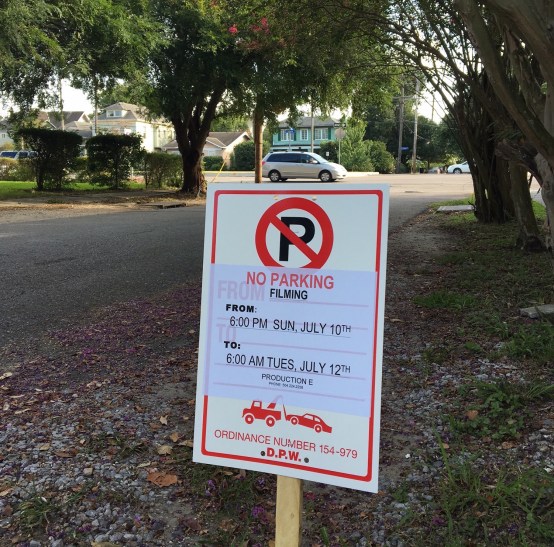
I’ve been thinking a lot about movies lately, partly because this pesky sign appeared outside my house a couple of days ago, and partly because of the Louisiana film tax credit, which has been all over the local news.

film sign 2

A couple of days ago, an Associated Press article reported that Louisiana’s motion picture industry was down by 90% this year as filmmakers moved production to states with more generous tax incentives. (I guess that puts the filming outside my house in the 10%?). It was also reported that Governor John Bel Edwards and the Louisiana Economic Development agency are going to commence an examination of the film tax credit and its economic impact in Louisiana. As the news reports indicate, the decline in movie production activity is undoubtedly due to the fact that, facing a state budget deficit, legislators placed caps and limitations on the credit in legislation passed last year. The most material change was an aggregate $180 million cap on the credit for tax years 2015-18, which will then sunset. RS: 47:6007(C)(1)(d)(ii). As a result, movie production has reportedly moved to states with more generous film tax incentives.

The Louisiana film tax credit is a complex beast, and I can’t cover all its intricacies here. But some broad policy points are worth mentioning. Continue reading “It’s Complicated.”

State Tax Reform Amidst Cajun Sausage Making

Steven Sheffrin
Professor of Economics & Director of the Murphy Institute, Tulane University

It was not quite Cajun boudin being prepared in Baton Rouge this winter and spring, but the sausage being concocted in the Louisiana Legislature was equally spicy. With low oil prices and years of “creative” budgets under Governor Bobby Jindal, the new Governor, John Bel Edwards, and the Legislature faced an initial budget shortfall of roughly 16 percent of the state general fund for the next fiscal year. Three separate legislative sessions later, they did reach a balanced budget, although with less revenue than the Governor had wanted. The revenue raisers included a dizzying array of sales tax changes that only temporarily limited exemptions, temporary limits on the refundability of business credits, and various other “haircuts” for business. Not exactly the purest of tax reforms.

But buried in this avalanche of legislation were some serious reforms of the Louisiana corporate tax along the lines that my colleagues and I had recommended to the Legislature last year.

Continue reading “State Tax Reform Amidst Cajun Sausage Making”

Oklahoma Decreases Working Poor Family Benefits

By Francine J. Lipman
OklahomaLRGThis Sunday New York Times editorial caught my eye (and heart) this morning, because I have been researching and writing about state EITCs and lobbying legislators to consider enacting or increasing this demonstrably effective work incentive and antipoverty tool. When I first looked into the issue I was pleasantly surprised to discover that twenty-six states and the District of Columbia have EITCs that build on the antipoverty success of the federal EITC. Continue reading “Oklahoma Decreases Working Poor Family Benefits”

Can EU-wide Corporate Consolidation Be Revived?

By: Diane Ring

On Tuesday, Shuyi  mentioned the EU’s Common Consolidated Corporate Tax Base proposal (CCCTB) in her post, noting some interesting parallels between maritime/bankruptcy coordination and international tax efforts at coordination. This motivated me to take a look at the recent developments that have happened around the CCCTB proposal. The CCCTB would provide a single set of rules for calculating the income of businesses operating in the EU – and would allow for such businesses to file a single consolidated return for their EU activities. The group’s income would then be allocated across the member states. Under this scheme, individual EU member states would still be able to tax their portion of the group’s income at their own country-specific tax rate. But I was curious–the CCCTB proposal is not new; it has been around for more than a decade. What has been happening on this stalled cooperation front? And, more importantly, will the EU’s announced re-launch of the proposal have a greater chance of success than previous attempts? Continue reading “Can EU-wide Corporate Consolidation Be Revived?”

A Hot News Week for Krispy Kreme

By: Diane Ring

The big news this week about Krispy Kreme is that they are going to be acquired for $1.35 billion. As reported in the WSJ last night, JAB Holding Co. (a European investment fund, which the WSJ noted holds an interesting mix of assets including Caribou Coffee, Jimmy Choo shoes, and  Durex condoms) is about to add glazed donuts to its asset pool. But this was not the Krispy Kreme news of the week that caught my eye. I was fascinated instead to read that this week the Missouri Supreme Court ruled on Krispy Kreme’s request for a refund of sales tax it had remitted on sales of donuts and other related items from 2003 through 2005.

Krispy Kreme had collected sales tax at the 4% rate applicable to food sold that would be immediately consumed. In contrast, food sold at grocery stores generally bore only a 1% state sales tax. Essentially, as the media described it, Krispy Kreme argued that its donuts were like grocery store food, and thus should bear only the sales tax rate applicable to such food. I may not follow the healthiest of diets but even I do not think that donuts are the equivalent of broccoli from the produce aisle. What were they thinking? But then my tax brain kicked in. I immediately understood. . .

Continue reading “A Hot News Week for Krispy Kreme”

“Unofficial” Jazz Fest (and Arbitrage, and Licensing, and Taxes)

By: Shu-Yi Oei

blogged on Wednesday about taxes and tax enforcement at Jazz Fest, a.k.a. the New Orleans Jazz and Heritage Festival. Today’s follow-on post celebrates the phenomenon that I call “unofficial” Jazz Fest.

There’s “official” Jazz Fest, which is what happens after you’ve bought your ticket, gone through security, and are within the confines of the New Orleans Fairgrounds (where the Fest is held). And then there’s “unofficial” Jazz Fest, which is what goes on in the surrounding Fairgrounds neighborhood outside the Fest. [fn.1] As I described in Wednesday’s post, “official” Jazz Fest is a big deal, well organized, and highly regulated. The music programming unfolds on a tight schedule. Only approved food and craft vendors are allowed, and those vendors need to be properly licensed and pay some sort of booth fee in order to sell at Jazz Fest. The organizers exert significant control over the food items sold—the Jazz Fest website says that “‘carnival’ food items or beverages” will be not sold and that duplication of food offerings is minimal.

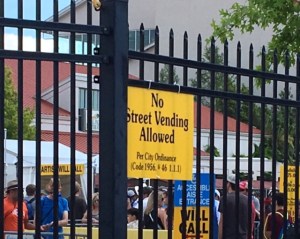
“Unofficial” Jazz Fest, as I call it, is what happens in the area outside the gates of the Fairgrounds. On Fest days, the neighborhood is transformed into its own unique microclimate of festive Festy-ness. Here, street vendors hawk wares such as hats, kooziessecond-line umbrellas, water, and art. no vending(There are “No Street Vending Allowed” signs posted, but those don’t seem to be given much weight.) Popup brass bands play for tips on the sidewalks. Some neighborhood residents hire bands and throw backyard parties, some of which you can attend for a fee (or, perhaps, crash unnoticed). New Orleans, like many other cities, has business licensing requirements, including mobile vendor licenses, and some of these vendors are clearly licensed, though it’s plausible that others might not be.

Many of these behaviors look like classic arbitrage: You can of course buy or enjoy most of those items or services in the official Jazz Fest, but they’re more expensive once you’re inside the Fairgrounds and committed to being there (general admission tickets allow single entry only). This creates obvious opportunities for unofficial vendors to sell products more cheaply just outside the Jazz Fest entrance gates. So, for example, it gets hot in New Orleans in April/May, and Fest rules allow you to bring in “Factory-sealed bottled water for personal consumption.” Bottled water sells for $3 in the Fest. But there are lots of people selling it out of a cooler for $1 in the surrounding streets, so it really makes sense to buy your water before you enter. From the seller’s point of view, if she buys 78 24-count cases of bottled water from Costco, it comes up to under 27 cents a bottle before tax. The incentive to make dollar-a-bottle sales outside the Fairgrounds on Fest days is obvious.

Others of these activities look like something close to agglomeration:  Continue reading ““Unofficial” Jazz Fest (and Arbitrage, and Licensing, and Taxes)”

The New Orleans Jazz and Heritage Festival (and Taxes)

By: Shu-Yi Oei

New Orleans is currently in the throes of Jazz Fest.

For those of you who don’t know what that is, Jazz Fest—or, the New Orleans Jazz and Heritage Festival—is a famous annual festival celebrating music and culture in New Orleans. It’s held at the New Orleans Fairgrounds. It spans seven days over two weekends. It draws hundreds of thousands of people.

But even that description doesn’t do the event justice. There are twelve different music stages and tents set up in the Fairgrounds and a lineup of over a hundred performance groups—this year’s headliners include Stevie Wonder, Pearl Jam, Paul Simon, Red Hot Chili Peppers, Snoop Dogg, and Van Morrison. There’s also a huge number of food and crafts vendors who set up at the Fest—over 200 food offerings sold! Some of us to go to the Fest at least as much for the food as for the music: my personal favorites include the Crawfish Monica, mango freeze, crawfish beignets, seafood stuffed mushrooms, and Chef Linda Green’s award-winning yakamein.

This past weekend, my colleague Ann Lipton and I traipsed down to the Fairgrounds to find the fun. While enjoying performances by Janelle Monáe (amazing), the Red Hot Chili Peppers (meh), Leroy Jones (so good), Herlin Riley (just, wow) and others, we chatted a bunch about vendor licensing and regulation at Fest. We even ran into an on-duty New Orleans revenue agent who was more than happy to tell us all about tax compliance at the Fest and kindly gave permission to blog about it.

After some research, some casual conversations, and some lurking around the food booths, here’s what we now know about Jazz Fest and taxes:

Continue reading “The New Orleans Jazz and Heritage Festival (and Taxes)”