By Francine J. Lipman
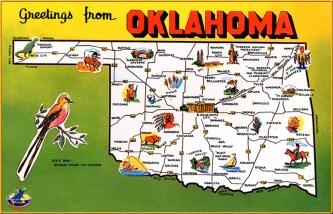 This Sunday New York Times editorial caught my eye (and heart) this morning, because I have been researching and writing about state EITCs and lobbying legislators to consider enacting or increasing this demonstrably effective work incentive and antipoverty tool. When I first looked into the issue I was pleasantly surprised to discover that twenty-six states and the District of Columbia have EITCs that build on the antipoverty success of the federal EITC. Continue reading “Oklahoma Decreases Working Poor Family Benefits”
Category: Tax in Popular Culture
Follow-up Friday: Messi and McDonald’s
By David J. Herzig
In what I’m dubbing follow-up Friday, I wanted to give a quick update to two stories I am following regarding tax avoidance structuring. One on the corporate side: the French Tax Authority Raids on Multinationals; and, one on the individual side: the Messi Tax Fraud Trial. Both stories are heating up.
French Tax Raids
It was reported overnight that McDonald’s French headquarters was raided by French taxing authorities. Unlike the Google raid that was reported in real time, this raid appeared to take place on May 18.
Much like the Google raid this investigation is centered on tax avoidance. McDonald’s problems seem to have started in December when a lawsuit was brought against the company for understating earnings. Apparently, in France, workers are entitled to a share of profits. A February 2015 report stated that McDonald’s avoided almost 1 billion euros of taxes using its Luxembourg subsidiary.
I guess Diane Ring was correct in her comment that all multinationals should be preparing for tax raids in France. If you don’t have a plan in place, you should be working on one now. Finally, Professor Byrnes at Texas A&M wrote an interesting story on his blog about routes for the United States to increase its involvement.
Messi Tax Fraud Trial
The most trustworthy news outlet, World Soccer Talk, is reporting that Lionel Messi will testify on June 2 for in his tax fraud trial. As I previously reported, the trial is due to start on May 31.
A fascinating wrinkle that the article points out is that although there is potential jail time (22 months) if Messi is convicted of tax fraud, often that sentence is suspended. “However, any such sentence would likely be suspended as is common in Spain for first offences carrying a sentence of less than two years.”
As I keep looking into sports figures tax avoidance planning, more and more amazing items come to light. In January, Kelly Phillips Erb, reported in Forbes about another FC Barcelona player, Javier Mascherano, pled guilty to not paying tax for 2011 and 2012. How fun would it be if two players of the NY Yankees were convicted of tax fraud.
These stories are why I love Europe!
Avocados and Other (Delicious) Tax Shelters
 Last night, I flew back from the (wonderful!) AMT conference. After a three-hour storm delay, I landed at Chicago O’Hare and, walking to get my bag, I checked Twitter. A tweet from Voice of San Diego (VoSD) (which seems largely to be a geographically-focused ProPublica) highlighted a convergence between two of my favorite things: taxes and avocados.
I grew up in and around San Diego, and I grew up eating avocados (both in guacamole and BLAT form),[fn1] but I’ll confess that I’d never much thought about why there were so many avocados grown in San Diego; I probably always assumed that they were native to Mexico, and that San Diego had a similar climate to Mexico, so they were a natural fit. Continue reading “Avocados and Other (Delicious) Tax Shelters”
Will New Data on the Volume of Sharing Economy Workers Prompt Tax Reform?
By: Diane Ring
Sharing economy and other platform workers are frequently classified as independent contractors and bear many of their own costs. Thus, these workers whom we don’t think of as “small businesses”—and don’t really think of themselves as small businesses—are thrust into the exciting world of quarterly reporting and calculation of proper deductions. Exciting if you are a tax lawyer, but less so if you are making limited income and are facing daunting tax compliance requirements. Despite these compliance challenges, there has not been much movement in responding to the tax challenges faced by sharing economy workers. These observations about the sharing economy sector have been around for a while; they were the focus of two forthcoming articles by my co-author, Shu-Yi Oei, and me (Can Sharing Be Taxed? and The Tax Lives of Uber Drivers: Evidence from Internet Discussion Forums).
Yesterday, a new report coming out of American University echoed our observations and findings. Caroline Bruckner of the Kogod Tax Policy Center presented testimony (and a supporting report) to Congress regarding the size and scope of worker participation in the sharing economy. Her goal was not to provide a definitive calculation nationwide of sharing and platform workers, but to offer a solid sense of the scale of participation in the sector (more than 2.5 million individuals) and note important growth trends. Based on the percentage of the American workforce active in the sharing/platform sector, she urged more government attention to reform that would address the tax compliance and administration challenges in this sector.
Will Congress and Treasury/IRS respond? Continue reading “Will New Data on the Volume of Sharing Economy Workers Prompt Tax Reform?”
About last night …
 “Ask not what your country can do for you, but ask what you can do for your country.” John F. Kennedy
We celebrated Volunteer Income Tax Assistance (VITA) in Las Vegas … and the numbers are impressive. Almost 200 volunteers spent 12,000 hours generating over $25 million in federal refunds that have and will continue to exponentially benefit our local communities and working families, including thousands of children. But for anyone who has served as a VITA volunteer, the personal rewards and deep fulfillment from helping others are priceless. If you are a tax professional looking for something more out of work-life-balance (or are curious about Woody Allen’s antihero advice and afterlife plan) … read more about encore tax opportunities here. Details about VITA programs and generous grant opportunities with fast-approaching deadlines (June 1) follow the fold …
Trump Tax (Non) Disclosure
By David J. Herzig
Today, Paul Caron in his TaxProf Blog, highlighted an article by John McGinnis (a Constitutional Law Scholar at Northwestern). In the article, McGinnis states that Trump should not have to disclose his income tax returns. His premise is that the norm of tax return disclosure is “bad.” He believes that privacy norms should trump any right of the electorate to see a candidates taxes. I vehemently disagree with this normative position. I hesitate to write a “hot take” or half-baked reaction to the article. But there is dangerous precedent failing to highlight the error(s) in McGinnis’ position. (I am under the assumption that McGinnis had limited space to write his opinion and nuance he would normally make is lost to space constraints).
I, as well as others such as, Joe Thorndike, have previously made the point that tax return disclosure is very important. In my Forbes article, I made the point of a variety of reason tax return disclosure is very important. I said, “First, tax returns can be a window to understanding how someone truly thinks and behaves; what you do when you think the public isn’t looking, shows the more authentic self. (Hillary Clinton’s tax return is arguably less revealing, since she has long known her returns would be made public.) Trump’s tax filings might provide some additional insight into how he would run the country. Does he follow rules? Stake out very aggressive positions? Take unnecessary risks?” I think how people act in private is the best proxy for understanding what they think. With a candidate like Trump, this may be the only window into how a Trump presidency would look like.
McGinnis starts his discussion by making the first point in support of his thesis that Continue reading “Trump Tax (Non) Disclosure”
Can EU-wide Corporate Consolidation Be Revived?
By: Diane Ring
On Tuesday, Shuyi mentioned the EU’s Common Consolidated Corporate Tax Base proposal (CCCTB) in her post, noting some interesting parallels between maritime/bankruptcy coordination and international tax efforts at coordination. This motivated me to take a look at the recent developments that have happened around the CCCTB proposal. The CCCTB would provide a single set of rules for calculating the income of businesses operating in the EU – and would allow for such businesses to file a single consolidated return for their EU activities. The group’s income would then be allocated across the member states. Under this scheme, individual EU member states would still be able to tax their portion of the group’s income at their own country-specific tax rate. But I was curious–the CCCTB proposal is not new; it has been around for more than a decade. What has been happening on this stalled cooperation front? And, more importantly, will the EU’s announced re-launch of the proposal have a greater chance of success than previous attempts? Continue reading “Can EU-wide Corporate Consolidation Be Revived?”
Trump Claims $557 Million in Income in 2015
By: David J. Herzig
Yesterday, Donald Trump filed his personal financial disclosure with the Federal Election Commission. This updated his initial financial disclosures. On his web site he claimed the disclosures were “the largest in the history of the FEC.” Unfortunately, he did not file his disclosures on-line like Hillary Clinton. Alas, we will have to wait a little bit to get to the details.
Nonetheless, according to Mr. Trump’s website he made $557 million in income in 2015. That number does not include “dividends, interest, capital gains, rents and royalties.” So, his real income should be substantially higher.
I have been writing about why a disclosure of Mr. Trump’s tax returns are necessary (at Forbes and the Wall Street Journal). Once I have a copy of the disclosures, I will give some updates (hopefully shortly) about various items that raise some red flags. From what I gather in innuendo and rumor about his disclosure, the calls for full disclosure of his tax returns to sort out facts from fiction will continue to gain steam.
The key reason the tax returns are needed is to permit a thoughtful discussion (hopefully more global tax policy discussions) between the relationship between his over $557 million in gross income and his taxable income.
[QUICK UPDATE: I was amazed how ABC, NBC, FOX, CBS, The Wall Street Journal and the New York Times all seemed to know what was in the not yet public disclosure. The rule according to the FEC is that the return is not public until they have approved it. However, despite the non-public disclosure, the FEC has apparently sent the disclosure out to certain news sources. It is amazing how a governmental agency can partake in such mishegoss!]
[UPDATE 7:45 pm] The Wall Street Journal put up Trump’s FEC disclosure. Available at: http://www.wsj.com/public/resources/documents/TrumpdisclosureMay2016.pdf?mod=e2twp
Money Monster Review over at BLPB
Last Friday, I went and saw Money Monster, the new Jodie Foster-directed movie with Julia Roberts and George Clooney in it. For the three of you thinking about seeing Money Monster instead of, say, Captain America: Civil War, my colleague, Ann Lipton has the securities law-ish review over at Business Law Profs Blog. Bottom line: Entertainment good, securities law not so good. Also, there’s a line about tax in there somewhere.
Lionel Messi, Tax Fraud and the Panama Papers
I have been fascinated by the accusations of tax fraud levied against soccer superstar Lionel Messi and his father by the Spanish tax authorities. Right when I thought the story could not get more interesting of course Messi is tied to the Panama Papers. As much as I like Hermione (h/t Shu-Yi), I love Messi!
As a quick background for non-sports and football (I mean soccer) fans, Messi is the greatest soccer player in the world and maybe the greatest soccer player of all time. As a point of reference, he would be the equivalent of Michael Jordan, Joe Montana, Babe Ruth rolled into one player. Imagine what would happen if LeBron James were accused right now of tax fraud by the IRS? This would dominate ESPN and probably network television. Well, this is what is happening in the rest of the world with Messi.
Last year, a bombshell was dropped when the Spanish taxing authorities accused Messi of defrauding Spain of more than $5 million. Continue reading “Lionel Messi, Tax Fraud and the Panama Papers”
Harry Potter/Panama Papers Fan Fiction Alert (Rated: Fiction T)
By: Shu-Yi Oei
Confession: I love Mallory Ortberg, and after today, I might love her even more.
Here’s the latest from Mallory and The Toast: Harry Potter/Panama Papers Fan Fiction! This, after various news sources reported that Emma Watson was named in the Panama Papers data leak as having set up a BVI offshore company.
(Hat tip: Various friends on Facebook)
Perhaps my favorite line: “I used to be a lot of things,’ Hermione said decisively. ‘I have money now instead.’” Boom! Harry Potter meets Ayn Rand.
The fan fiction is very funny, but honestly, I am personally more taken by Ortberg’s beautifully crafted pseudo-legal disclaimer:
“*WITH THE IMPORTANT CAVEAT THAT THE OFFICIAL LINE RIGHT NOW IS THAT HER SHELL CORPORATION WAS CREATED SO SHE COULD PURCHASE PROPERTY PRIVATELY AND WITHOUT FANFARE, WHICH IS CERTAINLY POSSIBLE, I DON’T MEAN TO IMPLY SHE IS 100% A TAX DODGER BUT IT CERTAINLY RAISES SOME QUESTION, OKAY, BACK TO THE FAN FICTION NOW, AGAIN BEARING IN MIND THAT THIS IS JUST FOR THE SHEER DELIGHT OF PICTURING A LIBERTARIAN HERMIONE IN A SMOKY ROOM CREATING SHELL CORPORATIONS AND BUILDING TAX SHELTERS, ALSO HERE IS A QUICK PRIMER ON THE PANAMA PAPERS IF YOU’RE UNFAMILIAR OR READ A PRIMER A FEW WEEKS AGO AND THEN FORGOT”
The tone is so spot on, it made me weep.
In seriousness, though, the fact that the Panama Papers has made The Toast (which can generally be described as a feminist website with lots of literary and pop culture references) tells us something about how public opinions surrounding offshore tax evasion and structuring become disseminated throughout popular consciousness. Sure, organizations like Tax Justice Network and Oxfam write about tax havens and offshore evasion all the time and those venues tend to be more salient to us tax people. But public opinion surrounding convulsive events such as data leaks is also shaped in other popular fora as well—in this case, by Ortberg using the fierce set of tools at her disposal (humor, sarcasm, wit, movie references, an encyclopedic knowledge of random things like the history of the Protestant church, Greek mythology, and 19th century Gothic romance novels, etc.). Whether and how these informal modes of opinion transmission actually affect legal and political outcomes is a question that needs systematic inquiry.
A Hot News Week for Krispy Kreme
By: Diane Ring
The big news this week about Krispy Kreme is that they are going to be acquired for $1.35 billion. As reported in the WSJ last night, JAB Holding Co. (a European investment fund, which the WSJ noted holds an interesting mix of assets including Caribou Coffee, Jimmy Choo shoes, and Durex condoms) is about to add glazed donuts to its asset pool. But this was not the Krispy Kreme news of the week that caught my eye. I was fascinated instead to read that this week the Missouri Supreme Court ruled on Krispy Kreme’s request for a refund of sales tax it had remitted on sales of donuts and other related items from 2003 through 2005.
Krispy Kreme had collected sales tax at the 4% rate applicable to food sold that would be immediately consumed. In contrast, food sold at grocery stores generally bore only a 1% state sales tax. Essentially, as the media described it, Krispy Kreme argued that its donuts were like grocery store food, and thus should bear only the sales tax rate applicable to such food. I may not follow the healthiest of diets but even I do not think that donuts are the equivalent of broccoli from the produce aisle. What were they thinking? But then my tax brain kicked in. I immediately understood. . .
It’s Here! The #PanamaPapers Database
On April 3, 2016, the International Consortium of Investigative Journalists, in partnership with a number of news organizations, announced that it had received a leaked trove of 11.5 million documents from the Panamanian law firm Mossack Fonesca. Dubbed the “Panama Papers,” leak, the ICIJ documented how the wealthy and the powerful used Mossack Fonesca to move money around the world of tax havens and, at least sometimes, to hide it from their countries’ revenue agencies.
Originally, the ICIJ declined to make its data available, even to governments.[fn1] It explained that it is: Continue reading “It’s Here! The #PanamaPapers Database”
More on Charitable Organizations and Marijuana
By Benjamin Leff
Last Friday, Phil Hackney posted on this blog about IRS Denial 201615018 (4/8/16), in which the IRS denied tax-exempt status under section 501(c)(3) to an organization that planned to support the cultivation and distribution of medical marijuana in a state in which such activities were legal. As Phil pointed out, the IRS held, among other things, that an organization whose purpose is the distribution of marijuana cannot be tax exempt under section 501(c)(3) because “a section 501(c)(3) organization cannot be created for a purpose that is illegal.” This position is not new. The IRS took a similar position way back in 2012.
Phil and I pretty much agree about the law. We both think that the IRS is probably right that under current law an organization whose charitable purpose includes engaging in illegal activities does not qualify for tax-exempt status under section 501(c)(3). Phil says that the law is “absolutely clear on this front,” which I think is a little bit of an overstatement, but that’s a quibble at best. The reason for this certainty is that the United States Supreme Court has held that an organization that had racially discriminatory admissions or dating policies could not qualify for tax-exemption under the so-called public policy doctrine, a common-law doctrine that applies to charitable trusts. The argument for denying tax-exemption for illegal activities is a part of the public policy doctrine, the rationale being that nothing more clearly defines a jurisdiction’s fundamental public policies than its laws, and so illegal activities must violate public policy.
Phil and I also agree on the “enforcement approach” that should ideally underlie the public policy doctrine. We agree that when the IRS is called upon to apply the public policy doctrine, it should do so according to the brightest possible lines. It should maintain “hard and fast” rules. That is because the room for abuse is so great in this area, since the suspect organizations are almost always advancing unpopular or counter-majoritarian values.
Where Phil and I disagree is whether “illegality” provides an adequately bright line to satisfy this enforcement approach. I think that even where conduct is facially “illegal,” there is ambiguity about whether it violates a fundamental public policy, and the IRS should hesitate before making a decision on that score. When it errs in applying the public policy doctrine, it should always err in favor of the organization. That is because when an organization’s conduct is illegal, there is always another enforcement entity that is empowered to enforce the law and prevent the illegal conduct. The IRS should grant tax-exempt status and then defer to the substantive enforcement entity to use whatever sanctions are at its disposal to enforce the law … if it chooses to do so.
Continue reading “More on Charitable Organizations and Marijuana”
“Unofficial” Jazz Fest (and Arbitrage, and Licensing, and Taxes)
By: Shu-Yi Oei
I blogged on Wednesday about taxes and tax enforcement at Jazz Fest, a.k.a. the New Orleans Jazz and Heritage Festival. Today’s follow-on post celebrates the phenomenon that I call “unofficial” Jazz Fest.
There’s “official” Jazz Fest, which is what happens after you’ve bought your ticket, gone through security, and are within the confines of the New Orleans Fairgrounds (where the Fest is held). And then there’s “unofficial” Jazz Fest, which is what goes on in the surrounding Fairgrounds neighborhood outside the Fest. [fn.1] As I described in Wednesday’s post, “official” Jazz Fest is a big deal, well organized, and highly regulated. The music programming unfolds on a tight schedule. Only approved food and craft vendors are allowed, and those vendors need to be properly licensed and pay some sort of booth fee in order to sell at Jazz Fest. The organizers exert significant control over the food items sold—the Jazz Fest website says that “‘carnival’ food items or beverages” will be not sold and that duplication of food offerings is minimal.
“Unofficial” Jazz Fest, as I call it, is what happens in the area outside the gates of the Fairgrounds. On Fest days, the neighborhood is transformed into its own unique microclimate of festive Festy-ness. Here, street vendors hawk wares such as hats, koozies, second-line umbrellas, water, and art. 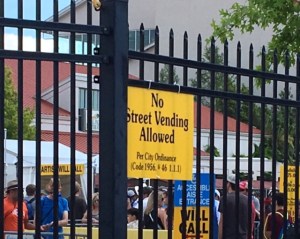 (There are “No Street Vending Allowed” signs posted, but those don’t seem to be given much weight.) Popup brass bands play for tips on the sidewalks. Some neighborhood residents hire bands and throw backyard parties, some of which you can attend for a fee (or, perhaps, crash unnoticed). New Orleans, like many other cities, has business licensing requirements, including mobile vendor licenses, and some of these vendors are clearly licensed, though it’s plausible that others might not be.
Many of these behaviors look like classic arbitrage: You can of course buy or enjoy most of those items or services in the official Jazz Fest, but they’re more expensive once you’re inside the Fairgrounds and committed to being there (general admission tickets allow single entry only). This creates obvious opportunities for unofficial vendors to sell products more cheaply just outside the Jazz Fest entrance gates. So, for example, it gets hot in New Orleans in April/May, and Fest rules allow you to bring in “Factory-sealed bottled water for personal consumption.” Bottled water sells for $3 in the Fest. But there are lots of people selling it out of a cooler for $1 in the surrounding streets, so it really makes sense to buy your water before you enter. From the seller’s point of view, if she buys 78 24-count cases of bottled water from Costco, it comes up to under 27 cents a bottle before tax. The incentive to make dollar-a-bottle sales outside the Fairgrounds on Fest days is obvious.
Others of these activities look like something close to agglomeration: Continue reading ““Unofficial” Jazz Fest (and Arbitrage, and Licensing, and Taxes)”
 The Surly Subgroup