What Would Happen if the Johnson Amendment Were Repealed?

By Benjamin Leff

Donald Trump recently repeated his campaign promise to “totally destroy” the Johnson Amendment. The Johnson Amendment is that portion of Section 501(c)(3) of the Internal Revenue Code that forbids tax-exempt charities (including most churches) from “interven[ing] in … any political campaign on behalf of (or in opposition to) any candidate for public office.” Only Congress can change the Tax Code, and, as Daniel Hemel recently pointed out, congressional Republicans just re-introduced the Free Speech Fairness Act, a bill to permit some limited campaign-related speech by the leaders of 501(c)(3) organizations, including churches. I’ve written previously in support of this legislation as an “adequate solution” to provide a little extra wiggle room to protect the speech rights of charities without making significant changes to the way campaigns are currently financed. Hemel points out that the Free Speech Fairness Act doesn’t come close to totally destroying the Johnson Amendment, but is more like a “de minimis carveout.”

But, rather than talk about the relatively sensible Free Speech Fairness Act, I want to predict what would happen if Donald Trump actually succeeds in “totally destroying” the Johnson Amendment. In other words, what would happen if Congress simply repealed the portion of section 501(c)(3) quoted above?

Because a charity must be organized and operated primarily for charitable purposes (although the word used in the statute is “exclusively”[1]), and intervening in campaigns is not a charitable purpose, new charities could not be created for the purpose of engaging in campaign speech or making political contributions. But existing charities could divert a significant quantity of their funds to political campaigns if they so chose. The question of how much is hard to answer without new guidance, but it would be plausibly reasonable (though aggressive[2]) for a charity to make 49% of its expenditures in any year as campaign contributions, since that leaves 51% of its activities to satisfy the requirement that it is engaged “primarily” in activities that accomplish its exempt purposes.

How would that change the way campaigns are financed in the US? Well, if people could find charities willing to accept their contributions and then spend them on political contributions, taxpayers could transform political campaign contributions from nondeductible expenditures to tax-deductible charitable contributions. This would work for corporations as well as individuals. The charities would then have to limit their political spending to 49% of their overall spending. The charities best suited for this type of intermediation of campaign spending are large existing public charities.[3] For example, a university, like the one I work for, could choose to make political contributions on behalf of its donors, if it wanted.

If I were involved in fundraising at my university, I would immediately suggest that it create a fund called the Alumni for Kamala Harris for President Fund and the Alumni for Paul Ryan for President Fund (just a guess for 2020). For every tax-deductible contribution of $100 to the fund, $60 would go to the candidate or to an independent PAC that supports the candidate, and $40 would go towards scholarships at the University. There are some legal issues that the University would have to maneuver to make this program work, and there might be some blowback from stakeholders who were upset about the University getting involved in politics, but the program would not be illegal or impossible.   As discussed below, for donors in the 39.6% tax bracket, a tax-deductible contribution of $100 costs about the same to them as a non-tax-deductible contribution of $60, so why not send $40 to scholarships at your alma mater, if it’s free (or, technically, paid for by the government)?

In the 2016 presidential election, total spending by Hilary Clinton, Donald Trump, the Democratic and Republican parties, and all Super PACS was just over $2 billion. There are almost certainly enough public charities in this country that would be tempted to raise funds in the manner described above that all $2 billion could be funneled through them, making all campaign spending tax-deductible for the donor.

So, would that be good or bad? Obviously, it has very little to do with whether churches or their leaders can or cannot endorse candidates from the pulpit. The question is whether it would be good or bad policy to permit all campaign contributions — whether to candidates directly or to independent PACs or political parties — to be made on a tax-deductible basis. Generally, a tax deduction functions like a government subsidy. On the one hand, subsidizing all campaign spending doesn’t seem so bad. Campaigns are important for democracy; why shouldn’t the government subsidize them? Under current law, the playing field is made level by denying tax deduction to everyone who makes a political contribution or spends money to elect a candidate. At first glance, it seems like the playing field would be equally level if everyone gets a tax deduction for similar spending. As long as everyone is treated the same, it seems like a fair system.

But everyone is not treated the same when political campaign contributions and campaign spending is tax deductible. First of all, most political campaign contributions are made by very wealthy taxpayers, and so subsidizing political spending is a subsidy for the wealthiest taxpayers. For example, the conservative Koch brothers were reported to have planned to spend almost 900 million dollars in the 2016 presidential election. The liberal donor Thomas Steyer reportedly spent over 86 million dollars. Even if the government subsidized such spending in an equal way, say 10 cents for every dollar spent, this subsidy would be unfair. The government would magnify the Koch brothers’ voice by 90 million dollars, Steyer’s voice by 8.6 million dollars and most Americans voice by nothing or almost nothing, simply because they make small contributions. Most people would think that even a subsidy that was delivered proportional to spending would probably be bad policy.

But a tax deduction is not proportional to money spent, because our Tax Code is not proportional. Tax deductions (including the deduction for charitable contributions) treat wealthier donors better than less wealthy donors. First, deductions for charitable contributions are only available to taxpayers who “itemize” their deductions. Under the current income tax system, 70 percent of taxpayers do not itemize; instead they take the standard deduction or do not owe any tax. If you take the standard deduction, your taxes remain exactly the same whether you make charitable contributions or not. If campaign contributions could be deducted like charitable contributions, then non-itemizers would not have any tax benefit from making campaign contributions, while itemizers would. Itemizers are disproportionately found among the highest-income taxpayers.

Second, the amount of benefit one receives from a deduction is equal to one’s marginal tax rate. Since tax rates are progressive, that means that higher-income taxpayers get more benefit from deductions than lower-income taxpayers. For example, single taxpayers who have taxable income over $415,050 pay tax at a 39.06% rate on their income that exceeds that threshold. That means that the ability to deduct a political contribution is worth 39.06 cents for every dollar contributed. It is like a federal subsidy of almost 40 percent to wealthy political donors. For single taxpayers (who itemize) with taxable income under $9,275, the comparable subsidy is only 10 cents for every dollar contributed. That’s what tax scholars generally call an “upside down” subsidy.

So, not only is deductibility a government subsidy for political spending that would go disproportionately to wealthy taxpayers, it would go to them in disproportionate amounts, providing a greater subsidy per dollar contributed to wealthier taxpayers than to less wealthy ones. It’s hard to imagine that there are many people who would interpret that dramatic tilt of the playing field in favor of wealthy donors a good thing. Not even Trump could sell a policy like that with a straight face.

[1] See Treas. Reg. 1.501(c)(3)-1(c)(1)(“An organization will be regarded as operated exclusively for one or more exempt purposes only if it engages primarily in activities which accomplish one or more of such exempt purposes specified in section 501(c)(3).” emphasis added.)

[2] It’s an aggressive position at least in part because the second sentence of Treas. Reg. 1.501(c)(3)-1(c)(a) states, “An organization will not be so regarded if more than an insubstantial part of its activities is not in furtherance of an exempt purpose.” A lot of negatives in that sentence, but it appears to interpret the opposite of “primarily” as “an insubstantial amount.” The idea that 49% of an organization’s activities is “an insubstantial part” is an aggressive position, to say the least.

[3] This post has been modified from its original form. It was originally published proposing that donor-advised funds would be the simplest vehicle for making tax-deductible campaign contributions. But, thanks to post-publication feedback about the likelihood that such use of donor-advised funds would still be improper even after a full repeal of the Johnson Amendment, I have changed the proposed vehicle for tax-deductible campaign contributions to existing public charities that are not donor-advised fund hosts.


Newspapers and the Total Destruction of the Johnson Amendment

By Sam Brunson

Yesterday at the National Prayer Breakfast, Donald Trump promised to “get rid of and totally destroy the Johnson Amendment.”

In case you’re unfamiliar with the name “Johnson Amendment” (and I kind of hope you are—it’s a stupid name), that refers to the phrase in section 501(c)(3) that prohibits tax-exempt organizations from endorsing or opposing candidates for office. It was proposed by Senator Lyndon Johnson in 1954, and inserted into the tax code with little fanfare and no legislative history.

There’s a lot that can (and, in fact, has) been said about Trump’s proposal, which follows up on a campaign promise he made, apparently repeatedly. I wouldn’t doubt if we return to it a few times here at Surly. But I just wanted to point out one potential consequence: Continue reading “Newspapers and the Total Destruction of the Johnson Amendment”

Leak-Driven Lawmaking

Shu-Yi Oei
Hoffman F. Fuller Professor of Law, Tulane Law School

Over the past decade, a steady drip of tax leaks has begun to exert an extraordinary influence on how international tax laws and policies are made. The Panama Papers and Bahamas leaks are the most recent examples, but they are only the tip of the leaky iceberg. Other leaks include (in roughly chronological order) the UBS and LGT leaks; the Julius Baer leak; HSBC “SwissLeaks”; the British Havens leaks; and the LuxLeaks scandal.

These tax leaks have revealed the offshore financial holdings and tax evasion and avoidance practices of various taxpayers, financial institutions, and tax havens. In so doing, they have been valuable in correcting long-standing informational asymmetries between taxing authorities and taxpayers with respect to these activities. Spurred by leaked data, governments and taxing authorities around the world have gone about punishing taxpayers and their advisers, recouping revenues from offshore tax evasion, enacting new domestic laws, and signing multilateral agreements that create greater transparency and exchange of financial information between countries.

Thus, it is clear that leaked data has started to be a significant driver in how countries conduct cross-border tax enforcement and make international tax law and policy. But using leaks to direct and formulate tax policy responses comes with some potentially serious pitfalls.

In a new paper—coming soon to an SSRN near you[fn.1]Diane Ring and I explore the social welfare effects of leak-driven lawmaking. Our argument, very generally, is that while data leaks can be socially beneficial by virtue of the behavioral responses they trigger and the enforcement-related laws and policies generated in their wake, there are under-appreciated downside hazards and costs to relying on leaked data in deterring tax evasion and making tax policy.

Continue reading “Leak-Driven Lawmaking”

A New Approach to Presidential Tax Disclosure [Updated]

By: Sam Brunson

I’ve written a couple times about the various presidential candidates’ tax return disclosure and nondisclosure. Ultimately, I concluded that, unless Congress mandates disclosure, it’s not going to happen.

It turns out that I may have been wrong.

No, I don’t mean that the disclosure norm is going to reassert itself. I do mean, though, that requiring presidential candidates to disclose their tax returns may not require Congressional action after all.  Continue reading “A New Approach to Presidential Tax Disclosure [Updated]”

Trump’s Emoluments Tax Problem, Part Two

By: Sam Brunson

A week and a half ago, David entered the debate about Trump’s potential problem with the Emoluments Clause. He pointed out that, whether or not Trump’s business interests would run afoul of the Emoluments Clause, any divestiture of assets would probably trigger a significant tax liability. (We don’t know exactly what that would be, but given that many of his assets are real property interests, he has probably been depreciating them, so even if they haven’t appreciated in value, his adjusted basis is probably significantly lower than the fair market value of the assets. So when he sells them, the sale will probably trigger a significant taxable gain.)  Continue reading “Trump’s Emoluments Tax Problem, Part Two”

The Art of the (Budget) Deal

By Daniel Hemel and David Herzig

Who Holds the Trump Card on Reconciliation?

Republicans on Capitol Hill are reportedly planning to use the filibuster-proof budget reconciliation process to repeal the Affordable Care Act and overhaul the tax code. Against that background, Sam Wice says that “the most powerful person in America” in 2017 will be Senate Parliamentarian Elizabeth MacDonough, the nonpartisan official who will “determine” how much of their agenda Republicans can pass through reconciliation. This, of course, is an exaggeration: like it or not, the most powerful person in America in 2017 will be Donald J. Trump, who will wield all the power of the imperial presidency. But Wice’s post helpfully directs our attention to the budget reconciliation process, the rules of which quite likely will determine whether the Republican leadership on Capitol Hill can repeal the ACA and reform the tax laws.

Yet while one should not underestimate the importance of reconciliation, one should also not overestimate the power of the Parliamentarian in the reconciliation process. As a formal matter, the Parliamentarian’s role is advisory; and as a practical matter, the Parliamentarian has little say over significant aspects of reconciliation. Other actors—most notably, Senate Budget Committee Chairman Mike Enzi (R-Wy.)—wield at least as much influence as the Parliamentarian. Most importantly, Enzi—not MacDonough—will determine whether the provisions in any reconciliation bill violate various rules against deficit-increasing legislation being passed via reconciliation. And unlike the Parliamentarian, the Budget Committee Chairman is very hard to fire.

Reconciliation measures can begin in either or both chambers. However, since the ultimate vote on the budget measure occurs in the Senate, we’ll focus on the Senate side of the reconciliation process for purposes of this discussion. On the House side, the Rules Committee Chair and the Budget Committee Chair will wield outsized influence as well. We expect Pete Sessions (R-Tex.) to stay on as House Rules Committee Chair; as for the House Budget Committee Chair, the race is on for a replacement to Tom Price, the Georgia Republican recently tapped as Trump’s Health and Human Services Secretary.

To understand why the Budget Committee Chair is as powerful as he is, a bit of background on reconciliation may be helpful. Continue reading “The Art of the (Budget) Deal”

Revisiting Presidential Tax Return Disclosure

imjustabillBy Sam Brunson

At this point, it’s pretty clear that the norm of presidential candidates (and, presumably, presidents) releasing their tax returns to the public is dead and buried. Sure, it’s been on life support for some time now (I mean, a significant number of candidates in this race released weak disclosures at best), but Trump’s election without having ever released his returns clearly demonstrates that flouting this particular norm is not a bar to election.

On election day I wrote that Congress should require disclosure from presidential candidates (and, at this point, I would expand that to sitting presidents and vice-presidents), and provided a handful of ideas about how such legislation should look. But my previous post suffers from one significant weakness: I assumed that disclosure was a good thing, without explaining why. Continue reading “Revisiting Presidential Tax Return Disclosure”

Federal Hall and Taxes

img_0082

By Sam Brunson

I spent my Thanksgiving in New York this year, ostensibly to see the Macy’s Thanksgiving Day Parade.[fn1]

Before and after Thanksgiving, my family and I went to various National Memorials in New York. (My Hamilton-obsessed kids were thrilled to make a pilgrimage to Hamilton Grange, even if they haven’t actually seen the musical yet.)

And on Friday, we went to Federal Hall.[fn2] And, like our visit to Alcatraz over the summer, I was surprised (and pleased) to find a tax connection.  Continue reading “Federal Hall and Taxes”

Trump’s Emolument Tax Problem

By: David J. Herzig (photo from Vox.com)

When a businessperson who runs many active businesses runs and wins for President, clearly there would be many second order problems associated with inherent conflicts between running corporations and the country.  When President-elect Trump won the office, many of these conflicts have bubbled to the surface.

For example, to avoid a conflict of interest between benefiting one’s personal holdings and the Country’s best interests, assets of the President are placed in a blind trust.  As many have pointed out, this works only when the President does not know the nature of the holdings.  Putting existing businesses into a blind trust does not stop the President for knowing the underlying assets of the trust.  The conflict is not ameliorated by trust structure.  Nor, by the way, would it be fixed if President elect Trump divests but the family continues to own the assets.

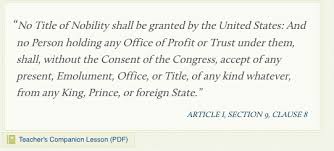
For this post, I want to consider the current discussion related to the blind trust problem called emolument.  Many prior to the election probably have not heard much about the idea of emolument.  Larry Tribe and others believe that President elect Trump’s ownership of active business assets, even in a blind trust, would violate, Article I, Section 9, Clause 8 of the Constitution which prevents the President from accepting “presents” or “Emolument” from foreign states.  Others, like Andy Grewal, do not believe that mere ownership of assets triggers the Emolument Clause.

If the solution to the blind trust and Emolument Clause problems is a divesture of President elect Trump’s assets as many advocate, this would trigger (to borrow a catch phrase of President elect Trump’s) huuuuuuge tax problem.

Continue reading “Trump’s Emolument Tax Problem”

Letter Urging the Senate to Vote on U.S. Tax Court Nominations

Over 50 tax law professors have signed a letter (available here) urging the U.S. Senate to vote on U.S. Tax Court nominees Elizabeth Ann Copeland and Vik Edwin Stoll. Unfortunately, these nominations may not get much attention in the wake of the election. However, the signatories (myself included) are urging the Senate to schedule a vote on these nominees, both of whom were favorably reported out of the Senate Finance Committee over a year ago. Danshera Cords has more on Procedurally Taxing.

Donald Trump —> Mandatory Tax Return Disclosure

So it looks like Trump wasn’t lying when he said he wouldn’t release his tax returns—it’s Election Day,[fn1] and we still haven’t seen them.[fn2]

As has been endlessly pointed out, every Republican nominee for president since Ronald Reagan has released his tax returns, and most nominees since the 1970s have. Trump, in refusing to release his returns, is flouting a long-standing norm.

The thing is, though, he’s run a campaign largely based on flouting norms. And it’s not like the norm was aging well, anyway. Sure, there were candidates with exemplary releases. But there were candidates—on both sides of the aisle (I’ve got my eye on you, Bernie Sanders!) who did less than the bare minimum, releasing only one or two years’ worth of returns, and only really releasing their 1040s. (Several months ago, I graded candidates’ tax return disclosures here.)  Continue reading “Donald Trump —> Mandatory Tax Return Disclosure”

Make Way for Ducklings?

Shu-Yi Oei 

Professor Charlotte Crane (Northwestern) presented Integrating a Fragmented Corporate Income Tax at BC Law School’s Tax Policy Workshop yesterday. Briefly, the paper is focused on recent proposals to integrate the corporate income tax, in particular, the yet-to-be-released Orrin Hatch proposal from the Senate Finance Committee. I’m no corporate tax expert, but the workshop afforded me the excuse to wade like a duckling through the recent literature…a nice break from other projects.

The corporate integration debate refers to the question of whether to eliminate the corporate double tax (i.e., the tax on both the corporation and its shareholders on the same underlying income) and replace it with a single layer of tax. Many have argued that this would reduce tax burdens, minimize economic distortions, and bring us closer to tax neutrality in investment decisions. Others have argued that corporate integration achieved through shifting the corporate tax to the shareholder level will enhance progressivity and fairness.

The integration debate has raged for decades, with important Treasury and ALI studies in 1992 and 1993, and a surge of recent academic and policy interest. There are various design possibilities, including: integration via a shareholder credit (a.k.a. imputation), integration via a dividend deduction paired with a shareholder withholding tax, integration via a shareholder dividend exclusion, flow-through taxation, and others. A couple of recent proposals: Toder and Viard have suggested eliminating the corporate tax and replacing it with taxation of shareholder dividends and gains at ordinary rates, with gains taxed on a mark-to-market (accrual) basis. And Gruber and Altshuler even more recently proposed pairing a lowered (15%) corporate tax rate with ordinary income taxation of shareholder dividends and capital gains (including an interest charge on deferred shareholder liabilities designed to minimize behavioral distortions).

Continue reading “Make Way for Ducklings?”

Pro Bono Week Free ABA Tax Justice CLE

By: Francine J. Lipman

There are many wonderful reasons to be a member of the ABA – Section of Taxation, including the Tax Section’s commitment to pro bono and outreach especially its education efforts with its people and its purse to work on the front lines with less fortunate and vulnerable neighbors across America. I can say without hesitation the ABA not only talks the talk, but it walks the walk. Indeed we are partnering with the ABA Civil Rights and Social Justice Section to present a free webinar on October 24 during pro bono week 2016. Tax justice at its best. I am a proud ABA tax justice passion warrior, join us in our efforts to help others as it is the gift that keeps on giving … We can, do, and will make a difference in the lives of countless American families.


images-2 Continue reading “Pro Bono Week Free ABA Tax Justice CLE”

Why the Constitution Protects Churches’ Right to Endorse Candidates

By Benjamin Leff

Last Sunday was Pulpit Freedom Sunday. With all of the speculation over Donald Trump’s tax strategies (personal and charitable), and then the publishing of the video showing Donald Trump saying terrible things, my Twitter feed had very little to say about pastors endorsing candidates from their pulpits. In fact, the news coverage has been surprisingly slim. But, all that notwithstanding, I thought I’d take the opportunity to finally explain why I think that the law does not prohibit pastors of tax-exempt churches (or leaders of any other 501(c)(3) organization) from communicating an express endorsement of a candidate in a regular meeting of the organization. I’ve mentioned this position in a number of previous posts here and here (and annoyingly to them I’m sure, on my friends’ Facebook feeds) and keep linking to a 2009 article I wrote on the topic. But who wants to read that?  The dominant argument against me appears to be that churches are free to endorse candidates or be tax-exempt, but not both, and forcing that choice is not a Constitutional problem.  But that argument is not an accurate description of the law, as I understand it (although, of course, I have to caveat that I’m a tax guy, not a Constitutional law scholar). Continue reading “Why the Constitution Protects Churches’ Right to Endorse Candidates”

Trump’s Abuse of Trump Foundation — Criminal Tax Implications?


By: Philip Hackney, Oct. 3, 2016

donald-j-trump-1342298_1280-1

Much attention is being paid to how Donald Trump could have amassed a $900 million NOL in the mid 90s. I remain laser-focused on the Donald J. Trump Foundation.  For this blog post I ask the question: could Mr. Trump’s misuse of the private foundation that he leads result in criminal sanctions under tax law?

I think there is enough evidence to open a criminal investigation into his activities. Nevertheless, a criminal prosecution is highly unlikely for both political reasons and issues of proof (ignorance of the law is a defense). Still, I think the IRS has a duty to open an investigation under the egregious set of facts I lay out.

Here is the important thing to keep in mind as you consider the arguments I lay out in this post: Donald Trump does not own the Foundation and its property does not belong to him. It does not matter from whom the money came. He is the president of a nonprofit organization that is entrusted with money to be used for charitable purposes that benefit the public. Continue reading “Trump’s Abuse of Trump Foundation — Criminal Tax Implications?”