
The Art of the (Budget) Deal

By Daniel Hemel and David Herzig

Who Holds the Trump Card on Reconciliation?

Republicans on Capitol Hill are reportedly planning to use the filibuster-proof budget reconciliation process to repeal the Affordable Care Act and overhaul the tax code. Against that background, Sam Wice says that “the most powerful person in America” in 2017 will be Senate Parliamentarian Elizabeth MacDonough, the nonpartisan official who will “determine” how much of their agenda Republicans can pass through reconciliation. This, of course, is an exaggeration: like it or not, the most powerful person in America in 2017 will be Donald J. Trump, who will wield all the power of the imperial presidency. But Wice’s post helpfully directs our attention to the budget reconciliation process, the rules of which quite likely will determine whether the Republican leadership on Capitol Hill can repeal the ACA and reform the tax laws.

Yet while one should not underestimate the importance of reconciliation, one should also not overestimate the power of the Parliamentarian in the reconciliation process. As a formal matter, the Parliamentarian’s role is advisory; and as a practical matter, the Parliamentarian has little say over significant aspects of reconciliation. Other actors—most notably, Senate Budget Committee Chairman Mike Enzi (R-Wy.)—wield at least as much influence as the Parliamentarian. Most importantly, Enzi—not MacDonough—will determine whether the provisions in any reconciliation bill violate various rules against deficit-increasing legislation being passed via reconciliation. And unlike the Parliamentarian, the Budget Committee Chairman is very hard to fire.

Reconciliation measures can begin in either or both chambers. However, since the ultimate vote on the budget measure occurs in the Senate, we’ll focus on the Senate side of the reconciliation process for purposes of this discussion. On the House side, the Rules Committee Chair and the Budget Committee Chair will wield outsized influence as well. We expect Pete Sessions (R-Tex.) to stay on as House Rules Committee Chair; as for the House Budget Committee Chair, the race is on for a replacement to Tom Price, the Georgia Republican recently tapped as Trump’s Health and Human Services Secretary.

To understand why the Budget Committee Chair is as powerful as he is, a bit of background on reconciliation may be helpful. Continue reading “The Art of the (Budget) Deal”
Trump’s Emolument Tax Problem

By: David J. Herzig (photo from Vox.com)

When a businessperson who runs many active businesses runs and wins for President, clearly there would be many second order problems associated with inherent conflicts between running corporations and the country.  When President-elect Trump won the office, many of these conflicts have bubbled to the surface.

For example, to avoid a conflict of interest between benefiting one’s personal holdings and the Country’s best interests, assets of the President are placed in a blind trust.  As many have pointed out, this works only when the President does not know the nature of the holdings.  Putting existing businesses into a blind trust does not stop the President for knowing the underlying assets of the trust.  The conflict is not ameliorated by trust structure.  Nor, by the way, would it be fixed if President elect Trump divests but the family continues to own the assets.

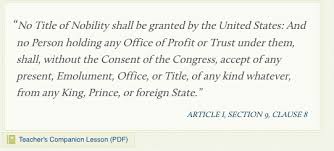
For this post, I want to consider the current discussion related to the blind trust problem called emolument.  Many prior to the election probably have not heard much about the idea of emolument.  Larry Tribe and others believe that President elect Trump’s ownership of active business assets, even in a blind trust, would violate, Article I, Section 9, Clause 8 of the Constitution which prevents the President from accepting “presents” or “Emolument” from foreign states.  Others, like Andy Grewal, do not believe that mere ownership of assets triggers the Emolument Clause.

If the solution to the blind trust and Emolument Clause problems is a divesture of President elect Trump’s assets as many advocate, this would trigger (to borrow a catch phrase of President elect Trump’s) huuuuuuge tax problem.

Continue reading “Trump’s Emolument Tax Problem”

Podcast: Require Candidates to Disclose Tax Returns?

By: Philip Hackney

On this morning where we have a newly elected president, Sam Brunson and I discussed in a #CookingtheBooks Podcast whether Congress should pass legislation requiring a presidential candidate to disclose some number of years of tax returns in order to run for office.

Sam argued here on the blog a couple of days ago that this should be a requirement. I agree with him, but neither of us believe the failure to disclose those returns was a critical factor in a Trump win. We just think it tells the American people something important about the person who will be leading the country.

We also discussed a little bit about what tax policy might look like in a Trump administration. Sam, ever the optimist, is worried but not terribly about Trump tax policy. Feeling a bit pessimistic myself this morning, and having lived through 8 years of Governor Jindal in Louisiana and very afraid that this will lead to enormous deficits.

In the end, we look very much forward to critiquing Trump tax policy as much as we would have critiqued Clinton tax policy.

Anyway, give the podcast a listen and let us know what you think. We enjoy the medium as another channel for discussing tax policy.

Cooking The Books Podcast on Trump’s Taxes

By: David J. Herzig

Today Pulitzer Prize winning journalist, David Cay Johnston, Phil Hackney, and I got together for a 30 minute podcast discussion regarding the recent NY Times follow-up article about Mr. Trump’s $916 million tax loss (“NOL”).

Here is link if you missed hyper-link above: http://share.sparemin.com/recording-5131

The topics ranged from the current tax reporting regarding Mr. Trump’s 1990s tax returns to the Trump Foundation to potential criminal sanctions against Mr. Trump.  It was fantastic to be a part of and I hope everyone listens.

Continue reading “Cooking The Books Podcast on Trump’s Taxes”

Yale Daily News Endorsed a Candidate -Political Campaign Intervention?

By: Philip Hackney, Oct. 31, 2016

Last week the Yale Daily News a college newspaper run by students associated with Yale University endorsed Hillary Clinton for president. While a newspaper endorsing a candidate for president is usually the ordinary course of business, when that newspaper is a section 501(c)(3) organization, its an issue. A charitable organization is absolutely prohibited from intervening in a political campaign.

On Friday October 28, I joined my tax prof friends and many surly bloggers Ben Leff, Sam Brunson, David Herzig and Andy Grewal to discuss in a Sparemin Podcast whether YDN put its exemption at risk or not. We had had a dispute on twitter and decided that a podcast discussion might enhance our understanding of one another’s views. It certainly helped me. Give it a listen yourself. Let us know what you think. Continue reading “Yale Daily News Endorsed a Candidate -Political Campaign Intervention?”

Will the Supreme Court Hear a Retroactive Taxation Case This Term?

By: David J. Herzig

Earlier this year, the Washington Supreme Court held that the retroactive application of the legislature’s amendment to a Business & Occupation (B&O) tax exemption revising the definition of “direct seller’s representative” to conform to the Washington Department of Revenue’s interpretation of the exemption did not violate a taxpayer’s rights under due process, collateral estoppel, or separation of powers principle.

Like most states, Washington had a B&O tax for “the act or privilege of engaging in business activities.”  Under the original law, out-of-state sellers were exempt if they acted through a representative.  DOT Foods shows up in Washington and sells through a wholly owned subsidiary to avoid the B&O tax.

In 1999, the Washington Department of Revenue changed its interpretation of the statute to subject DOT and others to the B&O tax.  Dot challenged that change (215 P.3d 185 (Wash. 2009) “DOT I”)) and won.  DOT I applied for the tax periods 2000-2006.

DOT then sought a refund for the period Jan. 2005 – Aug. 2009 (not the time period of DOT I).  In the meantime, in 2010 the Washington State Legislature changed Wash. Rev. Code Sec. 82.04.423(2) in response to the DOT I ruling.  The statute both retroactively and prospectively changed the statute. Based on the statutory change, the Washington Department of Revenue rejected the refund claim.

For the period covered by DOT I, DOT and Washington agreed on a settlement for a 97% refund for B&O taxes paid.  For the May 2006 to December 2007 period (after DOT I), the refund request was denied.  DOT challenged the retroactive application under the theories of collateral estoppel, separation of powers, and due process.  DOT lost in the Washington Supreme Court and now has appealed to the US Supreme Court.

The test for whether or not retroactive tax legislation satisfies Due Process is United States v. Carlton, 512 U.S. 26 (1994).  Carlton  applied a rational basis test.  The Court stated retroactive tax legislation would not violate due process if, “legitimate legislative purpose furthered by rational means.”  According to the ACTC brief,   “The Washington Supreme Court ignored the unique circumstances of the Carlton case, which involved the correction of an obvious legislative error that was identified very soon after the statute was enacted and which the taxpayer was admittedly exploiting for its own benefit.”

Continue reading “Will the Supreme Court Hear a Retroactive Taxation Case This Term?”

ClassCrits IX: The New Corporatocracy and Election 2016

Surly bloggers Sam Brunson, David Herzig and I (and Leslie Book over at Procedurally Taxing) are attending the ClassCrits IX conference hosted by Loyola University Chicago School of Law today and tomorrow. From the call for papers back in March:

As the U.S. presidential election approaches, our 2016 conference will explore the role of corporate power in a political and economic system challenged by inequality and distrust as well as by new energy for transformative reform.

There are some notable tax-related panels happening at the conference, along with other interesting panels relating to corporations and democracy:

Taxation, Social Justice and Development (Friday 10/21/16)

Doron Narotzki, University of Akron Business Administration
Corporate Social Responsibility and Taxation: The Next Step of the Evolution

Rohan Grey, Binzagr Institute for Sustainable Prosperity & Nathan Tankus, Modern Money Network
Corporate Taxation in a Modern Monetary Economy: Legal History, Theory, Prospects

Karl Botchway, CUNY Technology & Jamee Moudud, Sarah Lawrence Economics
Capacity Building, Taxation and Corporate power in Africa

Martha T. McCluskey, SUNY Buffalo Law, Corporatocracy and Class in State and Local “Job-Creation” Subsidies

Distributing Wealth, Law and Power (Friday 10/21/16)

Goldburn P. Maynard, Jr., University of Louisville Law
A Plea for Courts to Abolish the Judicially Created Right of the Wealthy to Avoid Estate Taxes

Victoria J. Haneman, Concordia University Law
The Collision of Holographic Wills and the 120-Hour Rule

Doron Narotzki, University of Akron Business Administration
Dark Pools, High-Frequency Trading and the Financial Transaction Tax: A Solution or Complication?

Robert Ashford, Syracuse University Law
Why Working But Poor?

Critical Perspectives on Tax Law (Saturday 10/22/16)

Shu-Yi Oei, Tulane University Law
The Troubling Case of Offshore Tax Enforcement

Les Book, Villanova University Law
Bureaucratic Oppression and the Tax System

Samuel Brunson, Loyola University Chicago Law
Avoiding Progressivity: RICs, Pease, and the AMT

David Herzig, Valparaiso University Law
Let Prophets Be (Non) Profits

Talking Tax on Twitter

twitterbird_rgbBy Sam Brunson

I was reminded yesterday both why I love Twitter and why Twitter is such a valuable tool for tax academics (and others).

See, yesterday I participated in two (or, actually, three) conversations about different tax topics. And, notwithstanding the inherent limitations of the medium (especially the 140-character limit), the discussions were both substantive and informative.  Continue reading “Talking Tax on Twitter”

When your job is predicting the future

rainBy: Diane Ring

In a post earlier this week, I considered how the international tax conference I was attending (the annual worldwide meeting of the International Fiscal Association, IFA) had something in common with the Japanese anime and manga conference hosted in the adjacent venue. Soon the anime event ended and the tax conference continued, but with a new neighbor – the Meteorological Technology World Expo 2016. No costumes – but some interesting, though puzzling, equipment outside in the courtyard. I thought about the big task of meteorology—predicting the future. Turns out that in-house tax advisors have the same job, it’s just that instead of rain, they predict the tax implications of business decisions for the C-suite. But the tax advisors do it without the tech, and there is a lot to keep them up at night . . . Continue reading “When your job is predicting the future”

International tax meets Japanese anime

By: Diane Ring

On Sunday, international tax lawyers and advisers from private sector, government officials, tax representatives from international organizations, in-house counsel, and tax academics converged on the convention center in Madrid for the annual conference of the International Fiscal Association (IFA).

But we were not alone.

An adjacent exhibition hall hosted “Japan Weekend 2016” a celebration of Japanese anime and manga. I had no trouble finding my place – I was unlikely to confuse international tax lawyers with the costumed crowd that channeled Alice in Wonderland meets the Flash. Once the tax conference got underway, though, I began to contemplate similarities between the two events, in particular, the meaning and role of reality and its construction. . . Continue reading “International tax meets Japanese anime”

Debate Prep: The Candidates’ Estate Tax Plans

By David Herzig

With the first Presidential debate tonight, we are sure (or at least I hope) to hear about various tax plans.  I would expect that the estate tax would be a topic of conversation since there is such a sharp contrast between the candidates.  The current reporting spins that Donald Trump wants to eliminate the estate tax; while, Hillary Clinton wants to tax the rich through a two-prong increase on the estate tax.  I thought it would be useful in advance of the debate to discuss the candidates’ actual estate tax plans. (If there is a PA for Lester Holt looking for some last minute questions for the candidates – scroll to the bottom and steal away no attribution needed!)

Currently, there is an estate (or death) tax. Unfortunately for the fisc, the tax accounts for less than 1 percent of federal revenue.  (See, Tax Foundation). What is amazing is that at other points in time, the tax actually raised revenue and effected many estates.  The primary reason for the drop in revenues even though overall net worth has increased, is related to the exemption amount available for taxpayers.  In 1976, the exemption amount per estate was $60,000 while today it is $5.45 million.  (I tackle a lot of these issues in my upcoming University of Southern California Law Review article).

Continue reading “Debate Prep: The Candidates’ Estate Tax Plans”

Does Enforcement Reduce Compliance?

Shu-Yi Oei 

Boston College Law School held its first Tax Policy Workshop of the semester last Thursday and the speaker was Surly Blogger Leandra Lederman. Leandra presented a draft paper entitled “To What Extent Does Enforcement Crowd Out Voluntary Tax Compliance?” The draft isn’t publicly available yet, but you can email Leandra for a copy.

So, what’s the paper about? The standard economic model tells us that a taxpayer will weigh the magnitude of the penalty and the likelihood of audit to reach an “expected” cost of punishment for tax evasion. Allingham & Sandmo (1972). So, if the audit rate is low (which it is), the expected cost of evasion also remains low, absent draconian penalties. Yet, we see relatively high voluntary compliance rates in the U.S. Some scholars claim that this is a “puzzle” and theorize that there is some sort of “intrinsic motivation” to comply with tax obligations, regardless of the low expected costs of punishment. Leandra has pointed out in several articles that this simple comparison presents a false puzzle because it ignores information reporting (and withholding), which IRS voluntary compliance statistics show is highly effective. She argues that information reporting is akin to an invisible audit. Nonetheless, some scholars suggest that enforcement and deterrence action are “extrinsic motivators” that might actually reduce compliance by displacing (i.e., “crowding out”) preexisting internal motivations to comply.

Leandra’s paper synthesizes the empirical literature on the effects of audit threats and fines as well as the growing tax and non-tax literature on contexts in which enforcement can lead to reduced compliance. In brief, the paper finds:

Continue reading “Does Enforcement Reduce Compliance?”

Trump, Churches, and Politics – Counterpoint

By Benjamin Leff

A few days ago, my good friend and fellow Subgrouper, David Herzig, wrote a post about Donald Trump’s appearance at a church in Flint Michigan, the Bethel United Methodist Church. Herzig argued in his post (and on Twitter) that the interruption of Trump’s attacks on Hilary Clinton by the church’s pastor, Rev. Timmons, was necessary to protect the church from violating the prohibition on campaign-related speech by churches (and other charities). He also quoted Professor Lloyd Mayer’s tweet on the topic, arguing that the church could have violated the prohibition simply by permitting Trump to speak at all, regardless of the topic. I lamely tweeted back that the short video that had been released failed to provide sufficient facts to make a determination about whether the church violated the law or not. I want to say more about the law and the IRS’s current interpretation of the law to supplement Herzig and Mayer’s valiant efforts, since I think I have a slightly different view on the issue than either of them.

The most important point is that the Constitution protects all churches’ right to engage in speech (as well as religious practice). Statutory law — including the prohibition on campaign intervention (sometimes called the “Johnson Amendment”) — does not (could not) interfere with those very basic and fundamental rights. In my view, the IRS’s interpretation of the law gets some things a little bit wrong, but even its interpretation is extremely permissive of speech that takes place in churches and other charities in deference to their very real speech rights.

So, what’s the law with respect to hosting a political candidate at a church or other charity (including, by the way, a university)? Is it the case that any appearance by a known candidate at any event hosted by a 501(c)(3) organization is a violation of the law? Continue reading “Trump, Churches, and Politics – Counterpoint”

Imputed Income and Donald Trump’s Tax Deduction for Stay-at-home Moms

By: Jennifer Bird-Pollan

This week Republican presidential nominee Donald Trump released a series of proposals aimed, presumably, at improving his approval ratings among women.  Much of the focus in reporting on this plan has been on the proposed six weeks of maternity leave that employers will have to make available to all of their female employees.  Another element of the proposal is focused on mothers who do not work outside of the home.  Trump’s plan offers a tax deduction for childcare expenses to all parents (including adoptive parents and foster parents) with children under the age of 13 living at home.  In a unique twist, rather than having a uniform cap for the amount of childcare expenses taxpayers can deduct, the plan caps the amount of the deduction at the average cost of childcare in the state of residence.  In another radical departure from current law, Trump’s childcare deduction would be available to stay-at-home parents who provide care for their own children in their own homes.  In the explanation of this proposal Trump claims that allowing the deduction to be claimed by stay at home parents means the government would be allowing families to decide for themselves”what’s in a family’s best interest.”   Further, the proposal claims that giving a deduction to stay home parents is “a belated recognition by the federal government of the economic value of the work provided by stay-at-home parents.”  Continue reading “Imputed Income and Donald Trump’s Tax Deduction for Stay-at-home Moms”

Trump, Churches and Politics

Photo: Evan Vucci/AP

By David J. Herzig

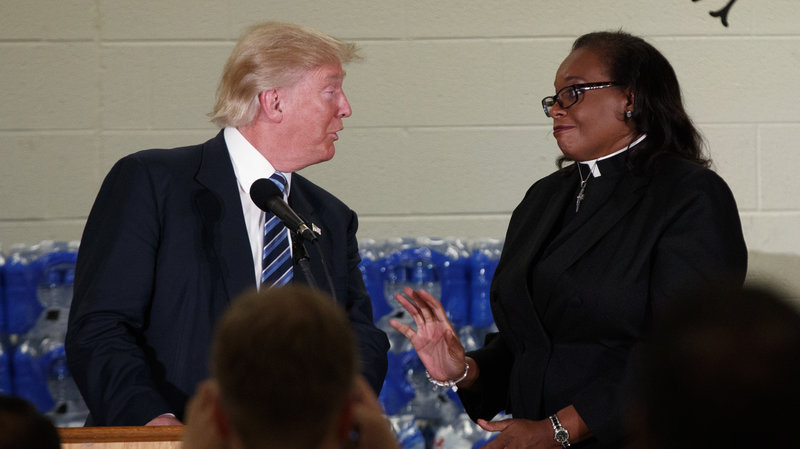
One of the leads in today’s news cycle was the Flint Pastor, Rev. Faith Green Timmons of the Bethel United Methodist Church, interrupting Republican Presidential Candidate Donald Trump during a speech at her church.

According to the story, Rev. Timmons, intervened during Mr. Trump’s speech  when he started attacking Democratic Presidential Candidate Hillary Clinton stating, “Mr. Trump, I invited you here to thank us for what we’ve done in Flint, not give a political speech, …”. To which Mr. Trump responded, “OK. That’s good. Then I’m going back onto Flint, OK? Flint’s pain is a result of so many different failures, …”.

I headed to Twitter to state that Rev. Timmons was doing the right thing protecting her churches charitable exemption by halting the political speech.  Quick blackletter law: churches, like other public charities, are exempt from tax under section 501(c)(3). But like all exemptions there are certain limitations, including an absolute prohibition on supporting or opposing candidates for office.  In IRS Publication 1828, the IRS position is clear,  “churches and religious organizations, are absolutely prohibited from directly or indirectly participating in, or intervening in, any political campaign on behalf of (or in opposition to) any candidate for elective public office.”  (For a primer on the topic, my co-blogger Sam Brunson wrote for Surly here and for a full blown analysis see his work for University of Colorado’s law review here).  Churches can’t (although they often do) engage in political speech.  Maybe Rev. Timmons was attempting to protect the church’s exemption.

However, as Lloyd Mayer pointed out on Twitter, having a candidate appear at your church two months before the election might in itself be political speech regardless of the topic actually discussed.  This would be true unless the church gave the same amount of “air time” to the opponent.  Publication 1828 supports Professor Mayer’s view.  Statements made by the religious leader of the church at an official church function or through use of the church’s assets would be improper political campaign intervention.  Hosting only one candidate regardless of the topic would seem to be an endorsement of that candidate and thus improper political campaign intervention.

Continue reading “Trump, Churches and Politics”