Child Care in the Presidential Campaign

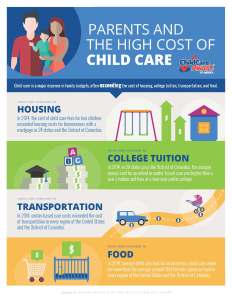
CCA-IG-CostsCompared_v1bToday, Donald Trump laid out a series of economic proposals. Included, naturally, were a series of tax proposals, which I assume we’ll address on this blog as time goes on. For now, I want to focus on just one of his proposals: easing the cost of child care.

While the cost of child care varies, it has risen dramatically, nearly doubling over the last 25 years. And although the cost of child care varies from state to state—and even from city to city—the numbers can be eye-opening. In Illinois, the average annual cost of child care for an infant and a 4-year-old is more than $22,000. At the same time, the median income for a single parent is about $24,000, and the median household income for married parents is about $88,000.[fn1] That means that the cost of child care for two children represents 25 percent of the median Illinois married couple’s household income, and fully 94 percent of the median income of a single parent.

Clearly, using averages and medians doesn’t paint an accurate picture of any given family’s situation. But in no state would child care costs make up less than 30 percent of a minimum wage-earner’s income. That’s a pretty dire picture. Dire enough, in fact, that the cost of child care is keeping women out of the workforce. (And note that it’s not just women who can afford to stay out of the workforce because of a spouse’s or partner’s income: 34 percent of stay-at-home mothers live in poverty, as opposed to 12 percent of mothers in the workforce.) Continue reading “Child Care in the Presidential Campaign”
“Taxman” at 50

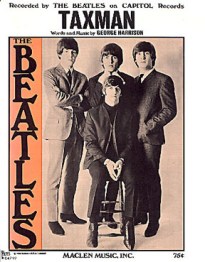
taxman20sheet20music
Updated lyrics are available here.

The Beatles’ hit song Taxman has just turned 50; it was released August 5, 1966 in the U.K. Taxman, written primarily by George Harrison, famously includes the lyrics

“Let me tell you how it will be
There’s one for you, nineteen for me
Cos I’m the taxman, yeah, I’m the taxman

Should five per cent appear too small
Be thankful I don’t take it all . . . .”

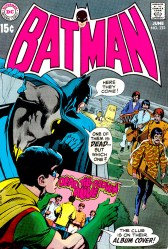
Apparently this song was at least partly inspired by the theme for the 1966 TV show, Batman! batman222june1970And, in the early 1980s, Weird Al Yankovic wrote a parody called “Pac-Man,” though it was not released  on any of his albums.

H&R Block used the Taxman song in a 2002 commercial literally showing only tax men: “It took an Act of Congress to pass 441 changes in the tax law. Will it take an act of God to understand them?” (There’s a different, more diverse version here.)

Did the Beatles really pay a 95% tax rate? According to a Bloomberg article, “The top rate for British taxpayers in the mid- Continue reading ““Taxman” at 50″

Rio 2016!

rioThe Rio Olympics start this weekend.[fn1] And, in spite of the catastrophe that the Rio Olympics may potentially be, we’ll be watching (in the same way John Oliver excoriated FIFA for 12 minutes before announcing that he was “still so excited” for the World Cup).
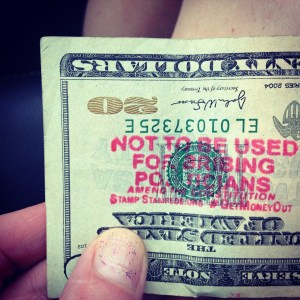
U.S. Olympians are likely to win a collective 100 or so medals over the next couple weeks. And, in addition to medals, winners will receive cash payments from the U.S. Olympic Committee—it will pay $25,000 for a gold, $15,000 for a silver, and $10,000 for a bronze. Continue reading “Rio 2016!”

Regressivity and Cook County Property Taxes

I was listening to “The Morning Shift” on WBEZ this morning, and they started talking about property tax. Now, property tax isn’t really my thing, but the story caught my ear for a couple reasons.

First, of course, I’m a homeowner in Chicago, so the recent property tax hike is salient enough that it’s worth some of my time. Second, as my wife pointed out to me, the assessment of property values has an aspect that seems tremendously regressive and, therefore, problematic. Continue reading “Regressivity and Cook County Property Taxes”

Examination of Allegations Against Clinton Foundation Part II

By: Philip Hackney

elections-1527438_1280

A week ago I considered one of three allegations Rep. Marsha Blackburn made against the Bill, Hillary & Chelsea Clinton Foundation in a letter Blackburn sent to the IRS, FBI, and FTC. I found the first allegation stated nothing of significance to the IRS. I now look at the other two and find them significantly wanting as well. Recently, IRS Commissioner Koskinen sent a letter indicating the IRS would investigate these complaints. I conclude they fail to state any complaint actionable by the IRS.

The second and third Blackburn allegations seem to come from a book by Peter Schweizer called Clinton Cash. Both allegations suggest that Sec. Clinton provided large governmental benefits in exchange for donations to the Clinton Foundation and payments to Bill Clinton. Both of the claims, already made by Presidential candidate Donald Trump, regarding Laureate University and Uranium One have been rated False and Mostly False by Politifact. Thus, it is difficult to take these allegations seriously.

Nevertheless, there are two things I do in this post. First. I discuss the factual conclusions of others regarding whether there was a quid pro quo arrangement associated with the second and third allegations. Then, I look at how the tax law might treat such arrangements were they true. Continue reading “Examination of Allegations Against Clinton Foundation Part II”

Johnny Rex Buckles: The Sexual Integrity of Religious Schools and Tax Exemption

Johnny Rex Buckles (University of Houston Law Center) has a new paper out entitled “The Sexual Integrity of Religious Schools and Tax Exemption” looking at whether religious schools that discriminate on the basis of sexual orientation should maintain their tax exemption. The article can be found here. The abstract states:

Many private universities and other schools adhere to religiously grounded codes of conduct that embrace heterosexual monogamy as the sole moral context for sexual relationships. The federal income tax exemption of these schools has been questioned following the recent Supreme Court opinion of Obergefell v. Hodges. In Obergefell, the Supreme Court held that the right to marry is a fundamental constitutional right that same-sex couples may exercise. The relevance of this decision to the federal tax status of private religious schools arises from another Supreme Court decision, Bob Jones University v. United States. The Court in Bob Jones held that two schools with racially discriminatory policies as to students were not entitled to exemption from federal income tax because the policies violate established public policy. The issue now is whether the sexual conduct policies of private religious schools violate the established public policy of the United States following Obergefell. After reviewing Bob Jones and surveying the application of the public policy doctrine by the IRS and the courts, this article argues that, regardless of the factual context of a controversy in which the IRS seeks to invoke Bob Jones to deny or revoke federal income tax exemption, the public policy doctrine should be narrowly construed. Applying a suggested framework for limiting the public policy doctrine coherently, this Article argues that schools maintaining sexual conduct policies that prohibit sexual activity inconsistent with their religiously informed, traditional view of marriage remain tax-exempt after Obergefell. Apart from the proposed framework, this Article further explains why Obergefell’s analytical approach, language and tone are inconsistent with applying Bob Jones to the disadvantage of religious schools that maintain sexual conduct policies.

Faculty Hiring: University of Richmond School of Law

I’m passing along a hiring announcement from Jessica Erickson, who is chairing Faculty Appointments at the University of Richmond School of Law:

The University of Richmond School of Law seeks to fill two entry-level tenure-track positions for the 2017-2018 academic year, including one in tax law.  Candidates should have outstanding academic credentials and show superb promise for top-notch scholarship and teaching.  The University of Richmond, an equal opportunity employer, is committed to developing a diverse workforce and student body and to supporting an inclusive campus community.  Applications from candidates who will contribute to these goals are strongly encouraged. 

Inquiries and requests for additional information may be directed to Professor Jessica Erickson, Chair of Faculty Appointments, at lawfacultyapp@richmond.edu

If Churches Really Want to Vindicate Their Right to Endorse a Candidate, It’s Easy for Them to Get into Court

By Benjamin Leff

Last week, attendees at the Republican National Convention applauded loudly when Donald Trump repeated his promise that if he’s elected president, he’ll work to end the ban on political-campaign activity by tax-exempt churches.  All 501(c)(3) organizations (including churches) have been prohibited from “intervening” in a campaign for public office for over half a century, and the arguments for and against the prohibition have remained remarkably consistent for decades.  Activists on one side call for an end to the ban, which they believe is an infringement on free exercise of religion or free speech.  Activists on the other side call for the IRS to actually enforce the ban, which they argue is being flouted by (mainly) churches who thereby distort the electoral process.  A long list of academics has written articles from a wide range of perspectives, proposing a wide range of solutions (including my contribution way back in 2009).  (I also spoke about this issue a few weeks ago in Australia, at a fabulous round-table at the University of Melbourne.)  As Sam Brunson pointed out on this blog in May, the IRS is “stuck in the middle.”

In his post, Sam pointed out that “Over the last eight years or so, the Alliance Defending Freedom has sponsored an annual event it calls Pulpit Freedom Sunday, in which pastors preach a sermon that expressly violates the prohibition, then send a copy of their sermon to the IRS. Of the possibly thousands of churches that have participated over the years, none have lost their exemptions.”  This is often presented as a dilemma for the churches: they want to get in to court, and are disappointed that the IRS won’t let them.

To me, this public stance on the part of the churches and Alliance Defending Freedom seems disingenuous.  If they really want to get into court, why don’t they just use the statutory procedures provided to 501(c)(3) organizations under the law?  Continue reading “If Churches Really Want to Vindicate Their Right to Endorse a Candidate, It’s Easy for Them to Get into Court”

Emmet Till and The Panama Papers

Photo AP.

By David J. Herzig

Yesterday (July 25) would have been Emmet Till’s 75th birthday.  Since high school I have been fascinated by his story and the impact he had on the Civil Rights movement. For those who don’t know, Mr. Till was born and lived in Chicago.  While visiting his relatives in Mississippi in 1955, at the age of 14, he was killed for allegedly flirting with a white women.  His killers (although an all white jury acquitted both men they both admitted to the killings in this Look Magazine article) were the husband of the woman, Roy Bryant and his half-brother J. W. Milam.

The death of Mr. Till is often credited with a mobilizing factor in the Civil Rights Movement.  For those interested, here is an excellent PBS documentary on the topic.

Thankfully, it did not take long to justify a post on a tax blog about a Civil Rights hero.  The son of one of Mr. Till’s killers name seems to show up in the Panama Papers.  According to the Clarion Ledger, “Harvey T. Milam of Ocean Springs, whose father, J.W., shot Till in 1955, appears in” the Panama Papers.  Apparently, Harvey had quite a scheme involving using off-shore insurance companies.  I may actually have to do some digging around to find out more about the alleged scheme.

What’d I Miss?

I’ve been traveling for the last month or so, a significant portion of that time without any internet access.

Whatd I MissThat doesn’t mean, of course, that I’ve been totally starved of news. With a 10-, 7-, and 4-year-old, I couldn’t miss the existence of Pokémon Go, and I’ve caught up (at least slightly) on the big, general news of the day. But by and large, I haven’t opened my Lexis Daily Federal Tax Tracker in a month. I’ll naturally read what my co-bloggers have written here, but I’m curious if there’s any other important tax happenings that I might not have seen.

So tell me: What’d I miss?

Examination of Allegations Against the Clinton Foundation

By: Philip Hackney

book-863418_1280Back in June I wrote disapprovingly of some actions of the Donald J. Trump Foundation. In that piece I promised to write about the Bill, Hillary & Chelsea Clinton Foundation too. Recently, Rep. Marsha Blackburn sent a letter that was scheduled to be sent to the FBI, the FTC, and the IRS. That letter makes a number of allegations about the misuse of the Clinton Foundation, and I figured these allegations would be a good place to analyze the performance of the Foundation that I had promised.

Blackburn alleges a number of things, but I am going to focus on her first allegation in this post because it is the only one that is a pure tax exemption question. She alleges that the Foundation is illegally operating outside the scope of its initial application for tax exemption to the IRS.  For reasons explained in the post below, I conclude there is very little involved in this claim and it is a misunderstanding of the law. There could be problems with the Foundation but this is not one of them.

UPDATE: I look at the remaining two Rep. Blackburn allegations here.

Continue reading “Examination of Allegations Against the Clinton Foundation”

Emerging Trend for Uber in Europe?

By: Diane Ring

Uber, one of the most prominent faces of the sharing economy, has not always been welcome in the EU. Similarly, Airbnb has experienced legal, regulatory, and public policy resistance across European countries. However, two recent developments in the EU suggest that, on balance, Europe might be staking out a regulatory path for the sharing economy that is intended to demonstrate the region’s support for the new sector. . . . Continue reading “Emerging Trend for Uber in Europe?”

Don’t Impeach IRS Commissioner Koskinen

Rep. Jason Chaffetz (R-Utah), Chair of the House Committee on Oversight and Government Reform, has introduced H. Res. 737, which would condemn and censure IRS Commissioner John Koskinen. Efforts to impeach or censure the Commissioner are the latest skirmish between Congress and the embattled IRS stemming from the IRS’s use of “Be On the Lookout” (BOLO) lists to screen for excessive political activity by applicants for tax-exempt status under Code section 501(c)(4). The American College of Tax Counsel (ACTC) has sent several House leaders a compelling letter expressing its “view that such actions are not commensurate with the alleged conduct” and its justifiable concern that resolutions to impeach and censure Commissioner Koskinen “will damage the agency at a time when it needs strong leadership.”

Readers may recall that Steve Miller was Acting Commissioner when the Treasury Inspector General for Tax Administration (TIGTA) released its report on the BOLO issue, entitled “Inappropriate Criteria Were Used to Identify Tax-Exempt Applications for Review” in May 2013. Miller resigned shortly after that, because President Obama asked Secretary of the Treasury Jack Lew to request Miller’s resignation. Daniel Werfel then became Acting Commissioner for about seven months. Mr. Koskinen did not become IRS Commissioner until Dec. 23, 2013. This was a challenging time to take on that role, given the state of the IRS’s relationship with Congress. The House Committee on Oversight and Government Reform held particularly partisan, contentious hearings. Continue reading “Don’t Impeach IRS Commissioner Koskinen”

The Tax Aspects of Pokémon Go

Adam Thimmesch
Assistant Professor, University of Nebraska-Lincoln College of Law

The new Pokémon Go app has already generated many discussions regarding the multiple ways that the game intersects with the law. I’ve previously opined on some of the broader issues, but, as a tax professor, my thoughts have naturally focused on that topic. Fortunately, the Surly Subgroup was nice enough to let me present those thoughts here in a guest post.

The tax issues that I’ve been thinking about stem largely from the fact that Pokémon Go is built on a freemium business model. That is, the app is free, but users can pay for certain “premium” features like additional Pokéballs, incense, and lure modules. (If these phrases mean nothing to you, here is a nice primer on the game.) Those purchases are all done through the purchase and use of an in-app currency called Pokécoins. The whole thing might sound silly, but the app is already generating over $1.5 million in daily revenue for its developer, Niantic, Inc. The company will also soon be selling “sponsored partnerships” that allow companies to be listed more prominently in the game. The potential revenue streams look plentiful at this point. So what are the tax issues?

Continue reading “The Tax Aspects of Pokémon Go”

IRS Announces More 2016 LITC Grants

By:  Francine Lipman

There has not been a great deal of good news lately about underserved communities or the IRS. But today America received some great news about nine new Low-Income Taxpayer Clinics (LITCs) in underserved areas across America. Five of the nine are in law schools. Continue reading “IRS Announces More 2016 LITC Grants”