The new Tax Gap Map: not much has changed

On Thursday, the IRS released new federal tax gap estimates, including a new Tax Gap Map (on page 3 here). It’s been a while; the previous estimates were calculated in December 2011, for tax year 2006. The principal new addition to the Tax Gap Map is that the estimate of the net tax gap (the gross tax gap reduced by enforced and late payments) is now broken down by type of tax. Also, the new release is different in that it doesn’t focus on a single tax year but rather averages for tax years 2008-2010.

The new estimates show an estimated gross tax gap of $458 billion—compared to $450 billion for 2006—and an overall “voluntary compliance rate” of 81.7% of tax liability, compared to 83.1% for 2006. At first glance, these figures suggest that voluntary compliance is declining and that the tax gap is growing. However, the IRS explains on page 2 of its report that these differences “are driven by improvements in the accuracy and comprehensiveness of the estimates through updates in methods and the inclusion of new tax gap components.” In particular, the IRS explained that “[h]ad the improvements not been made, the TY 2008–2010 tax gap estimates would have been slightly lower than the previous TY 2006 estimates.” (Emphasis added.) And although only about half of the decline from the estimated 83.1% rate to the new estimate of 81.7% is due to changes in methodology, the IRS explains the many factors that may change over time, the remaining 0.7% percentage point difference can’t be relied upon to indicate a real decline in voluntary compliance. Jim Alm & Jay Soled have argued that the tax gap may decline over time, for a variety of reasons, including the increasing use of electronic-payment mechanisms, which result in much more visible transactions than cash does, although they acknowledge that there are countervailing trends, as well, including the underfunding gap the IRS has been struggling with.

The single biggest contributor to the federal tax gap, in terms of dollars, according to the IRS’s estimates, remains underreporting by individuals of business income, at $125 billion (very similar to the $122 billion figure for 2006). Think cash transactions. It remains clear that third-party information reporting makes a huge difference. Page 5 of the IRS release shows that in a nice bar graph. While the IRS estimated that wages and salaries, which are subject to both information reporting and withholding, experienced the lowest net misreporting rate, at 1%, income subject to substantial information reporting experiences a fairly low 7% misreporting rate. By contrast, income subject to little or no information reporting has a 63% misreporting rate. That last category includes such things Continue reading “The new Tax Gap Map: not much has changed”

More on Charitable Organizations and Marijuana

By Benjamin Leff

Last Friday, Phil Hackney posted on this blog about IRS Denial 201615018 (4/8/16), in which the IRS denied tax-exempt status under section 501(c)(3) to an organization that planned to support the cultivation and distribution of medical marijuana in a state in which such activities were legal.  As Phil pointed out, the IRS held, among other things, that an organization whose purpose is the distribution of marijuana cannot be tax exempt under section 501(c)(3) because “a section 501(c)(3) organization cannot be created for a purpose that is illegal.”  This position is not new. The IRS took a similar position way back in 2012.

Phil and I pretty much agree about the law.  We both think that the IRS is probably right that under current law an organization whose charitable purpose includes engaging in illegal activities does not qualify for tax-exempt status under section 501(c)(3).  Phil says that the law is “absolutely clear on this front,” which I think is a little bit of an overstatement, but that’s a quibble at best.  The reason for this certainty is that the United States Supreme Court has held that an organization that had racially discriminatory admissions or dating policies could not qualify for tax-exemption under the so-called public policy doctrine, a common-law doctrine that applies to charitable trusts.  The argument for denying tax-exemption for illegal activities is a part of the public policy doctrine, the rationale being that nothing more clearly defines a jurisdiction’s fundamental public policies than its laws, and so illegal activities must violate public policy

Phil and I also agree on the “enforcement approach” that should ideally underlie the public policy doctrine.  We agree that when the IRS is called upon to apply the public policy doctrine, it should do so according to the brightest possible lines.  It should maintain “hard and fast” rules.  That is because the room for abuse is so great in this area, since the suspect organizations are almost always advancing unpopular or counter-majoritarian values.

Where Phil and I disagree is whether “illegality” provides an adequately bright line to satisfy this enforcement approach.  I think that even where conduct is facially “illegal,” there is ambiguity about whether it violates a fundamental public policy, and the IRS should hesitate before making a decision on that score.  When it errs in applying the public policy doctrine, it should always err in favor of the organization.  That is because when an organization’s conduct is illegal, there is always another enforcement entity that is empowered to enforce the law and prevent the illegal conduct.  The IRS should grant tax-exempt status and then defer to the substantive enforcement entity to use whatever sanctions are at its disposal to enforce the law … if it chooses to do so.

Continue reading “More on Charitable Organizations and Marijuana”

Dark Days: Blindfolding Nonprofit Regulators

By: Philip Hackney.

The Ways and Means Committee voted Thursday in favor of a bill, H.R. 5053, that would seriously hamper the ability of the IRS to enforce charitable tax law and nonprofit tax law generally. It is a bad-no-good-bill, that comes from folks who champion protection from the IRS, but whose real motive is to make it possible for wealthy individuals to act without hindrance in influencing political campaigns and politics generally. It emanates not from a place of conservatism, but a place of reactionarism and plutarchism (neither of which are words, but both of which probably should be :)). The Koch brothers support this bad bill for a reason.

The Bill will harm IRS regulation and make our already relatively secret-and-subject-to-corruption political contribution system more secret and more subject to corruption (the issue that democrats and interest groups focused upon in attacking the bill). The harm though can be expected to extend to the ability of the federal government and states to regulate individuals using nonprofits to accomplish their ends. Sometimes people running nonprofits do bad things. It will increase the dark in which our regulators try to police the nonprofit sector. Unfortunately, the IRS leant a hand to those trying to give donors greater secrecy as high level officials discussed eliminating schedule B back in December 2015. It is still not clear to me what they were thinking, but I genuinely hope we do not make such a foolish choice. As explained below, we have long recognized a regulatory need for this particular information.

What does this dastardly, seemingly well-intentioned, bill do? Continue reading “Dark Days: Blindfolding Nonprofit Regulators”

Rainy Saturday Tax Scholarship …

Irresponsibly Taxing Irresponsibility: The Individual Tax Penalty Under the Affordable Care Act 

Georgetown Journal on Poverty Law & Policy, Vol. 23, No. 3, Spring 2016 

In recent decades, Congress has used the federal income tax system increasingly to administer and deliver social benefits. This transition is consistent with the evolution of the American welfare system into workfare over the last several decades. As more and more social welfare benefits are conditioned upon work, family composition, and means-tested by income levels, the income tax system where this data is already systematically aggregated, authenticated, and processed has become the go-to administrative agency.

Continue reading “Rainy Saturday Tax Scholarship …”

“Unofficial” Jazz Fest (and Arbitrage, and Licensing, and Taxes)

By: Shu-Yi Oei

blogged on Wednesday about taxes and tax enforcement at Jazz Fest, a.k.a. the New Orleans Jazz and Heritage Festival. Today’s follow-on post celebrates the phenomenon that I call “unofficial” Jazz Fest.

There’s “official” Jazz Fest, which is what happens after you’ve bought your ticket, gone through security, and are within the confines of the New Orleans Fairgrounds (where the Fest is held). And then there’s “unofficial” Jazz Fest, which is what goes on in the surrounding Fairgrounds neighborhood outside the Fest. [fn.1] As I described in Wednesday’s post, “official” Jazz Fest is a big deal, well organized, and highly regulated. The music programming unfolds on a tight schedule. Only approved food and craft vendors are allowed, and those vendors need to be properly licensed and pay some sort of booth fee in order to sell at Jazz Fest. The organizers exert significant control over the food items sold—the Jazz Fest website says that “‘carnival’ food items or beverages” will be not sold and that duplication of food offerings is minimal.

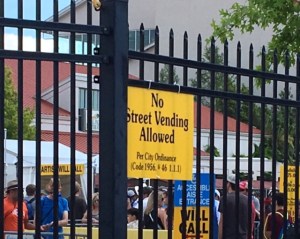
“Unofficial” Jazz Fest, as I call it, is what happens in the area outside the gates of the Fairgrounds. On Fest days, the neighborhood is transformed into its own unique microclimate of festive Festy-ness. Here, street vendors hawk wares such as hats, kooziessecond-line umbrellas, water, and art. no vending(There are “No Street Vending Allowed” signs posted, but those don’t seem to be given much weight.) Popup brass bands play for tips on the sidewalks. Some neighborhood residents hire bands and throw backyard parties, some of which you can attend for a fee (or, perhaps, crash unnoticed). New Orleans, like many other cities, has business licensing requirements, including mobile vendor licenses, and some of these vendors are clearly licensed, though it’s plausible that others might not be.

Many of these behaviors look like classic arbitrage: You can of course buy or enjoy most of those items or services in the official Jazz Fest, but they’re more expensive once you’re inside the Fairgrounds and committed to being there (general admission tickets allow single entry only). This creates obvious opportunities for unofficial vendors to sell products more cheaply just outside the Jazz Fest entrance gates. So, for example, it gets hot in New Orleans in April/May, and Fest rules allow you to bring in “Factory-sealed bottled water for personal consumption.” Bottled water sells for $3 in the Fest. But there are lots of people selling it out of a cooler for $1 in the surrounding streets, so it really makes sense to buy your water before you enter. From the seller’s point of view, if she buys 78 24-count cases of bottled water from Costco, it comes up to under 27 cents a bottle before tax. The incentive to make dollar-a-bottle sales outside the Fairgrounds on Fest days is obvious.

Others of these activities look like something close to agglomeration:  Continue reading ““Unofficial” Jazz Fest (and Arbitrage, and Licensing, and Taxes)”

Tulane Law is Looking for a Visiting Tax Professor

Here’s an announcement from Tulane. We’re looking for a visiting tax professor to cover tax courses for either Fall 2016 or the 2016-17 academic year. If you have questions, please feel free to contact me. I’m happy to wax lyrical about Tulane Law, our tax and other programming at the Murphy Institute, and New Orleans.

Tulane Law School is currently accepting applications for a visiting tax professor for either the Fall of 2016 or for the entire 2016-2017 Academic Year.  Visitors would be expected to teach basic Income Tax and other tax related courses.  Applicants at any career stage are encouraged.  To apply, please submit a CV along with a statement of interest and any supporting documentation.  Applications and questions may be directed to Vice Dean Ronald J. Scalise Jr. at rscalise@tulane.edu.   Tulane University is an equal opportunity/affirmative action employer committed to excellence through diversity.  All eligible candidates are invited to apply. 

Grading the Candidates’ Tax Disclosure (Updated)

By Sam Brunson

Image by Ludwig. License.

Nearly two months ago, guesting on Prawfsblawg, I wrote about the state of the presidential candidates’ disclosure of their tax returns. Since then, they’ve gone through several more primaries, and we have a better idea of where each candidate stands in the electorate. So, as the semester winds up and my focus shifts to grading, I thought I’d warm up by grading the candidates on their level of tax disclosure.

A caveat before we begin: as tax historian Joseph Thorndike has noted (here and 150 Tax Notes 591 (2016)), while there’s a strong norm for candidates’ releasing their tax returns (consistently since 1980, and sporadically for at least a decade before that), they are under no legal obligation to do so. If we really care about seeing candidates’ tax returns, we should encourage Congress to make disclosure mandatory.

That said, my grades aren’t based on legal obligation. They’re based on some combination of the quality and quantity of the disclosure.  Continue reading “Grading the Candidates’ Tax Disclosure (Updated)”

The New Orleans Jazz and Heritage Festival (and Taxes)

By: Shu-Yi Oei

New Orleans is currently in the throes of Jazz Fest.

For those of you who don’t know what that is, Jazz Fest—or, the New Orleans Jazz and Heritage Festival—is a famous annual festival celebrating music and culture in New Orleans. It’s held at the New Orleans Fairgrounds. It spans seven days over two weekends. It draws hundreds of thousands of people.

But even that description doesn’t do the event justice. There are twelve different music stages and tents set up in the Fairgrounds and a lineup of over a hundred performance groups—this year’s headliners include Stevie Wonder, Pearl Jam, Paul Simon, Red Hot Chili Peppers, Snoop Dogg, and Van Morrison. There’s also a huge number of food and crafts vendors who set up at the Fest—over 200 food offerings sold! Some of us to go to the Fest at least as much for the food as for the music: my personal favorites include the Crawfish Monica, mango freeze, crawfish beignets, seafood stuffed mushrooms, and Chef Linda Green’s award-winning yakamein.

This past weekend, my colleague Ann Lipton and I traipsed down to the Fairgrounds to find the fun. While enjoying performances by Janelle Monáe (amazing), the Red Hot Chili Peppers (meh), Leroy Jones (so good), Herlin Riley (just, wow) and others, we chatted a bunch about vendor licensing and regulation at Fest. We even ran into an on-duty New Orleans revenue agent who was more than happy to tell us all about tax compliance at the Fest and kindly gave permission to blog about it.

After some research, some casual conversations, and some lurking around the food booths, here’s what we now know about Jazz Fest and taxes:

Continue reading “The New Orleans Jazz and Heritage Festival (and Taxes)”

2016 Top 10 Outstanding Tax Women

By:  Francine J. Lipman

Tax Analysts announced  its 2016 Top Ten Outstanding Women in Tax selected from a pool of over 300 nominations. Congratulations and loud applause to this exceptional group of tax professionals.  Continue reading “2016 Top 10 Outstanding Tax Women”

A New Wave of Income Share Agreements

By: Diane Ring

Just a few years ago, Income Share Agreements, or ISAs, were garnering popular attention. ISAs are arrangements in which an individual receives upfront funding from investors, perhaps for education or a start-up business, in exchange for agreeing to pay a percentage of his or her future income for a period of time. Well-known examples included Fantex (which involved a stake in the future earnings of a professional athlete), as well as Upstart, Pave, and Lumni (which generally involved funding for education or business ventures). Although the structures and terms varied, the feature these ISAs had in common was the absence of a guaranteed return of principal and the degree to which the investor was investing in the personal, financial success of the funding recipient – a relationship some criticized as owning a piece of the funding recipient.

Ultimately, though, the market did not show tremendous interest in these instruments. Upstart and Pave shifted to traditional loan models, and Lumni reportedly has issued fewer than 30 ISAs in the United States. Fantex has remained active, but Fantex was always a little different, because it actually involved an issuance of stock in a corporation whose value effectively tracked the earnings performance of a pro athlete. Additionally, the Fantex investment had a novelty dimension, appealing to sports enthusiasts.

Why, though, was the market not that interested in ISAs? There are a few likely reasons:

Continue reading “A New Wave of Income Share Agreements”

Call for Papers: AALS 2017

At the 2017 AALS annual meeting (San Francisco, Jan. 3-17, 2017), the Section on Agency, Partnerships LLCs, and Unincorporated Associations and the Section on Nonprofit and Philanthropy Law are co-hosting a a joint program entitled “LLCs, New Charitable Forms, and and the Rise of Philanthrocapitalism.” The session will look at the tax, governance, and other policy implications of using for-profit LLCs as vehicles for philanthropy. I’ll paste the full call for papers after the break, but if you’re interested in participating, send a 1-2 page proposal to Mohsen Manesh or Garry W. Jenkins by July 1, 2016Continue reading “Call for Papers: AALS 2017”

John Kasich’s Tax Plan: 2008 Was Great!

Last week I wrote about Donald Trump’s dumbfounding decision, as the Republican frontrunner, to advocate for increasing taxes on the wealthy.  I left for today commentary on the amazing interview Ohio Governor John Kasich did with the Washington Post Editorial Board.  Essentially Gov. Kasich believes that we can obtain economic growth through spending cuts.  (Just to be clear why this is on a tax blog: spending and taxes go together like peanut butter and jelly).

It seems most pundits are speculating that there will be a contested Republic convention in Cleveland.  It has also been speculated that in that environment, a wildcard like, Gov. Kasich or Rep. Ryan, might end up the nomination.  Both Gov. Kasich and Rep. Ryan appear to hold the same position that spending cuts are good.  They believe that spending cuts plus tax cuts (I will address the tax cuts issue in a later post) will actually increase overall tax revenues through overall economic growth. It is not surprising that the two Republican establishment figures would hold such a belief.  This principle is alignment with popular thinking: polls show many Americans think spending cuts will have an economic benefit by a 55 to 18 percent margin.

I think, therefore, it is worth exploring why spending cuts as related to growth (economic and job) is not at all mainstream economic thinking.  But like all issues, here we have a complicated discussion.  It may be true that spending cuts help balance the budget which may grow the economy in other dimensions.  But spending in a recession, as most economic data seems to show, is the main way forward for job growth and to exit the recession.  Most mainstream economists believe: (1) that spending increases job growth on a temporary basis; (2) a reduction in spending will unwind the growth back to the baseline without spending; and (3) job growth will grow the economy.  However, in no way is there permanency attached to spending as related to job growth.  (This is the reason that Bernie Sander’s forecasts are of job growth in his plan are incorrect.  See this study.)

Continue reading “John Kasich’s Tax Plan: 2008 Was Great!”

Hello from Francine Lipman

“Dearly Beloved we are gathered here today to get through this thing we call ‘Life.'” Prince 1958 – 2016. I am delighted to join this exceptional tribe of talented law professors presently known as The Surly Subgroup. My day job is at the William S. Boyd School of Law at the University of Nevada, Las Vegas as a William S. Boyd Professor of Law teaching tax law, accounting and finance courses. I also get to research, write and publish about and advocate for “access to tax justice.”

Continue reading “Hello from Francine Lipman”

Prince and the Estate Tax

As radio stations play Prince songs all day long and Purple Rain makes a return to the theatre, I was struck by the vast amount of content Prince not only produced but owned. Sadly, immediately, I thought of the potential estate tax value of Prince’s estate.  This unique situation is playing out right now with the Michael Jackson estate but here Prince owned more of his own work.

Currently, conservative estimates have his estate at $300 million.  But these estimates may be way off as Prince actually owned his recording and publishing copyrights. According to the LA Times, music industry insiders say they “can’t imagine a catalog that would have a higher value.”

There is much speculation on who will receive his estate.  Because, probate has not been opened, we do not know if Prince had a will yet or not. There has been speculation that he had no will since he was unmarried and had no children.  But this seems rather silly (and kind of offensive) to me given his concern for protecting the value of his catalog during life. I would expect to see a pour-over will to a trust.

What will be interesting is what type of estate planning he engaged in during life.  Normally, estate tax returns are private and only the estate, the beneficiaries and the IRS know what is on them. However, in the case with a hard to value asset (e.g., a massive music library), there is often a difference of opinion between the estate and the IRS as to the value of the asset.  Since the resolution of the difference is in court, we will get a glimpse into the planning done by Prince.  One point to make here is that if the beneficiary of the estate is Jehovah’s Witnesses as has been reported (speculated), then this might not end up in court because there would be no tax due because of the estate charitable deduction.

Continue reading “Prince and the Estate Tax”

SRLY, SRSLY: A Tale of Loss and Longing to Belong

By: Shu-Yi Oei

Over the past few days, we here at Surly Subgroup have received several requests for a post explaining our blog name. So, here’s a Very General primer for non-tax readers, and for our tax readers who maybe don’t spend all of their waking hours staring at the consolidated return rules.

Old lawyerly disclaimer habits die hard, so I’ll just say that the following discussion is Very General and mostly for fun. Others have written about this far more exhaustively. See, e.g., Martin J. McMahon, Jr., Understanding Consolidated Returns, 12 Fla. Tax Rev. 125 (2012) and four whole BNA Tax Management Portfolios.

Here are the key points:

Everybody Wants to Belong…

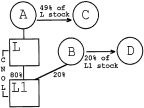
The general idea behind the consolidated return is that where there’s an affiliated group of corporations, a rule that requires each corporation in the group to file its own separate tax return may create frictions and transaction costs and may give rise to weird incentives and disincentives in the case of transactions between corporations in the group.

Enter the consolidated income tax return.

Continue reading “SRLY, SRSLY: A Tale of Loss and Longing to Belong”