NonBelief Relief and Form 990

By Sam Brunson

Speaking of the Freedom From Religion Foundation, last Thursday it filed suit challenging the constitutionality of section 6033(a)(3)(A) of the Code.

What does that first sentence mean? Broken down roughly: the tax law requires most entities exempt under section 501 to file an annual information return. That information return—currently Form 990—is filed with the IRS, but must also be made available to the public. It allows both the IRS and the general public a window into the financial workings of tax-exempt organizations, and provides a basis for administrative and public oversight of tax-exempt organizations. (For purposes of this lawsuit, it’s also worth noting that if a tax-exempt organization that is required to file a Form 990 doesn’t for three consecutive years, it automatically loses its exemption.)

Section 6033(a)(3)(A) provides a mandatory exception to the filing requirement, though. Under the Code, churches, their integrated auxiliaries, and conventions of churches don’t have to file a Form 990. While the IRS can still get access to them through an audit (though note that the steps the IRS must take to audit a church are really stringent), the general public has no way to see financial information about a U.S. church unless the church voluntarily discloses that information (which some do). Continue reading “NonBelief Relief and Form 990”
Seventh Circuit Preview: Gaylor v. Mnuchin

By Sam Brunson

A week from Wednesday, the Seventh Circuit will hear oral arguments in Gaylor v. Mnuchin, the case in which the Freedom From Religion Foundation is challenging the constitutionality of the parsonage allowance.[fn1]

In anticipation of the oral arguments, Professor Anthony Kreis and I are hosting a preview of the case this Wednesday, October 17, at noon. It will be in room 105 of the Corboy Law Center, 25 E. Pearson St., Chicago, IL 60611. There will be pizza, soda, and some great discussion. If you’re free for that hour (and, of course, in or near Chicago), I’d love to see you there! RSVP here. Continue reading “Seventh Circuit Preview: Gaylor v. Mnuchin”

Inheriting Property Tax Assessments in California

By Sam Brunson

I grew up in the north suburbs of San Diego and, while I haven’t lived in Southern California in a couple decades now, I try to keep a vestigial self-identification as a Southern Californian.[fn1] Part of that self-identification is listening to the Voice of San Diego podcast; it keeps me vaguely up-to-date on current politics in San Diego.

Today, as I was walking to the pet store, I turned on the most recent episode. On that episode, the regular hosts were joined by Liam Dillon, now a reporter for the LA Times. And they mentioned a story he’d recently written, about the inheritance of property tax rates in California. Continue reading “Inheriting Property Tax Assessments in California”

Trump, Tax Fraud, and the Statute of Limitations

By Sam Brunson

Photo by Takver. CC BY-SA 2.0

By now I’m sure you’ve read the New York Times story about the Trump gift tax evasion (or, if not that story—which is really, really long—at least a summary of it). There is a lot in there, and I suspect it’ll inspire more than a couple posts here, but I wanted to lead off with the statute of limitations.

Because let’s be real: I’ve always thought of the statute of limitations as being three years or, if you substantially understate your gross income, six years, unless you don’t file a return, in which case it runs forever until you file a return. Since most of the alleged fraud occurred in the 1990s or earlier, even the longer statute would be long passed.

It turns out that my mind entirely skipped over section 6501(c).[fn1] Section 6501(c) says that if you file a “false or fraudulent return,” there is no statute of limitations. The IRS can go in and assess a tax deficiency, with interest and penalties, whenever it wants. Continue reading “Trump, Tax Fraud, and the Statute of Limitations”

When Religious Tax Accommodations Are Inconsistent

By Sam Brunson

On Wednesday, October 24, the Seventh Circuit is going to hear arguments in the appeal of Gaylor v. Mnuchin. I’ve written about this parsonage allowance case a number of times in the past (see here and here for examples), but as a quick summary: section 107(2) of the Code says that “ministers of the gospel” don’t have to include rental allowances in gross income. Several years ago, the Freedom From Religion Foundation challenged this parsonage allowance on the grounds that it violated the Establishment Clause of the Constitution. They won in the district court, but the Seventh Circuit found that the plaintiffs didn’t have standing to challenge the provision.

The Seventh Circuit also suggested, in a footnote, that if they claimed a parsonage allowance and the IRS rejected their claim, they might have standing. So they did, the IRS did, and the district court again found the provision unconstitutional. And now the Seventh Circuit will weigh in (again).

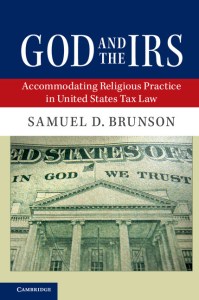
As a side note, this provision (as well as a bunch of others) made their way into God and the IRS, the book I wrote that was recently published about tax accommodations of religious individuals. The fundamental purpose of the book was to illustrate the ad hoc nature of religious accommodations in the tax law, and develop a framework that could provide some consistency as Congress and the IRS consider providing these accommodations. Continue reading “When Religious Tax Accommodations Are Inconsistent”

Paying with Data

By Adam B. Thimmesch

It is an oft repeated adage that if you are not paying for a product, then you are the product. This comment has traditionally been directed at products like Google, Facebook, and Instagram, but it is not just large software companies that are making use of consumer data as “payment” for their services. NPR recently published a story about a café in Rhode Island that is taking this one step further. They sell coffee in exchange for data.

According to the article, students and faculty at Brown University are the only customers allowed at the shop, and students get free coffee by allowing the coffee shop to gather and sell their data. The students also receive corporate pitches from the café’s workers. (Apparently professor data is not so valuable. They have to pay.) According to the article:

To get the free coffee, university students must give away their names, phone numbers, email addresses and majors, or in Brown’s lingo, concentrations. Students also provide dates of birth and professional interests, entering all of the information in an online form. By doing so, the students also open themselves up to receiving information from corporate sponsors who pay the cafe to reach its clientele through logos, apps, digital advertisements on screens in stores and on mobile devices, signs, surveys and even baristas. Continue reading “Paying with Data”

Elon Musk, Tweets, Fines, and Deductibility

By Norio Nakayama, CC BY-SA 2.0

By Sam Brunson

In the beginning of August, Elon Musk tweeted that he had secured financing to take Tesla private at $420 per share. It turned out that he, um, hadn’t. In the meantime, though, his tweet moved the market; on the day of his tweet, Tesla shares closed up 11%.[fn1]

It wasn’t only investors who noticed the tweet, though. The SEC was watching, too. And on Thursday, the SEC charged Musk with securities fraud. In its complaint, the SEC requested that the court: Continue reading “Elon Musk, Tweets, Fines, and Deductibility”

A Series of Series? Tax, Regulation, and Faculty Workshops at Boston College Law School

I do love a good faculty workshop. Reading and spiritedly discussing the work of other academics always fills me with energy and inspiration for my own projects. Plus, it’s great to be able to spend time with new and old friends and find out what’s been baking in their brains.

Here at BC Law, I’m fortunate to be involved in two exciting workshop series: the BC Tax Policy Workshop and the BC Regulation and Markets Workshop. Both kicked off this week: On Tuesday, we hosted Professor Jens Dammann from the University of Texas at Austin and heard about his paper, “Deference to Delaware Corporate Law Precedents and Shareholder Wealth: An Empirical Analysis.” Today, we welcomed Professor Ajay Mehrotra (Northwestern Law; Executive Director, American Bar Foundation) and had a lively discussion of his book project, “The VAT Laggard: A Comparative History of U.S. Resistance to the VAT.” Tomorrow, BC Law will have its first Faculty Colloquium of the semester. Professor Guy-Uriel Charles (Duke Law; visiting at Harvard Law) will present “The American Promise: Rethinking Voting Rights Law and Policy for a Divided America.”

You can never have too many workshops!

Below are the dates and speakers for the remainder of the semester. If you’re a Boston-area law professor and are interested in attending or would like to be on our workshop email list, just let me know.

Tax Policy Workshop (Fall 2018):

Thursday September 13, 2018
Ajay Mehotra (Northwestern, and American Bar Foundation):
The VAT Laggard: A Comparative History of US Resistance to the VAT
(co-sponsored with BC Legal History Workshop)

Tuesday November 6, 2018
Andrew Hayashi (UVA): title TBD

Tuesday Nov. 13, 2018
Cliff Fleming (BYU): title TBD

Tuesday November 27, 2018
Emily Satterthwaite (University of Toronto): title TBD
(co-sponsored with BC Regulation and Markets Workshop)

Continue reading “A Series of Series? Tax, Regulation, and Faculty Workshops at Boston College Law School”

A Quick Thought on the Accountable Capitalism Act and Federal Taxes

Last week, Senator Warren unveiled the Accountable Capitalism Act, setting off a firestorm of controversy. By and large, the responses have been all over the map, ranging from an argument that it will help companies do better for all constituencies, including shareholders, to the hyperbolic assertion that it would “help to destroy capitalism.”

I haven’t read the bill super-carefully (in fact, I mostly skimmed it late last night), but a Twitter discussion got me thinking about its potential tax consequences.

Continue reading “A Quick Thought on the Accountable Capitalism Act and Federal Taxes”

Update on Altera

By: Leandra Lederman

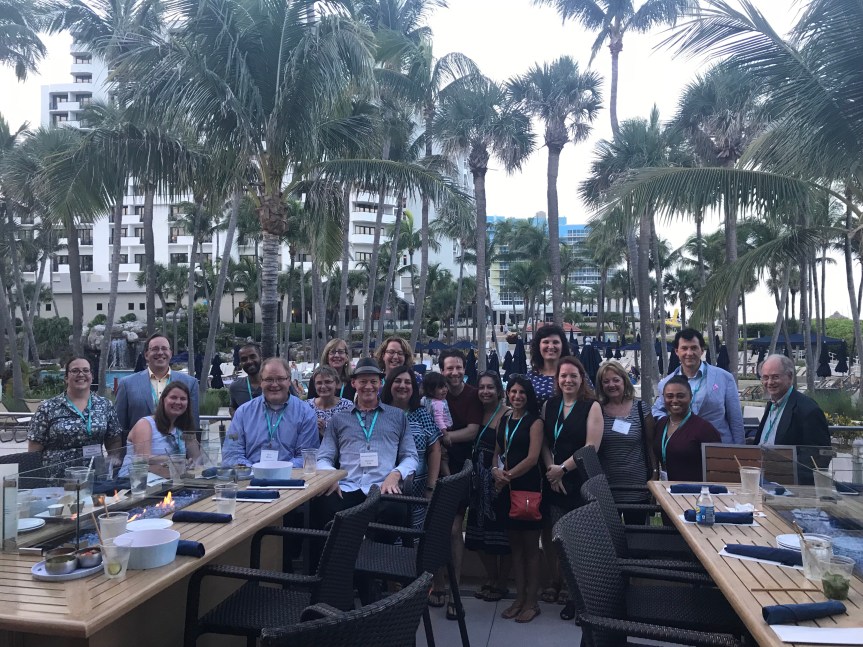
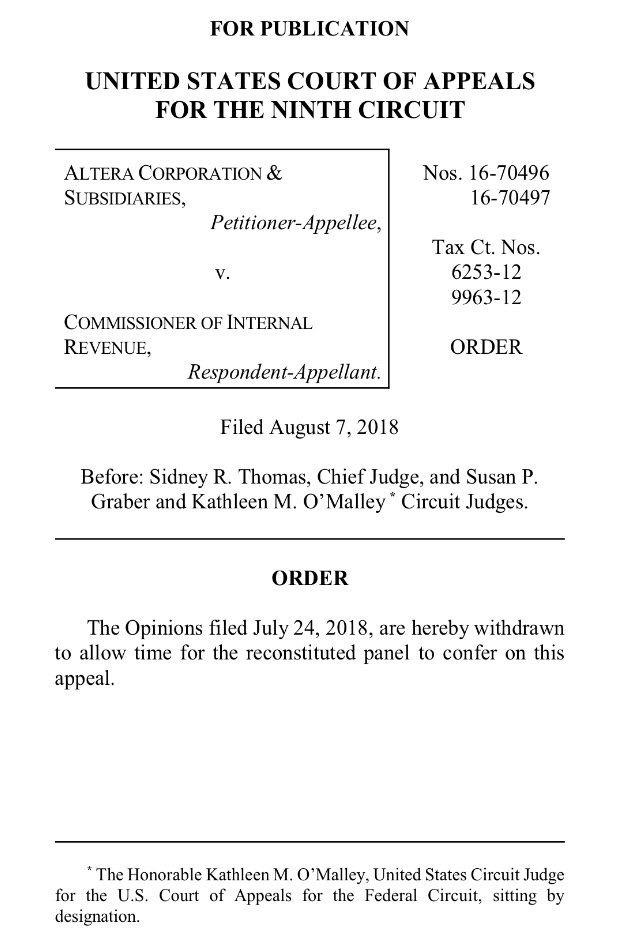
I’m currently at the #SEALS2018 conference in Ft. Lauderdale, but I wanted to quickly note that the opinion of the 9th Circuit panel in Altera Corp. v. Commissioner was withdrawn today. This follows the replacement of Judge Reinhardt, who passed away on March 29, with Judge Graber. Recall that the July 24 opinion in this important case reflected a 2-1 decision, with the late judge in the majority, as Christopher Walker and others had noted. (For my previous coverage of Altera, see here and here.)

A screenshot of the court’s order appears below.  It will be interesting to see what happens after the new panel confers!

Reversing the U.S. Tax Court, 9th Circuit Rules for IRS in Altera

In a 2-1 opinion, a panel of the Court of Appeals for the Ninth Circuit has reversed the U.S. Tax Court in Altera v. Commissioner.  (I don’t have a link yet to the opinion because it just came out this morning, but will add it as a comment when I do.) The decision is great news for IRS rulemaking: the Court of Appeals upheld a Treasury regulation in the face of a procedural challenge that alleged that “although Treasury solicited public comments, it did not adequately consider and respond to those responses, rendering the regulations arbitrary and capricious under State Farm.” Altera, slip. op. at 27.  The court found that Treasury’s approach to the regulation (a cost-sharing regulation under Code section 482) satisfied State Farm‘s requirements. Id. at 37. The Court of Appeals also accorded the regulation Chevron deference. Id. at 46.

In my view, this is the right outcome. (Full disclosure: Susan Morse and Stephen Shay spearheaded an amicus brief in the Ninth Circuit in favor of the Commissioner, in which I joined, along with Dick HarveyRuth Mason, and Bret Wells.) Treasury did consider and respond to the comments it received on the regulation; it simply had a different approach to the substance of the regulation than the taxpayers commenting did. The Court of Appeals explains:

“In short, the objectors were arguing that the evidence they cited—showing that unrelated parties do not share employee stock compensation costs—proved that Treasury’s commensurate with income analysis did not comport with the arm’s length standard. Thus, the thrust of the objection was that Treasury misinterpreted § 482. But that is a separate question—one properly addressed in the Chevron analysis. That commenters disagreed with Treasury’s interpretation of the law does not make the rulemaking process defective.”

Alterasupra, at 31-32.

It is worth noting that the court did not address larger questions of the applicability of the APA or Chevron in tax cases, stating in a footnote (and citing Stephanie Hoffer & Chris Walker and Kristin Hickman):

“Because the Commissioner does not contest the applicability of the APA or Chevron in this context, this case does not require us to decide the broader questions of the precise contours of the application of APA to the Commissioner’s administration of the tax system or the continued vitality of the theory of tax exceptionalism.”

Id. at 25 n.5. Dan Shaviro has blogged about the decision on Start Making Sense, noting that “the Chevron standard for reviewing administrative regulations . . . may well be on the Supreme Court’s chopping block in the near future.”

I would expect more coverage of the Altera decision soon. For prior Surly coverage, see here.

New Paper on Tax Legislative Process and Statutory Drafting

Shu-Yi Oei

For those readers in search of some light summer reading, Leigh Osofsky (UNC Law) and I have been working on a paper on statutory drafting, entitled “Constituencies and Control in Statutory Drafting: Interviews with Government Tax Counsels.” We finally got around to posting it on SSRN, here.

In the paper, we report findings from interviews we conducted with government tax counsels who have participated in the tax legislative process, in which we asked questions about various aspects of drafting and creating tax legislation. In addition to reporting our findings, we also discuss the implications of our research for statutory interpretation, tax system design, and the legislative process.

For readers interested in legislation, tax drafting, statutory interpretation, tax shelters, and the political process, the paper is probably worth a look. Feel free to contact either of us with comments.


More Post-Wayfair Thoughts: Sales Tax?

By now, anyone who reads this post should be aware that the Supreme Court decided South Dakota v. Wayfair and overruled its physical presence rule last week. States now have expanded authority to require the collection of their consumption taxes by remote vendors like online retailers. Coverage of the case and its impact on states and vendors has been widespread, including my preliminary thoughts offered on this blog and with Darien Shanske and David Gamage elsewhere.

One aspect of the coverage that would usually drive state tax aficionados crazy is the continued reference to the case as involving sales tax.

2cqxpi

For a long time, many of us have smugly corrected folks (often only in our own minds) and noted that it is the state use tax that is at issue when we are talking about online sales. That may be no more.

The South Dakota law that was challenged in Wayfair indeed requires remote vendors to collect the state’s sales tax rather than the state’s use tax. Historically, that would have been a big problem, but it didn’t trouble Justice Kennedy or the other members of the majority. This may require broader thinking than just analyzing what Wayfair means about states’ powers over remote vendors. The Court’s decision in Wayfair may have done much more than just overrule Quill; it may have unsettled some even longer-standing doctrine in this area.

Continue reading “More Post-Wayfair Thoughts: Sales Tax?”

South Dakota v. Wayfair: First Impressions

The Supreme Court issued a 5-4 decision overruling its long-standing physical presence rule in South Dakota v. Wayfair this morning. That decision provides welcomed relief to states (and to those of us who already pay use tax) and will have significant short- and long-term consequences. My reactions to Wayfair will surely extend for a long period of time, but here are some brief first thoughts.

The Basics

The Court’s holding was very limited: the physical presence rule no longer governs the determination of what constitutes a “substantial nexus” under the dormant Commerce Clause. The Court also found that nexus existed in the case based on the challengers’ connections with South Dakota. Finally, the Court did not bless the South Dakota statute completely, but remanded the decision back to the South Dakota courts to hear non-nexus based challenges to the law, if any exist.

What this means is that states will be able to continue (or expand) their efforts to require the collection of sales/use tax by online vendors. States will also need to monitor whether and how Congress responds, but they should be able to craft their laws to avoid state-court scrutiny until that time.

Continue reading “South Dakota v. Wayfair: First Impressions”