Update on Altera

By: Leandra Lederman

I’m currently at the #SEALS2018 conference in Ft. Lauderdale, but I wanted to quickly note that the opinion of the 9th Circuit panel in Altera Corp. v. Commissioner was withdrawn today. This follows the replacement of Judge Reinhardt, who passed away on March 29, with Judge Graber. Recall that the July 24 opinion in this important case reflected a 2-1 decision, with the late judge in the majority, as Christopher Walker and others had noted. (For my previous coverage of Altera, see here and here.)

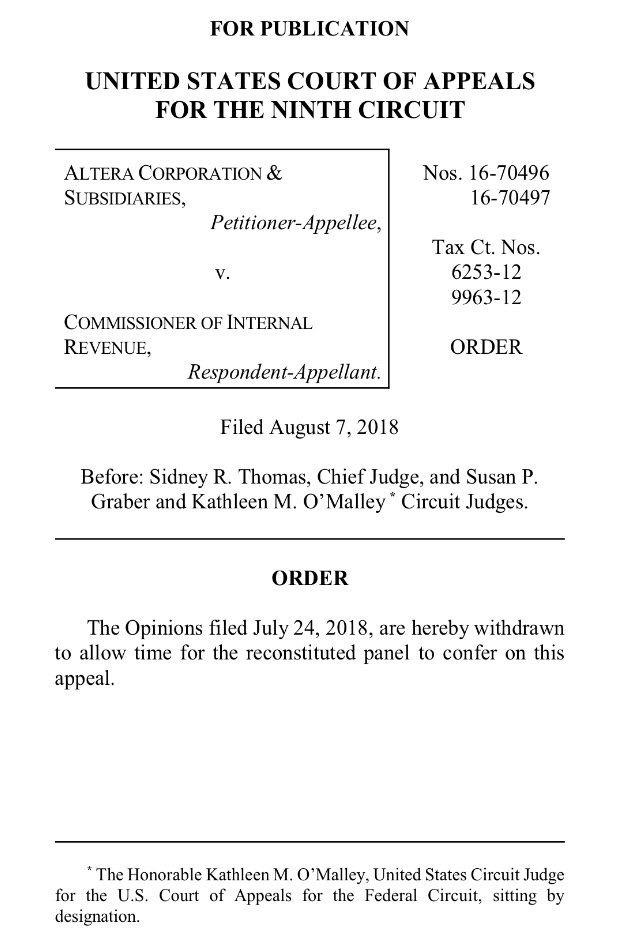
A screenshot of the court’s order appears below.  It will be interesting to see what happens after the new panel confers!

Reversing the U.S. Tax Court, 9th Circuit Rules for IRS in Altera

In a 2-1 opinion, a panel of the Court of Appeals for the Ninth Circuit has reversed the U.S. Tax Court in Altera v. Commissioner.  (I don’t have a link yet to the opinion because it just came out this morning, but will add it as a comment when I do.) The decision is great news for IRS rulemaking: the Court of Appeals upheld a Treasury regulation in the face of a procedural challenge that alleged that “although Treasury solicited public comments, it did not adequately consider and respond to those responses, rendering the regulations arbitrary and capricious under State Farm.” Altera, slip. op. at 27.  The court found that Treasury’s approach to the regulation (a cost-sharing regulation under Code section 482) satisfied State Farm‘s requirements. Id. at 37. The Court of Appeals also accorded the regulation Chevron deference. Id. at 46.

In my view, this is the right outcome. (Full disclosure: Susan Morse and Stephen Shay spearheaded an amicus brief in the Ninth Circuit in favor of the Commissioner, in which I joined, along with Dick HarveyRuth Mason, and Bret Wells.) Treasury did consider and respond to the comments it received on the regulation; it simply had a different approach to the substance of the regulation than the taxpayers commenting did. The Court of Appeals explains:

“In short, the objectors were arguing that the evidence they cited—showing that unrelated parties do not share employee stock compensation costs—proved that Treasury’s commensurate with income analysis did not comport with the arm’s length standard. Thus, the thrust of the objection was that Treasury misinterpreted § 482. But that is a separate question—one properly addressed in the Chevron analysis. That commenters disagreed with Treasury’s interpretation of the law does not make the rulemaking process defective.”

Alterasupra, at 31-32.

It is worth noting that the court did not address larger questions of the applicability of the APA or Chevron in tax cases, stating in a footnote (and citing Stephanie Hoffer & Chris Walker and Kristin Hickman):

“Because the Commissioner does not contest the applicability of the APA or Chevron in this context, this case does not require us to decide the broader questions of the precise contours of the application of APA to the Commissioner’s administration of the tax system or the continued vitality of the theory of tax exceptionalism.”

Id. at 25 n.5. Dan Shaviro has blogged about the decision on Start Making Sense, noting that “the Chevron standard for reviewing administrative regulations . . . may well be on the Supreme Court’s chopping block in the near future.”

I would expect more coverage of the Altera decision soon. For prior Surly coverage, see here.
IU Tax Policy Colloquium: Burman, “The Rising Tide Wage Credit”

Colloquium pic)
Left to right: Len Burman, Tim Riffle, Leandra Lederman, Karen Ward, Frank DiPietro, Brad Heim

By: Leandra Lederman

On April 5, the Indiana University Maurer School of Law’s Tax Policy Colloquium welcomed Len Burman from Syracuse University and the Urban Institute/Tax Policy Center, who presented “The Rising Tide Wage Credit.” This intriguing new paper is not yet publicly available.

The paper proposes replacing the existing Earned Income Tax Credit (EITC) with a new credit, the Rising Tide Wage Credit (RTWC), which, unlike the EITC, would be universal for workers, rather than phased out above low income levels. The RTWC also would differ from the EITC in that the amount of the RTWC would not depend on the number of children the taxpayer has. Instead, the RTWC would be a 100% credit in the amount of a worker’s wages, up to $10,000 of wages. The credit could be claimed on the taxpayer’s tax return, or subject to advance payment via the taxpayer’s employer. Thus, the maximum credit for an unmarried taxpayer would be $10,000, and for a married couple filing jointly would be $20,000. (The credit would not have a marriage penalty.) The credit would be indexed to increase with increases in GDP.

Because the proposed new credit would not vary with the number of children the taxpayer is supporting, the paper also proposes increasing the child tax credit from $2,000 to $2,500, and proposes making the child tax credit fully refundable (rather than partly refundable, as it is under current law). The RTWC and the increase in the child tax credit would be funded by a value added tax (VAT). The paper estimates that the proposal could be fully funded with an 8% VAT, along with federal income tax on the RTWC. A VAT was chosen as the funding mechanism because it is closely correlated with GDP. The paper discusses 3 illustrative examples and includes a table that shows the overall progressivity of the proposal under certain assumptions. Continue reading “IU Tax Policy Colloquium: Burman, “The Rising Tide Wage Credit””

IU Tax Policy Colloquium: Satterthwaite, “Optional Taxation: Survey Evidence from Ontario Microentrepreneurs”

IMG_5472
Left to right: Maicu Díaz de Terán, Tim Riffle, Emily Satterthwaite, Brian Broughman, Leandra Lederman, David Gamage, #taxprofbaby, Pamela Foohey, Austen Parrish

By: Leandra Lederman

On March 22, the Indiana University Maurer School of Law’s Tax Policy Colloquium welcomed Prof. Emily Satterthwaite from the University of Toronto Faculty of Law, who presented “Optional Taxation: Survey Evidence from Ontario Microentrepreneurs.” This interesting new paper is not yet publicly available.

The paper explores Canada’s “small supplier” exemption from value-added tax (VAT) registration. Canada’s exemption allows suppliers with less than CAD $30,000 of sales (turnover) in a year to avoid registering for and complying with the VAT unless they opt in. (This amount is not indexed for inflation, and Emily’s paper explains that this threshold is fairly low.) Although it may seem odd for someone to opt into a tax system, as Emily’s paper explains, some small suppliers have incentives to do so: if they buy supplies subject to VAT, they can offset that against VAT owed, and obtain a refund if VAT paid exceeds VAT due. In addition, some small suppliers may be encouraged by their VAT-registered customers to become part of a formal supply chain, because the VAT those customers pay on inputs is creditable. The downside of registering is the cost of doing so, which includes the requirement to file an annual return regardless of whether VAT is owed. Continue reading “IU Tax Policy Colloquium: Satterthwaite, “Optional Taxation: Survey Evidence from Ontario Microentrepreneurs””

IU Tax Policy Colloquium: Ring, “Silos and First Movers In the Sharing Economy Debates”

IMG_5114
Prof. Diane Ring

By: Leandra Lederman

On March 1, the Indiana University Maurer School of Law welcomed Surly’s own Prof. Diane Ring from Boston College Law School as the fourth speaker of the year in our Tax Policy Colloquium. Diane presented a new paper, which I believe is not yet publicly available, titled “Silos and First Movers In the Sharing Economy Debates.” This interesting paper focuses on the classification of workers in the “sharing” or “gig” economy as employees or independent contractors, arguing that “[t]wo interacting forces create the most serious risk for inadequate policy formulation: (1) silos among legal experts, and (2) first-mover effects.” (Page 1 of the draft.) The silo argument is that lawyers operate in subject areas that are isolated from each other, such that tax experts, for example, fail to perceive the effects of tax-related worker-classification rule changes on non-tax (such as employment) law, and vice versa. The first-mover argument is that the first actors on the worker-classification issue can wield outsized influence, shaping the debate in legal contexts other than the one directly affected.

The paper and presentation provide interesting insights into how giants of the service-worker sharing economy—not just Uber and Lyft, but also TaskRabbit—influence the development of the law on worker status. And subject-matter silos are a common complaint among legal academics. That issue has arisen in administrative law, for example, where there may be different rules developed in the context of different agencies. Courts and policymakers may struggle with tax exceptionalism (in the parlance of Kristin Hickman). But I wonder both if the legal silos in the gig economy are as strong as the paper suggests, and whether the effects the paper observes are first-mover effects or something else. Continue reading “IU Tax Policy Colloquium: Ring, “Silos and First Movers In the Sharing Economy Debates””

Stephanie McMahon, “Tax as Part of a Broken Budget: Good Taxes are Good Cause Enough”

By: Leandra Lederman

IMG_5084
Left to right: David Gamage, Leandra Lederman, Stephanie McMahon, Matt Metz (JD/MPA student)

On February 28, Prof. Stephanie McMahon from the University of Cincinnati College of Law gave a faculty workshop at the Indiana University Maurer School of Law. She presented her paper titled “Tax as Part of a Broken Budget: Good Taxes are Good Cause Enough.” The thesis of the paper is that Treasury regulations are needed to effectuate the statutory tax laws consistent with Congress’s budgeting expectations, and that given the importance of the revenue raised by taxes to the functioning of the U.S. federal government, tax regulations should be excused from the Administrative Procedure Act’s pre-promulgation notice-and-comment process under the APA’s “good cause” exception. The paper thus tackles two arguments that Prof. Kristin Hickman has advanced in her work: post-promulgation notice and comment is insufficient for tax regulations, and there is no reason for “tax exceptionalism” in administrative procedures. Stephanie’s paper also contains a detailed explanation of the tax legislative process.

Given the importance of tax rulemaking and the difficulties the IRS has suffered with its well-known budget cuts, it is very nice to see a paper defending Treasury’s rulemaking strategy. Moreover, Stephanie’s argument is creative and thoughtful. However, the argument seems to depend on regulations being a critical part of the revenue-raising process, as the need for revenue is what Stephanie relies on to justify application of the good-cause exception. But are regulations needed for that? In explaining the budget process, Stephanie’s paper points out that regulations are not scored as part of that process. I think she agrees that tax statutes can raise revenue even in the absence of regulations. Instead, she argues that regulations help effectuate, albeit imperfectly, Congress’s scoring of the tax legislation. But some Internal Revenue Code sections do not expressly call for regulations. Others do, but some of the latter never actually see regulations promulgated. Yet, the tax laws are applied despite these “spurned delegations.” And given President Trump’s anti-regulation Presidential Executive Order on Reducing Regulation and Controlling Regulatory Costs, we may see more tax statutes operating without regulations. Continue reading “Stephanie McMahon, “Tax as Part of a Broken Budget: Good Taxes are Good Cause Enough””

IU Tax Policy Colloquium: Glogower, “Taxing Inequality”

IMG_4720b
Left to right: Damage Gamage, Ari Glogower, Leandra Lederman, Tim Riffle

By: Leandra Lederman

On February 15, the Indiana University Maurer School of Law welcomed Prof. Ari Glogower from Ohio State University Moritz College of Law as the third speaker of the year in our Tax Policy Colloquium. Ari presented his paper titled “Taxing Inequality,” which argues in favor of a federal wealth tax and proposes a mechanism for integrating the base of such a tax with the base of the federal income tax. Ari’s paper sparked a really interesting discussion both in and outside the workshop on a wide range of issues, from distributive justice to the mechanics and likely impacts of his proposal.

The paper focused first on why we should have a federal tax on wealth. The draft points to rising economic inequality, and it grounds the need for a wealth tax in the theory of “relative economic power.” That theory, borrowed from political science, focuses on spending power—as opposed to actual spending—as a source of economic power. The basic idea is that the mere ownership pf wealth creates economic power without spending it. Moreover, “excessively unequal distributions of economic resources and market power can result in unequal divisions of political and social power as well.” (p.19) One of Ari’s paper’s contributions is to apply this economic-power theory as a justification for a progressive tax system.

The draft then describes the problem that tax-system designers have in imposing both a wealth tax and an income tax. Because the two types of taxes are imposed on different bases, if the taxes are not coordinated, taxpayers with very different abilities to pay based on their income or wealth may be taxed identically. The paper includes some nice examples of taxpayers with the same income but vastly different stocks of wealth and vice versa. It shows, for example, that a taxpayer with $200,000 of current income and no wealth (or negative wealth in the form of student-loan debt) has lower ability to pay than a taxpayer with $200,000 of current income and $35 million in wealth. (Ari’s talk included a great slide featuring an image of Scrooge McDuck swimming in money as the wealthy taxpayer, but for whatever reason, he resisted our suggestion to rename the paper “Taxing Scrooge McDuck”!) Continue reading “IU Tax Policy Colloquium: Glogower, “Taxing Inequality””

#TaxValentines

Heart1By: Leandra Lederman

It’s the time of year when tax experts are Twitterpated! Yes, on tax Twitter, it’s not Singles Awareness Day, but rather time for #TaxValentines! Twitter member Jeremy Cape reportedly started them a few years ago. Many of the valentines take the traditional format of the classic love poem, such as this never-before-tweeted basic tax valentine:

Roses are red

Violets are blue

I adore taxes

And I also love you


I like to play with the second line, such as in this one that I tweeted last year:


This next one plays with “rose” and is also a public service announcement:


Some of the tax valentines include plays on words, political commentary, and/or comments on recent tax developments. Here’s an example, with my follow-up, too:

Continue reading “#TaxValentines”

IU Tax Policy Colloquium: Brooks, “The Case for Incrementalism in Tax Reform”

By: Leandra Lederman

IMG_4287a
Left to right: Jake Brooks, Leandra Lederman, Bill Popkin, David Gamage, Tim Riffle

On February 1, the Indiana University Maurer School of Law welcomed Prof. Jake Brooks from Georgetown Law School as the second speaker of the year in our Tax Policy Colloquium. Jake presented an early draft of a paper titled “The Case for Incrementalism in Tax Reform,” which led to a lively and interesting discussion about what incrementalism is, what constitutes fundamental reform, how politics may affect the making of tax policy, and whether and how tax law differs from other fields of law.

The paper, which is not yet publicly available, argues that “fundamental tax reform,” while sometimes necessary, should not generally be the goal of tax policy, and that instead, policymakers should take an incremental approach to changing tax laws. “Incrementalism” has a long history in political science, and was first described by Charles Lindblom in an influential 1959 article, “The Science of Muddling Through.” In general, Lindblom’s approach in that article was to reject the urge to use a formal method that involves clarifying the principal goals up front, identifying the means to achieve them, and then analyzing every relevant factor in the decision. Lindblom instead advocated the use of a more casual method that he termed “successive limited comparisons,” which ignored important possible outcomes or alternatives and did not involve distinguishing means and ends. (Page 81 of Lindblom.) Lindblom argued that this “muddling through” approach was not only what was actually practiced by administrators, but also a method for which they need not apologize because administrators are less likely to make serious and lasting mistakes if they proceed through small, incremental changes (pp.86-87). As Jake acknowledges, Lindblom wrote at a time with much more limited ability to model and process large quantities of empirical data. He notes that incrementalism has continued to be an important theory in the literature. Despite technological advances, we cannot see the future, and there remain limits to what empirical data can help us predict.

Jake’s argument is driven in part by arguments in favor of tearing the Internal Revenue Code out by its roots and starting over. I agree with Jake that such an approach seems extremely risky. Policy driven by rhetoric and “horror stories” risks being ill-conceived, hasty, driven by political rent-seeking, and even destructive, as I have written about in the context of IRS reform. But does that necessarily mean that legislative tax changes should take a Lindblom-style incremental approach? Continue reading “IU Tax Policy Colloquium: Brooks, “The Case for Incrementalism in Tax Reform””

IU Tax Policy Colloquium: Brennan & McDonald, “Debt and Equity Taxation: A Combined Economic and Legal Perspective”

IMG_4076
Left to right: Tim Riffle, Tom Brennan, Leandra Lederman, David Gamage, Karen Ward

By: Leandra Lederman


On January 18, the Indiana University Maurer School of Law welcomed Prof. Tom Brennan from Harvard Law School as the first speaker of the year in our Tax Policy Colloquium. Tom presented an early draft of a paper co-authored with Robert L. McDonald, Debt and Equity Taxation: A Combined Economic and Legal Perspective. We had a lively and interesting discussion about it in the workshop, as well as over dinner.

The paper, which I do not believe is publicly available yet, deals with the taxation of hybrid securities. It describes current law on how those securities are categorized as debt or equity, as well as the history of how the law developed. The paper criticizes the binary categorization of hybrid instruments as either debt or equity. It thus argues for a bifurcated approach.

The core of the current draft is a proposed new approach to debt and equity that considers the capitalization of a corporation as a whole and taxes the components in line with the underlying economics. The paper disaggregates the risk-free return, the risky return, and abnormal returns (rents). The paper proposes two possible systems of taxation: the “unlevered equity system” and the “levered equity system.” In the unlevered equity system, debt consists of risk-free obligations (like short-term Treasury bills) and equity is unlevered ownership of assets. In the levered equity system, the definition of debt is the same but equity is fully leveraged ownership of assets (fully financed by risk-free obligations). Under the unlevered approach, although particular investors may own a mix of debt and equity, the corporation itself effectively issues no net debt because it issues no risk-free obligations.

A key insight of the paper applies the Domar-Musgrave economic result that, under certain assumptions, risky returns on assets do not bear tax. Brennan and McDonald point out that the Domar-Musgrave insight also applies to corporations, although the securities are liabilities for them instead of assets. (Many years ago, I applied Domar-Musgave analysis in an article of mine on the tax favoritism for entrepreneurship, but I had not thought about its possible application to corporate income, which is a fascinating idea.) The implication of that insight, as Brennan & McDonald note, is that the risk-premium portion of return on investment effectively does not bear tax. As a result, under the unlevered system, all corporate income would bear corporate tax because the unlevered system does not have any net debt obligations. By contrast, adopting the levered system would make the corporate tax burden only rents, given a tax deduction for debt. The paper explains that this reaches the same result as the Mirrlees Review’s exemption for “normal returns” on corporate capital, as well as the allowance for corporate equity (ACE), if the ACE deduction is defined in a particular way. Continue reading “IU Tax Policy Colloquium: Brennan & McDonald, “Debt and Equity Taxation: A Combined Economic and Legal Perspective””

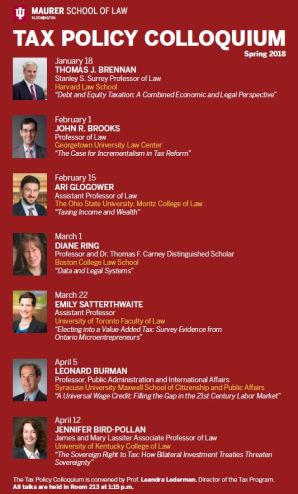
The 2018 Tax Policy Colloquium at the IU Maurer Law School

ColloquiumPosterBy Leandra Lederman

The 2018 Tax Policy Colloquium at the Indiana University Maurer School of Law will kick off next Thursday, January 18, with the presentation by Harvard Law School professor Tom Brennan of a fascinating and timely paper he is co-authoring with Robert L. McDonald, Debt and Equity Taxation: A Combined Economic and Legal Perspective. Tom is a terrific speaker, and I expect the workshop to be really interesting.

Last year, I did a closing post noting that some themes had emerged in the semester’s colloquium. This year, I plan to blog each workshop afterwards, with permission of the speakers. The full workshop schedule follows after the jump. If you will be in Bloomington and are interested in attending one or more workshops, just let me know and I can send you the paper once I receive it. (Most of the paper drafts will not be publicly available.)

The Tax Policy Colloquium is a course for students; I expect about 14 this semester, including a visiting scholar from another school on campus who has asked to audit. I conduct a background session with the students to help them get up to speed on the concepts presented in the paper draft. Typically, the actual workshops are attended not only by the students but also by my colleague David Gamage, senior tax attorney/Maurer alumnus Tim Riffle, and a few other faculty–law school colleagues and/or tax or economics faculty from other schools on campus. Sometimes other members of the community attend, such as a tax professor from another law school; another attorney practicing in Bloomington or Indianapolis; a student not enrolled in the class (Shuyi Oei‘s and Ben Leff‘s talks in 2016 were particularly popular with other students!); and/or a local judicial clerk. Eric Rasmusen from the IU Kelley School of Business and Margaret Ryznar from IU’s McKinney Law School in Indianapolis have each attended several of the talks.

Continue reading “The 2018 Tax Policy Colloquium at the IU Maurer Law School”

Sharing syllabi and course updates in the wake of the recent tax law changes

By Leandra Lederman

Tax professors are of course among the many people affected by the recent, significant changes to federal tax law. I have heard from several people wondering how best to adapt their courses starting in January to these changes. I think that exchanging ideas and sharing syllabi, etc., may be very helpful.

Accordingly, several of us have each agreed to serve as the point person for a particular course. The point person can set up an email list for those who express interest by email, and then use that list to exchange questions, ideas, syllabi, URLs, handouts, etc. with others teaching the same course. Of course, casebook authors may also be working on updates, and other listservs may be helpful, but these distribution lists will allow those interested to participate in topic-focused groups to exchange materials and ideas in advance of and throughout the semester.

The point people thus far are the following Surly bloggers, for the following courses:

Individual Income Tax: Jennifer Bird-Pollan (email jbirdpollan@uky.edu)

Corporate Tax: Leandra Lederman (email llederma@indiana.edu)

Partnership Tax: Phil Hackney (email phackney@lsu.edu)

 
To get on an email list, please email the applicable point person. And folks interested in serving as a point person for another course (i.e., in setting up the email list and getting it started), please post in the comments below, with the course name and your email address.

Happy new year, everyone!

Are Sexual Harassment Plaintiffs’ Attorneys’ Fees Inadvertently Disallowed by the Tax Cuts Bill?

By Leandra Lederman

The Tax Cuts and Job Act’s conference bill includes section 13307, titled “DENIAL OF DEDUCTION FOR SETTLEMENTS SUBJECT TO NONDISCLOSURE AGREEMENTS PAID IN CONNECTION WITH SEXUAL HARASSMENT OR SEXUAL ABUSE.” Fellow Surly blogger Sam Brunson blogged about an earlier version of this provision, which obviously reflects the recent, widely publicized revelations of sexual harassment and sexual assault that began with the Jody Kantor & Megan Twohey exposé of Harvey Weinstein in early October and was followed by a floodgate of allegations spanning a wide range of industries. Unfortunately, this tax provision, as drafted, is less than clear and could potentially have perverse—perhaps unintended—effects.

The provision seems intended as a policy-based provision rather than much of a revenue-raiser; it was one of very few things in the conference bill scored as raising less than $50 million over the entire 2018-2027 budget window. And, in the press release accompanying the predecessor of this provision, the Settlement Tax Deductions are Over for Predators Act (the STOP Act), which was introduced by Rep. Ken Buck (R-Colo.), Rep. Buck stated, “‘When we allow companies to deduct sexual assault and sexual harassment related settlements, we’re asking the American taxpayer to subsidize hush money payments that cover-up sexual misconduct.’”

But what exactly does the provision disallow? The principal language in the conference bill (the material other than the effective date and relettering) is a new subsection added to Code section 162 that reads:

“PAYMENTS RELATED TO SEXUAL HARASSMENT AND SEXUAL ABUSE.—No deduction shall be allowed under this chapter for—

“(1) any settlement or payment related to sexual harassment or sexual abuse if such settlement or payment is subject to a nondisclosure agreement, or

“(2) attorney’s fees related to such a settlement or payment.” Continue reading “Are Sexual Harassment Plaintiffs’ Attorneys’ Fees Inadvertently Disallowed by the Tax Cuts Bill?”

Tomorrow’s Ninth Circuit Oral Argument in Altera

By: Leandra Lederman

Susan Morse and Stephen Shay have blogged today on Procedurally Taxing about the Ninth’s Circuit oral argument tomorrow in Altera Corp. v. Commissioner, as has Dan Shaviro on his blog, Start Making SenseAltera is the transfer pricing and administrative law case involving the Treasury’s cost-sharing agreement regulation. The Tax Court invalidated the regulation under the Administrative Procedure Act, as arbitrary and capricious. That is because the Tax Court accepted the taxpayer’s argument that it need not share stock-based compensation costs under a qualified cost-sharing agreement because arm’s length parties would not do so. The Tax Court found that Treasury had inadequately addressed evidence in the notice-and-comment process that parties not under common control did not share stock-based compensation costs, although Treasury explained in the Preamble to the regulation that cost-sharing agreements between uncontrolled parties are not sufficiently comparable to those in controlled-party transactions.

Altera raises an important administrative law question about what is required of Treasury for its regulations to be valid. Susie and Steve spearheaded an amicus brief in the Ninth Circuit in favor of the Commissioner, in which I joined, along with Dick Harvey, Ruth Mason, and Bret Wells. An amicus brief prepared by another group of professors also supports the Commissioner. There are also amicus briefs by business groups on the other side. See Susie and Steve’s blog post for more detail. And for prior coverage on the Surly Subgroup, see this post on our amicus brief, explaining why the Ninth Circuit should reverse the Tax Court’s decision invalidating the regulation.

The Real IRS Scandal

By: Leandra Lederman

It is well known that the IRS was accused in 2013 of targeting Tea Party and other conservative groups for delays in their 501(c)(4) applications for tax-exempt status. TIGTA’s May 2013 report (and Lois Lerner’s statements at an ABA Tax Section meeting a few days earlier) launched the controversy, which harmed the IRS and a number of its employees. (Cf. my earlier Surly post, “Don’t Impeach IRS Commissioner Koskinen.”)

In 2016, I published an article, “IRS Reform: Politics As Usual?,” analyzing the facts underlying these accusations and the law applicable to the IRS’s determination of tax-exempt status. I argued that the facts showed that the IRS was not motivated by partisan politics. Rather, what happened was that IRS employees included a keyword approach in its efforts to triage the large volume of applications for tax-exempt status it was receiving. Its “Be On the Lookout” (BOLO) list of words was designed to help it identify for further scrutiny those organizations that were engaged in more political activity than was permitted under section 501(c)(4), which, generally speaking gants exempt status to organizations “for the promotion of social welfare.” As I describe in that article, the IRS tried but failed to get ahead of a brewing political controversy on this. There was evidence even in the 2010 IRS PowerPoint highlighting types of groups applying for a determination of exempt status under 501(c)(4) that the IRS had both Tea Party and progressive political organizations on its radar. But the news was full of stories of the IRS supposedly targeting conservative tax-exempt organizations.

The Washington Post has reported in an article titled Liberal groups got IRS scrutiny, too, inspector general suggests, that TIGTA will be issuing a new report finding that the IRS also used keywords to try to identify progressive groups engaging in too much political activity to qualify for the tax exemption under 501(c)(4) they were applying Continue reading “The Real IRS Scandal”