ClassCrits IX: The New Corporatocracy and Election 2016

Surly bloggers Sam Brunson, David Herzig and I (and Leslie Book over at Procedurally Taxing) are attending the ClassCrits IX conference hosted by Loyola University Chicago School of Law today and tomorrow. From the call for papers back in March:

As the U.S. presidential election approaches, our 2016 conference will explore the role of corporate power in a political and economic system challenged by inequality and distrust as well as by new energy for transformative reform.

There are some notable tax-related panels happening at the conference, along with other interesting panels relating to corporations and democracy:

Taxation, Social Justice and Development (Friday 10/21/16)

Doron Narotzki, University of Akron Business Administration
Corporate Social Responsibility and Taxation: The Next Step of the Evolution

Rohan Grey, Binzagr Institute for Sustainable Prosperity & Nathan Tankus, Modern Money Network
Corporate Taxation in a Modern Monetary Economy: Legal History, Theory, Prospects

Karl Botchway, CUNY Technology & Jamee Moudud, Sarah Lawrence Economics
Capacity Building, Taxation and Corporate power in Africa

Martha T. McCluskey, SUNY Buffalo Law, Corporatocracy and Class in State and Local “Job-Creation” Subsidies

Distributing Wealth, Law and Power (Friday 10/21/16)

Goldburn P. Maynard, Jr., University of Louisville Law
A Plea for Courts to Abolish the Judicially Created Right of the Wealthy to Avoid Estate Taxes

Victoria J. Haneman, Concordia University Law
The Collision of Holographic Wills and the 120-Hour Rule

Doron Narotzki, University of Akron Business Administration
Dark Pools, High-Frequency Trading and the Financial Transaction Tax: A Solution or Complication?

Robert Ashford, Syracuse University Law
Why Working But Poor?

Critical Perspectives on Tax Law (Saturday 10/22/16)

Shu-Yi Oei, Tulane University Law
The Troubling Case of Offshore Tax Enforcement

Les Book, Villanova University Law
Bureaucratic Oppression and the Tax System

Samuel Brunson, Loyola University Chicago Law
Avoiding Progressivity: RICs, Pease, and the AMT

David Herzig, Valparaiso University Law
Let Prophets Be (Non) Profits

When your job is predicting the future

rainBy: Diane Ring

In a post earlier this week, I considered how the international tax conference I was attending (the annual worldwide meeting of the International Fiscal Association, IFA) had something in common with the Japanese anime and manga conference hosted in the adjacent venue. Soon the anime event ended and the tax conference continued, but with a new neighbor – the Meteorological Technology World Expo 2016. No costumes – but some interesting, though puzzling, equipment outside in the courtyard. I thought about the big task of meteorology—predicting the future. Turns out that in-house tax advisors have the same job, it’s just that instead of rain, they predict the tax implications of business decisions for the C-suite. But the tax advisors do it without the tech, and there is a lot to keep them up at night . . . Continue reading “When your job is predicting the future”

International tax meets Japanese anime

By: Diane Ring

On Sunday, international tax lawyers and advisers from private sector, government officials, tax representatives from international organizations, in-house counsel, and tax academics converged on the convention center in Madrid for the annual conference of the International Fiscal Association (IFA).

But we were not alone.

An adjacent exhibition hall hosted “Japan Weekend 2016” a celebration of Japanese anime and manga. I had no trouble finding my place – I was unlikely to confuse international tax lawyers with the costumed crowd that channeled Alice in Wonderland meets the Flash. Once the tax conference got underway, though, I began to contemplate similarities between the two events, in particular, the meaning and role of reality and its construction. . . Continue reading “International tax meets Japanese anime”

Does Enforcement Reduce Compliance?

Shu-Yi Oei 

Boston College Law School held its first Tax Policy Workshop of the semester last Thursday and the speaker was Surly Blogger Leandra Lederman. Leandra presented a draft paper entitled “To What Extent Does Enforcement Crowd Out Voluntary Tax Compliance?” The draft isn’t publicly available yet, but you can email Leandra for a copy.

So, what’s the paper about? The standard economic model tells us that a taxpayer will weigh the magnitude of the penalty and the likelihood of audit to reach an “expected” cost of punishment for tax evasion. Allingham & Sandmo (1972). So, if the audit rate is low (which it is), the expected cost of evasion also remains low, absent draconian penalties. Yet, we see relatively high voluntary compliance rates in the U.S. Some scholars claim that this is a “puzzle” and theorize that there is some sort of “intrinsic motivation” to comply with tax obligations, regardless of the low expected costs of punishment. Leandra has pointed out in several articles that this simple comparison presents a false puzzle because it ignores information reporting (and withholding), which IRS voluntary compliance statistics show is highly effective. She argues that information reporting is akin to an invisible audit. Nonetheless, some scholars suggest that enforcement and deterrence action are “extrinsic motivators” that might actually reduce compliance by displacing (i.e., “crowding out”) preexisting internal motivations to comply.

Leandra’s paper synthesizes the empirical literature on the effects of audit threats and fines as well as the growing tax and non-tax literature on contexts in which enforcement can lead to reduced compliance. In brief, the paper finds:

Continue reading “Does Enforcement Reduce Compliance?”

Call for Papers: Applied Feminism and Intersectionality: Examining Law through the Lens of Multiple Identities

By: Francine J. Lipman

The Center on Applied Feminism at the University of Baltimore School of Law seeks paper proposals for the Tenth Anniversary of the Feminist Legal Theory Conference. We hope you will join us for this exciting celebration on March 30-31, 2017. 

imgres
Continue reading “Call for Papers: Applied Feminism and Intersectionality: Examining Law through the Lens of Multiple Identities”

Hemel and Maynard Push Boundaries of Equity in Recent Workshops

As part of its summer workshop series, Ohio State’s Moritz College of Law invites junior scholars to present works-in-progress.  This summer, we had the pleasure of hosting both Daniel Hemel, an assistant professor at the University of Chicago Law School and Goldburn Maynard, an assistant professor at the University of Louisville Brandeis School of Law.  Both junior tax scholars are challenging the ways in which tax policy makers think about equity in the context of distributive justice.

Maynard, whose work-in-progress finds its intellectual genesis in Murphy & Nagel’s The Myth of Ownership and Reuven Avi-Yonah’s “The Three Goals of Taxation,” focused on the prominence of everyday libertarianism in tax litigation and policy making.  Tax’s redistributive function, he asserted, should be tethered to equality rather than to economic liberty or to efficiency.  While acknowledging that “equality,” could mean different things to different people, Maynard concentrated on equality of income or wealth, rather than on more difficult-to-quantify forms, such as equality of opportunity. Although he did not explicitly raise it, Maynard seems also to be contemplating an eventual challenge to the sufficiency of vertical equity as a measuring stick in tax policy.  At this point, though, his goal is primarily to widen the discussion.

Hemel, too, is thinking of distributive justice in broader terms.  Using the home mortgage interest deduction as a case study, Hemel and Kyle Rozema, a postdoctoral fellow at the Northwestern-Pritzker School of Law, argue that labeling a tax provision as “progressive” or “regressive” should not be done in isolation.  Instead, scholars and policy makers should look both at the operation of a provision within the context of the Code and at the reallocation of revenue generated by a provision’s amendment or repeal.

For example, households in the top 1% of the income distribution tend to benefit more from the mortgage interest deduction than households in the bottom 99%. On the other hand, the presence of the deduction in the Code counter-intuitively causes the top 1% to bear a larger share of the total tax burden than they otherwise would.   In other words, Hemel and Rozema assert that while the deduction looks regressive when viewed in isolation, it actually increases progressivity overall in the Code.  (This, of course, is a function of what percentage of a taxpayer’s income is devoted to mortgage interest in a skewed income distribution, so the result might be different if Hemel and Rozema dug deeper into the distribution rather than focusing on the top.)  Regardless, Hemel and Rozema seem to be proving Maynard’s implicit point that traditionally “equitable” policies do not necessarily promote equality of income or wealth.

Perhaps more interesting is Hemel and Rozema’s argument that the progressivity or regressivity of an amendment to the Code cannot be determined without also considering Congress’s use of the resulting revenue.  For example, if Congress were to repeal the mortgage interest deduction and write equal-sized checks to each household, the distributional consequences would be more progressive than if additional revenue were used to reduce all taxpayers’ liabilities proportionately.  Here, Hemel and Rozema’s argument brings to mind earlier work by Lily Batchelder and others on the use of refundable credits versus non-refundable credits or deductions.  And notably, like Maynard’s work in progress, Hemel and Rozema’s work is pushing policy makers to look deeper into equity, questioning stock assumptions and asking how the concept can be made meaningful in practice and not just on paper.

That the traditional tax policy cannon (if there is such a thing) would breed restiveness in junior scholars at a time of political and class unrest should come as no surprise.  Maynard’s assertion that equality has separate meaning and import, and Hemel’s and Rozema’s argument that tax analysis is only half of the picture push tax policy scholarship in a direction that is more pragmatic, building a bridge of sorts between what students of tax policy learn and what is happening in government.  It will be interesting to see what the future holds both for these young scholars and for the world of tax policy more generally.

@ProfHoffer

Improving Tax Compliance in a Globalized World

By Jennifer Bird-Pollan

I have spent the past two days in the beautiful “free city” of Rust, Austria.  (Among other things, Rust is known as a haven for storks, including those in the photos below.  Most buildings in the old town have stork nests on their roofs.)

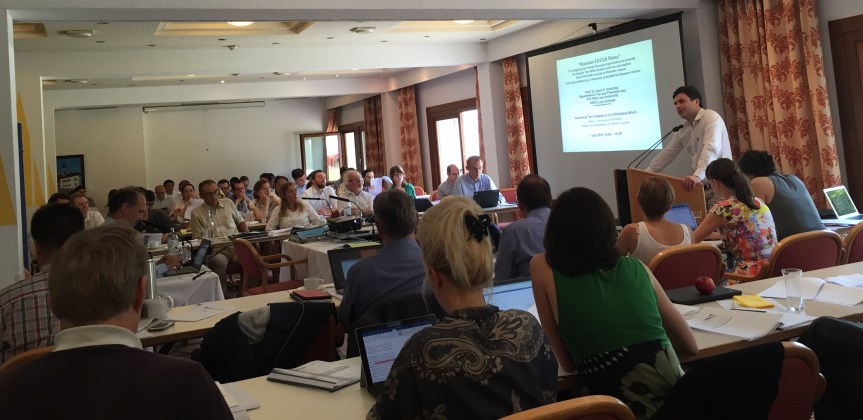
I am in Rust to attend a conference organized by the Institute of Austrian and International Tax Law of the Vienna University of Economics and Business.  The Institute organizes a conference in Rust every year using the same model.  Organizers first issue a call for contributors, each of whom writes a country report on the year’s topic, answering a series of questions prepared by Institute staff, describing the situation in his or her home country.  Contributors and participants include representatives of tax authorities, tax law and economics academics, practicing tax attorneys and accountants, and representatives of international organizations, among others.  The reports are circulated to participants in advance of the conference, and all are expected to prepare themselves by reading the country reports before arriving.  The two day conference then consists of the reporters presenting 3 minute “input statements” on a variety of topics, followed by discussion among the almost one hundred participants.  Here we are discussing an input statement from the Russian reporter, Professor Danil Vinnitskiy:

Rust Conference

As indicated in the title of my post, this year’s topic is tax compliance, and it has been fascinating to hear about the approaches of various governments including Kazakhstan, Indonesia, Norway, Russia, Germany, Nigeria, Croatia and many more.  Discussions have covered questions including the measurement of the tax gap, FATCA and other information exchange programs, inter-agency information exchange, and withholding procedures, among other things.  For those interested in learning more about these matters, the reports will ultimately be published in the coming months.

Professors Michael Lang and Alexander Rust host the conference, along with others from the Institute, and they understand that hard conference work should be accompanied by some opportunities to talk informally with other participants.  The informal events typically include a local wine tasting, a sunset dinner boat trip on the lovely Neusiedlersee, and many coffee breaks with opportunities for discussion with others.

Rust dinnerRust sunset

Having attended the Rust conference twice now, I can highly recommend it to others.  Keep an eye out for the call for participants for the 2017 conference!

Tax Times @ ABA Section of Taxation

By Francine J. Lipmanth

Supervising Editor Professor of Law Linda Beale and her team of outstanding ABA – Tax Section editors, Anne Dunn and Isel Pizarro, and staff have put together an exceptional June 2016 issue of the digital Tax Times. Features include . . . Continue reading “Tax Times @ ABA Section of Taxation”

Consumer Financial Regulation Meets Income Share Agreements

By: Shu-Yi Oei

On Wednesday, I spoke at the National Association of Consumer Credit Administrators (NACCA) 81st Annual Meeting and Regulators’ Training Symposium in Minneapolis. The panel was “Trends in Lending: Emerging Loan Products,” and the topic I was asked to discuss was income share agreements (ISAs).

The Powerpoint slides from the talk are here. The last slide contains a partial source list for those who’d like to read more about income share agreements.

I have some thoughts, following the presentation, and after sitting in a couple of (non-tax) panels on lending and regulation:

(1) Legal Scholarship and Restlessness

The NACCA invitation supports my longstanding theory about restlessness and legal scholarship. The theory is that two (or three, or four) years after you did the project (and are likely bored with it) is when anyone else notices that you’ve even done it at all. Therefore, to me, a big part of the scholarly endeavor is really the ongoing fight against your own internal boredom-clock (which, if you’re like me, is likely a tad…accelerated).[fn1]

In this case, Diane Ring and I wrote about ISA transactions back in 2014. See Human Equity? Regulating the New Income Share Agreements, 68 Vand. L. Rev. 681 (2015). And then we became convinced that the industry had sputtered and tanked and so our attention transitioned to other projects.[fn2] But folks I spoke to at the NACCA conference—as well as others I’ve have talked to—assure me that this is not so! Fast-forward to 2016 and new offerings by Cumulus Funding and Purdue University suggest that perhaps the ISA market is not entirely dead after all. Also, those ISAs entered into between 2012-14 (offered by companies like Pave and Upstart) have been percolating in the ether, and the full array of their tax and other regulatory consequences are presumably becoming clearer as time goes on. State regulators are now starting to pay attention and think about how to weigh in. So the time seems right to refocus the attention on an old scholarly project.

Continue reading “Consumer Financial Regulation Meets Income Share Agreements”

Uncle Sam as Danish Tax Collector

By: Diane Ring

Who says that real global tax cooperation is dead? During a very interesting conference on international tax held in Boston a couple of weeks ago, a recent U.S. tax case was discussed and caught my attention: Torben Dileng v. Commissioner (D.Ct. N. Ga., Jan. 15, 2016). In that case, a U.S. District Court ruled that the IRS could collect $2.5M of Danish taxes owed by a Danish citizen who was resident in the U.S.

IRS as Danish tax collector– what was this all about? Continue reading “Uncle Sam as Danish Tax Collector”

Tax at Midlife

I am at the Association of Mid-Career Tax Professors (AMT) Annual Conference today and tomorrow, along with Surly co-bloggers Jennifer Bird-Pollan, Sam Brunson, and Stephanie Hoffer. The conference is hosted by Dennis Ventry and Darien Shanske at UC Davis. Sam, Stephanie, and I are on the organizing committee, along with Dennis and Brian Galle. The conference itself is, I think, Brian’s brainchild–thanks, Brian!

I’m presenting an early-stage piece called The Distributive Case against Offshore Tax Enforcement, which I hope to workshop more extensively over the fall and spring. Jennifer is presenting Taxes, Democracy, and Investment Treaties; Stephanie, Corporate Acquisitions and Integration; and Sam, Playthings of the Wealthy: RICs, Pease, and the AMT.

A question I keep asking myself is: What’s the mission of the AMT conference? Or more broadly, what should we be focusing on at this stage of our scholarly lives?

Back in the day when dinosaurs roamed the earth and I used to attend the still-extant Junior Tax Workshop, the goals were pretty clear: Continue reading “Tax at Midlife”

EU State Aid Debate Lit Up the ABA Teaching Tax Session in DC

By: Diane Ring

As I blogged last week, the ABA Tax Section Teaching Tax Committee held a panel discussion Friday on the EU State Aid investigations on advance tax rulings. As I’ll discuss below, the panel was every bit as interesting as forecast. But first, a quick overview of what EU State Aid is all about:

EU State Aid Doctrine and Recent Controversy

Under Art. 107(1) of the Treaty on the Functioning of the European Union (as interpreted by the ECJ), if a member state provides state aid that distorts competition in the EU then the member must recover that aid from the benefiting entity to undo the distortive effects. Although this competition doctrine developed outside the tax context, it has previously been applied to tax benefits granted by a member state to a taxpayer. The European Commission oversees the investigation of state aid cases and issues the decisions.

Recently, though, application of the state aid doctrine to tax rulings issued by member states to multinationals has become a subject of tremendous controversy. In the past two years, the EC has been investigating tax rulings granted by member states to multinationals, including U.S. multinational taxpayers. The concern is that the multinationals receiving these rulings are not getting “mere” clarification of the law, but rather are securing a distinct advantage that creates distortion in the market. The U.S., along with various commenters, has expressed concern that these investigations might be disproportionately targeting U.S. businesses. Others have questioned whether the state aid rules are the most appropriate tool for combatting transfer pricing and/or double nontaxation situations that the EU finds problematic.

The Panel Discussion

During the discussion, it became apparent that there was a notable gap between the way many (but not all) in the U.S. view the European Commission’s recent state aid investigations involving U.S. taxpayers, and the EC’s vision of the role of the state aid doctrine in addressing potential harm caused by tax rulings granted to U.S. multinationals with very low effective tax rates. Thus, I was not surprised to hear these divergent positions characterized during the panel as “ships passing in the night”. What I did not anticipate was hearing the phrases “legal science fiction” (applied to certain suggested challenges to EC state aid decisions) or “a horror movie” (applied to the unfolding state aid investigations and decisions).

But the energy in the room was only part of the story. The panel provided very rich insights into the many complicated issues surrounding the current state aid investigations. I could not do them all justice here but thought I would highlight those that were mentioned by various panelists that really caught my attention:

Continue reading “EU State Aid Debate Lit Up the ABA Teaching Tax Session in DC”

Is the Global Trend Toward Tax Transparency and Disclosure a Surprise to Many Multinationals?: Insights from the ABA Tax Section Meeting in DC, May 6, 2016

By: Diane Ring

As I mentioned in my post earlier this week, I am in DC for the ABA Tax Section Meeting and am very much looking forward to this afternoon’s session on the EU State Aid Investigations. But at this morning’s session of the Administrative Practice Section, much of the conversation during the panel on the post-BEPS world focused on the array of new mechanisms that have emerged–or are being contemplated–at all levels (domestic tax law, international agreements, etc.) to provide increased transparency regarding multinational taxpayers and their tax treatment. Among the key examples were FATCA, BEPS-based country-by country-reporting, and new rules in the EU.

The fact that this was a topic at the ABA was not surprising, nor was the specific list of transparency and disclosure measures noted during the discussion. What did surprise me was the observation made during the panel that for many multinationals (not the really large ones, but the next tier down) this emerging trend was not on their radar. The point was made that these businesses did not have the staff to monitor the activities of the major international organizations such as the OECD and JITSIC in the same way that the very largest businesses did. Thus, despite the fact that the current world of transparency and disclosure was in fact foreseeable and reflects a perceptible evolution that has been taking place since the 1990s, it nonetheless took some of these taxpayers by surprise.

I am not sure what to make of this–but one point it suggests is that there was a general sense among these multinational businesses that although institutions such as the OECD played a role in international tax, it was a limited and predictable role that did not warrant ongoing and extensive monitoring by such businesses. I imagine institutions such as the OECD are getting more scrutiny from these businesses now.


ABA Tax Section May Meeting — Teaching Tax Panel: Government Speakers Will Debate EU-US Controversy Over State Aid (Friday, May 6, 3:00 pm)

By: Diane Ring

It’s already time for the May Meeting of the ABA Tax Section, in DC. and I wanted to highlight the session organized by the Teaching Tax Committee – it should prove to be immensely interesting.

As those who follow international tax know, there has been a been a controversy brewing between the U.S. and the EU regarding European Commission investigations into whether tax rulings that certain multinationals (most of which are U.S. corporations) received from EU member states constitute forbidden state aid. The U.S. has expressed concern that the investigations inappropriately target U.S. businesses, while the EU considers the inquiry a legitimate look at important tax rulings.

The panel discussion this Friday at 3:00pm will include the following government officials: Bob Stack, U.S. Deputy Assistant Secretary, International Affairs; Gert-Jan Koopman, Deputy Director-General State Aid, Directorate-General for Competition, European Commission; and Pierpaolo Rossi-Maccanico, European Commission.

I will be blogging about the panel later – but even better than reading about it will be attending and then reading the blog post!

For more information:

Continue reading “ABA Tax Section May Meeting — Teaching Tax Panel: Government Speakers Will Debate EU-US Controversy Over State Aid (Friday, May 6, 3:00 pm)”

Call for Papers: AALS 2017

At the 2017 AALS annual meeting (San Francisco, Jan. 3-17, 2017), the Section on Agency, Partnerships LLCs, and Unincorporated Associations and the Section on Nonprofit and Philanthropy Law are co-hosting a a joint program entitled “LLCs, New Charitable Forms, and and the Rise of Philanthrocapitalism.” The session will look at the tax, governance, and other policy implications of using for-profit LLCs as vehicles for philanthropy. I’ll paste the full call for papers after the break, but if you’re interested in participating, send a 1-2 page proposal to Mohsen Manesh or Garry W. Jenkins by July 1, 2016Continue reading “Call for Papers: AALS 2017”