Potential Effects of Tax Reform on Work (Guest Posts @ On Labor Blog)

Shu-Yi Oei

Diane Ring and I were invited to write a guest post for the On Labor blog, to explain the potential effects of tax reform on work arrangements for a labor law audience. There was some interest in tax reform among labor law experts in light of the New York Times article that ran on December 9, titled “Tax Plans May Give Your Co-Worker a Better Deal Than You.”

We wrote a pair of posts, describing the potential effects of tax reform on work arrangements (including decisions to form a passthrough or to classify oneself as an independent contractor).

Something that struck us in our attempt to translate the policy issues for a non-tax legal audience was the sheer complexity of some of the new provisions in the new proposed provisions and the difficulty of discussing them with integrity–maintaining nuance, not oversimplifying or being hyperbolic, but still being understandable. As others have noted, the creation of the proposed tax legislation and the subsequent commentary on it have both happened very quickly. Our attempt to explain clearly the proposed legislative provisions to a non-tax legal audience and to discuss the policy issues at stake really highlighted for us the complexity of these proposed laws, the policy pitfalls, and the perils of operating at high speed.

In any case, here are the posts:

Work-Related Distortions in the Tax Reform Bills: Understanding the New Proposed Provisions (Part 1 of 2)

…The goal of this two-part blog post is to summarize for a labor law audience how the proposed tax legislation creates these outcomes and to highlight the important policy issues that observers and commentators might be concerned about. This Part 1 focuses on the statutory provisions, and Part 2 will discuss the key policy conversations that are taking place….

Work-Related Distortions in the Proposed Tax Bills: Understanding the Policy Conversations (Part 2 of 2)

This post follows up on our prior post, which focused on the complex provisions of the proposed Senate tax bill. This post discusses some of the key concerns that have been expressed about the new tax bill. (Again, we focus here on the Senate version of the proposed legislation. The specifics of the analysis may change once we get the Conference version, though the broader policy and design questions are likely to persist.)
 

Paradise Papers: Day 2

By: Diane Ring

The most recent big financial data leak, dubbed the Paradise Papers, is now in full swing in the media. On Monday, Shu-Yi Oei blogged the initial release and its immediate takeaways (including the revelation that U.S. Commerce Secretary Wilbur Ross continued to hold investments in a shipping business that had business connections to key Russian figures). But each passing hour brings new information and individuals into the public spotlight – and in the process sheds light on how such information is likely to be used and what the media and the public seem to find most noteworthy.

So what did Day 2 bring? . . .

Continue reading “Paradise Papers: Day 2”

Some Initial Thoughts on the Paradise Papers Leak

Shu-Yi Oei

Another data leak broke on Sunday, November 5, while I was on a plane home from Bergen, Norway. Coincidentally, Diane Ring and I were in Bergen presenting our Leak-Driven Law paper at a tax conference organized by Max Planck Institute for Tax Law and Public Finance, Norwegian Centre for Taxation, and Notre Dame University.

This new “Paradise Papers” leak involves a set of 13.4 million records from 1950 to 2016.

From the ICIJ’s website:

“The new files come from two offshore services firms as well as from 19 corporate registries maintained by governments in jurisdictions that serve as waystations in the global shadow economy. The leaks were obtained by German newspaper Süddeutsche Zeitung and shared with the International Consortium of Investigative Journalists and a network of more than 380 journalists in 67 countries.”

The two offshore services firms in question are the offshore law firm Appleby and Asiaciti Trust, an offshore specialist headquartered in Singapore. Over 7 million of the records came from Appleby and affiliates.

Diane and I argued in Leak-Driven Law that (1) the high-salience and shocking nature of tax and other leaks and (2) the interventions of the press and other actors in processing, framing, and generating publicity about these leaks are important features that can affect how legal responses and reactions occur in the aftermath of a leak. We’ll be keeping track of how events unfold in the aftermath of this latest leak and how it fits or doesn’t fit with the observations in our paper:

Some initial notes and reactions:

This was at Least in Part a Cyber Hack.

Most of the news coverage I’m seeing is focused on the content on the leak, but it’s worth noting that at least with respect to Appleby, this new leak was in part a result of a cyberattack on Appleby that happened last year. I haven’t seen anything to suggest that this was a data theft by an insider (e.g., employee) turned whistleblower. In its response to the leak, Appleby defended itself and noted the challenges of cyber-crime for individuals and businesses.

The Appleby Hack Occurred in 2016.

Continue reading “Some Initial Thoughts on the Paradise Papers Leak”

ABA Tax Section 5th Annual International Tax Enforcement and Controversy Conference (Washington, DC, Oct. 27, 2017)

 By: Diane Ring

Yesterday my frequent co-author, Shu-Yi Oei, and I attended the ABA’s conference on “International Tax Enforcement and Controversy” in DC. The panels and discussion covered a range of interesting intersecting issues. These included: (1) the relationship among international organizations and bodies (such as the OECD, UN, World Bank, IMF and G20) in directing the shape of international tax law content and enforcement; (2) the place of developing countries in the evolving international tax system; (3) competing goals of finance ministers and tax ministers in various countries and the impact of that conflict on taxpayers; (4) the consequences of and responses to limited IRS resources; and (5) continuing benefits to enforcement from the Swiss Bank Program.

But probably the most significant theme that ran through the day’s discussion was the role of data, especially “big data”. . . .

Continue reading “ABA Tax Section 5th Annual International Tax Enforcement and Controversy Conference (Washington, DC, Oct. 27, 2017)”

International Sharing Economy Conference: Day 2 Takeaways

By: Diane Ring

Yesterday I blogged about Day 1 of the international sharing economy conference, titled “Reshaping: Work in the Platform Economy.” Today the Conference resumed in Amsterdam and included a fascinating roundtable with representatives from some of the platform firms alongside some sharing economy workers. Each offered their experience/perspective on the sector, posed questions to each other, and took questions from the audience.

Not surprisingly, just as there are a range of business models and niches in the sector, there are also a variety of reasons why workers participate in and do platform work. What workers seek from the platforms (beyond good pay) may differ from worker to worker. For example, a sharing economy worker may desire contact with other workers, a sense of community, predictability, or worker dignity. Building on the Day 1 discussions, several themes emerged by the close of the Conference:

Continue reading “International Sharing Economy Conference: Day 2 Takeaways”

Tomorrow’s Ninth Circuit Oral Argument in Altera

By: Leandra Lederman

Susan Morse and Stephen Shay have blogged today on Procedurally Taxing about the Ninth’s Circuit oral argument tomorrow in Altera Corp. v. Commissioner, as has Dan Shaviro on his blog, Start Making SenseAltera is the transfer pricing and administrative law case involving the Treasury’s cost-sharing agreement regulation. The Tax Court invalidated the regulation under the Administrative Procedure Act, as arbitrary and capricious. That is because the Tax Court accepted the taxpayer’s argument that it need not share stock-based compensation costs under a qualified cost-sharing agreement because arm’s length parties would not do so. The Tax Court found that Treasury had inadequately addressed evidence in the notice-and-comment process that parties not under common control did not share stock-based compensation costs, although Treasury explained in the Preamble to the regulation that cost-sharing agreements between uncontrolled parties are not sufficiently comparable to those in controlled-party transactions.

Altera raises an important administrative law question about what is required of Treasury for its regulations to be valid. Susie and Steve spearheaded an amicus brief in the Ninth Circuit in favor of the Commissioner, in which I joined, along with Dick Harvey, Ruth Mason, and Bret Wells. An amicus brief prepared by another group of professors also supports the Commissioner. There are also amicus briefs by business groups on the other side. See Susie and Steve’s blog post for more detail. And for prior coverage on the Surly Subgroup, see this post on our amicus brief, explaining why the Ninth Circuit should reverse the Tax Court’s decision invalidating the regulation.

Tax Leaks: The New Normal?

By: Diane Ring

Today, the Guardian is reporting that big-four accounting firm Deloitte suffered a hack back in March, 2017. The underlying attack may have originated in the fall of 2016 and may have allowed access to Deloitte systems for several months.

Deloitte itself is not unfamiliar with cybersecurity. As stated on its website, among the services that Deloitte offers clients is Cyber Risk. However, being a victim of a hack provides a new perspective. At this point, details are scarce on exactly which clients have been affected and what specific information may have been accessed, but it has been reported that “confidential emails and plans of some of its blue-chip clients” may have been compromised. This doesn’t sound good. But it is also no surprise.

Leaks and hacks can target a wide variety of data including business plans, mergers and acquisitions, scientific developments, business forecasts, individual identities, and government records. In recent years, tax-related information has proven especially attractive to leakers and hackers. As my co-author, Shu-Yi Oei and I explored in our recent article, Leak-Drive Law studying tax leaks that have occurred over the past 10 years, tax information can be valuable and their release by leakers can have powerful impacts. Moreover, as the tax community has embraced increased reporting and transparency to the government, the number of caches of well-organized data held by corporations, tax advisers and governments increases. Such caches may be magnets for those seeking to hack into it or leak it.

As we continue to move forward in this new world, what do we know? Continue reading “Tax Leaks: The New Normal?”

European Commission Prods OECD, EU, and Members States on Digital Taxation: An Analysis

By: Diane Ring

Complaints regarding the international tax system’s ability to handle the digital economy (think Google, Amazon, and a myriad of online service providers) are now ubiquitous. The heart of the problem is two-fold: (1) technology allows these corporations to effectively conduct business in a country without a physical presence there, and (2) much of these businesses’ value derives from intangibles whose value can be difficult to document.

The first reality limits a host country’s ability, under current law, to assert jurisdiction to tax the businesses. The second means that for core transactions by these businesses, such as licensing intangibles to related parties, it can be very difficult for the tax authorities to guarantee that the transactions are at arm’s length prices (and not shifting profit into low tax jurisdictions). The topic is pervasive enough to have merited its own Action Item in the ongoing OECD BEPS Project (Base Erosion and Profit Shifting).

However, a real, coordinated global response has been much harder to secure.  This week, the European Commission (EC) made its most recent foray into the debate with a Communication from the Commission to the European Parliament and the Council. But the EC was not just talking to European Union (EU) bodies; it was directly speaking to the OECD and EU member states. What exactly is the EC’s goal with this Communication?

Bottom line the EC seems to have several intersecting objectives: (1) clarify the problem, (2) identify and prod global actors, (3) delineate proper approaches, and (4) warn about the implications of nonaction. Continue reading “European Commission Prods OECD, EU, and Members States on Digital Taxation: An Analysis”

Macron and the Potential Future of Tax Leaks

By: Diane Ring

The French election for president—an event worthy of note in its own right (particularly on the heels of the Brexit vote)—generated a political, international relations, security and media firestorm due to a late-breaking data leak and hack. On Friday, the campaign of French centrist candidate Emmanuel Macron announced that it had been the subject of a major computer hack. At least 9GB of emails and personal and business documents from Macron’s campaign were posted to a document sharing site called Pastebin. Initial reports contended that the hack and leak were an effort to aid Macron’s far-right opponent Marine Le Pen, and may have been undertaken with Russian assistance. While Macron won the election, the potential fallout out from these leaks may have only just begun.

There’s an important tax dimension to the story, which may have been slightly overshadowed by Friday’s massive data dump. Two days before, on Wednesday, Le Pen hinted during a debate at possibility that Macron might have an offshore account in the Bahamas. Apparently, two hours before the debate, documents were anonymously posted on an internet forum that purported to include Macron’s signature and to show that he had a Bahamas bank account. During the debate, Macron responded that the claim was false and constituted “defamation.” On Thursday, Macron and his campaign outlined the spread of this offshore-account assertion on various sites and contended some were connected to “Russian interests.” On Friday, Macron lodged a complaint with the French prosecutor’s office regarding offshore account allegations made online.

Though the Friday hack and data dump have dominated the spotlight, the alleged tax leak is in fact part of the bigger and quite troubling picture of leaks in the modern cyber environment . . .

Continue reading “Macron and the Potential Future of Tax Leaks”

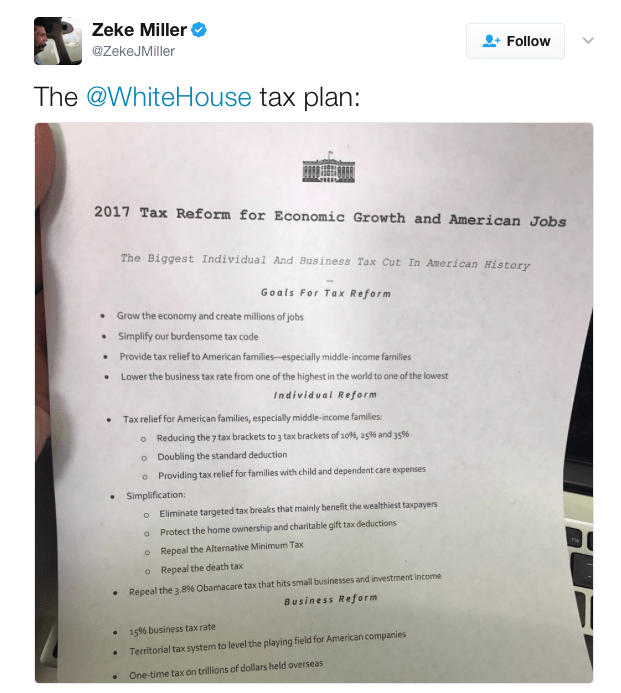
We Should be Taking President Trump’s Tax Plan Seriously

By: David J. Herzig

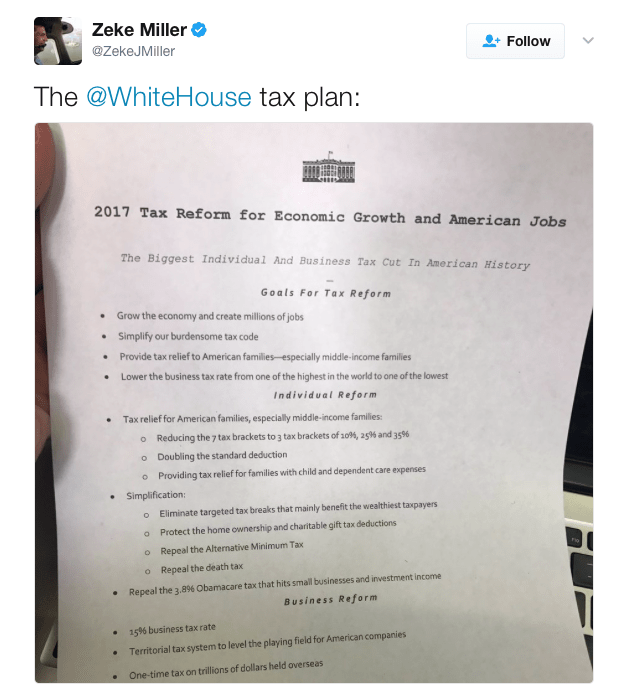
Today President Trump’s top tax advisors laid out the first details of the his tax plan. Chief economic adviser Gary Cohn and Treasury Secretary Steve Mnuchin unveiled the plan which according to Fox News, Cohn called “the most significant tax reform legislation since 1986, and one of the biggest tax cuts in American history.”

Oh, did I mention that the details of the biggest cuts were printed on a single sheet of paper?

Screen Shot 2017-04-26 at 4.22.18 PM

There has been plenty of ink (and jokes) already spilled about the plan.  For example, you can read Richard Rubin of the WSJ (here) or Alan Rappeport of the NY Times (here). The long and the short of the plan is it seems to very very costly.  The Committee for a Responsible Federal Budget guesses it could cost $3 to $7 trillion with their estimate at $5.5 trillion.  That is a lot of money!

Continue reading “We Should be Taking President Trump’s Tax Plan Seriously”

The Surly Subgroup Turns One!

Time flies when you’re having fun, I guess. Today is the one-year blogiversary of the Surly Subgroup. What started off as a group-blogging experiment hatched at last year’s Critical Tax Conference at Tulane Law School has provided quite a bit of entertainment for Surly bloggers and our guest bloggers, and hopefully for our readers as well.

It’s obviously been a big year on tax and other fronts. Since our inception, we’ve published 206 blog posts on a variety of topics. And we’ve drawn readers from 140 different countries.

Surly regulars and guest bloggers have covered various tax-related issues surrounding politics and the 2016 election—including disclosure of presidential tax returns, the Emoluments Clause, the Trump Foundation, and the Clinton Foundation. We’ve written about churches, 501(c)(3)s and the IRS treatment of non-profits. We’ve discussed the tax reform proposals of the 2016 presidential candidates and the #DBCFT. We’ve written several administrative law posts about Treasury Regulations and rulemaking.

Politics aside we’ve also covered other important issues in tax policy—including taxation and poverty, healthcare, tax policy and disabilities, tax compliance, and tax aspects of the Puerto Rico fiscal crisis. We’ve discussed several issues in international and cross-border taxes, touching on the EU state aid debate, the CCCTB, taxation and migration, the Panama Papers, tax leaks more generally, and tax evasion in China.

We hosted our first ever online Mini-Symposium on Tax Enforcement and Administration, which featured posts by ten different authors on a variety of tax administration topics. The Mini-Symposium was spearheaded by Leandra Lederman. Leandra had organized and moderated a discussion group on “The Future of Tax Administration and Enforcement” at the 2017 AALS Annual Meeting, and many of the discussion group participants contributed to the online symposium. We hope to organize future online symposia on other topics.

We’ve blogged about various conferences, workshops, and papers, both tax related and not-so-much tax related. We’ve also had lots of fun writing about taxes in popular culture – Surly bloggers and guest bloggers have written about the tax aspects of Pokémon Go, tax fiction, music-related tax issues (Jazz Fest! Prince! “Taxman”!), soccer players, dogs, Harry Potter fan fiction, Star Trek, and John Oliver. Surly bloggers even recorded a few tax podcasts!

In short, it’s been a busy year, and we’ve had a lot of fun with the Surly platform. We hope you have as well. Going forward, we’re going to keep the blog posts coming. We also hope to draw more regular and guest bloggers and to organize other online symposia.

Thanks for reading!

Panama Papers: The One-Year Anniversary

By: Diane Ring

This month marks the one-year anniversary of the Panama Papers leak. In April 2016, the ICIJ announced the leak and a few weeks later (May 9, 2016) released a database that included a subset of the leaked data. The leak itself comprised over 11 million records spanning 40 years from the Panamanian law firm Mossack Fonseca. At its core, the leak revealed the true ownership of over 200,000 offshore entities, thereby raising a host of tax and political questions regarding many of the entities’ owners.

So what has happened over the past year as a result of the leak? Continue reading “Panama Papers: The One-Year Anniversary”

The Games We Play

Shu-Yi Oei

I’ve been ever so slightly glum since my colleague Ann Lipton went and blogged about this game called the Unicorn Startup Simulator over at BLPB. The goal of the game is for your startup to have a billion dollar valuation by the end of the year while keeping your employees happy. You have to make a series of decisions juggling those two goals. Turns out that’s harder than one might imagine. Here is what keeps happening to me:

Screenshot 2017-04-10 23.18.32

So, I guess the message is “don’t quit your day job”?

Anyway, I was feeling grumpy about not having cool tax games to call our own but then I went hunting around and realized, WAIT, we do have tax games! Whether they’re cool or not is another story.

Here are a couple:

Continue reading “The Games We Play”

Teaching Depreciation with a #DBCFT Lurking

Shu-Yi Oei

I’m teaching depreciation in my Basic Federal Income Tax class this week. As I suspect is the case for most tax profs, our coverage of depreciation comes right after we wrap up discussion of expense taking in §§ 162 and 212 (and § 195) but before we get to § 165 losses.

Depreciation is literally my favorite topic in the entire universe to teach. I mean, if I was going to get a tattoo of a Code section on myself, it would literally be “26 U.S.C. § 168 (as amended).” No disrespect meant to 26 U.S.C. §§ 167, 179, 197 and friends. [Distraction: Here is a virtual tattoo generator. You, too, can practice getting your favorite Tax Code section inked on yourself.] I firmly believe that you can teach any number of core skills in tax class by teaching depreciation (e.g., statutory construction, policy choices, reading cross-references, political economy and legislative change, time value of money, etc.). Conversely, I also tend to think that if you can understand the depreciation statute in Basic Tax and explain it to your classmates, you can do pretty much anything in our legal profession.

Therefore, putting aside all of the reasons why cash-flow expensing may not have the effects that one might hope, I will be absolutely heartbroken if we actually end up with a cash-flow tax, because then what am I gonna talk about in tax class?

All of which brings me to today’s dilemma: Do I mention the ubiquitous #DBCFT in teaching depreciation this week? Or can I just pretend it’s not happening? If one does teach cash-flow expensing, when does one bring it up (i.e., in what order of coverage)? My inclination is to (1) explain the basics of how economic cost recovery over time works in theory; (2) talk briefly about the ACRS changes in 1981; (3) teach the Simon v. Commissioner cases (violin bows) to illustrate the policy tensions that arise once we move from true economic recovery and actual useful lives to ACRS and statutory recovery periods; (4) discuss #DBCFT as an alternative design approach, noting the possible benefits and downsides of that approach, noting that there’s some discussion in the ether right now re whether we should be doing this (and deemphasizing the border adjustment features); (5) introduce bonus depreciation concepts (§§ 168(k) and 179) as an illustration of how expensing has surreptitiously worked its way into the conversation in the guise of bonus depreciation circa financial crisis; and then (6) move right along to parsing the actual statutory elements of §§ 167 and 168 and understanding how it all stitches together.

This strikes me as a nice middle ground between (1) dorkin’ out and going #DBCFT full bore and totally losing the class, and (2) just ignoring the current debate. I’d be curious to know what other tax profs are doing with coverage here.

Taxation and Migration

By: Diane Ring
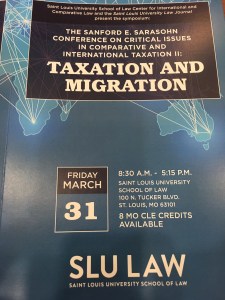
IMG_0592Today St. Louis University School of Law hosted the Sanford E. Sarasohn Conference on Critical Issues in Comparative International Taxation II: Taxation and Migration. This event offered a much needed forum to explore the intersection between international tax law and questions of migration and refugees. Topics addressed included using the tax system to remedy migration challenges (see, for example, Matthew Lister, “A Tax-Credit Approach to Addressing Brain-Drain” suggesting a tax transfer from jurisdictions on the receiving end of a brain drain to the countries losing skilled labor; and see Cristina Trenta, “Migrants and Refugees: An EU Perspective on Upholding Human Rights Through Taxation and Public Finance” advocating an EU-wide tax to finance members’ commitments to refugee human rights). Other papers considered the burdens that tax-induced migration creates for the society the migrant leaves and for some members of the jurisdiction the migrant joins (see, for example, Allison Christians, “Buying In: Citizenship and Residence by Investment”). The full set of 15 conference papers will be published in the St. Louis University Law Journal and will provide a valuable resource on the breadth of taxation and migration questions.