Past Moratoria on Tax Guidance and Regulations(?)

By: Sam Brunson

cch_standard_federal_tax_printOn my previous post talking about the the IRS’s announcement that it was putting a moratorium on issuing new regulations and formal guidance, a commenter asked if it was such an odd thing for a new Administration to temporarily pause guidance. After all, who wants to issue guidance before the new Administration’s people are in place and agenda is set, lest the new Administration change its priorities and positions in the coming months?

I didn’t remember any such (formal, at least) pause in 2009, but, when I got home, I decided to look back a few years. I looked at new regulations and revenue rulings in the first month of the Obama, George W. Bush, Clinton, and Reagan presidencies (I didn’t bother with George H.W. Bush, because that was a Republican to Republican switch). Also, because we don’t know how long the current limitations on regulations and other guidance will last, I also expanded my search of revenue rulings for the first three months of the new administrations.[fn1] Continue reading “Past Moratoria on Tax Guidance and Regulations(?)”

The (Near) Future of Treasury Regulations

cfrToday’s Tax Notes reports[fn1] that the IRS has announced that it will not release pretty much any new formal guidance (including revenue rulings and revenue procedures) for the foreseeable future.[fn2]

Why not? A confluence of an Executive Order and a January 20 memorandum. The EO, “Reducing Regulation and Controlling Regulatory Cost,” requires that, for every new regulation issued, two existing regulations be eliminated.

The January 20 memorandum further prohibits agencies from sending regulations to the Federal Register until they’ve been reviewed by an agency or department head appointed by Trump. Continue reading “The (Near) Future of Treasury Regulations”

Privacy Is Dead: Crowdsourcing Tax Enforcement

Sam Brunson
Professor, Loyola University Chicago School of Law

Periodically, the IRS estimates the tax gap (that is, the difference between taxes due and taxes owed). For the years 2008 through 2010, the IRS estimates the annual tax gap was about $458 billion. After including late payments and amounts collected through IRS enforcement efforts, the annual tax gap diminished by $52 billion a year, leaving a $406 billion tax gap in each of those three years.

The $406 billion tax gap is equivalent to just over 16 percent of taxes due. And the IRS is unlikely to significantly close this gap going forward. While the has proven remarkably efficient at collecting revenue—in fiscal year 2015, it collected $3.3 trillion on a budget of just under $11 billion—Congress has been cutting the IRS budget for the last decade or more, while, at the same time, assigning the IRS more responsibilities. In spite of its efficiency, the IRS must do more with less, and its ability to find taxpayers who do not pay their taxes is thus bound to suffer.

These constraints are reflected in the data about IRS enforcement activities: in 2015, the IRS audited about 0.8 percent of individual tax returns and 1.3 percent of corporate income tax returns. Not only does the IRS audit very few returns, but the number has been falling: in 2010, the IRS audited about 1.1 percent of all individual returns.

There is no easy solution to the tax gap, or to the audit rate. Increasing IRS funding, or decreasing its non-revenue-raising responsibilities, would perhaps be the most effective fix, but that currently appears unrealistic. In a 2015 Pew survey, 48 percent of Americans had an unfavorable view of the IRS, up from 40 percent five years earlier. And Republicans—who will control both the Executive and the Legislative branches of the federal government—score significant political points campaigning against the IRS. So properly funding the IRS appears unlikely in the near future.

An alternative solution, then, would be to reduce the costs to the IRS of enforcement. One way to reduce those costs? Crowdsource enforcement.

A Brief History of Tax Return Disclosure

Crowdsourcing tax enforcement is an old, albeit out-of-favor, idea. In fact, it was not until 1976 that Congress definitively ended more than a century’s experimentation with deputizing the public to help enforce the tax law. Beginning in 1861, the Civil War income tax law provided for public access to tax returns. To ensure that public access (and titillate their readers), newspapers published the returns of prominent citizens. This public disclosure ended when the income tax was allowed to expire, but Congress experimented anew with it in each successive iteration of the federal income tax.

Congress had one principal goal in publicizing tax returns: ensuring that taxpayers paid their taxes. Essentially, public access to taxpayers’ returns allowed the government to crowdsource enforcement—people would notice, for example, that their neighbor had paid suspiciously little in taxes. Knowing that the Panopticon was watching their returns, taxpayers would have every incentive to pay their full tax liabilities.

Not everybody appreciated this mandatory disclosure of tax returns, of course. From the start, public disclosure faced significant opposition. Every time Congress reintroduced public disclosure of tax returns, opponents of disclosure argued that such forced disclosure was both un-American and intrusive. According to critics, the publicity not only violated taxpayers’ privacy, but it might actually endanger taxpayers, exposing their wealth and addresses to criminals and kidnappers. Even without danger, the benefits, according to critics, were limited to individuals’ indulging their idle curiosity.

Moving to Privacy

By 1976, the public disclosure of tax returns had been severely curtailed. In spite of being “public records,” they were no longer generally available to newspapers or the public at large; rather, they were open to inspection by the general public under regulations approved by the president or pursuant to presidential order.

Federal agencies had more access to tax returns than the general public, but even federal agencies could only see them on a case-by-case basis, after providing a written request. In the 1970s, though, in the wake of Watergate and fears about the “proliferation of computerized data banks,” the government began to strengthen citizens’ privacy rights. The 1976 Tax Reform Act cemented those privacy rights, broadly forbidding government employees from disclosing taxpayers’ returns or return information.

Over the next two decades, privacy became such a central principle of American society that, in 1993, Professor Richard Pomp wrote that it was “unthinkable for proposals” for public disclosure of tax returns to be “taken seriously.” Less than a decade later, though, in the wake of Enron’s collapse, legislators, academics, policymakers, and the media were seriously discussing the implications of making corporate tax returns public.

A Post-Privacy World?

A decade and a half after Enron’s collapse, the table appears perfectly set for returning to public disclosure of tax returns. Earlier privacy concerns seem irrelevant, if not quaint, in today’s world. For many individuals, the public already has access to information about their salaries. At least half of the states maintain public databases of state employee salaries.[fn1] Securities and Exchange Commission rules require publicly-traded corporations to disclose the compensation of its five most highly-paid employees. And Forbes lists the income of the most highly-paid musicians, actors, and athletes, as well as its estimates of the net worth of the world’s wealthiest individuals.

Beyond this broad array of information already available, today’s privacy situation is almost the polar opposite of the post-Watergate world. While exponentially more personal information is stored on computer servers today than 40 years ago, Americans have largely put that information online voluntarily. Technology entrepreneurs argue that social norms have moved away from privacy. And while the entrepreneurs may have financial motivations for arguing that the norms have changed, they are not alone in that view. Many experts believe that within another decade, much of what we consider private today will no longer be considered private.

It may not even require movement with social norms to arrive at a post-privacy world with respect to tax returns. The IRS, tax, and accounting firms have, until now, done an admirable job keeping returns private. In contravention of decades of precedent, president-elect Donald Trump refused to release his tax returns. In spite of the pressure, only three pages of (state) tax returns were ever leaked. But the fact that he faced no leaked returns does not mean that they will not, in the future, be leaked: the extensive Panama Papers leaks suggest that no data—even private law firm data—is necessarily safe from public scrutiny. In fact, hackers may have accessed information on more than 700,000 taxpayers in an IRS data breach.

Of course, the fact that taxpayer information could be compromised, and that notions of privacy may change significantly in the future, do not present an affirmative case for requiring all taxpayers to disclose their tax returns.

Consequences of Crowdsourcing Enforcement

Requiring the public disclosure of tax returns has at least two beneficial results, from a tax compliance perspective. At the ex ante level, it forces taxpayers to think about how aggressive they want to be. When tax returns are private, only the taxpayer, her advisors, and maybe the IRS (if hers is one of the 0.8 percent of returns it audits) will know how she structured her tax life. She can thus maintain a public image as a tax-compliant citizen, even while pushing the boundaries. If, however, she knows that her tax returns will be available to the public, she is forced to internalize the non-monetary costs of her tax planning. Perhaps saving money by paying less in taxes is more important to her than being seen by her peers as complying with the tax law, in which case she may continue to take aggressive positions. To the extent there is a social norm of tax compliance, however, knowing that her peers will have access to her tax returns may cause a taxpayer to be more conservative.

At the ex post level, requiring taxpayers to publicly disclose their tax returns reduces the IRS’s search costs as it enforces the tax law. It would, of course, continue to use its matching system and other techniques for determining which returns to audit, but it would also have hundreds or thousands of additional eyes scrutinizing tax returns. Friends, neighbors, competitors, and former spouses may all have some interest in seeing tax returns, and potentially in reporting bad behavior.

This ex post crowdsourced auditing does have potential problems, of course. It would increase the noise, as presumably some percentage of tips would be false positives. And if it turns out that significant numbers of taxpayers are taking aggressive tax positions, it may encourage other similarly-situated taxpayers to take similarly aggressive positions.  In both cases, though, the sheer quantity of data may correct for the problem. The IRS may not want to act on every tip, but if it sees a pattern of behavior from a number of taxpayers, it may decide to look closely at returns that engage in that behavior. And if the IRS were to strategically target aggressive positions taken by a number of taxpayers, that could discourage other taxpayers from following suit.

Two Final Thoughts

Administratively, requiring disclosure would be tremendously easy. In 2015, almost 88 percent of individual returns were filed electronically. With electronically-filed returns, the IRS could automatically redact certain sensitive information (for example, social security numbers and, perhaps, names of dependents) and instantly make the returns available online. The 12 percent of returns filed on paper would take more work to redact, but the IRS could require taxpayers who filed on paper to file an unredacted and a redacted version of their returns.

But culturally, it would be hard. Although we may be approaching a post-privacy world, we are not there yet. Although people freely post all kinds of personal information to the internet, few people voluntarily publicize their tax returns, and mandatory disclosure could still face significant pushback.

As an intermediate step toward full publicity, then, perhaps the tax law should make such disclosure option, but offer a carrot to those who opt in. For example, such a program could provide that those who disclose their tax returns will be protected from penalties for a certain number of years.


[fn] I didn’t do an exhaustive search, but even a quick Google search found me databases for these states: Arkansas; California; Connecticut; Florida; Illinois; Indiana; Iowa; Kentucky; Maryland; Massachusetts; Minnesota; Missouri; Montana; New York; North Carolina; Ohio; Oklahoma; Pennsylvania; South Carolina; Tennessee; Texas; Utah; Virginia; Washington; Wisconsin.

Leak-Driven Lawmaking

Shu-Yi Oei
Hoffman F. Fuller Professor of Law, Tulane Law School

Over the past decade, a steady drip of tax leaks has begun to exert an extraordinary influence on how international tax laws and policies are made. The Panama Papers and Bahamas leaks are the most recent examples, but they are only the tip of the leaky iceberg. Other leaks include (in roughly chronological order) the UBS and LGT leaks; the Julius Baer leak; HSBC “SwissLeaks”; the British Havens leaks; and the LuxLeaks scandal.

These tax leaks have revealed the offshore financial holdings and tax evasion and avoidance practices of various taxpayers, financial institutions, and tax havens. In so doing, they have been valuable in correcting long-standing informational asymmetries between taxing authorities and taxpayers with respect to these activities. Spurred by leaked data, governments and taxing authorities around the world have gone about punishing taxpayers and their advisers, recouping revenues from offshore tax evasion, enacting new domestic laws, and signing multilateral agreements that create greater transparency and exchange of financial information between countries.

Thus, it is clear that leaked data has started to be a significant driver in how countries conduct cross-border tax enforcement and make international tax law and policy. But using leaks to direct and formulate tax policy responses comes with some potentially serious pitfalls.

In a new paper—coming soon to an SSRN near you[fn.1]Diane Ring and I explore the social welfare effects of leak-driven lawmaking. Our argument, very generally, is that while data leaks can be socially beneficial by virtue of the behavioral responses they trigger and the enforcement-related laws and policies generated in their wake, there are under-appreciated downside hazards and costs to relying on leaked data in deterring tax evasion and making tax policy.

Continue reading “Leak-Driven Lawmaking”

Budget Reconciliation Process and Obamacare

By: David Herzig

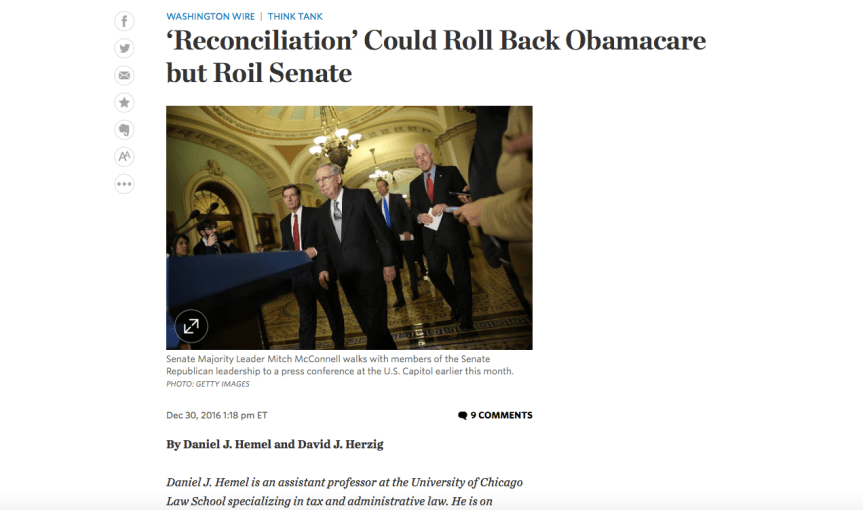
Friday the Wall Street Journal published Daniel Hemel and my article on why we think it will be very hard for the Senate to just do away with the ACA (aka Obamacare) via reconciliation.  We follow-up our earlier Surlygroup posting (also cross-posted at Yale J. Reg.) which discussed why the Senate norms are hard to break.  Since that article, we have developed some fairly interesting models on why we think the Senate norms are rather sticky – more on that to come.

In the Wall Street Journal article we state, “Most significantly, Majority Leader Mitch McConnell and his caucus may be forced to choose between their antipathy toward the ACA, also known as Obamacare, and their allegiance to longstanding institutional norms. In the end, the scope of ACA repeal will likely depend on whether Senate Republicans decide to score political victories in the short term or to maintain the Senate’s unique culture for the long haul.”

The problem for the republicans is the Byrd rule.  Repeal of the ACA will have budgetary impact beyond the budget window.  A decision will need to be made on the impact.  As we stated, “On some reconciliation-related questions, the presiding officer defers to the Budget Committee chairman, currently Senator Mike Enzi. On other questions, including whether a provision produces “merely incidental” effects on the budget, the presiding officer generally follows the advice of the Senate’s nonpartisan parliamentarian, the official adviser to the Senate on the body’s rules.”

Continue reading “Budget Reconciliation Process and Obamacare”

The Art of the (Budget) Deal

By Daniel Hemel and David Herzig

Who Holds the Trump Card on Reconciliation?

Republicans on Capitol Hill are reportedly planning to use the filibuster-proof budget reconciliation process to repeal the Affordable Care Act and overhaul the tax code. Against that background, Sam Wice says that “the most powerful person in America” in 2017 will be Senate Parliamentarian Elizabeth MacDonough, the nonpartisan official who will “determine” how much of their agenda Republicans can pass through reconciliation. This, of course, is an exaggeration: like it or not, the most powerful person in America in 2017 will be Donald J. Trump, who will wield all the power of the imperial presidency. But Wice’s post helpfully directs our attention to the budget reconciliation process, the rules of which quite likely will determine whether the Republican leadership on Capitol Hill can repeal the ACA and reform the tax laws.

Yet while one should not underestimate the importance of reconciliation, one should also not overestimate the power of the Parliamentarian in the reconciliation process. As a formal matter, the Parliamentarian’s role is advisory; and as a practical matter, the Parliamentarian has little say over significant aspects of reconciliation. Other actors—most notably, Senate Budget Committee Chairman Mike Enzi (R-Wy.)—wield at least as much influence as the Parliamentarian. Most importantly, Enzi—not MacDonough—will determine whether the provisions in any reconciliation bill violate various rules against deficit-increasing legislation being passed via reconciliation. And unlike the Parliamentarian, the Budget Committee Chairman is very hard to fire.

Reconciliation measures can begin in either or both chambers. However, since the ultimate vote on the budget measure occurs in the Senate, we’ll focus on the Senate side of the reconciliation process for purposes of this discussion. On the House side, the Rules Committee Chair and the Budget Committee Chair will wield outsized influence as well. We expect Pete Sessions (R-Tex.) to stay on as House Rules Committee Chair; as for the House Budget Committee Chair, the race is on for a replacement to Tom Price, the Georgia Republican recently tapped as Trump’s Health and Human Services Secretary.

To understand why the Budget Committee Chair is as powerful as he is, a bit of background on reconciliation may be helpful. Continue reading “The Art of the (Budget) Deal”

Cooking The Books Podcast on Trump’s Taxes

By: David J. Herzig

Today Pulitzer Prize winning journalist, David Cay Johnston, Phil Hackney, and I got together for a 30 minute podcast discussion regarding the recent NY Times follow-up article about Mr. Trump’s $916 million tax loss (“NOL”).

Here is link if you missed hyper-link above: http://share.sparemin.com/recording-5131

The topics ranged from the current tax reporting regarding Mr. Trump’s 1990s tax returns to the Trump Foundation to potential criminal sanctions against Mr. Trump.  It was fantastic to be a part of and I hope everyone listens.

Continue reading “Cooking The Books Podcast on Trump’s Taxes”

Congratulations to the Newly Elected Members of the American Law Institute!

By: Francine J. Lipman

The American Law Institute (ALI) has just announced its newly elected members. The members who join ALI from across the country will bring their diverse backgrounds and areas of legal expertise to ALI’s work. Fifteen of the 45 new members are professors, sixteen are partners (or the equivalent) in law firms, seven are judges, six are in private industry, and one is a government legal advisor.

“One of the most exciting aspects of being President of the ALI is meeting some of today’s most important and inspiring legal minds as they are elected into The American Law Institute. I look forward to having the opportunity to work alongside these new members in continuing the ALI’s efforts in clarifying the law,” said ALI President Roberta Cooper Ramo. Continue reading “Congratulations to the Newly Elected Members of the American Law Institute!”

Court Says No to Uber Class Action Settlement: What does that mean for worker classification?

By: Diane Ring

A major question in the sharing economy is the status of workers – are they employees or independent contractors? Of course, no single answer would apply across the entire sector but the debate has been most prominent in ridesharing. At the center of this debate are two litigations against Uber in California and Massachusetts (in January 2015 the Massachusetts case was transferred to the Northern District of California). The suits, brought on behalf of Uber drivers in the two states, “alleged [among other claims] that Uber misclassified its drivers as independent contractors rather than employees.” Reclassification as an employee would entitle drivers to various protections and potential compensation under state labor law. Three years into the litigation, the plaintiffs agreed on a settlement with Uber, which would provide for monetary relief of $84 million (plus an additional $16 million contingent on an initial public offering). The bulk of this payment would be split into two funds, with approximately $5-6 million for Massachusetts drivers, and approximately $56-66.9 million for California drivers.  Payouts to drivers would be based on miles driven under a formula.  Continue reading “Court Says No to Uber Class Action Settlement: What does that mean for worker classification?”

Tax Evasion and Risk Perceptions among Lawyers in China

Shu-Yi Oei

I recently read an interesting article by Prof. Benjamin van Rooij (UC Irvine), Weak Enforcement, Strong Deterrence: Dialogues with Chinese Lawyers about Tax Evasion and Compliance, 41 Law & Social Inquiry 288 (2016), available here.

The article studies a particular form of tax evasion practiced by some lawyers in China: The lawyer, although affiliated with a law firm, retains clients privately, accepts cash payments from such clients without giving the client a tax receipt, and does not report the case to the law firm. This behavior actually contains both a tax evasion and a business-driven purpose: it enables the lawyer to underreport income for tax purposes while also avoiding payment of a significant cut to the law firm. Unsurprisingly, the law prohibits these practices. The paper employs qualitative “semistructured” interviews with lawyers at large and medium-sized law firms using open-ended questions, in order to generate a nuanced picture of how enforcement, deterrence, and risk are perceived by these lawyers.

The findings are fascinating, and provide a unique perspective on legal ethics, tax compliance, and perceptions of enforcement and deterrence among lawyers in China. Continue reading “Tax Evasion and Risk Perceptions among Lawyers in China”

DC Circuit Seems to have Decided IRS Violated Constitution Before Trial in True the Vote Appeal.

By: Philip Hackney

graphics-882729_1280In 2014, a District Court dismissed (based on 12(b)(6) and 12(b)(1) motions) the complaint of a number of conservative organizations who alleged that the IRS “targeted” them by subjecting them to greater scrutiny in their applications for tax exemption. The lead organization, True the Vote, sought 501(c)(3) charitable organization status; the others primarily sought 501(c)(4) social welfare organization status. The world became aware of this targeting controversy in May 2013 when Lois Lerner, the head of the Exempt Organizations division of the IRS apologized to the Tea Party and other conservative groups for how the IRS treated their applications. To this day Taxprof Blog continues the IRS Scandal post over three years later dedicated at least in part to this controversy.

The primary complaints were the second and fifth claims: (2)  the IRS violated the organizations First Amendment rights to freedom of speech, and (5) the IRS violated the Administrative Procedures Act. The District Court concluded that because the IRS had granted exempt status to these organizations, the complaints were moot. True the Vote appealed this dismissal to the DC Circuit Court of Appeals.

Last week the Circuit Court breathed new life into claims 2 and 5. Though the Court found that some of the complaints were moot (including Bivens complaints against IRS employees and a claim of violation of 6103 disclosure rules), it allowed claims 2 and 5 forward because it found that the IRS had not voluntarily ceased its unlawful actions.

In reading the opinion, I find astonishing that the Circuit Court appears to have already concluded, without trial, that the IRS acted unconstitutionally. I recognize that for a 12(b)(1) motion the court is to assume the complaint true, but the court appears to have done much more than make assumptions. I focus on this issue. Continue reading “DC Circuit Seems to have Decided IRS Violated Constitution Before Trial in True the Vote Appeal.”

Examination of Allegations Against Clinton Foundation Part II

By: Philip Hackney

elections-1527438_1280

A week ago I considered one of three allegations Rep. Marsha Blackburn made against the Bill, Hillary & Chelsea Clinton Foundation in a letter Blackburn sent to the IRS, FBI, and FTC. I found the first allegation stated nothing of significance to the IRS. I now look at the other two and find them significantly wanting as well. Recently, IRS Commissioner Koskinen sent a letter indicating the IRS would investigate these complaints. I conclude they fail to state any complaint actionable by the IRS.

The second and third Blackburn allegations seem to come from a book by Peter Schweizer called Clinton Cash. Both allegations suggest that Sec. Clinton provided large governmental benefits in exchange for donations to the Clinton Foundation and payments to Bill Clinton. Both of the claims, already made by Presidential candidate Donald Trump, regarding Laureate University and Uranium One have been rated False and Mostly False by Politifact. Thus, it is difficult to take these allegations seriously.

Nevertheless, there are two things I do in this post. First. I discuss the factual conclusions of others regarding whether there was a quid pro quo arrangement associated with the second and third allegations. Then, I look at how the tax law might treat such arrangements were they true. Continue reading “Examination of Allegations Against Clinton Foundation Part II”

Tax Times @ ABA Section of Taxation

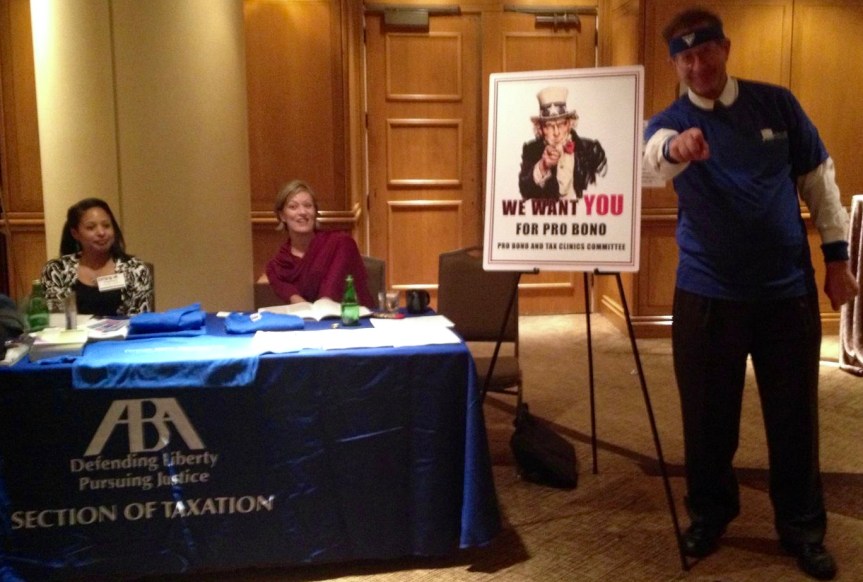
By Francine J. Lipmanth

Supervising Editor Professor of Law Linda Beale and her team of outstanding ABA – Tax Section editors, Anne Dunn and Isel Pizarro, and staff have put together an exceptional June 2016 issue of the digital Tax Times. Features include . . . Continue reading “Tax Times @ ABA Section of Taxation”

IRS Scrutinized Mostly Conservative Nonprofits: Evidence of Targeting?

By: Philip Hackney

owl-1019062_1280

Documents recently released in a court case demonstrate that 282 of 426 organizations caught in the IRS political advocacy, “Tea Party,” nonprofit organization net that caused such a hullabaloo three years ago, were in fact conservative. This comes three years after Lois Lerner apologized to Tea Party groups on behalf of the the IRS because, she said, it “inappropriate(ly)” selected these conservative groups’ applications for tax exemption for scrutiny based on name alone rather than legal cause.

An NPR report by Peter Overby concludes about the new information: “Whatever the IRS meant to do, this hodgepodge of a list illustrates how the agency bollixed the nonprofit application process.” In this post, I examine this seemingly “common-sense” claim and find it wanting. Additionally, because I have written publicly about this matter both at the time and more recently. I re-examine my conclusions in those writings in light of this new information.

Early on, I assumed that only about 1/3rd of the organizations caught in the IRS net were conservative. I made this assumption based on the TIGTA report because it noted that 96 of 298 applications, or 1/3rd of the organizations, were Tea Party, Patriot or 9/11 groups. I left wiggle room in my writing, but in the back of my mind, this was my assumption. I assumed TIGTA would have reported every conservative group that was in the lot. But, it turns out that about 2/3rds of the organizations  were conservative. Thus, my assumption was wrong. The vast majority of the organizations caught in the net were conservative. Nevertheless, I don’t think this new information demonstrates some additional level of bungling by the IRS that was hitherto unknown. And, frankly, a list like this with little context does nothing to tell us about whether the IRS was fair or not.¹ Continue reading “IRS Scrutinized Mostly Conservative Nonprofits: Evidence of Targeting?”

Consumer Financial Regulation Meets Income Share Agreements

By: Shu-Yi Oei

On Wednesday, I spoke at the National Association of Consumer Credit Administrators (NACCA) 81st Annual Meeting and Regulators’ Training Symposium in Minneapolis. The panel was “Trends in Lending: Emerging Loan Products,” and the topic I was asked to discuss was income share agreements (ISAs).

The Powerpoint slides from the talk are here. The last slide contains a partial source list for those who’d like to read more about income share agreements.

I have some thoughts, following the presentation, and after sitting in a couple of (non-tax) panels on lending and regulation:

(1) Legal Scholarship and Restlessness

The NACCA invitation supports my longstanding theory about restlessness and legal scholarship. The theory is that two (or three, or four) years after you did the project (and are likely bored with it) is when anyone else notices that you’ve even done it at all. Therefore, to me, a big part of the scholarly endeavor is really the ongoing fight against your own internal boredom-clock (which, if you’re like me, is likely a tad…accelerated).[fn1]

In this case, Diane Ring and I wrote about ISA transactions back in 2014. See Human Equity? Regulating the New Income Share Agreements, 68 Vand. L. Rev. 681 (2015). And then we became convinced that the industry had sputtered and tanked and so our attention transitioned to other projects.[fn2] But folks I spoke to at the NACCA conference—as well as others I’ve have talked to—assure me that this is not so! Fast-forward to 2016 and new offerings by Cumulus Funding and Purdue University suggest that perhaps the ISA market is not entirely dead after all. Also, those ISAs entered into between 2012-14 (offered by companies like Pave and Upstart) have been percolating in the ether, and the full array of their tax and other regulatory consequences are presumably becoming clearer as time goes on. State regulators are now starting to pay attention and think about how to weigh in. So the time seems right to refocus the attention on an old scholarly project.

Continue reading “Consumer Financial Regulation Meets Income Share Agreements”