
Obamacare, ACOs, and Tax-Exemption

By: Philip Hackney door-349807_1280

Sometimes, well probably every time, when I teach about hospitals qualifying as tax-exempt charitable organizations I tell the joke from the movie Airplane that goes like this:

Rumack: You’d better tell the Captain we’ve got to land as soon as we can. This woman has to be gotten to a hospital.

Elaine Dickinson: A hospital? What is it?

Rumack: It’s a big building with patients, but that’s not important right now.

The point of this joke is an important one to me. It helps to illuminate the fact that the “promotion of health” as a charitable purpose is focused heavily on a space and an activity combined. Generally for the promotion of health to qualify as a charitable purpose there must be a physical building where doctors and nurses relieve the suffering of the afflicted. Not just any promotion of health suffices. Running a cheap pharmacy just does not cut it. Providing sperm to the women of your choice for free, even though it may effect health, simply does not cut it either (don’t ask, just read the opinion). What about health insurance? Generally, because of section 501(m) of the Code, health insurance does not qualify. However, health maintenance organizations (HMOs) that sell health services in exchange for a monthly fee that also own a building where they treat patients can qualify.

That brings us to a recent IRS denial of the application for charitable status of an organization operated as an “accountable care organization” (“ACO”), a creature of Obamacare. Continue reading “Obamacare, ACOs, and Tax-Exemption”

Will New Data on the Volume of Sharing Economy Workers Prompt Tax Reform?

By: Diane Ring

Sharing economy and other platform workers are frequently classified as independent contractors and bear many of their own costs. Thus, these workers whom we don’t think of as “small businesses”—and don’t really think of themselves as small businesses—are thrust into the exciting world of quarterly reporting and calculation of proper deductions. Exciting if you are a tax lawyer, but less so if you are making limited income and are facing daunting tax compliance requirements. Despite these compliance challenges, there has not been much movement in responding to the tax challenges faced by sharing economy workers. These observations about the sharing economy sector have been around for a while; they were the focus of two forthcoming articles by my co-author, Shu-Yi Oei, and me (Can Sharing Be Taxed? and The Tax Lives of Uber Drivers: Evidence from Internet Discussion Forums).

Yesterday, a new report coming out of American University echoed our observations and findings. Caroline Bruckner of the Kogod Tax Policy Center presented testimony (and a supporting report) to Congress regarding the size and scope of worker participation in the sharing economy. Her goal was not to provide a definitive calculation nationwide of sharing and platform workers, but to offer a solid sense of the scale of participation in the sector (more than 2.5 million individuals) and note important growth trends. Based on the percentage of the American workforce active in the sharing/platform sector, she urged more government attention to reform that would address the tax compliance and administration challenges in this sector.

Will Congress and Treasury/IRS respond? Continue reading “Will New Data on the Volume of Sharing Economy Workers Prompt Tax Reform?”

A Hot News Week for Krispy Kreme

By: Diane Ring

The big news this week about Krispy Kreme is that they are going to be acquired for $1.35 billion. As reported in the WSJ last night, JAB Holding Co. (a European investment fund, which the WSJ noted holds an interesting mix of assets including Caribou Coffee, Jimmy Choo shoes, and  Durex condoms) is about to add glazed donuts to its asset pool. But this was not the Krispy Kreme news of the week that caught my eye. I was fascinated instead to read that this week the Missouri Supreme Court ruled on Krispy Kreme’s request for a refund of sales tax it had remitted on sales of donuts and other related items from 2003 through 2005.

Krispy Kreme had collected sales tax at the 4% rate applicable to food sold that would be immediately consumed. In contrast, food sold at grocery stores generally bore only a 1% state sales tax. Essentially, as the media described it, Krispy Kreme argued that its donuts were like grocery store food, and thus should bear only the sales tax rate applicable to such food. I may not follow the healthiest of diets but even I do not think that donuts are the equivalent of broccoli from the produce aisle. What were they thinking? But then my tax brain kicked in. I immediately understood. . .

Continue reading “A Hot News Week for Krispy Kreme”

More on Income Share Agreements: Will Proposed Legislation Fix their Marketability Problem?

By: Diane Ring

Last week I blogged about the apparent resurgence of income share agreements (ISAs), noting for example, Purdue University’s planned offering to juniors and seniors this fall, and the $30 million capital infusion received by ISA provider Cumulus Funding. I discussed how regulatory uncertainty is one likely barrier to more widespread market interest in these instruments. This week I thought I would take a look at the current round of ISA-related legislation in the House and the Senate, which is aimed at addressing some of this uncertainty.

The current legislation is actually the second go round at legislating the consequences of some ISAs. In 2014, Senator Rubio and Representative Petri introduced the Investing in Student Success Act of 2014. That legislation went nowhere. In 2015, Senator Rubio introduced a revised version of his bill, following the introduction of a similar bill in the House by Representatives Todd Young and Jared Polis. Both 2015 bills have much in common, although the Rubio bill tracks the structure of his earlier version. The point of each bill is to clarify the legal and regulatory treatment for those ISAs that fall within the bill’s definition by providing affirmative legal treatment for covered ISAs. ISAs that don’t fall within the bill’s parameters aren’t necessarily barred—they just aren’t covered by the legislation and presumably are left in the same legal limbo in which all ISAs currently operate.

As my co-author Shu-Yi Oei and I have discussed elsewhere, trying to craft one set of rules to cover many types of ISAs is problematic, and as a result, the 2014 bill was both under- and over-inclusive. For example, although it might make sense to regulate ISAs used for education in a manner similar to student loans – such student loan treatment might be inappropriate for ISA funding used to start a business rather than for education. Also, we expressed concern about the possibility of long-term ISAs in which an individual effectively assigns away a significant percentage of future income for what might be virtually all of his or her working life (e.g., a 30 year ISA). The 2014 bill did not limit such agreements.

So, do the 2015 bills do any better?

Continue reading “More on Income Share Agreements: Will Proposed Legislation Fix their Marketability Problem?”

Dark Days: Blindfolding Nonprofit Regulators

By: Philip Hackney.

The Ways and Means Committee voted Thursday in favor of a bill, H.R. 5053, that would seriously hamper the ability of the IRS to enforce charitable tax law and nonprofit tax law generally. It is a bad-no-good-bill, that comes from folks who champion protection from the IRS, but whose real motive is to make it possible for wealthy individuals to act without hindrance in influencing political campaigns and politics generally. It emanates not from a place of conservatism, but a place of reactionarism and plutarchism (neither of which are words, but both of which probably should be :)). The Koch brothers support this bad bill for a reason.

The Bill will harm IRS regulation and make our already relatively secret-and-subject-to-corruption political contribution system more secret and more subject to corruption (the issue that democrats and interest groups focused upon in attacking the bill). The harm though can be expected to extend to the ability of the federal government and states to regulate individuals using nonprofits to accomplish their ends. Sometimes people running nonprofits do bad things. It will increase the dark in which our regulators try to police the nonprofit sector. Unfortunately, the IRS leant a hand to those trying to give donors greater secrecy as high level officials discussed eliminating schedule B back in December 2015. It is still not clear to me what they were thinking, but I genuinely hope we do not make such a foolish choice. As explained below, we have long recognized a regulatory need for this particular information.

What does this dastardly, seemingly well-intentioned, bill do? Continue reading “Dark Days: Blindfolding Nonprofit Regulators”

Rainy Saturday Tax Scholarship …

Irresponsibly Taxing Irresponsibility: The Individual Tax Penalty Under the Affordable Care Act 

Georgetown Journal on Poverty Law & Policy, Vol. 23, No. 3, Spring 2016 

In recent decades, Congress has used the federal income tax system increasingly to administer and deliver social benefits. This transition is consistent with the evolution of the American welfare system into workfare over the last several decades. As more and more social welfare benefits are conditioned upon work, family composition, and means-tested by income levels, the income tax system where this data is already systematically aggregated, authenticated, and processed has become the go-to administrative agency.

Continue reading “Rainy Saturday Tax Scholarship …”

“Unofficial” Jazz Fest (and Arbitrage, and Licensing, and Taxes)

By: Shu-Yi Oei

blogged on Wednesday about taxes and tax enforcement at Jazz Fest, a.k.a. the New Orleans Jazz and Heritage Festival. Today’s follow-on post celebrates the phenomenon that I call “unofficial” Jazz Fest.

There’s “official” Jazz Fest, which is what happens after you’ve bought your ticket, gone through security, and are within the confines of the New Orleans Fairgrounds (where the Fest is held). And then there’s “unofficial” Jazz Fest, which is what goes on in the surrounding Fairgrounds neighborhood outside the Fest. [fn.1] As I described in Wednesday’s post, “official” Jazz Fest is a big deal, well organized, and highly regulated. The music programming unfolds on a tight schedule. Only approved food and craft vendors are allowed, and those vendors need to be properly licensed and pay some sort of booth fee in order to sell at Jazz Fest. The organizers exert significant control over the food items sold—the Jazz Fest website says that “‘carnival’ food items or beverages” will be not sold and that duplication of food offerings is minimal.

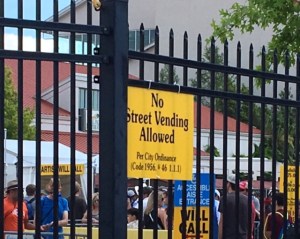
“Unofficial” Jazz Fest, as I call it, is what happens in the area outside the gates of the Fairgrounds. On Fest days, the neighborhood is transformed into its own unique microclimate of festive Festy-ness. Here, street vendors hawk wares such as hats, kooziessecond-line umbrellas, water, and art. no vending(There are “No Street Vending Allowed” signs posted, but those don’t seem to be given much weight.) Popup brass bands play for tips on the sidewalks. Some neighborhood residents hire bands and throw backyard parties, some of which you can attend for a fee (or, perhaps, crash unnoticed). New Orleans, like many other cities, has business licensing requirements, including mobile vendor licenses, and some of these vendors are clearly licensed, though it’s plausible that others might not be.

Many of these behaviors look like classic arbitrage: You can of course buy or enjoy most of those items or services in the official Jazz Fest, but they’re more expensive once you’re inside the Fairgrounds and committed to being there (general admission tickets allow single entry only). This creates obvious opportunities for unofficial vendors to sell products more cheaply just outside the Jazz Fest entrance gates. So, for example, it gets hot in New Orleans in April/May, and Fest rules allow you to bring in “Factory-sealed bottled water for personal consumption.” Bottled water sells for $3 in the Fest. But there are lots of people selling it out of a cooler for $1 in the surrounding streets, so it really makes sense to buy your water before you enter. From the seller’s point of view, if she buys 78 24-count cases of bottled water from Costco, it comes up to under 27 cents a bottle before tax. The incentive to make dollar-a-bottle sales outside the Fairgrounds on Fest days is obvious.

Others of these activities look like something close to agglomeration:  Continue reading ““Unofficial” Jazz Fest (and Arbitrage, and Licensing, and Taxes)”

The New Orleans Jazz and Heritage Festival (and Taxes)

By: Shu-Yi Oei

New Orleans is currently in the throes of Jazz Fest.

For those of you who don’t know what that is, Jazz Fest—or, the New Orleans Jazz and Heritage Festival—is a famous annual festival celebrating music and culture in New Orleans. It’s held at the New Orleans Fairgrounds. It spans seven days over two weekends. It draws hundreds of thousands of people.

But even that description doesn’t do the event justice. There are twelve different music stages and tents set up in the Fairgrounds and a lineup of over a hundred performance groups—this year’s headliners include Stevie Wonder, Pearl Jam, Paul Simon, Red Hot Chili Peppers, Snoop Dogg, and Van Morrison. There’s also a huge number of food and crafts vendors who set up at the Fest—over 200 food offerings sold! Some of us to go to the Fest at least as much for the food as for the music: my personal favorites include the Crawfish Monica, mango freeze, crawfish beignets, seafood stuffed mushrooms, and Chef Linda Green’s award-winning yakamein.

This past weekend, my colleague Ann Lipton and I traipsed down to the Fairgrounds to find the fun. While enjoying performances by Janelle Monáe (amazing), the Red Hot Chili Peppers (meh), Leroy Jones (so good), Herlin Riley (just, wow) and others, we chatted a bunch about vendor licensing and regulation at Fest. We even ran into an on-duty New Orleans revenue agent who was more than happy to tell us all about tax compliance at the Fest and kindly gave permission to blog about it.

After some research, some casual conversations, and some lurking around the food booths, here’s what we now know about Jazz Fest and taxes:

Continue reading “The New Orleans Jazz and Heritage Festival (and Taxes)”

A New Wave of Income Share Agreements

By: Diane Ring

Just a few years ago, Income Share Agreements, or ISAs, were garnering popular attention. ISAs are arrangements in which an individual receives upfront funding from investors, perhaps for education or a start-up business, in exchange for agreeing to pay a percentage of his or her future income for a period of time. Well-known examples included Fantex (which involved a stake in the future earnings of a professional athlete), as well as Upstart, Pave, and Lumni (which generally involved funding for education or business ventures). Although the structures and terms varied, the feature these ISAs had in common was the absence of a guaranteed return of principal and the degree to which the investor was investing in the personal, financial success of the funding recipient – a relationship some criticized as owning a piece of the funding recipient.

Ultimately, though, the market did not show tremendous interest in these instruments. Upstart and Pave shifted to traditional loan models, and Lumni reportedly has issued fewer than 30 ISAs in the United States. Fantex has remained active, but Fantex was always a little different, because it actually involved an issuance of stock in a corporation whose value effectively tracked the earnings performance of a pro athlete. Additionally, the Fantex investment had a novelty dimension, appealing to sports enthusiasts.

Why, though, was the market not that interested in ISAs? There are a few likely reasons:

Continue reading “A New Wave of Income Share Agreements”

Charitable Organizations and Marijuana?

In Denial 201615018 (released April 8, 2016 and for which I can only find a Tax Notes link) the IRS denied the charitable organization application of a nonprofit organization organized “to provide a way for your members to collectively and cooperatively cultivate and distribute medical marijuana for medical purposes to qualified patients and primary caregivers who come together to collectively and cooperatively cultivate physician-recommended marijuana.” The IRS denied the organization’s applications on two bases: (1) a charitable organization cannot engage in illegal activities and the distribution of marijuana is illegal under federal law; and (2)  it provided too much private benefit. I will focus only on the first basis.

Ben Leff and I have previously debated the issue of marijuana distribution and tax exemption. Ben contended that under certain circumstances a social welfare organization under 501(c)(4) could form to distribute marijuana and operate in a tax-exempt vehicle. The reason to try to do this instead of operating in a taxable vehicle is that under section 280E federal tax law prohibits marijuana distributors from deducting trade or business expenses. While I disagreed with Ben, neither of us argued that a charitable organization could engage in the distribution of marijuana. Both of us, and Ben should absolutely chime in, believed that the public policy/illegality limitation on charitable organizations is absolutely clear on this front: engaging in an illegal activity as a substantial purpose just does not cut it under charitable tax rules. Continue reading “Charitable Organizations and Marijuana?”

Uber and Lyft Drivers and San Francisco Business Licensing

By: Shu-Yi Oei

As some of you know, Diane Ring and I have written a couple of papers recently about tax and regulatory issues in the sharing economy.

Well, here’s the latest news out of San Francisco: It was reported a few days ago that the San Francisco City Treasurer recently obtained data about the identities of a number of transportation network company (“TNC,” i.e., Uber and Lyft) drivers and has proceeded to send some 37,000 notices to drivers. The notices require those driving for seven or more days in a year to register as a business operating in the city and pay San Francisco’s business registration fee ($91 for those earning $100,000 or less). The Treasurer’s office apparently refuses to say how they got the data, in the interests of taxpayer confidentiality, but in any case, they now have it and are using it to enforce the business registration requirement and fee against TNC drivers operating in San Francisco.

The applicable regulation lives in San Francisco Business and Tax Regulations Code Article 12, sections 853 and 855 of which impose the registration requirement and fee. The registration requirement and fee are imposed on those “engaging in business” in the city, unless exempt, and as far as I can tell, Article 6, § 6.2-12 specifically imposes the regulation on a person who “utilizes the streets within the City in connection with the operation of motor vehicles for business purposes for all or part of any seven days during a tax year.” The move to require registration also seems consistent with the continued position of the TNC companies that their drivers are appropriately classified as independent contractors, as opposed to employees. So unless I’m missing something big, it’s hard to see how the law would not on its face apply to drivers.

Several aspects of this development are interesting:

Continue reading “Uber and Lyft Drivers and San Francisco Business Licensing”

Hello world!

By: Shu-Yi Oei

I’m excited to be blogging on this site!

By way of introduction, I’m Shuyi. I teach tax classes and a legal scholarship workshop at Tulane Law School. My research interests are largely in tax law, though I tend to get curious about bankruptcy law, debtor-creditor law, and social insurance issues as well.

A lot of my research to date has been about tax collections mechanisms (such as the federal tax lien and the offer in compromise procedure), social insurance issues, and forbearance in tax administration. More recently, I’ve been working on a series of projects with my co-author, Diane Ring, dealing with the sharing economy, income sharing, human capital contracts, and other innovative transactions. I’ve very much enjoyed both lines of research, for very different reasons. I’ll likely be posting about these and other topics on this blog.

Taxes aside, I’m also an erstwhile student of the martial arts and denizen of New Orleans. Expect to see posts about these things as well, to the extent that they relate to tax policy and tax teaching.

Finally, we’ve been fortunate at Tulane Law to have the opportunity to host a number of tax and non-tax scholarly events, including our regular faculty workshop series, an annual tax roundtable, a property law roundtable, and a legal scholarship workshop series focused on the regulation of economic activity. I’ll blog here about scholarly happenings at Tulane Law and Tulane’s Murphy Institute as well.