The 2018 Tax Policy Colloquium at the IU Maurer Law School

ColloquiumPosterBy Leandra Lederman

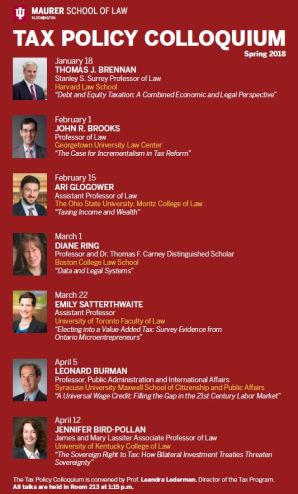
The 2018 Tax Policy Colloquium at the Indiana University Maurer School of Law will kick off next Thursday, January 18, with the presentation by Harvard Law School professor Tom Brennan of a fascinating and timely paper he is co-authoring with Robert L. McDonald, Debt and Equity Taxation: A Combined Economic and Legal Perspective. Tom is a terrific speaker, and I expect the workshop to be really interesting.

Last year, I did a closing post noting that some themes had emerged in the semester’s colloquium. This year, I plan to blog each workshop afterwards, with permission of the speakers. The full workshop schedule follows after the jump. If you will be in Bloomington and are interested in attending one or more workshops, just let me know and I can send you the paper once I receive it. (Most of the paper drafts will not be publicly available.)

The Tax Policy Colloquium is a course for students; I expect about 14 this semester, including a visiting scholar from another school on campus who has asked to audit. I conduct a background session with the students to help them get up to speed on the concepts presented in the paper draft. Typically, the actual workshops are attended not only by the students but also by my colleague David Gamage, senior tax attorney/Maurer alumnus Tim Riffle, and a few other faculty–law school colleagues and/or tax or economics faculty from other schools on campus. Sometimes other members of the community attend, such as a tax professor from another law school; another attorney practicing in Bloomington or Indianapolis; a student not enrolled in the class (Shuyi Oei‘s and Ben Leff‘s talks in 2016 were particularly popular with other students!); and/or a local judicial clerk. Eric Rasmusen from the IU Kelley School of Business and Margaret Ryznar from IU’s McKinney Law School in Indianapolis have each attended several of the talks.

Continue reading “The 2018 Tax Policy Colloquium at the IU Maurer Law School”

What’s Up with the Sharing Economy? (Report from the 13th International Human Rights Researchers Workshop)

By: Diane Ring

Sometimes we do get what we are seeking. In some of my recent work on the sharing economy I have advocated for more discussion and analysis across legal boundaries, so that the rules we develop have outcomes that more closely match our goals and don’t bring unexpected—and undesired—surprises. The two-day conference on “Sharing Economy: Markets & Human Rights” that I have been attending at the College of Law and Business in Ramat Gan, Israel has provided just such an opportunity. The papers presented cover a wide range of legal fields and issues from taxation to discrimination, and will ultimately be published together in the Law & Ethics of Human Rights Journal. Although we are all benefiting from the discussion of our drafts and will continue to revise our work, some interesting themes have emerged already . . .


Continue reading “What’s Up with the Sharing Economy? (Report from the 13th International Human Rights Researchers Workshop)”

GOP 2017 Tax Act Forces Nonprofits to Pay UBIT on Some Fringe Benefits

By: Philip Hackneyroad-3036620_1280

In the new tax act of 2017, Congress imposed an unrelated business income tax on transportation, parking, and athletic facility fringe benefits that a nonprofit provides to its employees. I write because I suspect there are universities or hospitals or other large nonprofits out there (pension funds maybe) that offer these types of fringe benefits that are unaware that they must pay UBIT on the total value of these benefits at the end of the year. The law went into effect for taxable years starting January 1, 2018.

In Section 13703 of the bill, Congress promulgated the following new rule: UBIT “shall be increased by any amount for which a deduction is not allowable under this chapter by reason of section 274 and which is paid or incurred by such organization for any qualified transportation fringe (as defined in section 132(f)), any parking facility used in connection with qualified parking (as defined in section 132(f)(5)(C)), or any on-premises
athletic facility (as defined in section 132(j)(4)(B)).” Continue reading “GOP 2017 Tax Act Forces Nonprofits to Pay UBIT on Some Fringe Benefits”

(Un)Happy New Year

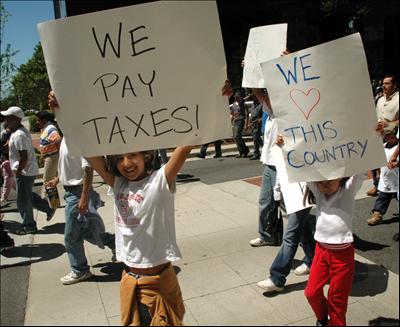
Today is the first day of calendar/tax year 2018. Today is also the first day that taxpaying American families with children who do not have a Social Security number will no longer qualify for any amount of Child Tax Credit (CTC). IRC Section 24(h)(7). Certain members of Congress have for years been trying to target these working families and increase their already high effective income tax rate. Many of these families already pay federal income taxes at a higher effective tax rate than their U.S. citizen counterparts. I have blogged about this issue here and published scholarly articles about the oppressive “Illegal Tax” here, here, and here. Moreover many of them pay into Social Security and Medicare although they cannot qualify for any otherwise earned benefits. Fortunately, frontline advocates who support families, immigrants, and children have been successful pushing back against this oppressive goal until TODAY.

Continue reading “(Un)Happy New Year”

Feminist Judgments: Rewritten Tax Opinions

51bljA0Y8oL._AC_US436_QL65_

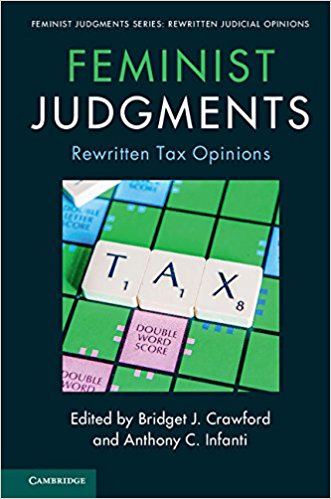
Tax-gift giving this holiday season just got so much easier!! Look what arrived just in time to celebrate the end of 2017! The FIRST in a series of subject-matter volumes of US Feminist Judgments is the Feminist Judgements: Rewritten Tax Opinions.

Featuring fantastic contributions by Surly Subgroup colleague Professor of Law Jennifer Bird-Pollan and dream team editors: James D. Hopkins Professor of Law Bridget J. Crawford and Buchanan, Ingersoll & Rooney Faculty Scholar, Gender, Sexuality & Women’s Studies Faculty (affiliate) and Professor of Law Anthony C. Infanti,

Commentary and rewritten tax opinions by Tax Professors and Scholars Extraordinaire Appleberry, Beale, Bird-PollanBrennen, Cain, Christensen, Cords, Cruz, Drumbl, Fellows, Gerzog, Heen, Knauer, Lahey, Lipman, Maynard, Murphy, Pratt, RobinsonRobson, Tait, Thompson, and Waterhouse Wilson.

Continue reading “Feminist Judgments: Rewritten Tax Opinions”

The Law With No Name or the “2017 Budget Reconciliation Act”

Victor Thuronyi

Legislative drafting conventions are conservative, and it is traditional for a bill to have a long title which describes the purposes of the bill in technical detail, and then to include in the first section a short title which provides a more user friendly name.  The short titles of Acts used to be fairly straightforward (e.g., the “Revenue Act of 1939”) but by the late 70s or early 80s, they tended to get cute and political, so now we have names like the “PATRIOT Act” and the “Affordable Care Act.”

The tax bill just passed by both houses of Congress introduces a new and somewhat unprecedented variation.  There is no short title.  There used to be: the “Tax Cuts and Jobs Act” (TCJA).  However, at the last minute, it was stripped out of the bill because the Senate Parliamentarian ruled that it was extraneous to the bill’s purpose of affecting revenues, which is what a reconciliation bill is limited to.  Hard to argue with that – the name of the law does not have an effect on revenues.

As a result, it would not be accurate to refer to this piece of legislation as the TCJA.  Opponents have been referring to it as the Trump Tax Scam, and likely will continue to do so.  It is probably too much to ask the media and tax advisors to refer to it that way, since that does seem overtly political.  The “2017 Budget Reconciliation Act” perhaps would work (BRA for short).  Several pieces of legislation enacted through reconciliation procedure have been called “Omnibus Budget Reconciliation Act of 19xx” so there is precedent.  So calling it a Budget Reconciliation Act is a correct generic description in the absence of an official short title.  I believe that calling it a tax reform act would also be political, since it falls far short of reform.  Budget reconciliation is perhaps as neutral as one can get.  An additional argument for this is that the bill contains not only tax provisions but also provisions on Alaska drilling, which are not tax related, but are related to budget reconciliation.


The Marriage Penalty and Head of Household Filing under the Senate Tax Bill [Updated]

Victor Thuronyi

One of the issues that has received little attention is the repeal of the marriage penalty in the Senate bill. There were no hearings on this, and nothing in the Joint Committee explanation of the Senate bill to indicate why the change is being made.

The tax bill as passed by the Senate would make a significant change to the taxation of married persons vs. single persons.  In headline terms, single people will pay more than married people as a group. This issue involves several policy goals, not all of which can be fully accommodated (the goals include neutrality on getting married, and all married couples with the same combined income pay the same tax). Under current law, these have been accommodated by a compromise. When individuals get married, there might be a marriage penalty or a marriage bonus, but the rate schedules have been adjusted to make these relatively small. Nevertheless, they are there.

The Senate bill would change this by removing the marriage penalty completely. When a couple is married, the tax consequences might be neutral (where the members of the couple have equal incomes), but there would be a marriage bonus in all other cases. The largest bonus occurs in the “traditional” marriage where there is a stay-at-home parent.

If the marriage penalty is eliminated, one implication is that the share of the overall tax burden borne by married persons as opposed to single persons will decline. In other words, singe persons will pay more tax. This is relative. Many single persons will experience a tax decrease, which will occur primarily for those who do not itemize deductions, since their standard deduction will increase. The point is that the decrease would be even greater if the marriage penalty were not being eliminated, because in effect the elimination of the marriage bonus has to be made up for by single people. As an example, two single nonitemizers with gross income of $75,000 would pay $11,889 in tax currently, or $23,778 for both, if unmarried, but 24,790 if married, so there is a marriage penalty of $1,012, or in percentage terms the unmarried individuals pay 96% of what the married couple with identical incomes pays. Under the Senate bill, this ratio is 100% for this couple.

In addition to there not being any marriage penalty, the tax disincentives for labor force participation of the second-earner spouse would not be improved by the Senate bill. In other words, there is a high marginal tax rate on the second earner. Continue reading “The Marriage Penalty and Head of Household Filing under the Senate Tax Bill [Updated]”

Potential Effects of Tax Reform on Work (Guest Posts @ On Labor Blog)

Shu-Yi Oei

Diane Ring and I were invited to write a guest post for the On Labor blog, to explain the potential effects of tax reform on work arrangements for a labor law audience. There was some interest in tax reform among labor law experts in light of the New York Times article that ran on December 9, titled “Tax Plans May Give Your Co-Worker a Better Deal Than You.”

We wrote a pair of posts, describing the potential effects of tax reform on work arrangements (including decisions to form a passthrough or to classify oneself as an independent contractor).

Something that struck us in our attempt to translate the policy issues for a non-tax legal audience was the sheer complexity of some of the new provisions in the new proposed provisions and the difficulty of discussing them with integrity–maintaining nuance, not oversimplifying or being hyperbolic, but still being understandable. As others have noted, the creation of the proposed tax legislation and the subsequent commentary on it have both happened very quickly. Our attempt to explain clearly the proposed legislative provisions to a non-tax legal audience and to discuss the policy issues at stake really highlighted for us the complexity of these proposed laws, the policy pitfalls, and the perils of operating at high speed.

In any case, here are the posts:

Work-Related Distortions in the Tax Reform Bills: Understanding the New Proposed Provisions (Part 1 of 2)

…The goal of this two-part blog post is to summarize for a labor law audience how the proposed tax legislation creates these outcomes and to highlight the important policy issues that observers and commentators might be concerned about. This Part 1 focuses on the statutory provisions, and Part 2 will discuss the key policy conversations that are taking place….

Work-Related Distortions in the Proposed Tax Bills: Understanding the Policy Conversations (Part 2 of 2)

This post follows up on our prior post, which focused on the complex provisions of the proposed Senate tax bill. This post discusses some of the key concerns that have been expressed about the new tax bill. (Again, we focus here on the Senate version of the proposed legislation. The specifics of the analysis may change once we get the Conference version, though the broader policy and design questions are likely to persist.)


Opening Volleys in South Dakota v. Wayfair

By Adam Thimmesch

Much of the tax world is currently focused on federal tax reform, and rightfully so. The speed with which the Republicans are pushing a bill through Congress has required an intense burst of attention, and academics evaluating the bill have already noted and written on number of glitches and loopholes in the current bills. (Full paper here.) While this is all occurring, though, a significant case is being pitched to the U.S. Supreme Court—South Dakota v. Wayfair. That case involves the Court’s physical-presence rule and the ongoing fight between states and retailers regarding the collection of use tax on online sales. This could be one of the most significant state tax cases heard by the Supreme Court in decades. Unfortunately, it is fighting for press against federal tax reform. Bad timing.

I’ve blogged about this dispute before, so I don’t want to rehash all of the history of Quill and the issues related to collecting use taxes on online commerce. However, both the Petition for Writ of Certiorari and the Respondents’ Brief in Opposition have now been filed (the Petition was filed by the State of South Dakota on October 2nd and the Respondents’ Brief in Opposition was filed last Thursday), so I thought that it might be helpful to summarize the major arguments made by both sides in their filings and to foreshadow some of the arguments to come. (Warning, this gets long even as a summary…)

Continue reading “Opening Volleys in South Dakota v. Wayfair”

A Mother’s Holiday Letter to Uncle Sam

Dear Mr. Tax Man, Uncle Sam, Sir:

I am writing this letter in December on my ten-minute break at work.  I apologize for my rushed handwriting and the tardiness of this letter. I don’t have access to a computer, except for short periods (only 15 minutes per session) at the library.  And the lines have gotten too long for me to wait while my three wiggly kids struggle to sit still (only to be hushed by the library staff and patrons every few minutes). I have been really busy balancing my new jobs with the kids’ schedules, especially with the holidays and all the stress and craziness that they add. Continue reading “A Mother’s Holiday Letter to Uncle Sam”

Giving Tuesday and State Use Taxes

By Adam Thimmesch

For a few years now, I’ve gently pushed the idea of Use Tax Tuesday to follow Cyber Monday. Why not follow one of the biggest tax-avoidance days of the year with a day dedicated to undoing that damage? As much as this makes sense to me, it appears that I have lost out to Giving Tuesday, and probably rightfully so.  Nevertheless, I want to suggest that Use Tax Tuesday can easily be folded within the more general ambit of Giving Tuesday. Maybe all is not lost.

Continue reading “Giving Tuesday and State Use Taxes”

Crip the Code*

By Francine J. Lipman

*Attribution, respect and applause to #CriptheVote Disability Visibility Project community organizers and activists.

images-7“[W]ork is a valued activity, both for individuals and society; and fulfills the need of an individual to be productive, promotes independence, enhances self-esteem, and allows for participation in the mainstream of life in America.”  Rehabilitation Act of 1973
Continue reading “Crip the Code*”

Repeal of Child Tax Credit For Taxpayers Without a Voice, Is A Great Way to Defund the Success of America’s Kids

By: Francine J. Lipman

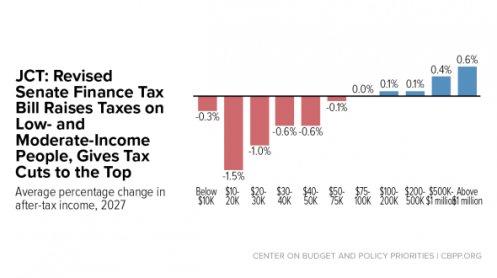
Senate & House dueling Tax Bills are now (more or less) out. Experts have determined the regressive nature of both tax bills, that is, overall tax increases on middle, low, lower, and the lowest income working families as compared to generous tax cuts for high, higher, and the highest income taxpayers. (Pet peeve here, please media et al. stop using “middle class” in lieu of “middle income” because if there is one lesson from 2017 that is that income level and class are not correlated).

Below is one of many compelling graphs from the Center on Budget & Policy Priorities evidencing that every group with income levels below $75,000 suffers a tax increase as compared to their higher income counterparts tax decrease in 2027. Many of these lower income taxpayers, including those with incomes below $30,000, suffer tax increases much earlier and most lower and middle income groups suffer tax increases by 2025, when the individual tax cuts phase out.jct-landing_infocus Continue reading “Repeal of Child Tax Credit For Taxpayers Without a Voice, Is A Great Way to Defund the Success of America’s Kids”

Tax Reform in an Age of Sexual Harassment

Tax reform is, in many ways, a product of its time. So I guess it shouldn’t surprise anybody that the late-2017 tax reform effort would somehow intersect with the post-Weinstein revelations of rampant sexual harassment and assault by powerful men.

And yesterday it happened: Senator Ken Buck introduced an amendment to H.R. 1. Under his proposed amendment, businesses would no longer be permitted to deduct payments for legal settlements, costs, fines, and fees associated with sexual harassment or sexual assault.  Continue reading “Tax Reform in an Age of Sexual Harassment”

Update on the GOP Bill’s Tax on Graduate Tuition Waivers

Patrick W. Thomas
Professor of the Practice, Notre Dame Law School

Following up on my post on the taxation of graduate student tuition waivers in the GOP tax bill, there have been a few new developments. (By the way, my fellow Hoosier from the opposite end of the state, Michael Austin, along with Sam Brunson, have a great post on the proposed repeal of section 117(d) as it affects university employees and their dependents.)

First, it’s been confirmed that the intent of the House bill (if not necessarily the effect, per my post) is to tax graduate student tuition waivers, for those graduate students who work in a research or teaching assistant role. According to an article in The Verge, a spokesperson from the Ways and Means Committee explicitly indicated as much in an email. While Congressman Brady did release an amendment to the bill Monday (text here) and a subsequent amendment on Thursday (text here), none of the education provisions were affected. Additionally, the bill (incorporating Congressman Brady’s amendments) was reported out of Ways and Means on a party line vote on Thursday. Continue reading “Update on the GOP Bill’s Tax on Graduate Tuition Waivers”