Update on the GOP Bill’s Tax on Graduate Tuition Waivers

Patrick W. Thomas
Professor of the Practice, Notre Dame Law School

Following up on my post on the taxation of graduate student tuition waivers in the GOP tax bill, there have been a few new developments. (By the way, my fellow Hoosier from the opposite end of the state, Michael Austin, along with Sam Brunson, have a great post on the proposed repeal of section 117(d) as it affects university employees and their dependents.)

First, it’s been confirmed that the intent of the House bill (if not necessarily the effect, per my post) is to tax graduate student tuition waivers, for those graduate students who work in a research or teaching assistant role. According to an article in The Verge, a spokesperson from the Ways and Means Committee explicitly indicated as much in an email. While Congressman Brady did release an amendment to the bill Monday (text here) and a subsequent amendment on Thursday (text here), none of the education provisions were affected. Additionally, the bill (incorporating Congressman Brady’s amendments) was reported out of Ways and Means on a party line vote on Thursday. Continue reading “Update on the GOP Bill’s Tax on Graduate Tuition Waivers”

The Senate Tax Bill’s “Clarification” of Independent Contractor Status: Tax and Employment Law Tradeoffs

By: Diane Ring

Shu-Yi Oei and I have been tracking the recent tax reform developments as well as a couple of proposed tax bills that deal with worker classification, information reporting, and tax withholding. Based on a description prepared by the Joint Committee on Taxation, it looks like the Senate Tax Bill is going to include a new safe harbor provision guaranteeing worker classification as an independent contractor and will make changes to independent contractor withholding and information reporting. We posted our analysis of this proposal and its potentially serious implications on TaxProf Blog: The Senate Bill and the Battles Over Worker Classification.

Our main points:

1. Not just tax: This worker classification safe harbor is not just about tax, it will likely have impacts on employment/labor law outcomes and protections as well.

2. Not just gig workers: Based on the Joint Committee description, the proposal is not limited to gig economy workers —anyone who meets the safe harbor requirements (which are pretty easy to satisfy in many cases) can be classified as an independent contractor. This may have the effect of encouraging employers to push workers into work relationships that come within the safe harbor. Or, in certain cases, it may facilitate the strategic movement of higher-income workers into independent contractor status — see point 4 below.

Continue reading “The Senate Tax Bill’s “Clarification” of Independent Contractor Status: Tax and Employment Law Tradeoffs”

Tax Reform, Tuition Waivers, and Economic Mobility

By Michael Austin and Sam Brunson

“Before any great things are accomplished, a memorable change must be made in the system of education and knowledge must become so general as to raise the lower ranks of society nearer to the higher. The education of a nation instead of being confined to a few schools and universities for the instruction of the few, must become the national care and expense for the formation of the many.”—John Adams

There has been much ado recently (including on Surly) about the fact that the current version of tax reform before the House of Representatives repeals Section 117(d) of the Internal Revenue Code. As a general rule, you have to pay taxes on anything of value your employer gives you. Section 117(d) is an exception to this rule; among other things, it exempts graduate students from paying taxes on tuition waivers. With that subsection excised from the Code, graduate students would be taxed on tuition waivers that they receive (usually in addition to a very modest stipend) when they worked as teaching and research assistants as part of their program.

If this repeal were to become law, students without personal or family resources would have a very difficult time pursuing graduate education. But while the plight of graduate students has gotten huge amounts of attention, it is not the worst thing about the repeal of Section 117(d). Continue reading “Tax Reform, Tuition Waivers, and Economic Mobility”

The Distortive Effects of Partially Repealing the SALT Deduction

By Adam Thimmesch

The treatment of the state and local tax deduction under the GOP’s tax bill has gotten a lot of attention since the bill’s roll out last week. All else being equal, the proposed changes would disproportionately impact high-income taxpayers in blue states, and that issue is front and center in discussions about the bill. The TCJA is also noteworthy, however, in that it does not propose completely eliminating the SALT deduction as had been previously discussed. Instead, it contains a partial repeal for some taxpayers. That creates some noteworthy distortions that might escape the attention of the average person following these discussions.

Continue reading “The Distortive Effects of Partially Repealing the SALT Deduction”

Paradise Papers: Day 2

By: Diane Ring

The most recent big financial data leak, dubbed the Paradise Papers, is now in full swing in the media. On Monday, Shu-Yi Oei blogged the initial release and its immediate takeaways (including the revelation that U.S. Commerce Secretary Wilbur Ross continued to hold investments in a shipping business that had business connections to key Russian figures). But each passing hour brings new information and individuals into the public spotlight – and in the process sheds light on how such information is likely to be used and what the media and the public seem to find most noteworthy.

So what did Day 2 bring? . . .

Continue reading “Paradise Papers: Day 2”

Some Initial Thoughts on the Paradise Papers Leak

Shu-Yi Oei

Another data leak broke on Sunday, November 5, while I was on a plane home from Bergen, Norway. Coincidentally, Diane Ring and I were in Bergen presenting our Leak-Driven Law paper at a tax conference organized by Max Planck Institute for Tax Law and Public Finance, Norwegian Centre for Taxation, and Notre Dame University.

This new “Paradise Papers” leak involves a set of 13.4 million records from 1950 to 2016.

From the ICIJ’s website:

“The new files come from two offshore services firms as well as from 19 corporate registries maintained by governments in jurisdictions that serve as waystations in the global shadow economy. The leaks were obtained by German newspaper Süddeutsche Zeitung and shared with the International Consortium of Investigative Journalists and a network of more than 380 journalists in 67 countries.”

The two offshore services firms in question are the offshore law firm Appleby and Asiaciti Trust, an offshore specialist headquartered in Singapore. Over 7 million of the records came from Appleby and affiliates.

Diane and I argued in Leak-Driven Law that (1) the high-salience and shocking nature of tax and other leaks and (2) the interventions of the press and other actors in processing, framing, and generating publicity about these leaks are important features that can affect how legal responses and reactions occur in the aftermath of a leak. We’ll be keeping track of how events unfold in the aftermath of this latest leak and how it fits or doesn’t fit with the observations in our paper:

Some initial notes and reactions:

This was at Least in Part a Cyber Hack.

Most of the news coverage I’m seeing is focused on the content on the leak, but it’s worth noting that at least with respect to Appleby, this new leak was in part a result of a cyberattack on Appleby that happened last year. I haven’t seen anything to suggest that this was a data theft by an insider (e.g., employee) turned whistleblower. In its response to the leak, Appleby defended itself and noted the challenges of cyber-crime for individuals and businesses.

The Appleby Hack Occurred in 2016.

Continue reading “Some Initial Thoughts on the Paradise Papers Leak”

GOP Raises Taxes on Graduate Students … Or Does It?

Patrick W. Thomas
Professor of the Practice, Notre Dame Law School

We’ve all been poring over the GOP tax bill, released last week. On my initial read, I mainly looked at those provisions that affect my own practice in a Low Income Taxpayer Clinic: the expansion/restriction of the Child Tax Credit; the elimination of the dependency exemption; and the lack of any expansion in the Earned Income Tax Credit (paging Paul Ryan…). Selfishly, I also calculated the bill’s effect on my own taxes: a nearly 3% tax cut that I do not need!

Or so I thought. You see, my wife is a Ph.D. student in computer science who, like most students at the University of Notre Dame, receives a full tuition waiver, in addition to a stipend from the university. As I returned home on Friday, ready to put the tax bill out of mind for a couple hours, I saw a tweet from Claus Wilke, professor of integrative biology at the University of Texas:

Uh oh. Back to tax policy on a Friday night, it seems. And, perhaps, so long to that tax cut. Continue reading “GOP Raises Taxes on Graduate Students … Or Does It?”

Missing In Tax Reform: What About the Gas Tax?

By: David J. Herzig

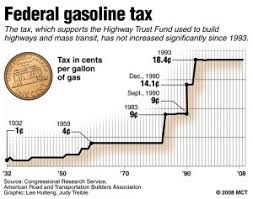
I, and others, certainly will have plenty of articles about what is wrong and right about the current tax cuts proposals.  But, as I read the plan, I became frustrated with a proposal that was missing – fixing the Highway Trust Fund.

Infrastructure spending is a priority of this administration.  In the spring President Trump announced his $1 Trillion ($1,000,000,000,000) infrastructure plan.   According to the administration, the plan will rebuild the nation’s roads, tunnels and bridges.  By September, the administration was contemplating how to pay for this spending from private sector credits to dumping the burden on the states.

The most recent discussion of how to pay for the $1 Trillion spend happened during discussions with the House Ways and Means members.  According to the Washington Post, “At the meeting Tuesday, Higgins said Trump indicated the administration instead would seek to pay for infrastructure upgrades through direct federal spending — either by paying for projects with new tax revenue or by taking on debt.”

images

I was hoping, I know naivety, that another option would be discussed – pay for the infrastructure spending like always via the Highway Trust Fund which generates revenues via the gasoline and diesel tax.  Since there would be a budgetary shortfall, maybe we should actually increase or fix the tax.

History of Gas Tax Continue reading “Missing In Tax Reform: What About the Gas Tax?”

Some Tax Reform Links and Tweets over at #BLPB

Ann Lipton at Business Law Profs Blog has assembled a nice collection of links to news commentary and tweets about the House tax bill.

Many of the links Ann has assembled look at the industry and deal-specific impacts of the tax bill…For example, potential effects on LBOs, sports stadium financing, future of stock options, higher education, and homebuilders.  A nice complement to the more ubiquitous analyses of revenue effects, scoring, and distributional estimates we’re seeing on the tax prof/economists side. This information about who is likely to feel what effects gives us some insights into how the politics/political economy of this tax reform is likely to unfold going forward. Well worth a click.

The Johnson Amendment Under GOP Plan

By: David Herzig

Back in May, I continued to track President Trump’s promise to end the Johnson Amendment.  At that time he promised during a National Prayer Breakfast that he would “get rid of and totally destroy” the Johnson Amendment and promised to issue an executive order (which he signed May 4).

But, a significant problem with legislating via Executive Order is that executives change and with the change so goes the Executive Orders.  What works much better is legislation. Enter, the Tax Cuts and Job Act, where there is a proposal to end the Johnson Amendment.

What is the Johnson Amendment? In 1954, without explanation, Lyndon Johnson  Continue reading “The Johnson Amendment Under GOP Plan”

International Sharing Economy Conference: Day 2 Takeaways

By: Diane Ring

Yesterday I blogged about Day 1 of the international sharing economy conference, titled “Reshaping: Work in the Platform Economy.” Today the Conference resumed in Amsterdam and included a fascinating roundtable with representatives from some of the platform firms alongside some sharing economy workers. Each offered their experience/perspective on the sector, posed questions to each other, and took questions from the audience.

Not surprisingly, just as there are a range of business models and niches in the sector, there are also a variety of reasons why workers participate in and do platform work. What workers seek from the platforms (beyond good pay) may differ from worker to worker. For example, a sharing economy worker may desire contact with other workers, a sense of community, predictability, or worker dignity. Building on the Day 1 discussions, several themes emerged by the close of the Conference:

Continue reading “International Sharing Economy Conference: Day 2 Takeaways”

International Sharing Economy Conference: Day 1 Takeaways

By: Diane Ring

Today the “Reshaping: Work in the Platform Economy” Conference got underway in Amsterdam. In contrast to many academic conferences, the explicit goal here is to bring together a truly wide array of actors in the sharing economy (policy makers, academics, actual gig workers, platform businesses, research institutes, and media) in a mixed format setting that includes academic presentations, panel presentations by gig workers, small group active round tables, and research-poster sessions. The international dimension, with participants and presenters from a variety of jurisdictions, contributes to the breadth of discussion.

I thought I would offer a few of my takeaways from day one: Continue reading “International Sharing Economy Conference: Day 1 Takeaways”

IRS ‘Targeted’ Liberal Organizations and After All These Years TIGTA is Still Wrong

darts-2349444_1920By: Philip Hackney

The Treasury Inspector General for Tax Administration (TIGTA) just issued a new report four years and five months after rebuking the IRS for using “inappropriate” criteria to select applications for tax exempt status for scrutiny. In the first report, TIGTA rebuked the IRS for pulling the applications of conservative leaning organizations for greater scrutiny.

This time it considers the fact that the IRS over a period of 10 years used liberal leaning names such as ACORN, Emerge, and Progressive as criteria for pulling applications for greater scrutiny. This resulted in the IRS applying greater scrutiny to these organizations. Some might say the IRS targeted these organizations. Those organizations appear to have faced long wait times as well, and sometimes some questions of limited merit.

I write this piece to make two points: (1) had this information been in the initial report, I don’t think we would have had the “scandal” that shook the IRS and the political world of the time; and (2) the TIGTA report built its primary claim on a garbled faux legal postulate. The original report did terrible damage to the IRS and individuals by failing on both of these fronts. Continue reading “IRS ‘Targeted’ Liberal Organizations and After All These Years TIGTA is Still Wrong”

The Real IRS Scandal

By: Leandra Lederman

It is well known that the IRS was accused in 2013 of targeting Tea Party and other conservative groups for delays in their 501(c)(4) applications for tax-exempt status. TIGTA’s May 2013 report (and Lois Lerner’s statements at an ABA Tax Section meeting a few days earlier) launched the controversy, which harmed the IRS and a number of its employees. (Cf. my earlier Surly post, “Don’t Impeach IRS Commissioner Koskinen.”)

In 2016, I published an article, “IRS Reform: Politics As Usual?,” analyzing the facts underlying these accusations and the law applicable to the IRS’s determination of tax-exempt status. I argued that the facts showed that the IRS was not motivated by partisan politics. Rather, what happened was that IRS employees included a keyword approach in its efforts to triage the large volume of applications for tax-exempt status it was receiving. Its “Be On the Lookout” (BOLO) list of words was designed to help it identify for further scrutiny those organizations that were engaged in more political activity than was permitted under section 501(c)(4), which, generally speaking gants exempt status to organizations “for the promotion of social welfare.” As I describe in that article, the IRS tried but failed to get ahead of a brewing political controversy on this. There was evidence even in the 2010 IRS PowerPoint highlighting types of groups applying for a determination of exempt status under 501(c)(4) that the IRS had both Tea Party and progressive political organizations on its radar. But the news was full of stories of the IRS supposedly targeting conservative tax-exempt organizations.

The Washington Post has reported in an article titled Liberal groups got IRS scrutiny, too, inspector general suggests, that TIGTA will be issuing a new report finding that the IRS also used keywords to try to identify progressive groups engaging in too much political activity to qualify for the tax exemption under 501(c)(4) they were applying Continue reading “The Real IRS Scandal”

Tax Leaks: The New Normal?

By: Diane Ring

Today, the Guardian is reporting that big-four accounting firm Deloitte suffered a hack back in March, 2017. The underlying attack may have originated in the fall of 2016 and may have allowed access to Deloitte systems for several months.

Deloitte itself is not unfamiliar with cybersecurity. As stated on its website, among the services that Deloitte offers clients is Cyber Risk. However, being a victim of a hack provides a new perspective. At this point, details are scarce on exactly which clients have been affected and what specific information may have been accessed, but it has been reported that “confidential emails and plans of some of its blue-chip clients” may have been compromised. This doesn’t sound good. But it is also no surprise.

Leaks and hacks can target a wide variety of data including business plans, mergers and acquisitions, scientific developments, business forecasts, individual identities, and government records. In recent years, tax-related information has proven especially attractive to leakers and hackers. As my co-author, Shu-Yi Oei and I explored in our recent article, Leak-Drive Law studying tax leaks that have occurred over the past 10 years, tax information can be valuable and their release by leakers can have powerful impacts. Moreover, as the tax community has embraced increased reporting and transparency to the government, the number of caches of well-organized data held by corporations, tax advisers and governments increases. Such caches may be magnets for those seeking to hack into it or leak it.

As we continue to move forward in this new world, what do we know? Continue reading “Tax Leaks: The New Normal?”