Under His Plan, Will Trump’s Taxes Go Up?

By Sam Brunson

Honestly, we have no way of knowing. For one thing, we don’t know how much Trump currently pays in taxes. For another, the plan he has provided is less a plan than it is a shopping list, a shopping list that’s really light on details. But we can at least make a guess. (Spoiler alert: he probably won’t.) Continue reading “Under His Plan, Will Trump’s Taxes Go Up?”

How Will Trump’s Tax Plan Affect Middle-Income Families?

By Stephanie Hoffer, @profhoffer

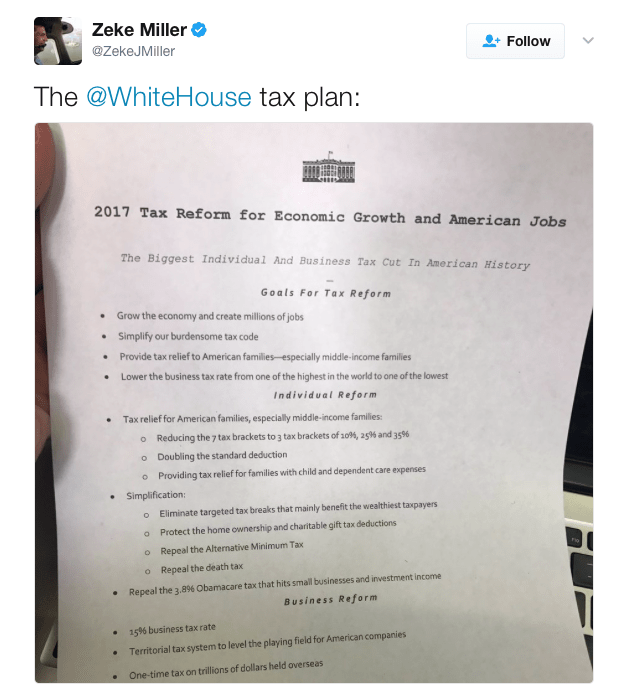
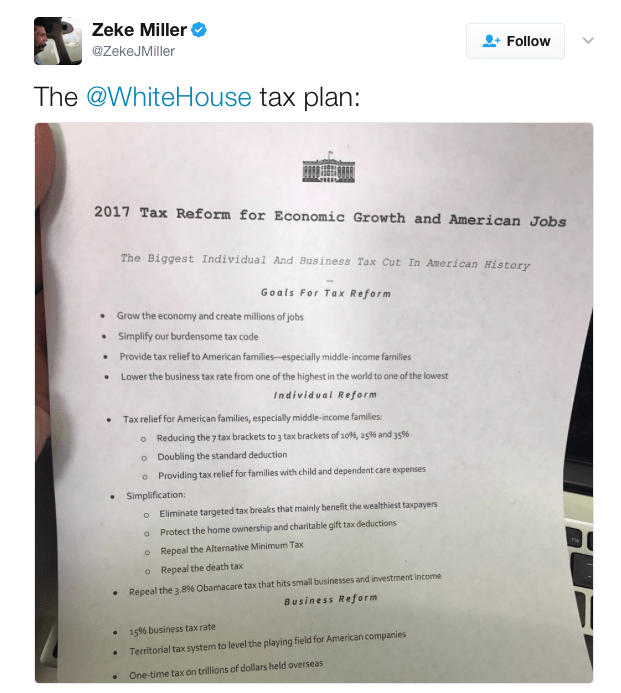
The President’s one-page tax plan, released on Wednesday, claims that it will “[p]rovide relief to American families – especially middle income families.”  Whether tax reform eventually lives up to the President’s claim, though, will depend on how he and the Congress choose to address not only tax rates and the standard deduction, but also the personal exemption and credits related to children and dependents.

Like the Republican blueprint for tax reform, the President’s plan would double the standard deduction while trimming itemized deductions.  It also would expand the credit for child and dependent care, although the plan doesn’t specify how.

Notably, the Republican proposal would eliminate personal exemptions provided by § 151, which allow a deduction of $4,050 per dependent in 2017.  Dependents include a taxpayer’s spouse, children, and other members of the household who rely family support.   Although the repeal of § 151 was not specifically mentioned in the President’s proposal, the President and Congress must reach consensus on how to reduce the cost of tax reform.  Eliminating personal exemptions in favor of an expanded standard deduction may be an approach on which both could agree, but it may not be good policy. Continue reading “How Will Trump’s Tax Plan Affect Middle-Income Families?”

We Should be Taking President Trump’s Tax Plan Seriously

By: David J. Herzig

Today President Trump’s top tax advisors laid out the first details of the his tax plan. Chief economic adviser Gary Cohn and Treasury Secretary Steve Mnuchin unveiled the plan which according to Fox News, Cohn called “the most significant tax reform legislation since 1986, and one of the biggest tax cuts in American history.”

Oh, did I mention that the details of the biggest cuts were printed on a single sheet of paper?

Screen Shot 2017-04-26 at 4.22.18 PM

There has been plenty of ink (and jokes) already spilled about the plan.  For example, you can read Richard Rubin of the WSJ (here) or Alan Rappeport of the NY Times (here). The long and the short of the plan is it seems to very very costly.  The Committee for a Responsible Federal Budget guesses it could cost $3 to $7 trillion with their estimate at $5.5 trillion.  That is a lot of money!

Continue reading “We Should be Taking President Trump’s Tax Plan Seriously”

Trump’s Back-to Basics Tax Plan: It’s Tremendous!

Aren’t we all wondering what President Trump’s big tax reform announcement will be tomorrow?  Loyola Los Angeles Tax LL.M. student Anosh Ali ventured a tongue-in-cheek guess in a short memo he wrote in Katie Pratt’s Tax Policy class.  We’ll see tomorrow how good a prognosticator Anosh is. 

Until then, at least we know that his Presidential ‘voice’ is spot on


TO:         President Trump

FROM:   Anosh Ali, White House Communications Specialist

RE:         Your tax reform press conference on Wednesday

DATE:    April 25, 2017

_____________________________________________________________________________________

You have asked me to prepare talking points for your tax reform press conference tomorrow. This memo includes general talking points and responses to hostile questions you are likely to get from the liberal media. Continue reading “Trump’s Back-to Basics Tax Plan: It’s Tremendous!”

The Surly Subgroup Turns One!

Time flies when you’re having fun, I guess. Today is the one-year blogiversary of the Surly Subgroup. What started off as a group-blogging experiment hatched at last year’s Critical Tax Conference at Tulane Law School has provided quite a bit of entertainment for Surly bloggers and our guest bloggers, and hopefully for our readers as well.

It’s obviously been a big year on tax and other fronts. Since our inception, we’ve published 206 blog posts on a variety of topics. And we’ve drawn readers from 140 different countries.

Surly regulars and guest bloggers have covered various tax-related issues surrounding politics and the 2016 election—including disclosure of presidential tax returns, the Emoluments Clause, the Trump Foundation, and the Clinton Foundation. We’ve written about churches, 501(c)(3)s and the IRS treatment of non-profits. We’ve discussed the tax reform proposals of the 2016 presidential candidates and the #DBCFT. We’ve written several administrative law posts about Treasury Regulations and rulemaking.

Politics aside we’ve also covered other important issues in tax policy—including taxation and poverty, healthcare, tax policy and disabilities, tax compliance, and tax aspects of the Puerto Rico fiscal crisis. We’ve discussed several issues in international and cross-border taxes, touching on the EU state aid debate, the CCCTB, taxation and migration, the Panama Papers, tax leaks more generally, and tax evasion in China.

We hosted our first ever online Mini-Symposium on Tax Enforcement and Administration, which featured posts by ten different authors on a variety of tax administration topics. The Mini-Symposium was spearheaded by Leandra Lederman. Leandra had organized and moderated a discussion group on “The Future of Tax Administration and Enforcement” at the 2017 AALS Annual Meeting, and many of the discussion group participants contributed to the online symposium. We hope to organize future online symposia on other topics.

We’ve blogged about various conferences, workshops, and papers, both tax related and not-so-much tax related. We’ve also had lots of fun writing about taxes in popular culture – Surly bloggers and guest bloggers have written about the tax aspects of Pokémon Go, tax fiction, music-related tax issues (Jazz Fest! Prince! “Taxman”!), soccer players, dogs, Harry Potter fan fiction, Star Trek, and John Oliver. Surly bloggers even recorded a few tax podcasts!

In short, it’s been a busy year, and we’ve had a lot of fun with the Surly platform. We hope you have as well. Going forward, we’re going to keep the blog posts coming. We also hope to draw more regular and guest bloggers and to organize other online symposia.

Thanks for reading!

Panama Papers: The One-Year Anniversary

By: Diane Ring

This month marks the one-year anniversary of the Panama Papers leak. In April 2016, the ICIJ announced the leak and a few weeks later (May 9, 2016) released a database that included a subset of the leaked data. The leak itself comprised over 11 million records spanning 40 years from the Panamanian law firm Mossack Fonseca. At its core, the leak revealed the true ownership of over 200,000 offshore entities, thereby raising a host of tax and political questions regarding many of the entities’ owners.

So what has happened over the past year as a result of the leak? Continue reading “Panama Papers: The One-Year Anniversary”

Teaching Depreciation with a #DBCFT Lurking

Shu-Yi Oei

I’m teaching depreciation in my Basic Federal Income Tax class this week. As I suspect is the case for most tax profs, our coverage of depreciation comes right after we wrap up discussion of expense taking in §§ 162 and 212 (and § 195) but before we get to § 165 losses.

Depreciation is literally my favorite topic in the entire universe to teach. I mean, if I was going to get a tattoo of a Code section on myself, it would literally be “26 U.S.C. § 168 (as amended).” No disrespect meant to 26 U.S.C. §§ 167, 179, 197 and friends. [Distraction: Here is a virtual tattoo generator. You, too, can practice getting your favorite Tax Code section inked on yourself.] I firmly believe that you can teach any number of core skills in tax class by teaching depreciation (e.g., statutory construction, policy choices, reading cross-references, political economy and legislative change, time value of money, etc.). Conversely, I also tend to think that if you can understand the depreciation statute in Basic Tax and explain it to your classmates, you can do pretty much anything in our legal profession.

Therefore, putting aside all of the reasons why cash-flow expensing may not have the effects that one might hope, I will be absolutely heartbroken if we actually end up with a cash-flow tax, because then what am I gonna talk about in tax class?

All of which brings me to today’s dilemma: Do I mention the ubiquitous #DBCFT in teaching depreciation this week? Or can I just pretend it’s not happening? If one does teach cash-flow expensing, when does one bring it up (i.e., in what order of coverage)? My inclination is to (1) explain the basics of how economic cost recovery over time works in theory; (2) talk briefly about the ACRS changes in 1981; (3) teach the Simon v. Commissioner cases (violin bows) to illustrate the policy tensions that arise once we move from true economic recovery and actual useful lives to ACRS and statutory recovery periods; (4) discuss #DBCFT as an alternative design approach, noting the possible benefits and downsides of that approach, noting that there’s some discussion in the ether right now re whether we should be doing this (and deemphasizing the border adjustment features); (5) introduce bonus depreciation concepts (§§ 168(k) and 179) as an illustration of how expensing has surreptitiously worked its way into the conversation in the guise of bonus depreciation circa financial crisis; and then (6) move right along to parsing the actual statutory elements of §§ 167 and 168 and understanding how it all stitches together.

This strikes me as a nice middle ground between (1) dorkin’ out and going #DBCFT full bore and totally losing the class, and (2) just ignoring the current debate. I’d be curious to know what other tax profs are doing with coverage here.

Taxation and Migration

By: Diane Ring
IMG_0592Today St. Louis University School of Law hosted the Sanford E. Sarasohn Conference on Critical Issues in Comparative International Taxation II: Taxation and Migration. This event offered a much needed forum to explore the intersection between international tax law and questions of migration and refugees. Topics addressed included using the tax system to remedy migration challenges (see, for example, Matthew Lister, “A Tax-Credit Approach to Addressing Brain-Drain” suggesting a tax transfer from jurisdictions on the receiving end of a brain drain to the countries losing skilled labor; and see Cristina Trenta, “Migrants and Refugees: An EU Perspective on Upholding Human Rights Through Taxation and Public Finance” advocating an EU-wide tax to finance members’ commitments to refugee human rights). Other papers considered the burdens that tax-induced migration creates for the society the migrant leaves and for some members of the jurisdiction the migrant joins (see, for example, Allison Christians, “Buying In: Citizenship and Residence by Investment”). The full set of 15 conference papers will be published in the St. Louis University Law Journal and will provide a valuable resource on the breadth of taxation and migration questions.

PROMESAs, PROMESAs?

Shu-Yi Oei

After swearing up and down that I would blog more about Puerto Rico’s 70 billion dollar debt crisis, I of course was remiss and did not. But a new paper by Mitu Gulati and Robert Rasmussen, “Puerto Rico and the Netherworld of Sovereign Debt Restructuring” has provided me the impetus to dive into this topic again.

Recall that unlike U.S. municipalities (such as Detroit), Puerto Rico bodies and utilities aren’t considered debtors for purposes of Chapter 9 of the U.S. Bankruptcy Code and therefore don’t have access to the municipal bankruptcy process. See 11 U.S.C. § 101(52). Puerto Rico attempted to address its fiscal woes by enacting the 2014 Puerto Rico Public Corporation Debt Enforcement and Recovery Act, which created a debt restructuring mechanism analogous to Chapter 9 municipal bankruptcy. However, the U.S. Supreme Court ruled on June 13, 2016 that the Act was preempted by Section 903(1) of the U.S. Bankruptcy Code. Puerto Rico v. Franklin California Tax-Free Trust, 136 S. Ct. 1938 (2016). [Fn. 1]

After the Franklin Trust decision, Congress stepped in and passed the Puerto Rico Oversight, Management, and Economic Stability Act (PROMESA) legislation on June 30, 2016, to allow Puerto Rico to restructure without filing for Chapter 9 bankruptcy. Briefly, PROMESA establishes an independent oversight board, provides for a bankruptcy-like debt restructuring process, and requires submission of a Fiscal Plan by Puerto Rico. Puerto Rico’s required Fiscal Plan was approved by the Oversight Board on March 13, 2017; however, that plan has come under criticism from bondholders.

This all begs the question, however, of what would have happened had Congress NOT passed the PROMESA legislation. Puerto Rico would have been left in a bind in which it had no access to the U.S. municipal bankruptcy process but was preempted from enacting any analogous debt restructuring mechanism by Section 903(1) of that same Bankruptcy Code, per Franklin California Tax-Free Trust. [Fn. 2]

Gulati and Rasmussen’s paper focuses on this question, arguing that, as a constitutional matter, the United States may not prohibit Puerto Rico from enacting its own bankruptcy-like restructuring process while offering no alternative mechanism. This leaves Puerto Rico in an untenable “netherworld,” in which it has the power to issue debt without the mechanisms for dealing with financial distress on the back end.

Continue reading “PROMESAs, PROMESAs?”

ACTC Letter Requesting a Variance for Tax Guidance

By: Leandra Lederman

Sam Brunson previously blogged about President Trump’s Executive Order of January 30, 2017, “Reducing Regulation and Controlling Regulatory Cost,” which requires an agency to identify two regulations to eliminate for every new regulation it issues. (Sam also has related posts here and here). As Sam stated, the Executive Order burdens taxpayers, who benefit from the public guidance Treasury regulations provide.

On March 23, the American College of Tax Counsel (ACTC) sent a letter to the Secretary of Treasury, Hon. Steven Mnuchin, and the Director of the Office of Management and Budget, Hon. Mick Mulvaney, “respectfully request[ing] that the Administration consider the unique role that the tax law plays in the lives of every American and provide the Treasury Department and the IRS with appropriate flexibility in issuing guidance that taxpayers and their advisors need in order to comply with the tax law.” The letter explains in part:

“By limiting the flexibility of Treasury and the IRS to issue such guidance, the Executive Order risks shifting the interpretive burden onto taxpayers, who must hire accountants, lawyers, and other advisors to guide them. . . . Moreover, by requiring Treasury and the IRS to identify two ‘deregulatory’ actions for each new guidance item, the Executive Order risks imposing additional burdens on taxpayers if it results in the elimination of existing rules that taxpayers and their advisors have come to rely on.”

I hope that Secretary Mnuchin and Director Mulvaney are receptive. As the ACTC’s letter states, even while simplification efforts are underway, “it is critical for taxpayers and their advisors to have the guidance needed to comply with the tax law as currently in effect.”

Did Rachel Maddow Break the Law? #TrumpTaxReturns

By Sam Brunson

Last night, Rachel Maddow dropped a bombshell: reporter David Cay Johnston had a leaked copy of Donald Trump’s 2005 tax return, and he shared it on her show.

Okay, maybe it wasn’t entirely a bombshell; in our leakhappy environment, it was almost inevitable that we’d eventually see some of Trump’s returns. And this barely counts as a return: it’s just his Form 1040 from 2005 (that is, the first two pages of a return). When I grade voluntary presidential candidate tax disclosures, one year’s Form 1040 realistically gets you a D+; the 1040 says how much you ultimately paid in taxes, but very little more than that. (For example, you can see that Trump had itemized deductions of just over $17 million, but you can’t tell what itemized deductions he took. I mean, is it mortgage interest? state and local taxes? charitable contributions? some combination? Without the full return, we have no way of knowing.) Continue reading “Did Rachel Maddow Break the Law? #TrumpTaxReturns”

The Insurance Market Regulations in the Republicans’ Health Care Bill: Crippling Obamacare, or Passing a Hot Potato to State Governments?

By David Gamage

On Monday, the House Republicans finally revealed their draft bill to “repeal and replace” the Affordable Care Act (#Obamacare or #ACA). The bill is titled the American Health Care Act, and commentators have been referring to it as either the #AHCA or #Trumpcare.

To assess the bill, it is helpful to think of it as consisting of four primary buckets:

  1. ending many of Obamacare’s tax provisions (read: large tax cuts for the very wealthy);
  2. phased-in cuts to Medicaid funding and scheduled devolution of Medicaid to the states (read: eroding the health safety-net program for the poor);
  3. transforming Obamacare’s other major health subsidies from being based mostly on income and health costs to being based more on age (read: the implications of this are actually less straightforward than what much of the commentary suggests, but that is a topic for another day); and
  4. other changes to Obamacare’s insurance market regulations (the subject of today’s blog post).

In this blog post, I will focus on the fourth bucket—the changes to Obamacare’s insurance market reforms other than the changes to the subsidies. Time permitting, I hope to write future blog posts on some of the other buckets.

What is most striking about the AHCA’s insurance market changes is how they keep the vast majority of Obamacare’s reforms in place. Right-wing groups have thus taken to calling the AHCA “#ObamacareLite”. Yet I consider this a misnomer. A more accurate label would be #ObamacareCrippled.

The AHCA’s changes do not really water down Obamacare, as the intended slur of “ObamacareLite” implies. Rather, the AHCA’s changes would likely cause Obamacare‘s framework for regulating the individual market to fall apart. If the AHCA bill were to be enacted in its current form, the result would likely be adverse-selection death spirals. The only real hope for saving the individual market would be for state governments to step up with new state-level regulations for supporting insurance markets within each state.

Continue reading “The Insurance Market Regulations in the Republicans’ Health Care Bill: Crippling Obamacare, or Passing a Hot Potato to State Governments?”

Past Moratoria on Tax Guidance and Regulations(?)

By: Sam Brunson

cch_standard_federal_tax_printOn my previous post talking about the the IRS’s announcement that it was putting a moratorium on issuing new regulations and formal guidance, a commenter asked if it was such an odd thing for a new Administration to temporarily pause guidance. After all, who wants to issue guidance before the new Administration’s people are in place and agenda is set, lest the new Administration change its priorities and positions in the coming months?

I didn’t remember any such (formal, at least) pause in 2009, but, when I got home, I decided to look back a few years. I looked at new regulations and revenue rulings in the first month of the Obama, George W. Bush, Clinton, and Reagan presidencies (I didn’t bother with George H.W. Bush, because that was a Republican to Republican switch). Also, because we don’t know how long the current limitations on regulations and other guidance will last, I also expanded my search of revenue rulings for the first three months of the new administrations.[fn1] Continue reading “Past Moratoria on Tax Guidance and Regulations(?)”

When Leaks Drive Tax Law (a.k.a. our new paper!)

Shu-Yi Oei

Diane Ring and I just posted our new article, Leak-Driven Law, on SSRN. I had previously blogged about this paper as part of Leandra Lederman’s 2017 Mini-Symposium on Tax Enforcement and Administration, The abstract is here:

Over the past decade, a number of well-publicized data leaks have revealed the secret offshore holdings of high-net-worth individuals and multinational taxpayers, leading to a sea change in cross-border tax enforcement. Spurred by leaked data, tax authorities have prosecuted offshore tax cheats, attempted to recoup lost revenues, enacted new laws, and signed international agreements that promote “sunshine” and exchange of financial information between countries.

The conventional wisdom is that data leaks enable tax authorities to detect and punish offshore tax evasion more effectively, and that leaks are therefore socially beneficial from an economic welfare perspective. This Article argues, however, that the conventional wisdom is too simplistic. In certain circumstances, leak-driven lawmaking may in fact produce negative social welfare outcomes. Agenda-setting behaviors of leakers and media organizations, inefficiencies in data transmission, suboptimally designed legislation, and unanticipated behavioral responses by enforcement-elastic taxpayers are all factors that may reduce social welfare in the aftermath of a tax leak.

This Article examines the potential welfare outcomes of leak-driven lawmaking and identifies predictable drivers that may affect those outcomes. It provides suggestions and cautions for making tax law, after a leak, in order to best tap into the benefits of leaks while managing their pitfalls.

In this paper, we wanted to explore how leaks of taxpayer data in the offshore context have shaped international tax law and policy, both in the US and other countries. We especially were interested in the possibility that—while leaks might appear useful on the surface from a tax enforcement and informational standpoint—there are unexplored pitfalls and downsides to relying on leaks to direct lawmaking and policy priorities.

In the non-tax world, of course, leaks have suddenly become very salient, in terms of both their usefulness and their dangers. But (non-tax lurkers take note!) tax law has been dealing with leaks of taxpayer information and what they mean for tax enforcement for at least the past ten years. Of course, tax leaks have some distinctive characteristics that make them different from other types of leaks. For example, the tax leaks that are the subject of this paper are usually (though not invariably) leaks of private taxpayer data, rather than leaks about governments from government sources.

We do think that the framework we introduce in our paper for analyzing the upsides and downsides of leak-driven lawmaking can be applied to explore how non-tax leaks and reactions to them may be socially beneficial but could also lead to less than ideal results. In both tax and in other fields, the meta-issue is not just how governments and private actors can use leaked information to sanction bad behaviors, make decisions, or design laws. Rather, the issue is how the actions and responses of leakers, governments, journalists, international organizations and the public work together to create and promote certain outcomes. Once we understand the underlying dynamics, then we can consider how the outcomes they create should be evaluated, supported, or resisted.

If you’re working on leak-related scholarship in either tax or other fields, we’d love to chat.
The (Near) Future of Treasury Regulations

cfrToday’s Tax Notes reports[fn1] that the IRS has announced that it will not release pretty much any new formal guidance (including revenue rulings and revenue procedures) for the foreseeable future.[fn2]

Why not? A confluence of an Executive Order and a January 20 memorandum. The EO, “Reducing Regulation and Controlling Regulatory Cost,” requires that, for every new regulation issued, two existing regulations be eliminated.

The January 20 memorandum further prohibits agencies from sending regulations to the Federal Register until they’ve been reviewed by an agency or department head appointed by Trump. Continue reading “The (Near) Future of Treasury Regulations”