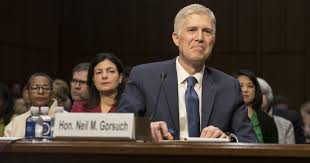
The Strategic Case Against the Democratic Filibuster of Neil Gorsuch

Photo: Jarrad Henderson, USA TODAY

By: Daniel Hemel and David Herzig

[Note: This post is co-authored with Daniel Hemel, Assistant Professor of Law at The University of Chicago School of Law.]

The strategic case against a Democratic filibuster of Neil Gorsuch is straightforward. The argument is not that the filibuster will prevent President Trump from putting someone like Andrew Napolitano on the Court. The argument is that the filibuster may prevent President Trump from filling a future vacancy with a well-credentialed conservative who is ideologically similar to or right of Judge Gorsuch. To elaborate:

— (a) The filibuster accomplishes no work when there are fewer than 50 Senators who will support a nominee on an up-or-down vote. (Napolitano presumably falls into this category.)

— (b) The filibuster also does no work when there are 50 or more Senators who will support a nominee even if that means going nuclear. (Judge Gorsuch appears to fall into this category.)

— (c) The filibuster matters when (1) there is a nominee who would win 50 or more Senators on an up-or-down vote, but (2) fewer than 50 Senators would support the nuclear option in order to put the nominee on the Court.

Is (c) an empty set?

Continue reading “The Strategic Case Against the Democratic Filibuster of Neil Gorsuch”

Cross-Training (or, Tulane Corporate and Securities Law Roundtable)

My pal Ann Lipton–corporate governance and securities law expert and blogger extraordinaire over at BLPB–is organizing a conference at Tulane Law School today on the topic of “Navigating Federalism in Corporate and Securities Law.” It looked so interesting that I had to leave Henry Ordower and Kerry Ryan’s fabulous Critical Issues in Comparative and International Taxation: Taxation and Migration Conference a day early to crash her party! I’ve been auditing Securities Regulation and very much feeling like a little duckling in the securities/corporate world all semester, so I’m really looking forward to sitting in on an unfamiliar conversation. I always find that “cross-training” in other fields gives me fresh perspectives on my own work.

Here is the schedule. Some of these papers are really interesting!

The Problem of Large Shareholders
(Discussant: Urska Velikonja)

The Problem of Small Shareholders
(Discussant: Ann Lipton)

  • Jill Fisch (Penn), Advance Voting Instructions: Tapping the Voice of the Excluded Retail Investor
  • J.W. Verret (George Mason), Uber-ized Corporate Law

What Can States Regulate?
(Discussant: Jill Fisch)

  • Kent Greenfield (Boston College), Corporate Power and Campaign Finance
  • Summer Kim (Irvine), Corporate Long Arms

The Line Between Corporate Law and Securities Law
(Discussant: James Cox)

  • Ann Lipton (Tulane), Reviving Reliance
  • James Park (UCLA), Delaware and Santa Fe
  • Robert Thompson (Georgetown), Delaware’s Dominance: A Peculiar Illustration of American Federalism

The Operation of the SEC
(Discussant: James Park)

  • James Cox (Duke), Revolving Elites: Assessing Capture in the SEC
  • Urska Velikonja (Emory), Admissions in Public Enforcement

Taxation and Migration

By: Diane Ring
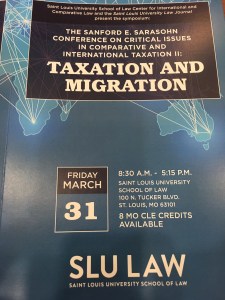
IMG_0592Today St. Louis University School of Law hosted the Sanford E. Sarasohn Conference on Critical Issues in Comparative International Taxation II: Taxation and Migration. This event offered a much needed forum to explore the intersection between international tax law and questions of migration and refugees. Topics addressed included using the tax system to remedy migration challenges (see, for example, Matthew Lister, “A Tax-Credit Approach to Addressing Brain-Drain” suggesting a tax transfer from jurisdictions on the receiving end of a brain drain to the countries losing skilled labor; and see Cristina Trenta, “Migrants and Refugees: An EU Perspective on Upholding Human Rights Through Taxation and Public Finance” advocating an EU-wide tax to finance members’ commitments to refugee human rights). Other papers considered the burdens that tax-induced migration creates for the society the migrant leaves and for some members of the jurisdiction the migrant joins (see, for example, Allison Christians, “Buying In: Citizenship and Residence by Investment”). The full set of 15 conference papers will be published in the St. Louis University Law Journal and will provide a valuable resource on the breadth of taxation and migration questions.

Call for Papers: 18th Global Conference on Environmental Taxation (Tucson, AZ, Sept. 27-29, 2017)

Here’s another call for papers:

Please plan ahead for the 18th Global Conference on Environmental Taxation! The deadline for submitting abstracts in response to the Call for Papers is May 1, 2017 and early submissions are welcome. For information about the conference and the Call for Papers, click here.

This year the conference’s focus is: Innovation Addressing Climate Change Challenges: Local and Global Perspectives

We are in a pivotal and defining time for global discourse on public/private sector response at all levels of government (national, state, indigenous, provincial, municipal, city, and local), to the impacts of climate change. And, GCET18 is well-positioned in its role as the leading global forum for innovative exchanges on principles, practices, and policies with respect to environmental taxation and market-based instruments.

The conference will explore various topics :

  • Climate change policy, biodiversity protection, environmental stewardship, pollution control, water conservation, land degradation, renewable energy, mining and rehabilitation
  • Market instruments such as carbon pricing, emissions trading schemes, other environmental taxes, subsidies, direct action or spending programs and tax concessions both positive and perverse.

Selected papers from the Global Conferences are published in Critical Issues in Environmental Taxation.

The conference this year will be hosted by the University of Arizona, James E. Rogers College of Law, and the Conference Chair is Mona Hymel. If you have questions, please contact her at law-gcet18@list.arizona.edu.

We hope to see you in Tucson!

Prof. Janet E. Milne
Director, Environmental Tax Policy Institute
Co-editor, Handbook of Research on Environmental Taxation
Vermont Law School, USA


Tax Professors on Twitter

By David J. Herzig

By David Herzig

I am trying to keep this updated quarterly.  So, please find the most updated list.  There are a number of new names on the updated list as tax professors continue to enter the twitterverse.  I did update the list to be in alphabetical order.  As always, if I am missing someone, please let me know.

Starting with the SurlySubgroup (@surlysubgroup)

Jennifer Bird-Pollan (@jbirdpollan)

Sam Brunson (@smbrnsn)

Phil Hackney (@EOTaxProf)

David Herzig (@professortax)

Stephanie Hoffer (@Profhoffer)

Leandra Lederman (@leandra2848)

Ben Leff (@benmosesleff)

Francine Lipman (@Narfnampil)

Diane Ring (@ringdi_dr)

Shu-Yi Oei (@shuyioei)

Other United States/Canadian Tax Professor (in alphabetical order):

Continue reading “Tax Professors on Twitter”

The Insurance Market Regulations in the Republicans’ Health Care Bill: Crippling Obamacare, or Passing a Hot Potato to State Governments?

By David Gamage

On Monday, the House Republicans finally revealed their draft bill to “repeal and replace” the Affordable Care Act (#Obamacare or #ACA). The bill is titled the American Health Care Act, and commentators have been referring to it as either the #AHCA or #Trumpcare.

To assess the bill, it is helpful to think of it as consisting of four primary buckets:

  1. ending many of Obamacare’s tax provisions (read: large tax cuts for the very wealthy);
  2. phased-in cuts to Medicaid funding and scheduled devolution of Medicaid to the states (read: eroding the health safety-net program for the poor);
  3. transforming Obamacare’s other major health subsidies from being based mostly on income and health costs to being based more on age (read: the implications of this are actually less straightforward than what much of the commentary suggests, but that is a topic for another day); and
  4. other changes to Obamacare’s insurance market regulations (the subject of today’s blog post).

In this blog post, I will focus on the fourth bucket—the changes to Obamacare’s insurance market reforms other than the changes to the subsidies. Time permitting, I hope to write future blog posts on some of the other buckets.

What is most striking about the AHCA’s insurance market changes is how they keep the vast majority of Obamacare’s reforms in place. Right-wing groups have thus taken to calling the AHCA “#ObamacareLite”. Yet I consider this a misnomer. A more accurate label would be #ObamacareCrippled.

The AHCA’s changes do not really water down Obamacare, as the intended slur of “ObamacareLite” implies. Rather, the AHCA’s changes would likely cause Obamacare‘s framework for regulating the individual market to fall apart. If the AHCA bill were to be enacted in its current form, the result would likely be adverse-selection death spirals. The only real hope for saving the individual market would be for state governments to step up with new state-level regulations for supporting insurance markets within each state.

Continue reading “The Insurance Market Regulations in the Republicans’ Health Care Bill: Crippling Obamacare, or Passing a Hot Potato to State Governments?”

The Taxman and Jazz Radio

By Sam Brunson

Yesterday, driving my son to swim lessons, I flipped my radio to WDCB, Chicagoland’s jazz radio station. An organ trio was playing something that sounded vaguely familiar. And then they returned to the melody, and it was the Beatles’s “Taxman.” And just like that, two of my favorite things—jazz and taxes—intersected.

Several months ago, Leandra did a great post on the history and context of “Taxman.” And her post yesterday on taxes in a series of novels got me thinking about how often tax shows up in jazz. When I posted about the musical tax canon, I mentioned Fats Waller’s “We the People,” but here, I specifically wanted to look for jazz covers of “Taxman.” And I found two: Continue reading “The Taxman and Jazz Radio”

Twitter Tax Feeds for 2017

By David Herzig

I promised I would update the twitter tax feeds in my last post.  There are a number of new names on the updated list as tax professors continue to enter the twitterverse.  I did update the list to be in alphabetical order.  As always, if I am missing someone, please let me know.

Starting with the SurlySubgroup (@surlysubgroup)

Jennifer Bird-Pollan (@jbirdpollan)

Sam Brunson (@smbrnsn)

Phil Hackney (@EOTaxProf)

David Herzig (@professortax)

Stephanie Hoffer (@Profhoffer)

Leandra Lederman (@leandra2848)

Ben Leff (@benmosesleff)

Francine Lipman (@Narfnampil)

Diane Ring (@ringdi_dr)

Shu-Yi Oei (@shuyioei)

Other United States/Canadian Tax Professor (in alphabetical order):

Continue reading “Twitter Tax Feeds for 2017”

Mind the Gap: Effect of IRS Budget Cuts on the Tax Gap and Potential Solutions

Roberta Mann
Mr. and Mrs. L. L. Stewart Professor of Business Law, University of Oregon School of Law

The Internal Revenue Service faces many challenges: scandals, threats to impeach the Commissioner, increasing burdens from expanding responsibilities, and, of course, the tax gap. In 2015, Jon Forman and I published an article entitled “Making the IRS Work,” which discussed ways of making the IRS more efficient given likely continued budget cuts under a Republican majority Congress. We concluded that while the IRS could become more efficient, the best way to enhance compliance and protect taxpayers would be to increase the IRS budget.

Since then, the prospect of increasing the IRS budget has not improved. Commissioner Koskinen reported that the IRS budget is down by $900 million since 2010. While the Obama Administration requested $12.280 billion to be appropriated for the IRS in FY2017, representing $1.045 billion more than the amount enacted for FY2016, the House passed a bill providing $10.999 billion in appropriations for the IRS in FY2017, representing $236 million below the amount enacted for FY2016. The Senate bill maintained FY2016 funding in its appropriations for the IRS.

An underlying assumption of our analysis is that the IRS should continue to function as an effective revenue collector. With lower budgets, the IRS must become more efficient to continue to effectively collect revenue. Uncollected revenue leads to the tax gap, which in general terms is the difference between the revenue owed and the revenue collected. A large tax gap not only constrains revenue, but also can lead to reduced voluntary compliance. IRS budget cuts over the past several years have not yet significantly affected the tax gap, which the IRS updated in April 2016. Continue reading “Mind the Gap: Effect of IRS Budget Cuts on the Tax Gap and Potential Solutions”

Tulane Law School Seeks to Hire Forrester Fellow and VAP

I’m passing along this hiring announcement from Tulane Law School for two positions: (1) the Forrester Fellowship, and (2) a VAP position focusing on the regulation of economic activity, broadly defined. (Emerging scholars doing work in tax are welcome to apply for both positions.)

Tulane Law School invites applications for its Forrester Fellowship and visiting assistant professor positions, both of which are designed for promising scholars who plan to apply for tenure-track law school positions. Both positions are full-time faculty in the law school and are encouraged to participate in all aspects of the intellectual life of the school. The law school provides significant support, both formal and informal, including faculty mentors, a professional travel budget, and opportunities to present works-in-progress to other faculty workshop in various settings.

Tulane’s Forrester Fellows teach legal writing in the first-year curriculum to two sections of 25 to 30 first-year law students in a program coordinated by the Director of Legal Writing. Fellows are appointed to a one-year term with the possibility of a single one-year renewal. Applicants must have a J.D. from an ABA-accredited law school, outstanding academic credentials, and at least three years of law-related practice and/or clerkship experience. To apply, please visit the Tulane University “iRecruitment” website at http://tinyurl.com/phd53k7. If you have any questions, please contact Erin Donelon at edonelon@tulane.edu.

Tulane’s visiting assistant professor (VAP), a two-year position, is supported by the Murphy Institute at Tulane (http://murphy.tulane.edu/home/), an interdisciplinary unit specializing in political economy and ethics that draws faculty from the university’s departments of economics, philosophy, history, and political science. The position entails teaching a law school course or seminar in three of the four semesters of the professorship (presumably the last three semesters). It is designed for scholars focusing on regulation of economic activity very broadly construed (including, for example, research with a methodological or analytical focus relevant to scholars of regulation). In addition to participating in the intellectual life of the law school, they will be expected to participate in scholarly activities at the Murphy Institute. Candidates should apply through Interfolio, at apply.interfolio.com/, providing a CV identifying at least three references, post-graduate transcripts, electronic copies of any scholarship completed or in-progress, and a letter explaining your teaching interests and your research agenda. If you have any questions, please contact Adam Feibelman at afeibelm@tulane.edu

The law school aims to fill both positions by March 2017.  Tulane is an equal opportunity employer and encourages women and members of minority communities to apply.
Top 2017 Tax Twitter Follows

By David Herzig

Every year, Kelly Erb (@taxgirl) posts her top tax Twitter follows.  This year, I was fortunate to make the list.  In addition to my shameless self promotion, I am directing you to her article because it was nice to see that many other academics made the list.

I think the fact that so many academics made this list is very important right now.  First, academics tend to get a bad rap for living in ivory towers.  Twitter is a great egalitarian platform. Second, in the upcoming months, active engagement by the best and brightest is paramount.  Twitter for all its flaws allows for real time interactions.  Seriously, you would be amazed how far you can spread your knowledge!  Finally, it reminds me to update my old list I posted at Surly. If I am missing your name, please let me know and I will repost later this month.

In the meantime, here were the academics on the list:

Tim Todd – @lawproftodd – Assoc Dean for Academic Affairs & Law Professor @LibertyLaw;

Andy Grewal – @AndyGrewal  – Professor of Law, @uiowa;

Judith Freedman – @JudithFreedman –  Oxford University Professor of Taxation Law;

Lily Batchelder  – @lilybatch – Professor of Law & Public Policy at @nyulaw;

David Herzig  – @professortax –  – Professor of Law @ValparaisoLaw;

Allison Christians – @taxpolblog –  Stikeman Chair in Tax Law, McGill University; and

Xavier Oberson – @XavierRoberson –  Professor of Swiss and International Tax Law at Geneva University

Budget Reconciliation Process and Obamacare

By: David Herzig

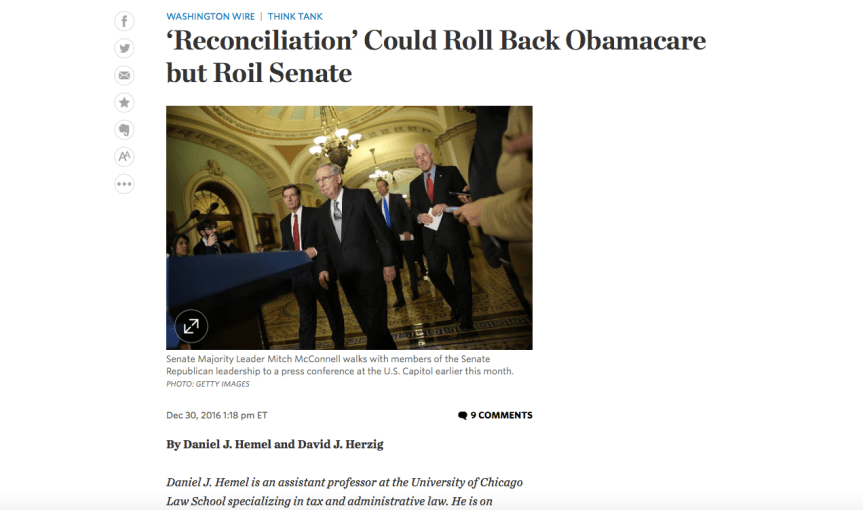
Friday the Wall Street Journal published Daniel Hemel and my article on why we think it will be very hard for the Senate to just do away with the ACA (aka Obamacare) via reconciliation.  We follow-up our earlier Surlygroup posting (also cross-posted at Yale J. Reg.) which discussed why the Senate norms are hard to break.  Since that article, we have developed some fairly interesting models on why we think the Senate norms are rather sticky – more on that to come.

In the Wall Street Journal article we state, “Most significantly, Majority Leader Mitch McConnell and his caucus may be forced to choose between their antipathy toward the ACA, also known as Obamacare, and their allegiance to longstanding institutional norms. In the end, the scope of ACA repeal will likely depend on whether Senate Republicans decide to score political victories in the short term or to maintain the Senate’s unique culture for the long haul.”

The problem for the republicans is the Byrd rule.  Repeal of the ACA will have budgetary impact beyond the budget window.  A decision will need to be made on the impact.  As we stated, “On some reconciliation-related questions, the presiding officer defers to the Budget Committee chairman, currently Senator Mike Enzi. On other questions, including whether a provision produces “merely incidental” effects on the budget, the presiding officer generally follows the advice of the Senate’s nonpartisan parliamentarian, the official adviser to the Senate on the body’s rules.”

Continue reading “Budget Reconciliation Process and Obamacare”

Rockefellers, Pratts and Private Cemeteries

By: David J. Herzig

The New York Times wrote about the Pratt Family burial plot. As Daniel Hemel pointed out there was also a tax story; apparently, the cemetery qualifies as a 501(c)(13) tax-exempt entity. So, when you combine tax and a Cleveland company, I was fascinated by the story. [1]

Because the cemetery is tax-exempt under section (c)(13), it can only benefit its members. This is contrary to the general rule for tax-exempts that you benefit everyone as opposed to just members. The question that the IRS had to address was how discriminatory could the cemetery be.  For example, whether both the Rockefellers and the Pratts could be buried in the cemetery. According to Daniel’s review of the rulings and regulations, “the Pratt family cemetery won’t lose its tax exempt status if it excludes the Rockefellers (or any other non-Pratts) from being buried there. But the family cemetery need not limit membership to Pratts in order to maintain its tax exemption.” All of which is true.

But, I wondered why does the family care so much about maintaining the tax exemption. I started to dig around to find the 990s of the cemetery. What if the tax-exemption were terminated? (As a certain President Elect has come to decide – sometimes the maintenance of tax-exempt entities are more trouble than they are worth).

Continue reading “Rockefellers, Pratts and Private Cemeteries”

White Nationalists Groups are Charitable? Apparently so According to IRS (Cooking the Books Podcast)

By: Philip Hackney, December 22, 2016

apple-256262_1280

Sam Brunson and I discuss an AP story “White Nationalists Raise Millions with Tax-Exempt Charities,” by Michael Kunzelman on a Cooking the Books  Podcast today on Sparemin.  The recording quality today is not the best, but I really liked the conversation a lot and hated to throw it away. I try to summarize it a bit below. Give it a listen. Let us know what you think.

Many might be surprised that these organizations that educate people about the righteousness of the superiority of the “white race” are operating openly under IRS approval as tax exempt organizations. It means that the US government effectively subsidizes the operation of these organizations through tax deductible charitable contributions and exemption for any income they earn.

How do they qualify? The primary argument must be that they are educational. The difficulty with this claim is that the IRS had success in the 1980s and 1990s in denying the tax exemption of two similar groups the National Alliance and the Nationalist Movement. This IRS CPE talks about those cases.  Continue reading “White Nationalists Groups are Charitable? Apparently so According to IRS (Cooking the Books Podcast)”

The Amazing Section 1202

By: David Herzig

I was fortunate enough to present to the Chicago Estate Planning Council about a week ago.  I rearranged a presentation that I gave at the Notre Dame Tax and Estate Planning Institute. (As an aside, both of these forums are great sources of continuing cutting edge eduction for the practicing bar).  I spent the majority of the hour I was allotted describing section 1202 the Qualified Small Business Stock Exemption.  To my shock, most of the 300 in attendance either were not familiar with the provision or had not thought about it for a decade.  After a quick twitter exchange, I thought I would do a short post explaining the code section as well as why it should be used or at least discussed more.

First, can everyone in Silicon Valley please stop laughing. I get it. You have been using 1202 since the 1990s.  Almost every VC agreement requires the target to qualify as 1202.  For the rest of us, let me catch you up on why 1202 is maybe one the largest give aways in the tax code today.

The QBSB Election came in existence in 1993. Why was the section so forgettable?  Well, if I told you there was a tax credit if you formed a C corp that lowered your rate from 28% to 14% but still had an AMT phase-out – I probably lost you at C Corp.  Even if I had your attention, as capital rates lowered to 20%, the QSBS stayed steady at 14% so why set a C Corporation to save 6%? Yes, 6% is a large savings but, not, when the Code required that 7% of the amount excluded from gross income be treated as a “preference” item and subject to AMT.

Continue reading “The Amazing Section 1202”