Chuck Berry, Cash, and Taxes

Copyright Missouri History Museum, Some Rights Reserved

By Sam Brunson

In the aftermath of Chuck Berry’s death on March 18, I learned that I’m way more familiar with his music than I had realized. I’ll confess that I never spent a lot of time thinking about Chuck Berry, but his songs (it turns out) were an accidental soundtrack to my growing up. My dad had two or three oldies stations programmed into the radio, and Berry’s music was ubiquitous on their playlists. And many songs I’m partial to have turned out to be his. (I’m thinking particularly of Nina Simone’s cover of “Brown-Eyed Handsome Man.”)

Still, I’m not a big enough fan to try to write about Berry on a tax blog. Or, rather, I wasn’t until last night, at the gym. As I listened to Sound Opinions, I learned that, like so many musicians, Berry had a run-in with the IRS. Continue reading “Chuck Berry, Cash, and Taxes”

ACTC Letter Requesting a Variance for Tax Guidance

By: Leandra Lederman

Sam Brunson previously blogged about President Trump’s Executive Order of January 30, 2017, “Reducing Regulation and Controlling Regulatory Cost,” which requires an agency to identify two regulations to eliminate for every new regulation it issues. (Sam also has related posts here and here). As Sam stated, the Executive Order burdens taxpayers, who benefit from the public guidance Treasury regulations provide.

On March 23, the American College of Tax Counsel (ACTC) sent a letter to the Secretary of Treasury, Hon. Steven Mnuchin, and the Director of the Office of Management and Budget, Hon. Mick Mulvaney, “respectfully request[ing] that the Administration consider the unique role that the tax law plays in the lives of every American and provide the Treasury Department and the IRS with appropriate flexibility in issuing guidance that taxpayers and their advisors need in order to comply with the tax law.” The letter explains in part:

“By limiting the flexibility of Treasury and the IRS to issue such guidance, the Executive Order risks shifting the interpretive burden onto taxpayers, who must hire accountants, lawyers, and other advisors to guide them. . . . Moreover, by requiring Treasury and the IRS to identify two ‘deregulatory’ actions for each new guidance item, the Executive Order risks imposing additional burdens on taxpayers if it results in the elimination of existing rules that taxpayers and their advisors have come to rely on.”

I hope that Secretary Mnuchin and Director Mulvaney are receptive. As the ACTC’s letter states, even while simplification efforts are underway, “it is critical for taxpayers and their advisors to have the guidance needed to comply with the tax law as currently in effect.”

Tax Professors on Twitter

By David J. Herzig

By David Herzig

I am trying to keep this updated quarterly.  So, please find the most updated list.  There are a number of new names on the updated list as tax professors continue to enter the twitterverse.  I did update the list to be in alphabetical order.  As always, if I am missing someone, please let me know.

Starting with the SurlySubgroup (@surlysubgroup)

Jennifer Bird-Pollan (@jbirdpollan)

Sam Brunson (@smbrnsn)

Phil Hackney (@EOTaxProf)

David Herzig (@professortax)

Stephanie Hoffer (@Profhoffer)

Leandra Lederman (@leandra2848)

Ben Leff (@benmosesleff)

Francine Lipman (@Narfnampil)

Diane Ring (@ringdi_dr)

Shu-Yi Oei (@shuyioei)

Other United States/Canadian Tax Professor (in alphabetical order):

Continue reading “Tax Professors on Twitter”

Update on the Future of Treasury Regulations

cfrBy Sam Brunson

I previously wrote about the fact that Treasury and the IRS were going to essentially stop issuing guidance in light of the Trump administration’s one-in-two-out rule for regulations.[fn1]

There seems to be some movement on this front. Yesterday, Commissioner Koskinen announced that the IRS was set to begin issuing “subregulatory” guidance again. He didn’t define what he meant by subregulatory, but it probably includes revenue procedures, notices, and revenue rulings, at least. (Interestingly enough, the Tax Notes reporting doesn’t mention revenue rulings,[fn2] while the BNA reporting does. I don’t know if that difference is accidental, or if the two organizations are interpreting differently what Commissioner Koskinen means by subregulatory.) Continue reading “Update on the Future of Treasury Regulations”

Satan, Tea Parties, and the IRS

By Sam Brunson

Did you hear that the IRS granted a Satanic cult tax-exempt status in ten days?!? Meanwhile, Tea Party groups’ exemption applications languished for months or even years?!?

I know, it sounds pure conspiracy theory: the IRS loves Satan and hates conservatives. But it’s true! Or, at least, kind of! But it needs to be contextualized, because comparing the exemption application of Reason Alliance, Ltd. (the putative Satanic cult) and Tea Party groups is inapposite.[fn1] Continue reading “Satan, Tea Parties, and the IRS”

Did Rachel Maddow Break the Law? #TrumpTaxReturns

By Sam Brunson

Last night, Rachel Maddow dropped a bombshell: reporter David Cay Johnston had a leaked copy of Donald Trump’s 2005 tax return, and he shared it on her show.

Okay, maybe it wasn’t entirely a bombshell; in our leakhappy environment, it was almost inevitable that we’d eventually see some of Trump’s returns. And this barely counts as a return: it’s just his Form 1040 from 2005 (that is, the first two pages of a return). When I grade voluntary presidential candidate tax disclosures, one year’s Form 1040 realistically gets you a D+; the 1040 says how much you ultimately paid in taxes, but very little more than that. (For example, you can see that Trump had itemized deductions of just over $17 million, but you can’t tell what itemized deductions he took. I mean, is it mortgage interest? state and local taxes? charitable contributions? some combination? Without the full return, we have no way of knowing.) Continue reading “Did Rachel Maddow Break the Law? #TrumpTaxReturns”

When a Tax Strategy Benefits a Subnational Government

2014-polo-ao5-1-million-lineBy: Leandra Lederman

Usually we think of tax shelters and other tax strategies as the province of private parties. These shelters may involve accommodation parties, even foreign government infrastructure, such as transportation systems, but we tend to think of private parties as getting the tax benefits. We may not think as often about a subnational government bolstering its tax revenues at the expense of the national government, particularly via a cooperating private party’s transaction structure. But that’s what happened a few years ago in Spain.

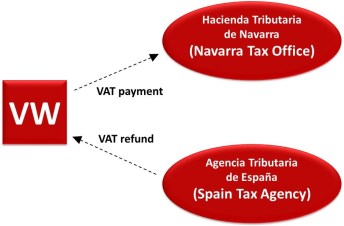
There is a Volkswagen (VW) plant in Pamplona, a city in the autonomous community of Navarra. From 2007-2011, Navarra reportedly collected approximately 1.5 billion Euros in value-added tax (VAT) from Volkswagen for its cars manufactured at the plant there. If VW-Navarra (which is a subsidiary of SEAT) had shipped the cars directly from Navarra to Germany, presumably Navarra would have had to refund that VAT. (Cars shipped to Germany leave Spain “clean of VAT* (translation mine)).

Instead, according to an interview with Prof. Fernando de la Hucha in this El Diario article, the basic structure was that VW-Navarra sold the cars (although without physically moving them there) to a related Barcelona company, VAESA (Volkswagen-Audi España S.A.), which is located in the Catalunya region, not Navarra. VAESA then sold them to SEAT with the very low mark-up of 5 Euros per car. SEAT, which is also in Catalunya, then sold them to VW-Germany—the transfer abroad triggering entitlement to a refund. But because the cars were sold from a city outside the Navarra region, VW’s refund claim did not go to Navarra. Instead, the Spanish national government was the one that issued the refund, which is how Navarra benefitted. (Catalunya did not issue the refund because, unlike Navarra, does not have a fiscal agreement with Spain that allows it to administer and collect taxes—only Navarra and the Basque regions do). The result was that Volkswagen was refunded the taxes it paid but Navarra profited at the expense of the Spanish government. (Spain has a credit-invoice VAT. Technically, the amount that Navarra retained was the VAT that VW-Navarra paid, which was the VAT on its sales to VAESA minus the VAT its suppliers had paid.)

Here is a simple diagram of the transaction, along with a map of Spain’s regions. (Navarra is in the north, bordering France; Catalunya—that’s the Catalan spelling—is in the northeast, also bordering France.)
Spain Tax Blog Post Diagram--LLmap_spain

Continue reading “When a Tax Strategy Benefits a Subnational Government”

The Insurance Market Regulations in the Republicans’ Health Care Bill: Crippling Obamacare, or Passing a Hot Potato to State Governments?

By David Gamage

On Monday, the House Republicans finally revealed their draft bill to “repeal and replace” the Affordable Care Act (#Obamacare or #ACA). The bill is titled the American Health Care Act, and commentators have been referring to it as either the #AHCA or #Trumpcare.

To assess the bill, it is helpful to think of it as consisting of four primary buckets:

  1. ending many of Obamacare’s tax provisions (read: large tax cuts for the very wealthy);
  2. phased-in cuts to Medicaid funding and scheduled devolution of Medicaid to the states (read: eroding the health safety-net program for the poor);
  3. transforming Obamacare’s other major health subsidies from being based mostly on income and health costs to being based more on age (read: the implications of this are actually less straightforward than what much of the commentary suggests, but that is a topic for another day); and
  4. other changes to Obamacare’s insurance market regulations (the subject of today’s blog post).

In this blog post, I will focus on the fourth bucket—the changes to Obamacare’s insurance market reforms other than the changes to the subsidies. Time permitting, I hope to write future blog posts on some of the other buckets.

What is most striking about the AHCA’s insurance market changes is how they keep the vast majority of Obamacare’s reforms in place. Right-wing groups have thus taken to calling the AHCA “#ObamacareLite”. Yet I consider this a misnomer. A more accurate label would be #ObamacareCrippled.

The AHCA’s changes do not really water down Obamacare, as the intended slur of “ObamacareLite” implies. Rather, the AHCA’s changes would likely cause Obamacare‘s framework for regulating the individual market to fall apart. If the AHCA bill were to be enacted in its current form, the result would likely be adverse-selection death spirals. The only real hope for saving the individual market would be for state governments to step up with new state-level regulations for supporting insurance markets within each state.

Continue reading “The Insurance Market Regulations in the Republicans’ Health Care Bill: Crippling Obamacare, or Passing a Hot Potato to State Governments?”

The Taxman and Jazz Radio

By Sam Brunson

Yesterday, driving my son to swim lessons, I flipped my radio to WDCB, Chicagoland’s jazz radio station. An organ trio was playing something that sounded vaguely familiar. And then they returned to the melody, and it was the Beatles’s “Taxman.” And just like that, two of my favorite things—jazz and taxes—intersected.

Several months ago, Leandra did a great post on the history and context of “Taxman.” And her post yesterday on taxes in a series of novels got me thinking about how often tax shows up in jazz. When I posted about the musical tax canon, I mentioned Fats Waller’s “We the People,” but here, I specifically wanted to look for jazz covers of “Taxman.” And I found two: Continue reading “The Taxman and Jazz Radio”

Death, Taxes, and a Beach Read

51bm1qlqlzl-_sy344_bo1204203200_By: Leandra Lederman

Back in December 2011, I received a targeted mailing. It was the postcard below, which I received at the office. Tfullsizerender-1hus far, I haven’t found a Maurer colleague or tax friend who received this mailing. Some marketer apparently did his or her homework and identified me as someone with an interest in both tax and chick lit! I don’t get to read novels very often anymore, but this looked like exactly the kind of book I would enjoy. I even acted on the sticker on the reverse of the postcard, which said “A book makes a great holiday gift!” “Death, Taxes, and a French Manicure” was a great start to the Christmas list request I had recently received.

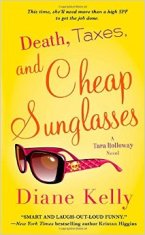
I received the book for Christmas and got hooked on the series. I’ve gotten through Book 10 so far. They’re a lot of fun. It never occurred to me to blog about them, though, until I read the first page of “Death, Taxes, and Cheap Sunglasses” while on a plane, and saw a link with tax issues I frequently write about. The opening paragraph reads:

“I slid my gun into my purse, grabbed my briefcase, and headed out to my car. Yep, tax season was in full swing once again, honest people scrambling to round up their receipts, hoping for a refund or at least to break even. As a taxpayer myself, I felt for them. But as far as tax cheats were concerned, I had no sympathy. The most recent annual report indicated that American individuals and corporations had underpaid their taxes by $450 billion. Not exactly chump change. That’s where I came in.”

I had just presented my latest tax compliance article, “Does Enforcement Crowd Out Voluntary Tax Compliance?” and here were tax gap figures showing up in a novel! “Death, Taxes, and Cheap Sunglasses” was published in 2015, when the annual federal tax gap was in fact estimated at $450 billion. (The updated tax gap figures, released in April 2016, and which I blogged about previously, are available here.)  Continue reading “Death, Taxes, and a Beach Read”

TaxSlayer: Technically Acceptable for VITA Returns?

Adam C. Mansfield
Staff Attorney, Legal Services for Students, University of Kansas

The first time I logged into the TaxSlayer training lab I knew that this tax season was going to be a problem. It became obvious when I typed “1040NR” into the form lookup box in the upper left corner of the TaxSlayer screen and the search came up empty. Next I tried “1042-S” and “8843.” Same result. Now I’m not some old fuddy-duddy that doesn’t like change.  I love working with new gadgets, software, or operating systems—as long as it does what it is supposed to do.

I work for Legal Services for Students at the University of Kansas. The main target population for our Volunteer Income Tax Assistance (VITA) grant is nonresident alien (NRA) students and scholars.  Every tax year we help hundreds of international students and researchers determine their residency status, calculate any applicable tax treaty benefits, and prepare their federal and state returns. In the past, TaxWise has worked just fine for this purpose.  I had no problem preparing a return for the student from Bangladesh who had income in both Kansas and Missouri or the Chinese student who has multiple 1042-S forms for scholarships and awards but still needs to apply treaty benefits to his or her wages. This year, TaxSlayer is just not up to the task.

I feel bad for Whitley, a member of TaxSlayer’s customer support squad, who is left with the task of informing me that they are aware of the “issue” that prevents their software from properly applying and reporting a tax treaty benefit on a nonresident alien return.  She proceeded to tell me that they could only handle “simple” state returns in conjunction with an NRA return.  This means that I can’t make any adjustments to the state return in order to properly apportion income. They are “working diligently to iron out the wrinkles.”  Not being able to prepare a pretty basic nonresident alien return is a little more than just a wrinkle. Continue reading “TaxSlayer: Technically Acceptable for VITA Returns?”

Past Moratoria on Tax Guidance and Regulations(?)

By: Sam Brunson

cch_standard_federal_tax_printOn my previous post talking about the the IRS’s announcement that it was putting a moratorium on issuing new regulations and formal guidance, a commenter asked if it was such an odd thing for a new Administration to temporarily pause guidance. After all, who wants to issue guidance before the new Administration’s people are in place and agenda is set, lest the new Administration change its priorities and positions in the coming months?

I didn’t remember any such (formal, at least) pause in 2009, but, when I got home, I decided to look back a few years. I looked at new regulations and revenue rulings in the first month of the Obama, George W. Bush, Clinton, and Reagan presidencies (I didn’t bother with George H.W. Bush, because that was a Republican to Republican switch). Also, because we don’t know how long the current limitations on regulations and other guidance will last, I also expanded my search of revenue rulings for the first three months of the new administrations.[fn1] Continue reading “Past Moratoria on Tax Guidance and Regulations(?)”

The Status of Judicial Anti-Abuse Doctrines if Code Section 7701(o) Were Repealed

As Daniel Hemel points out in a cross-linked post on Whatever Source Derived, if Congress repeals the Affordable Care Act (ACA), it is possible that Code section 7701(o) will go with it. (Section 7701(o) and its accompanying penalty were included in the ACA as a revenue raiser.) This raises the question of what repeal would mean for the economic substance doctrine specifically and for judicial anti-abuse rules more generally. This post makes three main points:

  1. Repeal of Code section 7701(o) is not a good idea. At a minimum, its potential repeal should be considered separately from the ACA, as it has no substantive link to the ACA.
  1. Repeal of the codified economic substance doctrine should not affect other judicial doctrines.
  1. Repeal of Code section 7701(o) would not eliminate the judicially developed economic substance doctrine. Daniel has provided a couple of arguments in support of that view, drawing on statutory-interpretation principles, and I add an argument based on the language of section 7701(o) itself.

First, anti-abuse rules are valuable. They help prevent taxpayers from engaging in artificial transactions designed to produce artificial tax benefits, such as non-economic losses used to offset unrelated income. Some of these transactions may not actually “work” under the technical provisions of the Code, Treasury regulations, or IRS guidance. However, abusive tax shelters typically are structured to take advantage of the literal language of the tax laws. If (and, ideally, only if) technical challenges fail, anti-abuse doctrines help prevent misuse of the tax laws. Continue reading “The Status of Judicial Anti-Abuse Doctrines if Code Section 7701(o) Were Repealed”

When Leaks Drive Tax Law (a.k.a. our new paper!)

Shu-Yi Oei

Diane Ring and I just posted our new article, Leak-Driven Law, on SSRN. I had previously blogged about this paper as part of Leandra Lederman’s 2017 Mini-Symposium on Tax Enforcement and Administration, The abstract is here:

Over the past decade, a number of well-publicized data leaks have revealed the secret offshore holdings of high-net-worth individuals and multinational taxpayers, leading to a sea change in cross-border tax enforcement. Spurred by leaked data, tax authorities have prosecuted offshore tax cheats, attempted to recoup lost revenues, enacted new laws, and signed international agreements that promote “sunshine” and exchange of financial information between countries.

The conventional wisdom is that data leaks enable tax authorities to detect and punish offshore tax evasion more effectively, and that leaks are therefore socially beneficial from an economic welfare perspective. This Article argues, however, that the conventional wisdom is too simplistic. In certain circumstances, leak-driven lawmaking may in fact produce negative social welfare outcomes. Agenda-setting behaviors of leakers and media organizations, inefficiencies in data transmission, suboptimally designed legislation, and unanticipated behavioral responses by enforcement-elastic taxpayers are all factors that may reduce social welfare in the aftermath of a tax leak.

This Article examines the potential welfare outcomes of leak-driven lawmaking and identifies predictable drivers that may affect those outcomes. It provides suggestions and cautions for making tax law, after a leak, in order to best tap into the benefits of leaks while managing their pitfalls.

In this paper, we wanted to explore how leaks of taxpayer data in the offshore context have shaped international tax law and policy, both in the US and other countries. We especially were interested in the possibility that—while leaks might appear useful on the surface from a tax enforcement and informational standpoint—there are unexplored pitfalls and downsides to relying on leaks to direct lawmaking and policy priorities.

In the non-tax world, of course, leaks have suddenly become very salient, in terms of both their usefulness and their dangers. But (non-tax lurkers take note!) tax law has been dealing with leaks of taxpayer information and what they mean for tax enforcement for at least the past ten years. Of course, tax leaks have some distinctive characteristics that make them different from other types of leaks. For example, the tax leaks that are the subject of this paper are usually (though not invariably) leaks of private taxpayer data, rather than leaks about governments from government sources.

We do think that the framework we introduce in our paper for analyzing the upsides and downsides of leak-driven lawmaking can be applied to explore how non-tax leaks and reactions to them may be socially beneficial but could also lead to less than ideal results. In both tax and in other fields, the meta-issue is not just how governments and private actors can use leaked information to sanction bad behaviors, make decisions, or design laws. Rather, the issue is how the actions and responses of leakers, governments, journalists, international organizations and the public work together to create and promote certain outcomes. Once we understand the underlying dynamics, then we can consider how the outcomes they create should be evaluated, supported, or resisted.

If you’re working on leak-related scholarship in either tax or other fields, we’d love to chat.
The (Near) Future of Treasury Regulations

cfrToday’s Tax Notes reports[fn1] that the IRS has announced that it will not release pretty much any new formal guidance (including revenue rulings and revenue procedures) for the foreseeable future.[fn2]

Why not? A confluence of an Executive Order and a January 20 memorandum. The EO, “Reducing Regulation and Controlling Regulatory Cost,” requires that, for every new regulation issued, two existing regulations be eliminated.

The January 20 memorandum further prohibits agencies from sending regulations to the Federal Register until they’ve been reviewed by an agency or department head appointed by Trump. Continue reading “The (Near) Future of Treasury Regulations”