
Analysis of the ABA Tax Section’s Reduced Travel Support for Academics

CaptureAusBy: Leandra Lederman

A hot topic among professors at the recent ABA Tax Section meeting in Austin was the reduction in travel support for academics scheduled to take effect with the upcoming meeting in San Diego. As Prof. Bryan Camp wrote on TaxProf blog, The background is that, for years, and through the most recent meeting, full-time professors who have a leadership role in the section (Chair or Vice-Chair of a committee, or higher positions) have received a travel subsidy. The subsidy consists of $100/night toward actual hotel expenses, reimbursement of coach airfare (up to a mileage-based cap*), and $10 towards local transportation. Full-time professors speaking on panels who are not in leadership have also long received a travel subsidy, which I believe is the same as for professors in leadership, except without the $100/night towards hotel room cost. The Tax Section recently decided to eliminate the subsidy for academics, except for those who meet the Section’s definition of “young lawyer,” which has been reported as under age 40 or less than 5 years in practice. (I’m not sure how the “less than 5 years in practice” works, but I imagine it refers to something like bar membership, so that someone like me, who practiced for less than 5 years before entering academia in 1994, would not qualify.)

What’s so sad about this decision is that Tax Section meeting attendance by academics is likely to drop off markedly, although academics add a lot to the Section, as discussed further below. The Teaching Taxation Committee will suffer significantly, and so will other committees with many professors in leadership. It will also be harder to get faculty to speak on panels. There are several factors that will drive this effect:

  1. Law school budgets, and notably travel budgets, have been cut significantly in the wake of student application declines nationally that began in about 2011. My school continues to be generous, but I have heard from so many professors I have lost count about reduced, often dramatically reduced, annual travel budgets for faculty–budgets that may not support more than one or two conferences a year, for example. Continue reading “Analysis of the ABA Tax Section’s Reduced Travel Support for Academics”

Stetson Law School Seeks a Tax Professor

Stetson Law School, Florida’s oldest law school, is looking for a tax professor, especially a lateral. Here is the ad, from TaxProf blog:

Stetson University College of Law invites applications for a full-time tenured or tenure-track faculty position for a dedicated teacher/scholar specializing in tax law. While we are particularly interested in receiving applications from experienced lateral candidates, we will consider hiring at all levels, with or without tenure.

Stetson encourages applications from women, minorities, LGBTQ candidates, persons with disabilities, and all others who will contribute to our stimulating and diverse cultural and intellectual environment. Applicants should have a strong academic record and demonstrated commitment to outstanding teaching, scholarship, and service. Confidential inquiries are welcome.

Stetson’s beautiful campuses are located in Florida’s Tampa Bay region, the nation’s eighteenth largest metropolitan area. Stetson Law, Florida’s oldest law school, is internationally known for its programs in Advocacy, Legal Writing, Elder Law, and Higher Education Law. We encourage interested applicants to visit our website at http://www.law.stetson.edu to learn more about our school, our community, and our programs.

Application review will begin by mid-August and will continue until the positions are filled. Lateral candidates may be asked initially to video conference with the Appointments Screening Committee; other interviews may occur in Washington, D.C. during the AALS 2017 Faculty Recruitment Conference.

Please submit your cover letter, resume, and contact information for professional references, and address your application to Professors Mark Bauer and Ann Piccard, Co-Chairs, Faculty Appointments Screening Committee. You may email your application to facultyappointments@law.stetson.edu. You may also apply through standard mail; please send correspondence to Jessica Zook, Stetson University College of Law, 1401 61st Street South, Gulfport, Florida 33707.

Looking Back at Maurer’s SALT-Filled 2017 Tax Policy Colloquium

By: Leandra Lederman

With classes starting again, I have been planning for the new academic year, which also entails looking back at the 2016-2017 year. I’m teaching Introduction to Income Tax this Fall, and will be teaching Corporate Tax and Tax Policy Colloquium this Spring.

I am fortunate to run our Tax Policy Colloquium. I blogged on TaxProf Blog about launching the Colloquium and reflected back on it there after its first year. From my perspective, it has consistently been a terrific experience. Spring 2017 was special, though, because many of the paper topics seemed to connect, although that was largely unplanned. Here is the list of presenters we hosted, and their paper titles:

Daniel Hemel, University of Chicago Law SchoolFederalism as a Safeguard of Progressivity

Rebecca Kysar, Brooklyn Law School, Automatic Legislation

Les Book, Villanova University School of Law & David Walker, Intuit (via Skype), Thinking About Taxpayer Rights and Social Psychology to Improve Administration of the EITC

Allison Christians, McGill University Faculty of LawHuman Rights At the Borders of Tax Sovereignty

Mildred Robinson, University of Virginia School of Law, Irreconcilable Differences?: State Income Tax Law in the Shadow of the Internal Revenue Code

Jason Oh, UCLA School of LawAre Progressive Tax Rates Progressive Policy?

David Gamage, Indiana University Maurer School of LawTax Cannibalization and State Government Tax Incentive Programs

Justin Ross, Indiana University School of Public and Environmental AffairsThe Impact of State Taxes on Pass-Through Businesses: Evidence from the 2012 Kansas Income Tax Reform

These papers got us to think both about state tax systems and about how the U.S. federal and state tax systems interact or differ. One recurring theme was how regressive U.S. state tax systems generally are (aggregating all the taxes within a state). That discussion started with Daniel Hemel’s paper; he cited 2015 ITEP data that came up repeatedly throughout the course.

The ITEP site lists Washington, Florida, Texas, South Dakota, Illinois, Pennsylvania, Tennessee, Arizona, Kansas, and Indiana as the 10 states with the most regressive tax systems. I notice that several of those don’t have state income taxes. But many, including Indiana, do. As an example, here are the stats on Indiana’s tax system in 2015, coming in at 10th most regressive in the ITEP study.

In case you’re wondering, ITEP says that the 7 states with the least regressive tax systems in 2015 were (in alphabetical order) California, Delaware, the District of Columbia, Minnesota, Montana, Oregon, and Vermont. Least regressive doesn’t mean “progressive,” though: “In each of these states, at least some low- or middle-income groups pay more of their income in state and local taxes than wealthy families. In other words, every single state and local tax system is regressive and even these states that do better than others have much room for improvement.”

I’m now looking ahead to another terrific group of Colloquium speakers in Spring 2018. Paper topics are as yet undetermined, so I don’t know if themes will emerge, but I will plan to follow up with more on the Colloquium content in the future.

The University of Pittsburgh School of Law Seeks to Hire A Tax Professor

By: Leandra Lederman

I’ve been asked to post the following announcement. I’m told that Pittsburgh would be able to hire at all levels from assistant professor to full professor.

The University of Pittsburgh School of Law invites applications for a tenure-stream position, beginning in the 2018-2019 academic year, to teach courses in the tax area. The successful candidate will become an integral part of Pitt Law’s tax program, which includes a Tax Law Concentration, a Low-Income Taxpayer Clinic, and the peer-reviewed Pittsburgh Tax Review. We anticipate hiring for this position at the rank of assistant, associate, or full professor, depending on the candidate’s qualifications. We strongly encourage applications from lateral candidates at all levels.

An interest in teaching and research in international aspects of tax law and/or in business/commercial law is desirable, as is an interest in and/or experience with incorporating experiential learning and innovative pedagogy (e.g., writing intensive, inter-professional, flipped classroom, etc.) into the classroom.

The University of Pittsburgh is an Affirmative Action, equal opportunity employer and does not discriminate on the basis of race, color, sex, veteran status, disability, national origin, creed, marital status, age, gender identity or sexual orientation in its hiring.  In furtherance of our strong institutional commitment to a diverse faculty, we particularly welcome applications from minorities, women, and others who would add diversity to our faculty.

Contact:  Harry Flechtner, Chair, Faculty Appointments Committee, University of Pittsburgh School of Law, 3900 Forbes Ave., Pittsburgh, PA 15260.  Email: law-appointments@pitt.edu.  Email submissions are preferred.  The deadline for applications is November 1, 2017.

AALS Call for Papers by Junior Scholars

By: Leandra Lederman

The AALS has issued a call for papers for presentation at the 2018 meeting in San Diego, CA. “Those who will have been full-time law teachers at an AALS member or fee-paid school for five years or less on July 1, 2017, are invited to submit a paper on a topic related to or concerning law.” The deadline is August 4, 2017. There is more information at this link on the AALS website.

AALS Call for Papers on The Challenges and Opportunities of Exotic Hybrids

By: Leandra Lederman


At the
2018 AALS annual meeting (San Diego, Jan. 3-6, 2018), the Section on Agency, Partnerships LLCs, and Unincorporated Associations will be co-sponsoring a program with the AALS Sections on Taxation, Securities Regulation, and Business Associations on “The Challenges and Opportunities of Exotic Hybrids—Series LLCs, Up-C’s and Master Limited Partnerships.” In addition to featuring invited speakers, speakers (and papers) will be selected from a call for papers located at this link. The submission deadline is June 15, 2017. 

ACTC Letter Requesting a Variance for Tax Guidance

By: Leandra Lederman

Sam Brunson previously blogged about President Trump’s Executive Order of January 30, 2017, “Reducing Regulation and Controlling Regulatory Cost,” which requires an agency to identify two regulations to eliminate for every new regulation it issues. (Sam also has related posts here and here). As Sam stated, the Executive Order burdens taxpayers, who benefit from the public guidance Treasury regulations provide.

On March 23, the American College of Tax Counsel (ACTC) sent a letter to the Secretary of Treasury, Hon. Steven Mnuchin, and the Director of the Office of Management and Budget, Hon. Mick Mulvaney, “respectfully request[ing] that the Administration consider the unique role that the tax law plays in the lives of every American and provide the Treasury Department and the IRS with appropriate flexibility in issuing guidance that taxpayers and their advisors need in order to comply with the tax law.” The letter explains in part:

“By limiting the flexibility of Treasury and the IRS to issue such guidance, the Executive Order risks shifting the interpretive burden onto taxpayers, who must hire accountants, lawyers, and other advisors to guide them. . . . Moreover, by requiring Treasury and the IRS to identify two ‘deregulatory’ actions for each new guidance item, the Executive Order risks imposing additional burdens on taxpayers if it results in the elimination of existing rules that taxpayers and their advisors have come to rely on.”

I hope that Secretary Mnuchin and Director Mulvaney are receptive. As the ACTC’s letter states, even while simplification efforts are underway, “it is critical for taxpayers and their advisors to have the guidance needed to comply with the tax law as currently in effect.”

When a Tax Strategy Benefits a Subnational Government

2014-polo-ao5-1-million-lineBy: Leandra Lederman

Usually we think of tax shelters and other tax strategies as the province of private parties. These shelters may involve accommodation parties, even foreign government infrastructure, such as transportation systems, but we tend to think of private parties as getting the tax benefits. We may not think as often about a subnational government bolstering its tax revenues at the expense of the national government, particularly via a cooperating private party’s transaction structure. But that’s what happened a few years ago in Spain.

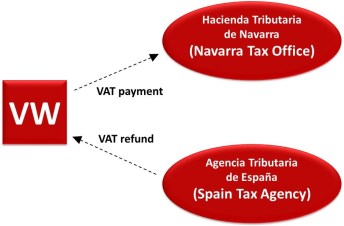
There is a Volkswagen (VW) plant in Pamplona, a city in the autonomous community of Navarra. From 2007-2011, Navarra reportedly collected approximately 1.5 billion Euros in value-added tax (VAT) from Volkswagen for its cars manufactured at the plant there. If VW-Navarra (which is a subsidiary of SEAT) had shipped the cars directly from Navarra to Germany, presumably Navarra would have had to refund that VAT. (Cars shipped to Germany leave Spain “clean of VAT* (translation mine)).

Instead, according to an interview with Prof. Fernando de la Hucha in this El Diario article, the basic structure was that VW-Navarra sold the cars (although without physically moving them there) to a related Barcelona company, VAESA (Volkswagen-Audi España S.A.), which is located in the Catalunya region, not Navarra. VAESA then sold them to SEAT with the very low mark-up of 5 Euros per car. SEAT, which is also in Catalunya, then sold them to VW-Germany—the transfer abroad triggering entitlement to a refund. But because the cars were sold from a city outside the Navarra region, VW’s refund claim did not go to Navarra. Instead, the Spanish national government was the one that issued the refund, which is how Navarra benefitted. (Catalunya did not issue the refund because, unlike Navarra, does not have a fiscal agreement with Spain that allows it to administer and collect taxes—only Navarra and the Basque regions do). The result was that Volkswagen was refunded the taxes it paid but Navarra profited at the expense of the Spanish government. (Spain has a credit-invoice VAT. Technically, the amount that Navarra retained was the VAT that VW-Navarra paid, which was the VAT on its sales to VAESA minus the VAT its suppliers had paid.)

Here is a simple diagram of the transaction, along with a map of Spain’s regions. (Navarra is in the north, bordering France; Catalunya—that’s the Catalan spelling—is in the northeast, also bordering France.)
Spain Tax Blog Post Diagram--LLmap_spain

Continue reading “When a Tax Strategy Benefits a Subnational Government”

Death, Taxes, and a Beach Read

51bm1qlqlzl-_sy344_bo1204203200_By: Leandra Lederman

Back in December 2011, I received a targeted mailing. It was the postcard below, which I received at the office. Tfullsizerender-1hus far, I haven’t found a Maurer colleague or tax friend who received this mailing. Some marketer apparently did his or her homework and identified me as someone with an interest in both tax and chick lit! I don’t get to read novels very often anymore, but this looked like exactly the kind of book I would enjoy. I even acted on the sticker on the reverse of the postcard, which said “A book makes a great holiday gift!” “Death, Taxes, and a French Manicure” was a great start to the Christmas list request I had recently received.

I received the book for Christmas and got hooked on the series. I’ve gotten through Book 10 so far. They’re a lot of fun. It never occurred to me to blog about them, though, until I read the first page of “Death, Taxes, and Cheap Sunglasses” while on a plane, and saw a link with tax issues I frequently write about. The opening paragraph reads:

“I slid my gun into my purse, grabbed my briefcase, and headed out to my car. Yep, tax season was in full swing once again, honest people scrambling to round up their receipts, hoping for a refund or at least to break even. As a taxpayer myself, I felt for them. But as far as tax cheats were concerned, I had no sympathy. The most recent annual report indicated that American individuals and corporations had underpaid their taxes by $450 billion. Not exactly chump change. That’s where I came in.”

I had just presented my latest tax compliance article, “Does Enforcement Crowd Out Voluntary Tax Compliance?” and here were tax gap figures showing up in a novel! “Death, Taxes, and Cheap Sunglasses” was published in 2015, when the annual federal tax gap was in fact estimated at $450 billion. (The updated tax gap figures, released in April 2016, and which I blogged about previously, are available here.)  Continue reading “Death, Taxes, and a Beach Read”

The Status of Judicial Anti-Abuse Doctrines if Code Section 7701(o) Were Repealed

As Daniel Hemel points out in a cross-linked post on Whatever Source Derived, if Congress repeals the Affordable Care Act (ACA), it is possible that Code section 7701(o) will go with it. (Section 7701(o) and its accompanying penalty were included in the ACA as a revenue raiser.) This raises the question of what repeal would mean for the economic substance doctrine specifically and for judicial anti-abuse rules more generally. This post makes three main points:

  1. Repeal of Code section 7701(o) is not a good idea. At a minimum, its potential repeal should be considered separately from the ACA, as it has no substantive link to the ACA.
  1. Repeal of the codified economic substance doctrine should not affect other judicial doctrines.
  1. Repeal of Code section 7701(o) would not eliminate the judicially developed economic substance doctrine. Daniel has provided a couple of arguments in support of that view, drawing on statutory-interpretation principles, and I add an argument based on the language of section 7701(o) itself.

First, anti-abuse rules are valuable. They help prevent taxpayers from engaging in artificial transactions designed to produce artificial tax benefits, such as non-economic losses used to offset unrelated income. Some of these transactions may not actually “work” under the technical provisions of the Code, Treasury regulations, or IRS guidance. However, abusive tax shelters typically are structured to take advantage of the literal language of the tax laws. If (and, ideally, only if) technical challenges fail, anti-abuse doctrines help prevent misuse of the tax laws. Continue reading “The Status of Judicial Anti-Abuse Doctrines if Code Section 7701(o) Were Repealed”

Concluding Thoughts on the 2017 Mini-Symposium on “The Future of Tax Administration and Enforcement”

By: Leandra Lederman

Since January 18, 2017, the Surly Subgroup has hosted a mini-symposium featuring posts by members of the Discussion Group I organized for the Association of American Law Schools (AALS) annual meeting on the topic of The Future of Tax Administration and Enforcement.” Over the course of the mini-symposium, we have seen a wide range of posts, all of which are listed at the end of this post, following my take on the topic.

Specifically, Sam Brunson argued that, in light of the large tax gap and low IRS audit rate, it’s time for tax returns to be public (with information such as Social Security numbers redacted). Roberta Mann also blogged on possible solutions to the tax gap. In part, she points to improving the process for IRS guidance.

Chris Walker also focused on IRS guidance, blogging on “administrative law exceptionalism,” particularly in the context of the application of APA rules to Treasury rulemaking in Altera, a case in which he served as counsel of record for the U.S. Chamber of Commerce as amicus curiae in support of Petitioner-Appellee Altera in the 9th Circuit, and in which I participated in an amicus brief in support of the Commissioner.

Part of what has caused problems for the IRS has been the outrage in 2013 over its treatment of organizations applying for exemption as social welfare organizations under Code section 501(c)(4) despite names suggesting a focus on political activity. Lloyd Mayer’s post focused on the exempt organizations context, pointing to three issues impeding IRS enforcement: (1) unchecked growth in the use of tax-exempt entities; (2) vague facts-and-circumstances tests for qualifying for tax exemption; and (3) shrinking IRS resources, particularly in the exempt organizations area. He also proposed substantive law changes and a more robust enforcement vehicle. Continue reading “Concluding Thoughts on the 2017 Mini-Symposium on “The Future of Tax Administration and Enforcement””

2017 Mini-Symposium on “The Future of Tax Administration and Enforcement”

By: Leandra Lederman

On January 7, 2017, I had the pleasure of moderating a Discussion Group I organized for the Association of American Law Schools (AALS) annual meeting. The topic of the discussion was “The Future of Tax Administration and Enforcement.” The topic was prompted by the funding crisis in which the IRS finds itself and the challenges that poses for tax administration, which I wrote about in two articles published last year, “The IRS, Politics, and Income Inequality,” 150 Tax Notes 1329 (Mar. 14, 2016) and “IRS Reform: Politics As Usual?,” 7 Columbia Tax J. 36 (2016) (the latter of which was part of a symposium Kristin Hickman organized on tax administration).

The AALS Discussion Group included experts on tax law, administrative law, and cybersecurity. The discussion spanned topics that included IRS resource and task priority issues, administrative law aspects of tax administration, and cross-border tax administration concerns. In the coming weeks, Surly Subgroup will be hosting a mini-symposium featuring posts by members of the Discussion Group. The first substantive post will be this Friday, January 20, and is by Christopher Walker from The Ohio State University, Michael E. Moritz College of Law, who is a member of the group but was unable to attend the discussion itself due to a flight cancellation. The panel on January 7 was as follows:

Over the next few weeks, watch for more Mini-Symposium posts! They will be categorized under “2017 Mini-Symposium on Tax Enforcement and Administration.”

Deficient Notices of Deficiency and the Remedy Question

By: Leandra Lederman

In QinetiQ v. Commissioner, the Court of Appeals for the Fourth Circuit refused to invalidate a Notice of Deficiency that simply stated “that QinetiQ ‘ha[d] not established that [it was] entitled’ to a deduction ‘under the provisions of [26 U.S.C.] § 83.’” The taxpayer had argued that the Notice “failed to provide a reasoned explanation for the agency’s final decision, as required by the Administrative Procedure Act (APA), 5 U.S.C. §§ 701-06.” The court’s analysis of this issue focuses on the distinction between court review that is subject to the APA and court review that is not. The QinetiQ court found that review of IRS deficiency actions, which predates the APA, falls into the latter category.

The QinetiQ case can readily be grouped with Mayo Foundation and the post-Mayo cases focused on the intersection of administrative law with federal tax law. In a recent post on the Procedurally Taxing blog, Bryan Camp does a nice job of analyzing the case in that context. But another perspective on the case is that the APA argument in QinetiQ is the latest packaging of some taxpayers’ complaints about uninformative Notices of Deficiency. In fact, QinetiQ also argued that the Notice violated Code section 7522, which requires various IRS notices, including Notices of Deficiency, to “describe the basis for, and identify the amounts (if any) of, the tax due, interest, additional amounts, additions to the tax, and assessable penalties included in such notice.”

As I wrote over two decades ago, in one of my first articles, “‘Civil’izing Tax Procedure: Applying General Federal Learning to Statutory Notices of Deficiency,” 30 U.C. Davis L. Rev. 183 (1996), the conflicts and confusion over the validity of Notices of Deficiency stem from two issues. The first is that courts often focus on only one of the Notice’s functions in isolation, such as its jurisdictional role as the “ticket to Tax Court” in deficiency cases. My 1996 article argued that the Notice of Deficiency not only plays that role, it also provides notice to the taxpayer (like civil process) and acts as an inchoate complaint, helping to frame the issues if a Tax Court case ensues. As I explain there, less content should be required for jurisdictional purposes than to frame the content of the litigation. Code section 7522 arguably reflects this idea, as I’ll explain further below. Continue reading “Deficient Notices of Deficiency and the Remedy Question”

Letter Urging the Senate to Vote on U.S. Tax Court Nominations

Over 50 tax law professors have signed a letter (available here) urging the U.S. Senate to vote on U.S. Tax Court nominees Elizabeth Ann Copeland and Vik Edwin Stoll. Unfortunately, these nominations may not get much attention in the wake of the election. However, the signatories (myself included) are urging the Senate to schedule a vote on these nominees, both of whom were favorably reported out of the Senate Finance Committee over a year ago. Danshera Cords has more on Procedurally Taxing.

Tax Professor Letter Opposing Impeachment or Censure of IRS Commissioner Koskinen

By: Leandra Lederman

123 tax law professors recently signed a letter (available here) urging House leaders “to oppose any resolution to impeach or censure John Koskinen, the Commissioner of Internal Revenue.” Full disclosure: I am among the signatories. The letter explains not only that “[w]e believe that nothing that has been reported provides any basis for impeachment or censure” but also that impeachment or censure will undermine tax administration:

“The IRS carries out a vitally important mission for our country. Respect for the IRS fosters the voluntary compliance that is essential for our revenue system to work.

Impeachment or censure will harm the country by weakening our revenue system.  Impeachment or censure would disrupt the functioning of the IRS—which has had four Commissioners in as many years—leading to increased tax evasion, reduced revenue collection, and a higher national debt.  Impeachment or censure would also set a dangerous precedent and deter talented people from working to improve the country’s struggling revenue system.”

This is an important message and I hope House leaders will listen.

Continue reading “Tax Professor Letter Opposing Impeachment or Censure of IRS Commissioner Koskinen”