Slurpees and the Cook County Sweetened Beverage Tax

Me with my Slurpee.

By Sam Brunson

Today and tomorrow are 7-Eleven’s annual Bring Your Own Cup Day. In case you’re not familiar with it (or your Facebook feeds aren’t filled with bizarre containers of florescent sugar-ice), on #BYOCupDay, you can bring any container in your house to a 7-Eleven and, as long as it fits in the Slurpee machine, you can fill it up for $1.50.

After my wife and kids spent the day on the beach watching the Air and Water Show rehearsal, they were ready for some Slurpee. So, when I got out of work, we walked the three blocks to the nearest 7-Eleven. (Last year, we took berry-picking buckets; this year, we were much more modest and just brought cups my father-in-law bought when we took him to a Cubs game a couple years ago.)

When we got to the store, we were greeted by this sign: Continue reading “Slurpees and the Cook County Sweetened Beverage Tax”

So about that Robot Tax…

Shu-Yi Oei

I came across a couple of news stories recently about how South Korea is introducing the world’s first robot tax. But based on the press reports, it sounds like the so-called robot tax is actually just a reduction of the tax deductions available to businesses that invest in productivity-boosting automation. The news sources themselves concede that this “robot tax” not exactly a tax on robots but rather a tax benefit reduction for automation investment.

Talk of a “robot tax” has landed at the forefront of tax news since Bill Gates mentioned it in a Quartz interview back in February of 2017. But of course, scholarship about robots (not to mention robots themselves) has been around for quite a bit longer. There’s even a “We-Robot” robotics law and policy conference that’s been going on since 2012, which I keep meaning to crash, but then there’s always something else going on.

A lot of what seems to be driving the tax conversation is the fear that robots are taking over jobs, though there’s some uncertainty about the extent to which robots are to blame.

Personally, I’ve been having a hard time squaring the newly ascendant tax conversation about the robot tax with the broader legal scholarship on robots. In some of the news and other commentary discussing Robotaxation, my reaction has been something to the effect of “I’m not sure that word means what you think it means.” Turns out, there is something of an existing conversation about what constitutes a robot in the first place—see, for example, Richards and Smart (2013) for a nice discussion of some of the definitional issues. See also this “What is a Robot?” piece in The Atlantic. In defining “robot,” it might matter how a robot moves in the physical world, what kind of quasi-independent agency it seems to exercise (autonomous vs. semi-autonomous), how humans interact with it, and even what sorts of emotions it triggers in us mere humans. We might understand some automated machines to be robots but others to just be automated equipment. And these distinctions make sense, from the viewpoint of areas like tort law, privacy law, the law of principals and agents, and the more general regulation of robots (and of artificial intelligence as a subcategory of robots).

But in some of the tax discussions about robots that I’ve seen on the interwebs, it’s quite clear that the authors don’t necessarily mean Robot when they say Robot. Continue reading “So about that Robot Tax…”

The Front Lines of Sharing Economy Legal Debates

By: Diane Ring

Last month I blogged about new proposed legislation in Congress that sought to provide a safe harbor for gig worker classification for tax purposes. However, as I noted, the proposal implicitly favored one side of the debate by making the safe harbor one that would ensure the “easy” ability to classify a worker as an independent contractor (rather than an employee). In that post, I suggested that having tax lead the charge in this sharing economy worker classification debate perhaps allowed the tax “tail” to lead the employment relations “dog”. There are pressing nontax issues in the sharing economy that are driving litigation and dominating worker concerns – particularly employment law issues. Just last week, we saw further evidence of serious tensions in the landscape of sharing economy labor law.

On Tuesday, July 31, 207, in Chamber of Commerce of the United States, et al.,  v. The City of Seattle, a U.S. federal judge dismissed a challenge to legislation approved by the Seattle City Council in fall 2015. Pursuant to the Seattle law, businesses that hire or contract with taxi-drivers, for-hire transportation companies and “transportation network companies” must bargain with drivers if a majority want to be represented. That is, Seattle effectively allows Uber and Lyft drivers to unionize. Not surprisingly, Uber and Lyft objected to the law . . . Continue reading “The Front Lines of Sharing Economy Legal Debates”

Tax at the National Parks: Tuskegee Airmen National Historic Site Edition

By Sam Brunson

Last week, my family and I were at the Tuskegee Airmen National Historic Site. I wasn’t terribly familiar with the Tuskegee Airmen before visiting; frankly, their story is amazing, inspiring, and shocking. Basically, Army War College study from the early twentieth century claimed that African Americans lacked intelligence, ambition, and courage, and were thus unfit for the military, and especially unfit to be airmen.

The Tuskegee Institute had an airfield where it trained African American pilots; eventually the government accepted it as a training ground for military pilots. The Tuskegee Airmen proved the Army War College study wrong with a distinguished record of military service. Still, the military in the 1940s was segregated, and these Tuskegee Airmen served in segregated units and, when they returned home, they faced continued racism. Many, tired of what they experienced, went on to join the civil rights movement. And many of them share their stories, through audio, video, pictures, and artifacts, at the NHS. Continue reading “Tax at the National Parks: Tuskegee Airmen National Historic Site Edition”

The Tail, the Dog, and Gig Workers

By: Diane Ring

tail.dog

New legislation has just been introduced in the Senate that creates a “safe harbor” for independent contractor status. The proposed legislation provides that if a worker relationship satisfies certain criteria, then that worker can bypass the sometimes messy, multi-factor test for distinguishing between employees and independent contractors, and will be classified as an independent contractor for tax purposes. What prompted action now to address what has been a decades-old classification challenge for workers, businesses and the IRS alike? The gig economy. (Hence, the not-so-catchy title for the legislation: The New Economy Works to Guarantee Independence and Growth (NEW GIG) Act of 2017 (S. 1549).)

The legislation’s sponsor, Senate Finance Committee member John Thune, (R-S.D), described the impetus for the legislation as follows: “My legislation would provide clear rules so that these freelance style workers can work as independent contractors with the peace of mind that their tax status will be respected by the IRS.”

Is this really what gig workers are worrying about? . . . Continue reading “The Tail, the Dog, and Gig Workers”

House Appropriations Bill

By: David Herzig

With all the diversions this week, it was easy to miss that the House Committee on Appropriations posted on June 28th the Appropriations Bill for FY 2018.  The bill seems to include a couple items that not many were expecting.  So, I thought I would highlight some of the key provisions.  Since it is Friday before a Holiday weekend, I’ll keep it short for now.  There are four main provisions I will address: (1) IRS Targeting/Johnson Amendment; (2) ACA Penalties; (3) Conservation Easements; and (4) 2704 (Estate/Gift Tax).

I. IRS Targeting/Death of Johnson Amendment

First, is a clear response to the “targeting” of groups from the Lois Lerner Administration. In three separate sections (107, 108 and 116), the bill attempts to regulate the IRS, not Continue reading “House Appropriations Bill”

Mortgage Interest Deduction

By: David J. Herzig

The Trump and Republican tax plans have circled around the idea of repealing the mortgage interest deduction.  Although I’m not convinced it will happen (see e.g., Treasury Secretary Mnuchin’s remarks).  The mere threat of the repeal has garnered a fair amount of attention.

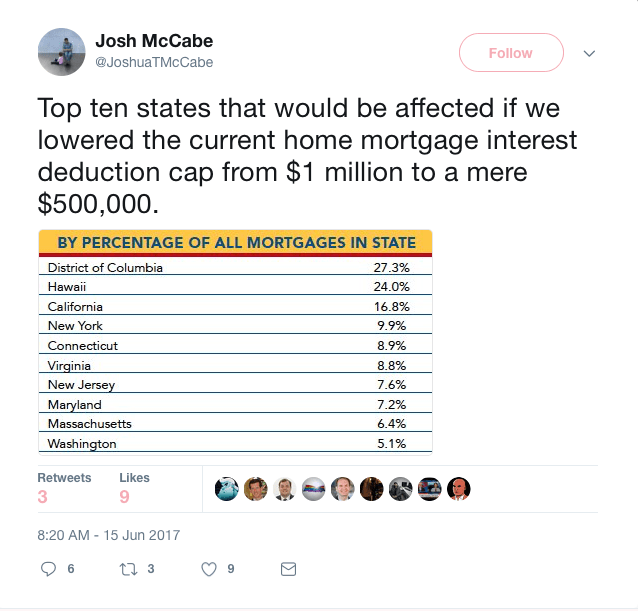
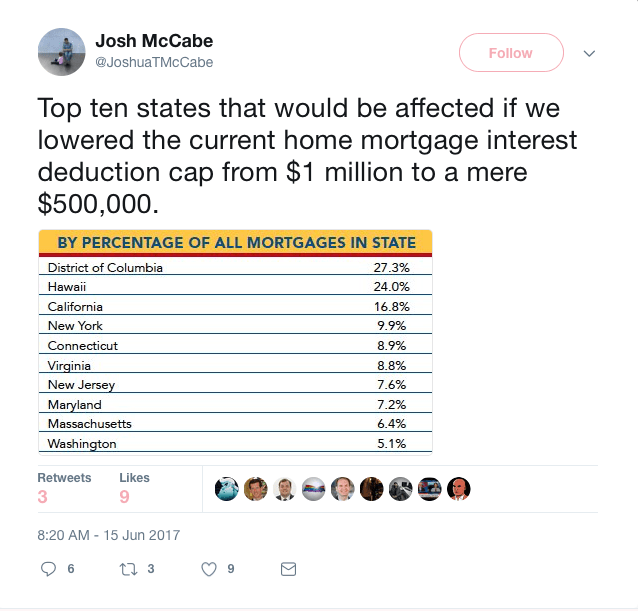
For example, the other day this chart was making its rounds on twitter.

Screen Shot 2017-06-16 at 7.42.50 AM

I have not verified the methodology of the chart or the data.  I interpret that the chart examines (in absolute numbers) how many mortgages exist at $1,000,000. The implicit conclusion of the chart is that homeowners in states like D.C., Hawai’i, California and New York have the most at stake in retaining the deduction.

Why?

Because there seems to be evidence that the mortgage interest deduction contributes to housing inflation.  Back in 2011 the Senate held hearings on incentives for homeownership. [1]  It has been suggested that the elimination of the deduction will drop home prices between 2 and 13% with significant regional differences. [2]  So, if the mortgage interest deduction is eliminated, then the aforementioned states might have numerous problems, including a smaller property tax base.

What exactly is the Mortgage Interest Deduction?

Continue reading “Mortgage Interest Deduction”

The Surly Subgroup Turns One!

Time flies when you’re having fun, I guess. Today is the one-year blogiversary of the Surly Subgroup. What started off as a group-blogging experiment hatched at last year’s Critical Tax Conference at Tulane Law School has provided quite a bit of entertainment for Surly bloggers and our guest bloggers, and hopefully for our readers as well.

It’s obviously been a big year on tax and other fronts. Since our inception, we’ve published 206 blog posts on a variety of topics. And we’ve drawn readers from 140 different countries.

Surly regulars and guest bloggers have covered various tax-related issues surrounding politics and the 2016 election—including disclosure of presidential tax returns, the Emoluments Clause, the Trump Foundation, and the Clinton Foundation. We’ve written about churches, 501(c)(3)s and the IRS treatment of non-profits. We’ve discussed the tax reform proposals of the 2016 presidential candidates and the #DBCFT. We’ve written several administrative law posts about Treasury Regulations and rulemaking.

Politics aside we’ve also covered other important issues in tax policy—including taxation and poverty, healthcare, tax policy and disabilities, tax compliance, and tax aspects of the Puerto Rico fiscal crisis. We’ve discussed several issues in international and cross-border taxes, touching on the EU state aid debate, the CCCTB, taxation and migration, the Panama Papers, tax leaks more generally, and tax evasion in China.

We hosted our first ever online Mini-Symposium on Tax Enforcement and Administration, which featured posts by ten different authors on a variety of tax administration topics. The Mini-Symposium was spearheaded by Leandra Lederman. Leandra had organized and moderated a discussion group on “The Future of Tax Administration and Enforcement” at the 2017 AALS Annual Meeting, and many of the discussion group participants contributed to the online symposium. We hope to organize future online symposia on other topics.

We’ve blogged about various conferences, workshops, and papers, both tax related and not-so-much tax related. We’ve also had lots of fun writing about taxes in popular culture – Surly bloggers and guest bloggers have written about the tax aspects of Pokémon Go, tax fiction, music-related tax issues (Jazz Fest! Prince! “Taxman”!), soccer players, dogs, Harry Potter fan fiction, Star Trek, and John Oliver. Surly bloggers even recorded a few tax podcasts!

In short, it’s been a busy year, and we’ve had a lot of fun with the Surly platform. We hope you have as well. Going forward, we’re going to keep the blog posts coming. We also hope to draw more regular and guest bloggers and to organize other online symposia.

Thanks for reading!

Panama Papers: The One-Year Anniversary

By: Diane Ring

This month marks the one-year anniversary of the Panama Papers leak. In April 2016, the ICIJ announced the leak and a few weeks later (May 9, 2016) released a database that included a subset of the leaked data. The leak itself comprised over 11 million records spanning 40 years from the Panamanian law firm Mossack Fonseca. At its core, the leak revealed the true ownership of over 200,000 offshore entities, thereby raising a host of tax and political questions regarding many of the entities’ owners.

So what has happened over the past year as a result of the leak? Continue reading “Panama Papers: The One-Year Anniversary”

Teaching Depreciation with a #DBCFT Lurking

Shu-Yi Oei

I’m teaching depreciation in my Basic Federal Income Tax class this week. As I suspect is the case for most tax profs, our coverage of depreciation comes right after we wrap up discussion of expense taking in §§ 162 and 212 (and § 195) but before we get to § 165 losses.

Depreciation is literally my favorite topic in the entire universe to teach. I mean, if I was going to get a tattoo of a Code section on myself, it would literally be “26 U.S.C. § 168 (as amended).” No disrespect meant to 26 U.S.C. §§ 167, 179, 197 and friends. [Distraction: Here is a virtual tattoo generator. You, too, can practice getting your favorite Tax Code section inked on yourself.] I firmly believe that you can teach any number of core skills in tax class by teaching depreciation (e.g., statutory construction, policy choices, reading cross-references, political economy and legislative change, time value of money, etc.). Conversely, I also tend to think that if you can understand the depreciation statute in Basic Tax and explain it to your classmates, you can do pretty much anything in our legal profession.

Therefore, putting aside all of the reasons why cash-flow expensing may not have the effects that one might hope, I will be absolutely heartbroken if we actually end up with a cash-flow tax, because then what am I gonna talk about in tax class?

All of which brings me to today’s dilemma: Do I mention the ubiquitous #DBCFT in teaching depreciation this week? Or can I just pretend it’s not happening? If one does teach cash-flow expensing, when does one bring it up (i.e., in what order of coverage)? My inclination is to (1) explain the basics of how economic cost recovery over time works in theory; (2) talk briefly about the ACRS changes in 1981; (3) teach the Simon v. Commissioner cases (violin bows) to illustrate the policy tensions that arise once we move from true economic recovery and actual useful lives to ACRS and statutory recovery periods; (4) discuss #DBCFT as an alternative design approach, noting the possible benefits and downsides of that approach, noting that there’s some discussion in the ether right now re whether we should be doing this (and deemphasizing the border adjustment features); (5) introduce bonus depreciation concepts (§§ 168(k) and 179) as an illustration of how expensing has surreptitiously worked its way into the conversation in the guise of bonus depreciation circa financial crisis; and then (6) move right along to parsing the actual statutory elements of §§ 167 and 168 and understanding how it all stitches together.

This strikes me as a nice middle ground between (1) dorkin’ out and going #DBCFT full bore and totally losing the class, and (2) just ignoring the current debate. I’d be curious to know what other tax profs are doing with coverage here.

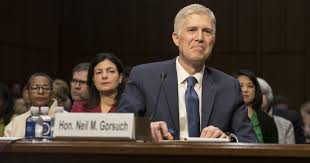
The Strategic Case Against the Democratic Filibuster of Neil Gorsuch

Photo: Jarrad Henderson, USA TODAY

By: Daniel Hemel and David Herzig

[Note: This post is co-authored with Daniel Hemel, Assistant Professor of Law at The University of Chicago School of Law.]

The strategic case against a Democratic filibuster of Neil Gorsuch is straightforward. The argument is not that the filibuster will prevent President Trump from putting someone like Andrew Napolitano on the Court. The argument is that the filibuster may prevent President Trump from filling a future vacancy with a well-credentialed conservative who is ideologically similar to or right of Judge Gorsuch. To elaborate:

— (a) The filibuster accomplishes no work when there are fewer than 50 Senators who will support a nominee on an up-or-down vote. (Napolitano presumably falls into this category.)

— (b) The filibuster also does no work when there are 50 or more Senators who will support a nominee even if that means going nuclear. (Judge Gorsuch appears to fall into this category.)

— (c) The filibuster matters when (1) there is a nominee who would win 50 or more Senators on an up-or-down vote, but (2) fewer than 50 Senators would support the nuclear option in order to put the nominee on the Court.

Is (c) an empty set?

Continue reading “The Strategic Case Against the Democratic Filibuster of Neil Gorsuch”

PROMESAs, PROMESAs?

Shu-Yi Oei

After swearing up and down that I would blog more about Puerto Rico’s 70 billion dollar debt crisis, I of course was remiss and did not. But a new paper by Mitu Gulati and Robert Rasmussen, “Puerto Rico and the Netherworld of Sovereign Debt Restructuring” has provided me the impetus to dive into this topic again.

Recall that unlike U.S. municipalities (such as Detroit), Puerto Rico bodies and utilities aren’t considered debtors for purposes of Chapter 9 of the U.S. Bankruptcy Code and therefore don’t have access to the municipal bankruptcy process. See 11 U.S.C. § 101(52). Puerto Rico attempted to address its fiscal woes by enacting the 2014 Puerto Rico Public Corporation Debt Enforcement and Recovery Act, which created a debt restructuring mechanism analogous to Chapter 9 municipal bankruptcy. However, the U.S. Supreme Court ruled on June 13, 2016 that the Act was preempted by Section 903(1) of the U.S. Bankruptcy Code. Puerto Rico v. Franklin California Tax-Free Trust, 136 S. Ct. 1938 (2016). [Fn. 1]

After the Franklin Trust decision, Congress stepped in and passed the Puerto Rico Oversight, Management, and Economic Stability Act (PROMESA) legislation on June 30, 2016, to allow Puerto Rico to restructure without filing for Chapter 9 bankruptcy. Briefly, PROMESA establishes an independent oversight board, provides for a bankruptcy-like debt restructuring process, and requires submission of a Fiscal Plan by Puerto Rico. Puerto Rico’s required Fiscal Plan was approved by the Oversight Board on March 13, 2017; however, that plan has come under criticism from bondholders.

This all begs the question, however, of what would have happened had Congress NOT passed the PROMESA legislation. Puerto Rico would have been left in a bind in which it had no access to the U.S. municipal bankruptcy process but was preempted from enacting any analogous debt restructuring mechanism by Section 903(1) of that same Bankruptcy Code, per Franklin California Tax-Free Trust. [Fn. 2]

Gulati and Rasmussen’s paper focuses on this question, arguing that, as a constitutional matter, the United States may not prohibit Puerto Rico from enacting its own bankruptcy-like restructuring process while offering no alternative mechanism. This leaves Puerto Rico in an untenable “netherworld,” in which it has the power to issue debt without the mechanisms for dealing with financial distress on the back end.

Continue reading “PROMESAs, PROMESAs?”

The Insurance Market Regulations in the Republicans’ Health Care Bill: Crippling Obamacare, or Passing a Hot Potato to State Governments?

By David Gamage

On Monday, the House Republicans finally revealed their draft bill to “repeal and replace” the Affordable Care Act (#Obamacare or #ACA). The bill is titled the American Health Care Act, and commentators have been referring to it as either the #AHCA or #Trumpcare.

To assess the bill, it is helpful to think of it as consisting of four primary buckets:

  1. ending many of Obamacare’s tax provisions (read: large tax cuts for the very wealthy);
  2. phased-in cuts to Medicaid funding and scheduled devolution of Medicaid to the states (read: eroding the health safety-net program for the poor);
  3. transforming Obamacare’s other major health subsidies from being based mostly on income and health costs to being based more on age (read: the implications of this are actually less straightforward than what much of the commentary suggests, but that is a topic for another day); and
  4. other changes to Obamacare’s insurance market regulations (the subject of today’s blog post).

In this blog post, I will focus on the fourth bucket—the changes to Obamacare’s insurance market reforms other than the changes to the subsidies. Time permitting, I hope to write future blog posts on some of the other buckets.

What is most striking about the AHCA’s insurance market changes is how they keep the vast majority of Obamacare’s reforms in place. Right-wing groups have thus taken to calling the AHCA “#ObamacareLite”. Yet I consider this a misnomer. A more accurate label would be #ObamacareCrippled.

The AHCA’s changes do not really water down Obamacare, as the intended slur of “ObamacareLite” implies. Rather, the AHCA’s changes would likely cause Obamacare‘s framework for regulating the individual market to fall apart. If the AHCA bill were to be enacted in its current form, the result would likely be adverse-selection death spirals. The only real hope for saving the individual market would be for state governments to step up with new state-level regulations for supporting insurance markets within each state.

Continue reading “The Insurance Market Regulations in the Republicans’ Health Care Bill: Crippling Obamacare, or Passing a Hot Potato to State Governments?”

The Status of Judicial Anti-Abuse Doctrines if Code Section 7701(o) Were Repealed

As Daniel Hemel points out in a cross-linked post on Whatever Source Derived, if Congress repeals the Affordable Care Act (ACA), it is possible that Code section 7701(o) will go with it. (Section 7701(o) and its accompanying penalty were included in the ACA as a revenue raiser.) This raises the question of what repeal would mean for the economic substance doctrine specifically and for judicial anti-abuse rules more generally. This post makes three main points:

  1. Repeal of Code section 7701(o) is not a good idea. At a minimum, its potential repeal should be considered separately from the ACA, as it has no substantive link to the ACA.
  1. Repeal of the codified economic substance doctrine should not affect other judicial doctrines.
  1. Repeal of Code section 7701(o) would not eliminate the judicially developed economic substance doctrine. Daniel has provided a couple of arguments in support of that view, drawing on statutory-interpretation principles, and I add an argument based on the language of section 7701(o) itself.

First, anti-abuse rules are valuable. They help prevent taxpayers from engaging in artificial transactions designed to produce artificial tax benefits, such as non-economic losses used to offset unrelated income. Some of these transactions may not actually “work” under the technical provisions of the Code, Treasury regulations, or IRS guidance. However, abusive tax shelters typically are structured to take advantage of the literal language of the tax laws. If (and, ideally, only if) technical challenges fail, anti-abuse doctrines help prevent misuse of the tax laws. Continue reading “The Status of Judicial Anti-Abuse Doctrines if Code Section 7701(o) Were Repealed”

When Leaks Drive Tax Law (a.k.a. our new paper!)

Shu-Yi Oei

Diane Ring and I just posted our new article, Leak-Driven Law, on SSRN. I had previously blogged about this paper as part of Leandra Lederman’s 2017 Mini-Symposium on Tax Enforcement and Administration, The abstract is here:

Over the past decade, a number of well-publicized data leaks have revealed the secret offshore holdings of high-net-worth individuals and multinational taxpayers, leading to a sea change in cross-border tax enforcement. Spurred by leaked data, tax authorities have prosecuted offshore tax cheats, attempted to recoup lost revenues, enacted new laws, and signed international agreements that promote “sunshine” and exchange of financial information between countries.

The conventional wisdom is that data leaks enable tax authorities to detect and punish offshore tax evasion more effectively, and that leaks are therefore socially beneficial from an economic welfare perspective. This Article argues, however, that the conventional wisdom is too simplistic. In certain circumstances, leak-driven lawmaking may in fact produce negative social welfare outcomes. Agenda-setting behaviors of leakers and media organizations, inefficiencies in data transmission, suboptimally designed legislation, and unanticipated behavioral responses by enforcement-elastic taxpayers are all factors that may reduce social welfare in the aftermath of a tax leak.

This Article examines the potential welfare outcomes of leak-driven lawmaking and identifies predictable drivers that may affect those outcomes. It provides suggestions and cautions for making tax law, after a leak, in order to best tap into the benefits of leaks while managing their pitfalls.

In this paper, we wanted to explore how leaks of taxpayer data in the offshore context have shaped international tax law and policy, both in the US and other countries. We especially were interested in the possibility that—while leaks might appear useful on the surface from a tax enforcement and informational standpoint—there are unexplored pitfalls and downsides to relying on leaks to direct lawmaking and policy priorities.

In the non-tax world, of course, leaks have suddenly become very salient, in terms of both their usefulness and their dangers. But (non-tax lurkers take note!) tax law has been dealing with leaks of taxpayer information and what they mean for tax enforcement for at least the past ten years. Of course, tax leaks have some distinctive characteristics that make them different from other types of leaks. For example, the tax leaks that are the subject of this paper are usually (though not invariably) leaks of private taxpayer data, rather than leaks about governments from government sources.

We do think that the framework we introduce in our paper for analyzing the upsides and downsides of leak-driven lawmaking can be applied to explore how non-tax leaks and reactions to them may be socially beneficial but could also lead to less than ideal results. In both tax and in other fields, the meta-issue is not just how governments and private actors can use leaked information to sanction bad behaviors, make decisions, or design laws. Rather, the issue is how the actions and responses of leakers, governments, journalists, international organizations and the public work together to create and promote certain outcomes. Once we understand the underlying dynamics, then we can consider how the outcomes they create should be evaluated, supported, or resisted.

If you’re working on leak-related scholarship in either tax or other fields, we’d love to chat.