A $916 Million Loss? #TrumpLeaks

By Sam Brunson

trump-returnThe New York Times reported tonight that in 1995, Republican presidential candidate Donald Trump may have claimed a $916 loss, a loss substantial enough that it could have allowed him to avoid paying taxes for nearly two decades.

The push notification for the story showed up on my phone at 8:30 pm Central time on a Saturday, so I haven’t had time to really dig into it. I’m sure that, over the next few days, we’ll have something more substantive to say. But in the meantime, a couple thoughts:  Continue reading “A $916 Million Loss? #TrumpLeaks”

When your job is predicting the future

rainBy: Diane Ring

In a post earlier this week, I considered how the international tax conference I was attending (the annual worldwide meeting of the International Fiscal Association, IFA) had something in common with the Japanese anime and manga conference hosted in the adjacent venue. Soon the anime event ended and the tax conference continued, but with a new neighbor – the Meteorological Technology World Expo 2016. No costumes – but some interesting, though puzzling, equipment outside in the courtyard. I thought about the big task of meteorology—predicting the future. Turns out that in-house tax advisors have the same job, it’s just that instead of rain, they predict the tax implications of business decisions for the C-suite. But the tax advisors do it without the tech, and there is a lot to keep them up at night . . . Continue reading “When your job is predicting the future”

Debate Prep: The Candidates’ Marginal Rate Proposals #debates

By Sam Brunson

In anticipation of tonight’s debate, I’m going to describe what both candidates propose to do with tax rates, provide a little commentary, and suggest a couple questions that the moderator might ask to clarify what the candidates plan on doing.

The candidates’ proposals for individual tax rates illustrate one of their biggest divergences. As best I can tell, in fact, their plans for tax rates are as different as it is possible to be. And what are those plans? Continue reading “Debate Prep: The Candidates’ Marginal Rate Proposals #debates”

Debate Prep: The Candidates’ Estate Tax Plans

By David Herzig

With the first Presidential debate tonight, we are sure (or at least I hope) to hear about various tax plans.  I would expect that the estate tax would be a topic of conversation since there is such a sharp contrast between the candidates.  The current reporting spins that Donald Trump wants to eliminate the estate tax; while, Hillary Clinton wants to tax the rich through a two-prong increase on the estate tax.  I thought it would be useful in advance of the debate to discuss the candidates’ actual estate tax plans. (If there is a PA for Lester Holt looking for some last minute questions for the candidates – scroll to the bottom and steal away no attribution needed!)

Currently, there is an estate (or death) tax. Unfortunately for the fisc, the tax accounts for less than 1 percent of federal revenue.  (See, Tax Foundation). What is amazing is that at other points in time, the tax actually raised revenue and effected many estates.  The primary reason for the drop in revenues even though overall net worth has increased, is related to the exemption amount available for taxpayers.  In 1976, the exemption amount per estate was $60,000 while today it is $5.45 million.  (I tackle a lot of these issues in my upcoming University of Southern California Law Review article).

Continue reading “Debate Prep: The Candidates’ Estate Tax Plans”

I’ve Got ITINs on My Mind

By: Francine J. Lipman

Individual Taxpayer Identification Number (ITIN) Holders Pay Over $45 Billion Annually in Federal, State, and Local Taxes

Among the many amazing opportunities I have had as a law professor at the University of Nevada, Las Vegas is continuing my work with immigrants on their tax issues. As I have written about at length unauthorized immigrants pay many tens of billions of dollars a year in taxes including federal (about 4.4 million ITIN tax returns were filed in 2015 paying over $23 billion including $18.1 in federal income taxes and $5.5 in self-employment taxes), state, and local income, property, sales, excise, etc. ($12 billion annually), and payroll taxes (about $12 billion a year in net Social Security and Medicare taxes for which they currently receive no current or future benefit).

ITINs GENERALLY

Nevertheless, Congress continues to challenge this population with respect to their tax compliance. If you do not know what an ITIN is then this issue likely does not directly affect you … however if you want a quick education the National Immigration Law Center (NILC) has a great primer available in English and Spanish here. Since 1996, IRS has issued about 21 million ITINs although only about 5 million are currently being used. Congress had previously enacted legislation causing any ITIN not used for five years to expire. However, that legislation was not given a chance to be enforced, because Congress has been busy enacting more recent ITIN expiration legislation that supersedes the five year law.

THE CURRENT ITIN on my mind ISSUE

ITIN EXPIRATIONS

In the recently enacted PATH Act of 2015 (Protecting Americans from Tax Hikes), among other matters, all ITINs issued before 2013 will be expiring and have to be renewed. An ITIN issued after December 31, 2012, will remain valid unless the person to whom it was issued does not file a tax return—or is not included as a dependent on the return of another taxpayer—for three consecutive years.

Congress has phased-in the expiration of ITINS as follows:

IF THE ITIN WAS ISSUED         THE ITIN EXPIRES ON

before January 1, 2008                    January 1, 2017
in 2008                                             January 1, 2018
in 2009 or 2010                                January 1, 2019
in 2011 or 2012                                January 1, 2020

In an effort to streamline the process, the IRS is identifying the first wave of ITINs expiring on January 1, 2017 as ITINs with the middle digits of 78 or 79. The IRS will identify the respective middle digits for the second, third, and fourth waves of expirations in time.

HOW TO RENEW BEGINNING October 1, 2016 

ITINs scheduled to expire as of January 1, 2017 (middle digits 78 or 79 or any ITIN not used on a tax return for the last three consecutive years (e.g., 2013, 2014, and 2015)), can be renewed using the newly revised for this purpose Form W7 (available here) also known as an Application for IRS Individual Taxpayer Identification Number. No tax return is required for a renewal application.

The application including all required original documents (e.g., passport) must be mailed to Internal Revenue Service, ITIN Operation, P.O. Box 149342, Austin, TX 78714-9342. The anticipated time that the IRS will take to renew or issue an ITIN outside of peak processing times (between January and April) has historically been about six weeks. However, in a recent press conference the IRS said that they would be sending 400,000 letters to ITIN holders with expiring ITNs so there could be a much longer waiting period. The National Taxpayer Advocate has written about the ITIN application backlog and bottleneck in her 2015 Report to Congress as Most Serious Problem Number 18.

Any original documents or certified copies submitted in support of an ITIN application are supposed to be returned within 65 days. Taxpayers who do not receive their original and certified documents within 65 days of mailing them to the IRS may call 1-800-908-9982 to check on their documents.

CERTIFIED ACCEPTANCE AGENTS   Not surprisingly, many immigrants will not want to send original documents to the IRS. In lieu of sending original documentation, taxpayers may be eligible to use an IRS authorized Certified Acceptance Agent (CAA) or make an appointment at a designated IRS Taxpayer Assistance Center location. CAAs often charge a fee for services rendered although some of the large chains of retail tax preparation companies are advertising free ITIN renewal services. I would advise taxpayers to proceed with caution as there may be ancillary costs, charges, or fees. The Consumer Federation of America, among others including myself, have written about the high cost of tax assistance services for low-income taxpayers and the potential for consumer abuse including price gouging.

FAMILY ITIN APPLICATIONS   The IRS will accept a Form W-7 renewal application from each member of a family if at least one of the family members listed on a tax return has an ITIN with the middle digits of 78 or 79. If one family member has middle digits 78 or 79, all family members who have an ITIN may submit a Form W-7 renewal application at the same time.

FINANCIAL CONSEQUENCES IF ITINs Are NOT Renewed

Until ITINs are renewed, returns with expired ITINs will be processed and treated as timely filed, but the returns will be processed without any exemptions and/or credits claimed and no refund will be paid. The taxpayer will receive a notice from the IRS explaining the delay in any refund and that ITINs must be renewed. Once ITINs are renewed, any exemptions and credits will be processed and any allowed refunds will be paid. If ITINs are not renewed, taxpayers may be subject to interest and penalties for any tax owed as a result of disallowed exemptions and credits.

images


HELP IS AVAILABLE

The more than 130 Low-Income Taxpayer Clinics across the country should be able to answer questions and point you in the right direction to get assistance. To find the contact information for a LITC in your area look at this user-friendly map and list in English and Spanish here.

Moreover, the NILC and other immigrant advocate groups and pro bono lawyers like myself are always here to lend a hand. On November 16th, UNLV will be hosting a Continuing Legal Education program titled “Everything You Need to Know About the NEW Taxpayer Identification Number (ITIN) Renewal Process” from 12:30 – 2:30 p.m. at William S. Boyd School of Law, Moot Court Room. Join us.

images-1


2015 Poverty Measures Released: Antipoverty Relief Delivered through the IRC = EITC & CTC

By:  Francine J. Lipman

“Few topics in American society have more myths and stereotypes surrounding them than poverty, misconceptions that distort both our politics and our domestic policymaking.” Mark R. Rank

The U.S. Census Bureau of the Department of Commerce: Economics and Statistics Administration has released the 2015 poverty measures and the news is eye-poppingly good. The Supplemental Poverty Measure (SPM), the most comprehensive poverty measure, dropped one percent from 2014. Down from 15.3% to 14.3% — nevertheless more than  Continue reading “2015 Poverty Measures Released: Antipoverty Relief Delivered through the IRC = EITC & CTC”

Trump, Churches and Politics

Photo: Evan Vucci/AP

By David J. Herzig

One of the leads in today’s news cycle was the Flint Pastor, Rev. Faith Green Timmons of the Bethel United Methodist Church, interrupting Republican Presidential Candidate Donald Trump during a speech at her church.

According to the story, Rev. Timmons, intervened during Mr. Trump’s speech  when he started attacking Democratic Presidential Candidate Hillary Clinton stating, “Mr. Trump, I invited you here to thank us for what we’ve done in Flint, not give a political speech, …”. To which Mr. Trump responded, “OK. That’s good. Then I’m going back onto Flint, OK? Flint’s pain is a result of so many different failures, …”.

I headed to Twitter to state that Rev. Timmons was doing the right thing protecting her churches charitable exemption by halting the political speech.  Quick blackletter law: churches, like other public charities, are exempt from tax under section 501(c)(3). But like all exemptions there are certain limitations, including an absolute prohibition on supporting or opposing candidates for office.  In IRS Publication 1828, the IRS position is clear,  “churches and religious organizations, are absolutely prohibited from directly or indirectly participating in, or intervening in, any political campaign on behalf of (or in opposition to) any candidate for elective public office.”  (For a primer on the topic, my co-blogger Sam Brunson wrote for Surly here and for a full blown analysis see his work for University of Colorado’s law review here).  Churches can’t (although they often do) engage in political speech.  Maybe Rev. Timmons was attempting to protect the church’s exemption.

However, as Lloyd Mayer pointed out on Twitter, having a candidate appear at your church two months before the election might in itself be political speech regardless of the topic actually discussed.  This would be true unless the church gave the same amount of “air time” to the opponent.  Publication 1828 supports Professor Mayer’s view.  Statements made by the religious leader of the church at an official church function or through use of the church’s assets would be improper political campaign intervention.  Hosting only one candidate regardless of the topic would seem to be an endorsement of that candidate and thus improper political campaign intervention.

Continue reading “Trump, Churches and Politics”

The Freedom Caucus and Koskinen

To follow up on Leandra’s post from two weeks ago: various news sources are reporting that the House Freedom Caucus is planning to make a “privileged resolution” sometime today to force a vote on impeaching Commissioner Koskinen. (Which makes sense: the Freedom Caucus’s Twitter feed seems to be all-impeach-Koskinen-all-the-time.) If they pass the resolution, they hope to force a vote on the impeachment within the next two days.

Stay tuned.

Trump Pays $2,500 Excise Tax: Is that Enough?

By: Philip Hackney

boy-666803_1280

A couple of months ago, I wrote about the tax consequences of the Donald J. Trump Foundation paying $25,000 to the Pam Bondi campaign for attorney general in Florida in 2013. While most folks are focused on whether the payment was a bribe, I still see signs of a mismanaged charitable organization. I suggested that the political contribution could lead to the Foundation losing its exempt status and should require it to pay some excise taxes. I also said that there was enough questionable information for the IRS to open an audit of the Foundation. Well, last week, David Fahrenthold reported that Donald Trump recently paid $2,500 to the IRS as a tax for that impermissible political contribution made by the Foundation. This action leaves a lot of odd unanswered questions that I write about here.

Jeffrey McConney, the senior vice president and controller of the Foundation, told the Washington Post that Trump himself filed paperwork with the IRS alerting them to the improper political contribution from the Foundation, paid a 10% excise tax, and returned the $25,000. McConney states that the Foundation believes this should end the problem because the Foundation has done everything it has “been instructed to do”. While some have assumed that the IRS had communicated with the Foundation, it is not clear who did the instructing. Continue reading “Trump Pays $2,500 Excise Tax: Is that Enough?”

Tax Professor Letter Opposing Impeachment or Censure of IRS Commissioner Koskinen

By: Leandra Lederman

123 tax law professors recently signed a letter (available here) urging House leaders “to oppose any resolution to impeach or censure John Koskinen, the Commissioner of Internal Revenue.” Full disclosure: I am among the signatories. The letter explains not only that “[w]e believe that nothing that has been reported provides any basis for impeachment or censure” but also that impeachment or censure will undermine tax administration:

“The IRS carries out a vitally important mission for our country. Respect for the IRS fosters the voluntary compliance that is essential for our revenue system to work.

Impeachment or censure will harm the country by weakening our revenue system.  Impeachment or censure would disrupt the functioning of the IRS—which has had four Commissioners in as many years—leading to increased tax evasion, reduced revenue collection, and a higher national debt.  Impeachment or censure would also set a dangerous precedent and deter talented people from working to improve the country’s struggling revenue system.”

This is an important message and I hope House leaders will listen.

Continue reading “Tax Professor Letter Opposing Impeachment or Censure of IRS Commissioner Koskinen”

Call for Papers: Applied Feminism and Intersectionality: Examining Law through the Lens of Multiple Identities

By: Francine J. Lipman

The Center on Applied Feminism at the University of Baltimore School of Law seeks paper proposals for the Tenth Anniversary of the Feminist Legal Theory Conference. We hope you will join us for this exciting celebration on March 30-31, 2017. 

imgres
Continue reading “Call for Papers: Applied Feminism and Intersectionality: Examining Law through the Lens of Multiple Identities”

House Staffer is a Tax Protester?

By: David J. Herzig

Politico reported yesterday that “Isaac Lanier Avant, chief of staff to Rep. Bennie Thompson (D-Miss.) and Democratic staff director for the Homeland Security Committee, allegedly did not file returns for the 2009 to 2013 tax years.”

According to the Department of Justice Press Release, Mr. Avant has been a staff member of the U.S. House of Representatives since 2002.  In 2005, he filed a form with “his employer that falsely claimed he was exempt from federal income taxes.  Avant did not have any federal tax withheld from his paycheck until the Internal Revenue Service (IRS) mandated that his employer begin withholding in January 2013.”

This seemingly innocent story might get more torrid.  For starters, missing from the press release by Justice is that, as Richard Rubin pointed out to me, Mr. Avant’s employer was Congress.  Do you hear the can of worms opening?  I mean, who at payroll in Congress is green-lighting the stopping of withholding?  What did his form look like? Did he make up an official and name it – W-NONE?  How many other staffer’s did this?  How did he never get audited?  According the the press release and the story, Mr. Avant did not file tax returns for 5 years; I guess a matching program would not catch anything since he had no withholding.  But, one would think Congress would at least ensure that every employee has filed a tax return.

Not sure which awesome tax protester argument he is going with.  Personally, I hope it is that he is a sovereign citizen.  It would be great if the Democratic staff director of Homeland Security thought the U.S. laws did not apply to him.  I guess we will have to wait for the actual complaint.  For those interested, the IRS has outlined numerous frivolous tax arguments.

 [UPDATE 8/24/16 at 8:41 pm: It appears that a claim of Sovereign Citizen might really be in play.  According to the Panolian, a local Batesville, Mississippi newspaper, Mr. Avant is the son of Vernice Black Avant and the late Robert Allen Avant Sr.  In 2011, according to the Panolian, Mr. Avant’s mother, who is also a court clerk, filed an “11-page ‘Affidavit of Truth'”  “declaring that she is a “freeborn Sovereign” are meant to distinguish her as an individual, distinct from a corporation.”  “The affidavit cites participation in the use of bank accounts, Social Security numbers, driver’s licenses, vehicle license plates and tax returns as ‘under duress.'”]

DC Circuit Seems to have Decided IRS Violated Constitution Before Trial in True the Vote Appeal.

By: Philip Hackney

graphics-882729_1280In 2014, a District Court dismissed (based on 12(b)(6) and 12(b)(1) motions) the complaint of a number of conservative organizations who alleged that the IRS “targeted” them by subjecting them to greater scrutiny in their applications for tax exemption. The lead organization, True the Vote, sought 501(c)(3) charitable organization status; the others primarily sought 501(c)(4) social welfare organization status. The world became aware of this targeting controversy in May 2013 when Lois Lerner, the head of the Exempt Organizations division of the IRS apologized to the Tea Party and other conservative groups for how the IRS treated their applications. To this day Taxprof Blog continues the IRS Scandal post over three years later dedicated at least in part to this controversy.

The primary complaints were the second and fifth claims: (2)  the IRS violated the organizations First Amendment rights to freedom of speech, and (5) the IRS violated the Administrative Procedures Act. The District Court concluded that because the IRS had granted exempt status to these organizations, the complaints were moot. True the Vote appealed this dismissal to the DC Circuit Court of Appeals.

Last week the Circuit Court breathed new life into claims 2 and 5. Though the Court found that some of the complaints were moot (including Bivens complaints against IRS employees and a claim of violation of 6103 disclosure rules), it allowed claims 2 and 5 forward because it found that the IRS had not voluntarily ceased its unlawful actions.

In reading the opinion, I find astonishing that the Circuit Court appears to have already concluded, without trial, that the IRS acted unconstitutionally. I recognize that for a 12(b)(1) motion the court is to assume the complaint true, but the court appears to have done much more than make assumptions. I focus on this issue. Continue reading “DC Circuit Seems to have Decided IRS Violated Constitution Before Trial in True the Vote Appeal.”

Child Care in the Presidential Campaign

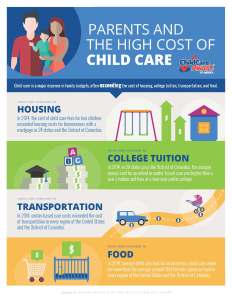
CCA-IG-CostsCompared_v1bToday, Donald Trump laid out a series of economic proposals. Included, naturally, were a series of tax proposals, which I assume we’ll address on this blog as time goes on. For now, I want to focus on just one of his proposals: easing the cost of child care.

While the cost of child care varies, it has risen dramatically, nearly doubling over the last 25 years. And although the cost of child care varies from state to state—and even from city to city—the numbers can be eye-opening. In Illinois, the average annual cost of child care for an infant and a 4-year-old is more than $22,000. At the same time, the median income for a single parent is about $24,000, and the median household income for married parents is about $88,000.[fn1] That means that the cost of child care for two children represents 25 percent of the median Illinois married couple’s household income, and fully 94 percent of the median income of a single parent.

Clearly, using averages and medians doesn’t paint an accurate picture of any given family’s situation. But in no state would child care costs make up less than 30 percent of a minimum wage-earner’s income. That’s a pretty dire picture. Dire enough, in fact, that the cost of child care is keeping women out of the workforce. (And note that it’s not just women who can afford to stay out of the workforce because of a spouse’s or partner’s income: 34 percent of stay-at-home mothers live in poverty, as opposed to 12 percent of mothers in the workforce.) Continue reading “Child Care in the Presidential Campaign”

“Taxman” at 50

taxman20sheet20music
Updated lyrics are available here.

The Beatles’ hit song Taxman has just turned 50; it was released August 5, 1966 in the U.K. Taxman, written primarily by George Harrison, famously includes the lyrics

“Let me tell you how it will be
There’s one for you, nineteen for me
Cos I’m the taxman, yeah, I’m the taxman

Should five per cent appear too small
Be thankful I don’t take it all . . . .”

Apparently this song was at least partly inspired by the theme for the 1966 TV show, Batman! batman222june1970And, in the early 1980s, Weird Al Yankovic wrote a parody called “Pac-Man,” though it was not released  on any of his albums.

H&R Block used the Taxman song in a 2002 commercial literally showing only tax men: “It took an Act of Congress to pass 441 changes in the tax law. Will it take an act of God to understand them?” (There’s a different, more diverse version here.)

Did the Beatles really pay a 95% tax rate? According to a Bloomberg article, “The top rate for British taxpayers in the mid- Continue reading ““Taxman” at 50″