Welcome to Surly, Adam Thimmesch!

Great news: Adam Thimmesch of the Nebraska College of Law has agreed to come aboard as a Surly blogger. You may remember Adam from last year, when he gave us a great (and popular!) post on Pokémon Go.

While Adam will provide a fuller introduction of himself in due time, let me say: we’ve been sadly deficient in our SALT expertise, and Adam will capably fill that slot, as well as blogging about whatever other tax issues he finds interesting. So welcome, Adam!

Tax at the National Parks: Grand Portage Edition

By Sam Brunson

A year ago, the National Parks surprised me with a tax name-check. I mean, realistically, there shouldn’t have been anything surprising about encountering a picture of Al Capone at Alcatraz, but I didn’t think I’d see taxes there.

So consider this the second year in a row where the National Parks have surprised me with tax. My family was at Grand Portage National National Monument (which is incredibly cool, btw) learning about the Ojibwe and the North West Company and the thriving fur trade. In one room, there was a display about hatmaking. And, on the wall, was this cartoon:

Continue reading “Tax at the National Parks: Grand Portage Edition”

Mortgage Interest Deduction

By: David J. Herzig

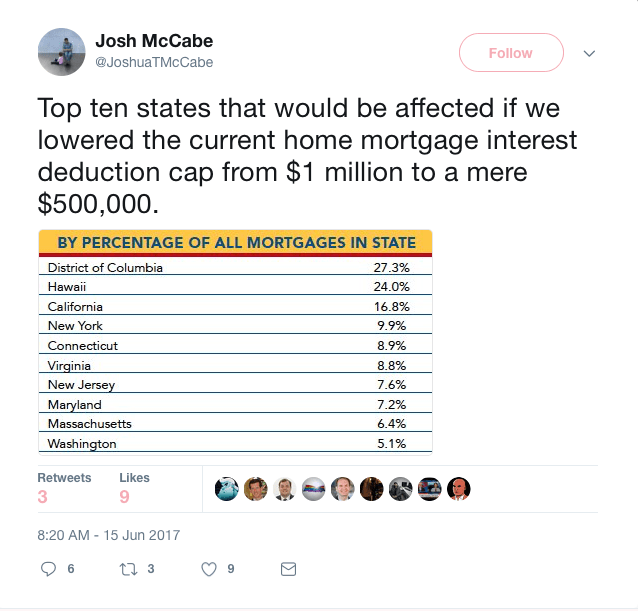
The Trump and Republican tax plans have circled around the idea of repealing the mortgage interest deduction.  Although I’m not convinced it will happen (see e.g., Treasury Secretary Mnuchin’s remarks).  The mere threat of the repeal has garnered a fair amount of attention.

For example, the other day this chart was making its rounds on twitter.

Screen Shot 2017-06-16 at 7.42.50 AM

I have not verified the methodology of the chart or the data.  I interpret that the chart examines (in absolute numbers) how many mortgages exist at $1,000,000. The implicit conclusion of the chart is that homeowners in states like D.C., Hawai’i, California and New York have the most at stake in retaining the deduction.

Why?

Because there seems to be evidence that the mortgage interest deduction contributes to housing inflation.  Back in 2011 the Senate held hearings on incentives for homeownership. [1]  It has been suggested that the elimination of the deduction will drop home prices between 2 and 13% with significant regional differences. [2]  So, if the mortgage interest deduction is eliminated, then the aforementioned states might have numerous problems, including a smaller property tax base.

What exactly is the Mortgage Interest Deduction?

Continue reading “Mortgage Interest Deduction”

Prognosticating Estate Tax Repeal using State Interests

By: David Herzig

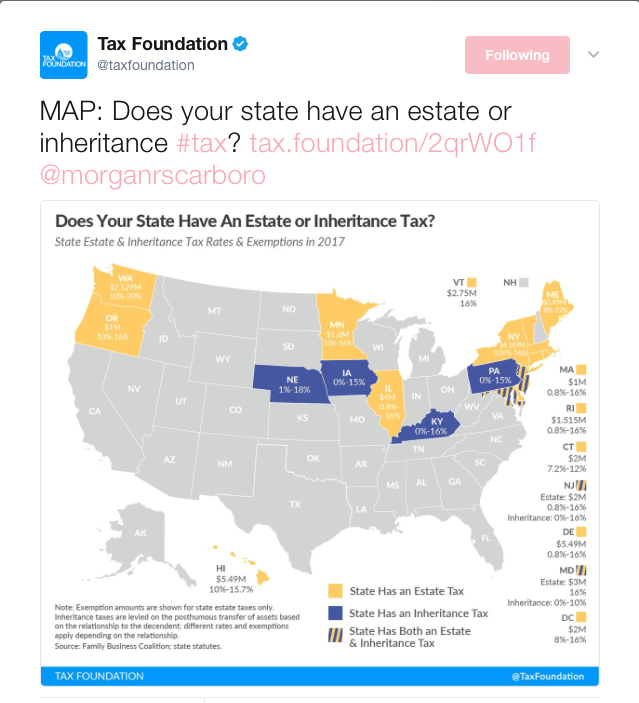
Last week Tax Foundation tweeted about the states that have either a state level estate or inheritance tax.

Screen Shot 2017-06-01 at 8.29.10 AM

The map and subsequent conversations I have had reinvigorated my interest in the prospect of an estate tax.  Briefly in this post, I wanted to say a couple things about the state level estate or inheritance tax, the map, and the effect of the Economic Growth and Tax Relief Reconciliation Act of 2001 (“EGTRAA“) on the prospects of the elimination of federal estate tax.

I’ll readily admit that it has been a while since I did an estate tax return.  So, I needed some refreshing regarding the idiosyncrasies of the interaction between the state and federal taxes.  Some recent history is not only necessary but illustrative of the prospects of permanent federal estate tax repeal.

Brief History of Switch From Credit to Deduction

Prior to the enactment of EGTRAA, the federal estate tax provided an tax credit for an amount paid because of a state level estate tax.  The mechanics of credit was essentially a revenue sharing agreement for the tax collected between the federal government and the states – essentially, up to 16% of an estate’s value.  The credit applied whether or not the state had an independent estate tax.  This tax was known as a “pick-up” or “sponge” tax.

Continue reading “Prognosticating Estate Tax Repeal using State Interests”

On Marginal and Effective Tax Rates

By Sam Brunson

A friend sent me a cartoon that’s been going around his Facebook feed. The cartoon’s message amounts, roughly, to: undocumented immigrants are far better-off than legal residents because taxes.

The various assertions the cartoon makes are an amazing collection of racist and wrong. In fact, there’s too much racist, and too much wrong, to address. But it’s worth pointing out that, although the cartoon uses numbers, its numbers are wildly, wildly wrong.

If you want to hate-read the whole thing, you can see it here, but for my purposes, we’re going to look at these two panels: Continue reading “On Marginal and Effective Tax Rates”

AALS Call for Papers by Junior Scholars

By: Leandra Lederman

The AALS has issued a call for papers for presentation at the 2018 meeting in San Diego, CA. “Those who will have been full-time law teachers at an AALS member or fee-paid school for five years or less on July 1, 2017, are invited to submit a paper on a topic related to or concerning law.” The deadline is August 4, 2017. There is more information at this link on the AALS website.

… and police are on their way to your house to arrest you

By Sam Brunson

Over the last couple weeks I’ve gotten at least three calls from numbers I’m not familiar with. When I pick up, a heavily-accented recorded voice tells me that I haven’t paid my taxes, the IRS has filed a lawsuit (or, in one recording, a “law-sweet”) against me, and that police are on their way to arrest me. I can get out of my problems if I call them back immediately.

I’ve called back three times. The first time, I got flustered when asked for personal information, and told the guy I knew it was a scam. The third time, the call center noises were so loud that I could barely hear the person, and eventually, she put me on hold and then the call dropped. The second, though …

The second, I told the guy on the phone that my name was Carlos Danger. (I had to spell “Danger” for him.) I gave him a fake string of 9 digits (that he read back to me, and I was lucky that I mostly remembered it. Protip: if you’re giving a fake SSN to scammers, do something memorable. David Herzig, for example, recommends 867-53-0909). He put me on hold, and checked his computer, and then told me his records showed I owed $9,700 in back taxes. Continue reading “… and police are on their way to your house to arrest you”

Macron and the Potential Future of Tax Leaks

By: Diane Ring

The French election for president—an event worthy of note in its own right (particularly on the heels of the Brexit vote)—generated a political, international relations, security and media firestorm due to a late-breaking data leak and hack. On Friday, the campaign of French centrist candidate Emmanuel Macron announced that it had been the subject of a major computer hack. At least 9GB of emails and personal and business documents from Macron’s campaign were posted to a document sharing site called Pastebin. Initial reports contended that the hack and leak were an effort to aid Macron’s far-right opponent Marine Le Pen, and may have been undertaken with Russian assistance. While Macron won the election, the potential fallout out from these leaks may have only just begun.

There’s an important tax dimension to the story, which may have been slightly overshadowed by Friday’s massive data dump. Two days before, on Wednesday, Le Pen hinted during a debate at possibility that Macron might have an offshore account in the Bahamas. Apparently, two hours before the debate, documents were anonymously posted on an internet forum that purported to include Macron’s signature and to show that he had a Bahamas bank account. During the debate, Macron responded that the claim was false and constituted “defamation.” On Thursday, Macron and his campaign outlined the spread of this offshore-account assertion on various sites and contended some were connected to “Russian interests.” On Friday, Macron lodged a complaint with the French prosecutor’s office regarding offshore account allegations made online.

Though the Friday hack and data dump have dominated the spotlight, the alleged tax leak is in fact part of the bigger and quite troubling picture of leaks in the modern cyber environment . . .

Continue reading “Macron and the Potential Future of Tax Leaks”

About the ACLU’s [Update: FFRF’s] Challenge to the Promoting Free Speech and Religious Liberty EO

By Sam Brunson

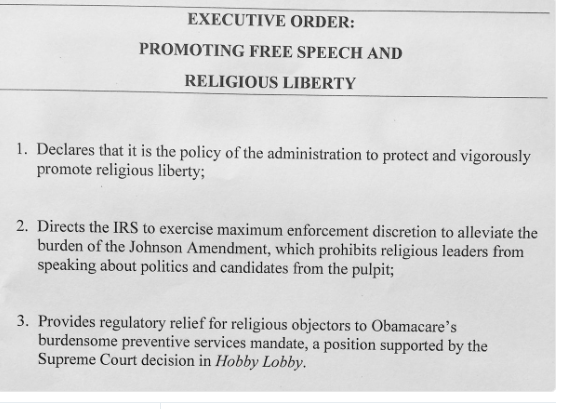
Trump signed his Promoting Free Speech and Religious Liberty executive order earlier today. The EO was expected to order the IRS to stop enforcing the so-called Johnson Amendment against religious organizations. As Ben explained, by its language, it may have done significantly less—it appears to merely reaffirm the status quo for enforcement. Whatever its substantive effects, though, the existence of the order is no surprise, and, as has happened with any number of Trump’s previous EOs, the ACLU Freedom From Religion Foundation has already announced that it will challenge the EO in court. [Update: the ACLU looked at the EO and agreed with Ben that there was nothing there, and decided not to sue. The FFRF, otoh, decided to sue. So it’s the FFRF that will face these procedural hurdles before it has to face the substantive (or rather, lack of substance) ones.]

Leaving aside the question of whether this EO actually does anything substantive, it’s worth remembering that any judicial challenge to the executive order faces two significant hurdles: standing and administrative discretion.[fn1] It’s also possible that the Trump administration inadvertently made those hurdles easier to pass. Continue reading “About the ACLU’s [Update: FFRF’s] Challenge to the Promoting Free Speech and Religious Liberty EO”

Trump’s Johnson Amendment Executive Order Does Not Say What He Said it Said

By Benjamin Leff

Trump issued an Executive Order (EO) today, the text of which was a complete shock (at least to naive little me). I had written a thousand-word blog post based on reporting before the release of the EO that Trump would direct the Internal Revenue Service to “exercise maximum enforcement discretion to alleviate the burden of the Johnson amendment which prohibits religious leaders from speaking about politics and candidate from the pulpit[.]” Then I watched the whole signing ceremony and Trump confirmed that he was planning to clearly open the door for religious leaders to communicate their views on candidates from the pulpits of their houses of worship.

The pre-prepared post argued that the IRS should issue some guidance explaining how it would enforce the Johnson Amendment in light of the EO, especially (1) whether it would create a “safe harbor” only for the speech of the organization, or also for the organization’s money and (2) whether it would extend the “safe harbor” to all 501(c)(3) organizations, or just houses of worship. The general consensus among advocates of changing the Johnson Amendment is that any liberalization of the rule should apply equally to all 501(c)(3) organizations and that it should permit speech but not spending.

Then, after a couple of hours, the White House released the actual text of the Executive Order. Unless I’m blind, what it says is literally nothing like what the Trump Administration said it would say, and even less like what Trump said it said when he signed it in the Rose Garden ceremony just a few hours ago. Continue reading “Trump’s Johnson Amendment Executive Order Does Not Say What He Said it Said”

What is the Johnson Amendment?

By: David Herzig

As the world braces for the upcoming Executive Order from President Trump,

Screen Shot 2017-05-04 at 8.18.56 AM

I wanted to take a minute and describe the Johnson Amendment.  Later today, after the actual Executive Order is made public, Ben Leff will be writing up a more through post.

A couple of months ago President Donald Trump told the audience at the National Prayer Breakfast that he would “get rid of and totally destroy” the Johnson Amendment. Which raises the question: what is the Johnson Amendment. Because he brought it up at the National Prayer Breakfast, it also leads to the question of how does affects churches.

In 1954, without explanation, Lyndon Johnson proposed a small amendment to the tax law governing tax-exempt organizations: forbid them from endorsing or opposing candidates for office. One of the few consistent talking points during president-elect Donald Trump’s campaign was that this so-called “Johnson Amendment” should be repealed; since comprehensive tax reform is part of Trump’s plan for his first 100 days in office, the repeal may happen immediately. Continue reading “What is the Johnson Amendment?”

Ebooks and ExamSoft

By Sam Brunson

A couple weeks ago, one of my students emailed me. This semester, he bought the ebook for my BizOrg class, and didn’t bother buying a physical copy. And he wanted to know if he could use his ebook on the final.

My finals are all open-book; students can bring in and use the casebook, the statutory supplement, and any notes that they create (on their own or in their study group). So in theory, I’m totally fine with it.

In practice, though, I had to send him to our Dean of Students. Because, like many law schools (and some bar examiners), we use ExamSoft for tests.[fn1] Now. I haven’t personally used ExamSoft since I was in law school (it was fine back then, though it was apparently not Mac compatible back in those days). Basically, when I used it, it was a basic word processor that saved your work every minute and blocked access to the rest of your computer while you took the exam. Continue reading “Ebooks and ExamSoft”

We Hear What We Want to Hear

Shu-Yi Oei

I’ve been preoccupied by country music these past few days. For this, I blame my Tulane colleague, Sally Richardson, who recently wrote this post on Property Law Profs Blog. In it, Sally makes the following observation:

Last week, my good friend, brilliant colleague, and property law scholar extraordinaire, Jim Gordley (Tulane), told me that he had been on a road trip and listened to a good deal of country music.  In the course of listening to a series of country songs, Jim decided that country music was about two things:  love and breaking the law.  Being from the south and having listened to my fair share of country music, I have to admit that Jim is right.  Just listen to Friends in Low PlacesAchy-Breaky HeartBefore He CheatsFolsom Prison Blues, and Ol’ Red and you can see for yourself.  Sure, there are some other songs about dogs and beer, but those are really in the minority.  Most country music is about love and the law.

Sally also shares some really genius lyrics coined by Jim, which include:

I assign and convey to you
That unencumbered heart
With one restrictive covenant
That we shall never part,
And this condition subsequent
That if you let it break,
Then I in my discretion
May reenter and retake.

Reminds me a bit of the Conway Twitty tax case—both the Tax Court’s Ode and the IRS AOD in response!

Of course, as a matter of substance, I think Jim and Sally are dead wrong. Love and breaking the law…pshaw! Aside from some notable lines such as the one about Ilsa the acrobat falling in love with Horatio the Human Cannonball, country music is, in fact, all about economic security, lending and financing, foreclosure, bailouts, and tax.

Let me explain:

Caveat: I have an immense soft spot for country music. Some days I have half a mind to move to Nashville and try to earn a living as a country music songwriter. (I’m only very slightly kidding about that.) However, I do not actually know anything about country music. And obviously, country music has a bazillion subgenres is about lots of other things as well (as this article describes), including the painful, painful process of creating legal scholarship.

Continue reading “We Hear What We Want to Hear”

Under His Plan, Will Trump’s Taxes Go Up?

By Sam Brunson

Honestly, we have no way of knowing. For one thing, we don’t know how much Trump currently pays in taxes. For another, the plan he has provided is less a plan than it is a shopping list, a shopping list that’s really light on details. But we can at least make a guess. (Spoiler alert: he probably won’t.) Continue reading “Under His Plan, Will Trump’s Taxes Go Up?”

How Will Trump’s Tax Plan Affect Middle-Income Families?

By Stephanie Hoffer, @profhoffer

The President’s one-page tax plan, released on Wednesday, claims that it will “[p]rovide relief to American families – especially middle income families.”  Whether tax reform eventually lives up to the President’s claim, though, will depend on how he and the Congress choose to address not only tax rates and the standard deduction, but also the personal exemption and credits related to children and dependents.

Like the Republican blueprint for tax reform, the President’s plan would double the standard deduction while trimming itemized deductions.  It also would expand the credit for child and dependent care, although the plan doesn’t specify how.

Notably, the Republican proposal would eliminate personal exemptions provided by § 151, which allow a deduction of $4,050 per dependent in 2017.  Dependents include a taxpayer’s spouse, children, and other members of the household who rely family support.   Although the repeal of § 151 was not specifically mentioned in the President’s proposal, the President and Congress must reach consensus on how to reduce the cost of tax reform.  Eliminating personal exemptions in favor of an expanded standard deduction may be an approach on which both could agree, but it may not be good policy. Continue reading “How Will Trump’s Tax Plan Affect Middle-Income Families?”