
Revisiting Presidential Tax Return Disclosure

imjustabillBy Sam Brunson

At this point, it’s pretty clear that the norm of presidential candidates (and, presumably, presidents) releasing their tax returns to the public is dead and buried. Sure, it’s been on life support for some time now (I mean, a significant number of candidates in this race released weak disclosures at best), but Trump’s election without having ever released his returns clearly demonstrates that flouting this particular norm is not a bar to election.

On election day I wrote that Congress should require disclosure from presidential candidates (and, at this point, I would expand that to sitting presidents and vice-presidents), and provided a handful of ideas about how such legislation should look. But my previous post suffers from one significant weakness: I assumed that disclosure was a good thing, without explaining why. Continue reading “Revisiting Presidential Tax Return Disclosure”

Federal Hall and Taxes

img_0082

By Sam Brunson

I spent my Thanksgiving in New York this year, ostensibly to see the Macy’s Thanksgiving Day Parade.[fn1]

Before and after Thanksgiving, my family and I went to various National Memorials in New York. (My Hamilton-obsessed kids were thrilled to make a pilgrimage to Hamilton Grange, even if they haven’t actually seen the musical yet.)

And on Friday, we went to Federal Hall.[fn2] And, like our visit to Alcatraz over the summer, I was surprised (and pleased) to find a tax connection.  Continue reading “Federal Hall and Taxes”

Donald Trump —> Mandatory Tax Return Disclosure

So it looks like Trump wasn’t lying when he said he wouldn’t release his tax returns—it’s Election Day,[fn1] and we still haven’t seen them.[fn2]

As has been endlessly pointed out, every Republican nominee for president since Ronald Reagan has released his tax returns, and most nominees since the 1970s have. Trump, in refusing to release his returns, is flouting a long-standing norm.

The thing is, though, he’s run a campaign largely based on flouting norms. And it’s not like the norm was aging well, anyway. Sure, there were candidates with exemplary releases. But there were candidates—on both sides of the aisle (I’ve got my eye on you, Bernie Sanders!) who did less than the bare minimum, releasing only one or two years’ worth of returns, and only really releasing their 1040s. (Several months ago, I graded candidates’ tax return disclosures here.)  Continue reading “Donald Trump —> Mandatory Tax Return Disclosure”

The Halloween Parent Tax

halloween-candy1By Sam Brunson

I was asked on Twitter about the Halloween Parent Tax. And with Halloween coming up, it seemed like it needed a post. So here you are:

Design Considerations

You’ve got a couple options here. Are you going to create an income tax? A consumption tax? A head tax? Each is slightly different, in certain relevant ways:

Income Tax: This is probably what you think of when you think of the Halloween Parent Tax. Essentially, children are required to give their parents some percentage of the candy they get. (My wife’s parents imposed a 15-percent Halloween Parent Tax when she was growing up.) There are some design complications here—for example, are you taking a percentage of the number of pieces of candy the kids get? Or do different kinds of candy have different values? And do you take size into account in calculating candy value?[fn1] Continue reading “The Halloween Parent Tax”

Outraged Yet? A Tax Reason the Pentagon’s Clawback Sucks — Updated

By: Sam Brunson

cngYesterday, both my Facebook and WBEZ told me about how the Pentagon is clawing back bonuses it paid—a decade ago!—to members of the California National Guard as reenlistment bonuses. [Update, 10/26/16: today, Defense Secretary Ash Carter ordered the Pentagon to suspend its efforts to claw back the bonuses. Note, though, that there’s no indication that it will return any portion of bonuses that have already been clawed back, so the tax issues still stand, afaik.] 

The whole story is pretty enraging, but, so that I don’t bury my particular lede too far: though the stories don’t discuss the tax consequences to the soldiers, the soldiers are likely to miss out on significant deductions that they deserve.

To understand why, you need to know about the clawbacks. I’ll let the LA Times do the hard explanatory work, but in brief: in the mid-2000s, the military was facing recruitment shortfalls, so it started offering super-generous incentives to the military to get them to reenlist, and it paid those incentives (often $15,000 or more) upfront, essentially replicating private sector signing bonuses.  Continue reading “Outraged Yet? A Tax Reason the Pentagon’s Clawback Sucks — Updated”

Talking Tax on Twitter

twitterbird_rgbBy Sam Brunson

I was reminded yesterday both why I love Twitter and why Twitter is such a valuable tool for tax academics (and others).

See, yesterday I participated in two (or, actually, three) conversations about different tax topics. And, notwithstanding the inherent limitations of the medium (especially the 140-character limit), the discussions were both substantive and informative.  Continue reading “Talking Tax on Twitter”

A $916 Million Loss? #TrumpLeaks

By Sam Brunson

trump-returnThe New York Times reported tonight that in 1995, Republican presidential candidate Donald Trump may have claimed a $916 loss, a loss substantial enough that it could have allowed him to avoid paying taxes for nearly two decades.

The push notification for the story showed up on my phone at 8:30 pm Central time on a Saturday, so I haven’t had time to really dig into it. I’m sure that, over the next few days, we’ll have something more substantive to say. But in the meantime, a couple thoughts:  Continue reading “A $916 Million Loss? #TrumpLeaks”

Debate Prep: The Candidates’ Marginal Rate Proposals #debates

By Sam Brunson

In anticipation of tonight’s debate, I’m going to describe what both candidates propose to do with tax rates, provide a little commentary, and suggest a couple questions that the moderator might ask to clarify what the candidates plan on doing.

The candidates’ proposals for individual tax rates illustrate one of their biggest divergences. As best I can tell, in fact, their plans for tax rates are as different as it is possible to be. And what are those plans? Continue reading “Debate Prep: The Candidates’ Marginal Rate Proposals #debates”

Can His Fans #SaveNelly?

By Sam Brunson

Photo by reeb0k2008. CC BY 2.0

I listened to Nelly’s “Hot in Herre” last night. And I’m not alone—apparently, over the last couple days, Nelly’s Spotify streams have tripled as compared with the week before.

Why? Taxes, of course.

Apparently, Nelly has joined the storied ranks of popular entertainers who don’t pay their taxes. (See also Willie Nelson, Lauryn Hill, MC Hammer, and Jerry Lee Lewis, among others.[fn1])  Continue reading “Can His Fans #SaveNelly?”

The Freedom Caucus and Koskinen

To follow up on Leandra’s post from two weeks ago: various news sources are reporting that the House Freedom Caucus is planning to make a “privileged resolution” sometime today to force a vote on impeaching Commissioner Koskinen. (Which makes sense: the Freedom Caucus’s Twitter feed seems to be all-impeach-Koskinen-all-the-time.) If they pass the resolution, they hope to force a vote on the impeachment within the next two days.

Stay tuned.

Every Old Scam is New Again

Michael Schvo's "Sheep Station." Photo by Inhabitat. Used under a CC BY-NC-ND 2.0 licence.
“Sheep Station.” Photo by Inhabitat. Used under a CC BY-NC-ND 2.0 licence.

When I was in law school, I took a class in state and local taxation from Professor Richard Pomp. Although I don’t spend much of my professional life thinking about state taxes, I clearly remember one of the stories he told us.

A fur store in Manhattan, he told us, would ship empty boxes (or boxes filled with rocks or magazines) to an empty lot in New Jersey for customers. Why? Because nonresident purchasers didn’t have to pay New York sales tax if the purchase was shipped out of state.[fn1]

The New York Times provides more detail on the scheme: the furrier in question, Ben Thylan Furs Corporation, would allow customers to take the furs home without paying sales tax (and, with an average fur price of $8,700, the evasion of an 8.25% sales tax saved customers an average of $717.75 per fur). It would then ship a box filled with something else (or with nothing) to create a false record to back the out-of-state purchase. And, in 1985, Ben Thylan was indicted.  Continue reading “Every Old Scam is New Again”

Ireland, Apple, and State Aid

EUMaybe you heard: Apple owes up to €13 billion in back taxes, plus interest, to Ireland. And maybe you also heard that Ireland doesn’t want Apple to pay. So what’s up?

appleFirst a caveat: I don’t have any particular expertise in European Union law, so I’m going off of news reports[fn1] and the European Commission’s press release. (As of when I’m writing this on Tuesday afternoon, the actual opinion isn’t up on the EC’s website. I’ll add a link when it’s available.)
In short: members of the EU can establish their own tax systems; the EU doesn’t have any authority over those systems. Over the last two years or so, though, the EC has been looking at special tax deals member countries have been giving to companies; where it finds that a country has provided special tax treatment to one particular company (and not granted similar tax treatment to other companies), it has held that the country provided “state aid” to that company. The EU treaty prohibits state aid and, when a member country provides such aid, the EC can require that country to recover the taxes it should have collected from the company in question. Though this Apple ruling is the most recent, last year the EC determined that Luxembourg and the Netherlands had used tax rulings to provide state aid to Fiat and Starbucks, and it is still looking into tax rulings provided by Luxembourg to McDonald’s and Amazon. Continue reading “Ireland, Apple, and State Aid”

Tax Canon, Music Edition

A week and a half ago, Leandra posted some of the history and context of the Beatle’s “Taxman.” It got me thinking about something I’ve been wondering about for a while: what songs are out there that talk about tax?[fn1]

I’ve found a couple places that have addressed the question, but they’re all deficient. “Sound Opinions” did a show on the question this last April, but, in spite of calling it the “Tax Day Special,” they included songs about money broadly, not taxes specifically.

VH1 got the taxes (mostly) right (“Take the Money and Run” is a stretch for my purposes), but limited themselves to 10 songs, and all of the songs are rock songs. (Still, I’m going to steal several of theirs for this.)  Continue reading “Tax Canon, Music Edition”

Child Care in the Presidential Campaign

CCA-IG-CostsCompared_v1bToday, Donald Trump laid out a series of economic proposals. Included, naturally, were a series of tax proposals, which I assume we’ll address on this blog as time goes on. For now, I want to focus on just one of his proposals: easing the cost of child care.

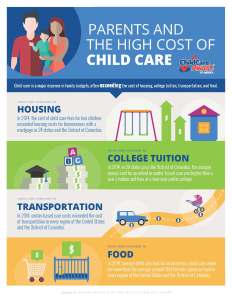
While the cost of child care varies, it has risen dramatically, nearly doubling over the last 25 years. And although the cost of child care varies from state to state—and even from city to city—the numbers can be eye-opening. In Illinois, the average annual cost of child care for an infant and a 4-year-old is more than $22,000. At the same time, the median income for a single parent is about $24,000, and the median household income for married parents is about $88,000.[fn1] That means that the cost of child care for two children represents 25 percent of the median Illinois married couple’s household income, and fully 94 percent of the median income of a single parent.

Clearly, using averages and medians doesn’t paint an accurate picture of any given family’s situation. But in no state would child care costs make up less than 30 percent of a minimum wage-earner’s income. That’s a pretty dire picture. Dire enough, in fact, that the cost of child care is keeping women out of the workforce. (And note that it’s not just women who can afford to stay out of the workforce because of a spouse’s or partner’s income: 34 percent of stay-at-home mothers live in poverty, as opposed to 12 percent of mothers in the workforce.) Continue reading “Child Care in the Presidential Campaign”

Rio 2016!

rioThe Rio Olympics start this weekend.[fn1] And, in spite of the catastrophe that the Rio Olympics may potentially be, we’ll be watching (in the same way John Oliver excoriated FIFA for 12 minutes before announcing that he was “still so excited” for the World Cup).

U.S. Olympians are likely to win a collective 100 or so medals over the next couple weeks. And, in addition to medals, winners will receive cash payments from the U.S. Olympic Committee—it will pay $25,000 for a gold, $15,000 for a silver, and $10,000 for a bronze. Continue reading “Rio 2016!”