Tomorrow’s Ninth Circuit Oral Argument in Altera

By: Leandra Lederman

Susan Morse and Stephen Shay have blogged today on Procedurally Taxing about the Ninth’s Circuit oral argument tomorrow in Altera Corp. v. Commissioner, as has Dan Shaviro on his blog, Start Making SenseAltera is the transfer pricing and administrative law case involving the Treasury’s cost-sharing agreement regulation. The Tax Court invalidated the regulation under the Administrative Procedure Act, as arbitrary and capricious. That is because the Tax Court accepted the taxpayer’s argument that it need not share stock-based compensation costs under a qualified cost-sharing agreement because arm’s length parties would not do so. The Tax Court found that Treasury had inadequately addressed evidence in the notice-and-comment process that parties not under common control did not share stock-based compensation costs, although Treasury explained in the Preamble to the regulation that cost-sharing agreements between uncontrolled parties are not sufficiently comparable to those in controlled-party transactions.

Altera raises an important administrative law question about what is required of Treasury for its regulations to be valid. Susie and Steve spearheaded an amicus brief in the Ninth Circuit in favor of the Commissioner, in which I joined, along with Dick Harvey, Ruth Mason, and Bret Wells. An amicus brief prepared by another group of professors also supports the Commissioner. There are also amicus briefs by business groups on the other side. See Susie and Steve’s blog post for more detail. And for prior coverage on the Surly Subgroup, see this post on our amicus brief, explaining why the Ninth Circuit should reverse the Tax Court’s decision invalidating the regulation.

IRS ‘Targeted’ Liberal Organizations and After All These Years TIGTA is Still Wrong

darts-2349444_1920By: Philip Hackney

The Treasury Inspector General for Tax Administration (TIGTA) just issued a new report four years and five months after rebuking the IRS for using “inappropriate” criteria to select applications for tax exempt status for scrutiny. In the first report, TIGTA rebuked the IRS for pulling the applications of conservative leaning organizations for greater scrutiny.

This time it considers the fact that the IRS over a period of 10 years used liberal leaning names such as ACORN, Emerge, and Progressive as criteria for pulling applications for greater scrutiny. This resulted in the IRS applying greater scrutiny to these organizations. Some might say the IRS targeted these organizations. Those organizations appear to have faced long wait times as well, and sometimes some questions of limited merit.

I write this piece to make two points: (1) had this information been in the initial report, I don’t think we would have had the “scandal” that shook the IRS and the political world of the time; and (2) the TIGTA report built its primary claim on a garbled faux legal postulate. The original report did terrible damage to the IRS and individuals by failing on both of these fronts. Continue reading “IRS ‘Targeted’ Liberal Organizations and After All These Years TIGTA is Still Wrong”

Saule Omarova (Cornell) presents “Private Wealth and Public Goods: A Case for a National Investment Authority” At Boston College Law School

Shu Yi Oei

UPDATE 9/19/17: I blogged more about Omarova & Hockett’s National Investment Authority suggestion over on Taxprof Blog. You can read the post here.


Today, Boston College Law School welcomes Professor Saule Omarova (Cornell) as the first presenter in our inaugural Regulation and Markets Workshop Series. The paper (with Robert Hockett, also of Cornell) is entitled “Private Wealth and Public Goods: A Case for a National Investment Authority.” It’s available on SSRN.

Here’s the abstract:

The American Presidential election of 2016 was won under the rhetorical banner of returning America to its past productive glory. Any such undertaking presents an extraordinary challenge, demanding a correspondingly extraordinary institutional response. This Article proposes precisely such a response. It designs and advocates a new public instrumentality – a National Investment Authority (“NIA”) – charged with the critical task of devising and implementing a comprehensive long-term development strategy for the United States.

Patterned in part after the New Deal-era Reconstruction Finance Corporation, in part after modern sovereign wealth funds, and in part after private equity and venture capital firms, the NIA is an inherently hybrid, public-private entity that combines the unique strengths of public instrumentalities – their vast scale, lengthy investment horizons, and explicit backing by the public’s full faith and credit – with the micro-informational advantages of private market actors. By creatively adapting familiar tools of financial and legal engineering, the NIA overcomes obstacles that ordinarily impede or discourage private investment in critically necessary and even transformative public infrastructure goods. By channeling presently speculative private capital back into the real-economy, moreover, the NIA plays an important role in enhancing the resilience and stability of the U.S. and global financial systems.

The Article makes original contributions not only to contemporary policy debates over how to revive America’s productive prowess and bring its financial system back into the service of the real economy, but also to current theoretical understandings of “public goods” and how to provide them. It offers a more complete and coherent account of such goods as solutions to collective action problems that pervade decentralized markets, hence as goods that can be supplied only through exercises of collective agency. The NIA proposal advanced in the Article operationalizes this theoretical insight by elaborating a specific institutional form that such collective agency can take.

The paper is really interesting and I have many swirling thoughts. I’ll say more after the workshop.


Something Old, Something New: Two Workshop Series @ Boston College Law School this Fall

Shu Yi Oei

I’m happy to announce that we have a couple of workshop series happening at BC Law School this academic year. I’m really quite excited about these. Because what’s life without a workshop?

Tax Policy Workshops & Roundtable…

Boston College Law School has run a Tax Policy Workshop Series since 2007. This fall, we continue in that tradition, with speakers Daniel Hemel (Chicago), Ruth Mason (UVA), Zachary Liscow (Yale), and Lily Batchelder (NYU) presenting papers.

BC Law and Tulane Law are also hosting a joint BC-Tulane Tax Roundtable on March 23, 2018. More info about that coming soon.

…and a New Regulation and Markets Workshop Series!

In addition, here’s something a bit fun: Some BC Law colleagues and I have started a new workshop series, focusing on Regulation, Markets, and Business. This multidisciplinary workshop series focuses on the study of regulatory approaches to markets and business. It investigates how such economic regulation should be designed in order to balance the interests of various constituencies. It also explores how traditional approaches to regulation compare, contrast, and intersect with emerging methodologies.

We’ll feature presentations by invited legal scholars of their works-in-progress. The hope is to create opportunities for scholars working on issues of economic regulation to discuss and present their research in a forum of academics working in related intellectual spaces. The workshop is offered to Boston College JD and LLM students as a 1-credit seminar.

Here’s the 2017-18 slate:

FALL 2017

September 12, 2017 – Saule Omarova (Cornell): “Private Wealth and Public Goods: A Case for a National Investment Authority”

September 26, 2017 – Rory Van Loo (Boston University): “Consumer Law as Tax Alternative”

Tuesday, October 17, 2017 – William Birdthistle (Chicago-Kent):  “Free Funds: Retirement Saving as Public Infrastructure”

Tuesday, November 14, 2017 – Cary Martin Shelby (DePaul): “The Role of Competition in the Regulation of Investment Funds”

Tuesday, November 28, 2017, 12:15 pm – Lily Batchelder (NYU), co-sponsored with Tax Policy Workshop: “The Shaky Case for a Business Cash-Flow Tax”

Continue reading “Something Old, Something New: Two Workshop Series @ Boston College Law School this Fall”

So about that Robot Tax…

Shu-Yi Oei

I came across a couple of news stories recently about how South Korea is introducing the world’s first robot tax. But based on the press reports, it sounds like the so-called robot tax is actually just a reduction of the tax deductions available to businesses that invest in productivity-boosting automation. The news sources themselves concede that this “robot tax” not exactly a tax on robots but rather a tax benefit reduction for automation investment.

Talk of a “robot tax” has landed at the forefront of tax news since Bill Gates mentioned it in a Quartz interview back in February of 2017. But of course, scholarship about robots (not to mention robots themselves) has been around for quite a bit longer. There’s even a “We-Robot” robotics law and policy conference that’s been going on since 2012, which I keep meaning to crash, but then there’s always something else going on.

A lot of what seems to be driving the tax conversation is the fear that robots are taking over jobs, though there’s some uncertainty about the extent to which robots are to blame.

Personally, I’ve been having a hard time squaring the newly ascendant tax conversation about the robot tax with the broader legal scholarship on robots. In some of the news and other commentary discussing Robotaxation, my reaction has been something to the effect of “I’m not sure that word means what you think it means.” Turns out, there is something of an existing conversation about what constitutes a robot in the first place—see, for example, Richards and Smart (2013) for a nice discussion of some of the definitional issues. See also this “What is a Robot?” piece in The Atlantic. In defining “robot,” it might matter how a robot moves in the physical world, what kind of quasi-independent agency it seems to exercise (autonomous vs. semi-autonomous), how humans interact with it, and even what sorts of emotions it triggers in us mere humans. We might understand some automated machines to be robots but others to just be automated equipment. And these distinctions make sense, from the viewpoint of areas like tort law, privacy law, the law of principals and agents, and the more general regulation of robots (and of artificial intelligence as a subcategory of robots).

But in some of the tax discussions about robots that I’ve seen on the interwebs, it’s quite clear that the authors don’t necessarily mean Robot when they say Robot. Continue reading “So about that Robot Tax…”

The Front Lines of Sharing Economy Legal Debates

By: Diane Ring

Last month I blogged about new proposed legislation in Congress that sought to provide a safe harbor for gig worker classification for tax purposes. However, as I noted, the proposal implicitly favored one side of the debate by making the safe harbor one that would ensure the “easy” ability to classify a worker as an independent contractor (rather than an employee). In that post, I suggested that having tax lead the charge in this sharing economy worker classification debate perhaps allowed the tax “tail” to lead the employment relations “dog”. There are pressing nontax issues in the sharing economy that are driving litigation and dominating worker concerns – particularly employment law issues. Just last week, we saw further evidence of serious tensions in the landscape of sharing economy labor law.

On Tuesday, July 31, 207, in Chamber of Commerce of the United States, et al.,  v. The City of Seattle, a U.S. federal judge dismissed a challenge to legislation approved by the Seattle City Council in fall 2015. Pursuant to the Seattle law, businesses that hire or contract with taxi-drivers, for-hire transportation companies and “transportation network companies” must bargain with drivers if a majority want to be represented. That is, Seattle effectively allows Uber and Lyft drivers to unionize. Not surprisingly, Uber and Lyft objected to the law . . . Continue reading “The Front Lines of Sharing Economy Legal Debates”

The Tail, the Dog, and Gig Workers

By: Diane Ring

tail.dog

New legislation has just been introduced in the Senate that creates a “safe harbor” for independent contractor status. The proposed legislation provides that if a worker relationship satisfies certain criteria, then that worker can bypass the sometimes messy, multi-factor test for distinguishing between employees and independent contractors, and will be classified as an independent contractor for tax purposes. What prompted action now to address what has been a decades-old classification challenge for workers, businesses and the IRS alike? The gig economy. (Hence, the not-so-catchy title for the legislation: The New Economy Works to Guarantee Independence and Growth (NEW GIG) Act of 2017 (S. 1549).)

The legislation’s sponsor, Senate Finance Committee member John Thune, (R-S.D), described the impetus for the legislation as follows: “My legislation would provide clear rules so that these freelance style workers can work as independent contractors with the peace of mind that their tax status will be respected by the IRS.”

Is this really what gig workers are worrying about? . . . Continue reading “The Tail, the Dog, and Gig Workers”

House Appropriations Bill

By: David Herzig

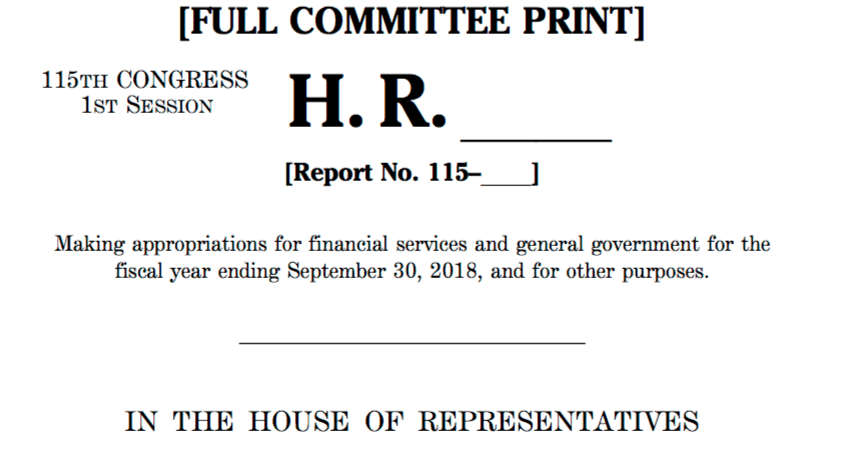
With all the diversions this week, it was easy to miss that the House Committee on Appropriations posted on June 28th the Appropriations Bill for FY 2018.  The bill seems to include a couple items that not many were expecting.  So, I thought I would highlight some of the key provisions.  Since it is Friday before a Holiday weekend, I’ll keep it short for now.  There are four main provisions I will address: (1) IRS Targeting/Johnson Amendment; (2) ACA Penalties; (3) Conservation Easements; and (4) 2704 (Estate/Gift Tax).

I. IRS Targeting/Death of Johnson Amendment

First, is a clear response to the “targeting” of groups from the Lois Lerner Administration. In three separate sections (107, 108 and 116), the bill attempts to regulate the IRS, not Continue reading “House Appropriations Bill”

We Should be Taking President Trump’s Tax Plan Seriously

By: David J. Herzig

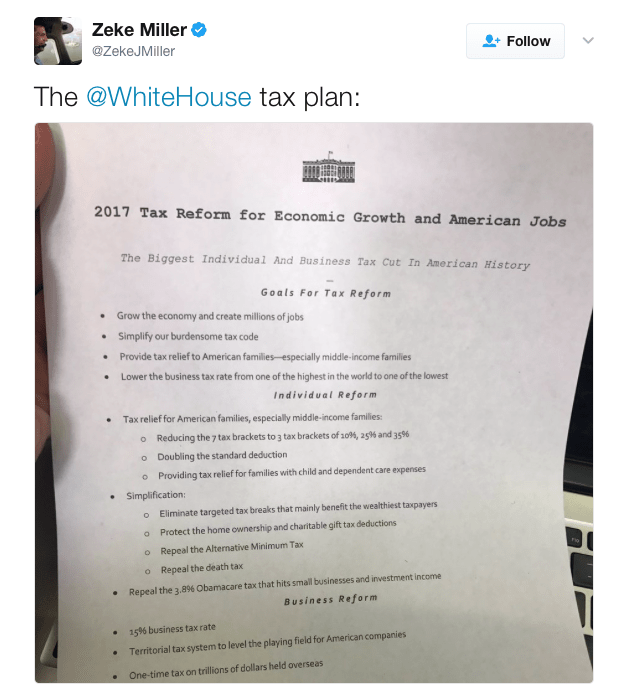
Today President Trump’s top tax advisors laid out the first details of the his tax plan. Chief economic adviser Gary Cohn and Treasury Secretary Steve Mnuchin unveiled the plan which according to Fox News, Cohn called “the most significant tax reform legislation since 1986, and one of the biggest tax cuts in American history.”

Oh, did I mention that the details of the biggest cuts were printed on a single sheet of paper?

Screen Shot 2017-04-26 at 4.22.18 PM

There has been plenty of ink (and jokes) already spilled about the plan.  For example, you can read Richard Rubin of the WSJ (here) or Alan Rappeport of the NY Times (here). The long and the short of the plan is it seems to very very costly.  The Committee for a Responsible Federal Budget guesses it could cost $3 to $7 trillion with their estimate at $5.5 trillion.  That is a lot of money!

Continue reading “We Should be Taking President Trump’s Tax Plan Seriously”

The Surly Subgroup Turns One!

Time flies when you’re having fun, I guess. Today is the one-year blogiversary of the Surly Subgroup. What started off as a group-blogging experiment hatched at last year’s Critical Tax Conference at Tulane Law School has provided quite a bit of entertainment for Surly bloggers and our guest bloggers, and hopefully for our readers as well.

It’s obviously been a big year on tax and other fronts. Since our inception, we’ve published 206 blog posts on a variety of topics. And we’ve drawn readers from 140 different countries.

Surly regulars and guest bloggers have covered various tax-related issues surrounding politics and the 2016 election—including disclosure of presidential tax returns, the Emoluments Clause, the Trump Foundation, and the Clinton Foundation. We’ve written about churches, 501(c)(3)s and the IRS treatment of non-profits. We’ve discussed the tax reform proposals of the 2016 presidential candidates and the #DBCFT. We’ve written several administrative law posts about Treasury Regulations and rulemaking.

Politics aside we’ve also covered other important issues in tax policy—including taxation and poverty, healthcare, tax policy and disabilities, tax compliance, and tax aspects of the Puerto Rico fiscal crisis. We’ve discussed several issues in international and cross-border taxes, touching on the EU state aid debate, the CCCTB, taxation and migration, the Panama Papers, tax leaks more generally, and tax evasion in China.

We hosted our first ever online Mini-Symposium on Tax Enforcement and Administration, which featured posts by ten different authors on a variety of tax administration topics. The Mini-Symposium was spearheaded by Leandra Lederman. Leandra had organized and moderated a discussion group on “The Future of Tax Administration and Enforcement” at the 2017 AALS Annual Meeting, and many of the discussion group participants contributed to the online symposium. We hope to organize future online symposia on other topics.

We’ve blogged about various conferences, workshops, and papers, both tax related and not-so-much tax related. We’ve also had lots of fun writing about taxes in popular culture – Surly bloggers and guest bloggers have written about the tax aspects of Pokémon Go, tax fiction, music-related tax issues (Jazz Fest! Prince! “Taxman”!), soccer players, dogs, Harry Potter fan fiction, Star Trek, and John Oliver. Surly bloggers even recorded a few tax podcasts!

In short, it’s been a busy year, and we’ve had a lot of fun with the Surly platform. We hope you have as well. Going forward, we’re going to keep the blog posts coming. We also hope to draw more regular and guest bloggers and to organize other online symposia.

Thanks for reading!

Panama Papers: The One-Year Anniversary

By: Diane Ring

This month marks the one-year anniversary of the Panama Papers leak. In April 2016, the ICIJ announced the leak and a few weeks later (May 9, 2016) released a database that included a subset of the leaked data. The leak itself comprised over 11 million records spanning 40 years from the Panamanian law firm Mossack Fonseca. At its core, the leak revealed the true ownership of over 200,000 offshore entities, thereby raising a host of tax and political questions regarding many of the entities’ owners.

So what has happened over the past year as a result of the leak? Continue reading “Panama Papers: The One-Year Anniversary”

Cross-Training (or, Tulane Corporate and Securities Law Roundtable)

My pal Ann Lipton–corporate governance and securities law expert and blogger extraordinaire over at BLPB–is organizing a conference at Tulane Law School today on the topic of “Navigating Federalism in Corporate and Securities Law.” It looked so interesting that I had to leave Henry Ordower and Kerry Ryan’s fabulous Critical Issues in Comparative and International Taxation: Taxation and Migration Conference a day early to crash her party! I’ve been auditing Securities Regulation and very much feeling like a little duckling in the securities/corporate world all semester, so I’m really looking forward to sitting in on an unfamiliar conversation. I always find that “cross-training” in other fields gives me fresh perspectives on my own work.

Here is the schedule. Some of these papers are really interesting!

The Problem of Large Shareholders
(Discussant: Urska Velikonja)

The Problem of Small Shareholders
(Discussant: Ann Lipton)

  • Jill Fisch (Penn), Advance Voting Instructions: Tapping the Voice of the Excluded Retail Investor
  • J.W. Verret (George Mason), Uber-ized Corporate Law

What Can States Regulate?
(Discussant: Jill Fisch)

  • Kent Greenfield (Boston College), Corporate Power and Campaign Finance
  • Summer Kim (Irvine), Corporate Long Arms

The Line Between Corporate Law and Securities Law
(Discussant: James Cox)

  • Ann Lipton (Tulane), Reviving Reliance
  • James Park (UCLA), Delaware and Santa Fe
  • Robert Thompson (Georgetown), Delaware’s Dominance: A Peculiar Illustration of American Federalism

The Operation of the SEC
(Discussant: James Park)

  • James Cox (Duke), Revolving Elites: Assessing Capture in the SEC
  • Urska Velikonja (Emory), Admissions in Public Enforcement

ACTC Letter Requesting a Variance for Tax Guidance

By: Leandra Lederman

Sam Brunson previously blogged about President Trump’s Executive Order of January 30, 2017, “Reducing Regulation and Controlling Regulatory Cost,” which requires an agency to identify two regulations to eliminate for every new regulation it issues. (Sam also has related posts here and here). As Sam stated, the Executive Order burdens taxpayers, who benefit from the public guidance Treasury regulations provide.

On March 23, the American College of Tax Counsel (ACTC) sent a letter to the Secretary of Treasury, Hon. Steven Mnuchin, and the Director of the Office of Management and Budget, Hon. Mick Mulvaney, “respectfully request[ing] that the Administration consider the unique role that the tax law plays in the lives of every American and provide the Treasury Department and the IRS with appropriate flexibility in issuing guidance that taxpayers and their advisors need in order to comply with the tax law.” The letter explains in part:

“By limiting the flexibility of Treasury and the IRS to issue such guidance, the Executive Order risks shifting the interpretive burden onto taxpayers, who must hire accountants, lawyers, and other advisors to guide them. . . . Moreover, by requiring Treasury and the IRS to identify two ‘deregulatory’ actions for each new guidance item, the Executive Order risks imposing additional burdens on taxpayers if it results in the elimination of existing rules that taxpayers and their advisors have come to rely on.”

I hope that Secretary Mnuchin and Director Mulvaney are receptive. As the ACTC’s letter states, even while simplification efforts are underway, “it is critical for taxpayers and their advisors to have the guidance needed to comply with the tax law as currently in effect.”

Update on the Future of Treasury Regulations

cfrBy Sam Brunson

I previously wrote about the fact that Treasury and the IRS were going to essentially stop issuing guidance in light of the Trump administration’s one-in-two-out rule for regulations.[fn1]

There seems to be some movement on this front. Yesterday, Commissioner Koskinen announced that the IRS was set to begin issuing “subregulatory” guidance again. He didn’t define what he meant by subregulatory, but it probably includes revenue procedures, notices, and revenue rulings, at least. (Interestingly enough, the Tax Notes reporting doesn’t mention revenue rulings,[fn2] while the BNA reporting does. I don’t know if that difference is accidental, or if the two organizations are interpreting differently what Commissioner Koskinen means by subregulatory.) Continue reading “Update on the Future of Treasury Regulations”

The Insurance Market Regulations in the Republicans’ Health Care Bill: Crippling Obamacare, or Passing a Hot Potato to State Governments?

By David Gamage

On Monday, the House Republicans finally revealed their draft bill to “repeal and replace” the Affordable Care Act (#Obamacare or #ACA). The bill is titled the American Health Care Act, and commentators have been referring to it as either the #AHCA or #Trumpcare.

To assess the bill, it is helpful to think of it as consisting of four primary buckets:

  1. ending many of Obamacare’s tax provisions (read: large tax cuts for the very wealthy);
  2. phased-in cuts to Medicaid funding and scheduled devolution of Medicaid to the states (read: eroding the health safety-net program for the poor);
  3. transforming Obamacare’s other major health subsidies from being based mostly on income and health costs to being based more on age (read: the implications of this are actually less straightforward than what much of the commentary suggests, but that is a topic for another day); and
  4. other changes to Obamacare’s insurance market regulations (the subject of today’s blog post).

In this blog post, I will focus on the fourth bucket—the changes to Obamacare’s insurance market reforms other than the changes to the subsidies. Time permitting, I hope to write future blog posts on some of the other buckets.

What is most striking about the AHCA’s insurance market changes is how they keep the vast majority of Obamacare’s reforms in place. Right-wing groups have thus taken to calling the AHCA “#ObamacareLite”. Yet I consider this a misnomer. A more accurate label would be #ObamacareCrippled.

The AHCA’s changes do not really water down Obamacare, as the intended slur of “ObamacareLite” implies. Rather, the AHCA’s changes would likely cause Obamacare‘s framework for regulating the individual market to fall apart. If the AHCA bill were to be enacted in its current form, the result would likely be adverse-selection death spirals. The only real hope for saving the individual market would be for state governments to step up with new state-level regulations for supporting insurance markets within each state.

Continue reading “The Insurance Market Regulations in the Republicans’ Health Care Bill: Crippling Obamacare, or Passing a Hot Potato to State Governments?”