President Trumpeting Marketplace Fairness?

By Adam Thimmesch

Hello everyone! I’m excited to be joining the Surly Subgroup and appreciate the opportunity to share some of my thoughts in thus forum. I’ve been at the University of Nebraska College of Law since 2012, and I teach Individual Income Tax, State and Local Tax, Corporate Tax, Corporate Finance, and Business Associations. Much of my research to date has focused on state-tax issues, though I’ve recently been spending time also thinking about how our tax systems intersect with individual privacy interests. I am looking forward to blogging about these issues—and maybe a good tax-and-soccer scandal from time to time.

This is a particularly good week to enter the blogging world as a state-tax guy. I woke up yesterday ready for a regular day of summer research and writing when this happened:

Now, I’m generally inclined to not give much attention to our current President’s tweets, but it isn’t often that state-tax issues get presidential attention, so it seemed like a good opportunity to dig into the tweet a bit more. (Plus it gave me the opportunity to use a terrible Trump pun right off the bat as a blogger.)

The Tweet

Although the President’s tweet is difficult to interpret (and that’s being gracious), it appears that he was primarily attempting to criticize The Washington Post as “fake news.” That came a day after the paper reported on the fact that several of his golf clubs had posted fake Time magazine covers on their walls. Trump made this criticism, though, through an oddly constructed reference to the paper’s relationship with Amazon and Amazon’s position with respect to “internet taxes,” which most likely is a reference to the collection of use tax on online sales. (The Washington Post and Amazon are not related, of course, except that Jeff Bezos—the founder, chairman, and CEO of Amazon—purchased the paper in 2013.)

Continue reading “President Trumpeting Marketplace Fairness?”
Mortgage Interest Deduction

By: David J. Herzig

The Trump and Republican tax plans have circled around the idea of repealing the mortgage interest deduction.  Although I’m not convinced it will happen (see e.g., Treasury Secretary Mnuchin’s remarks).  The mere threat of the repeal has garnered a fair amount of attention.

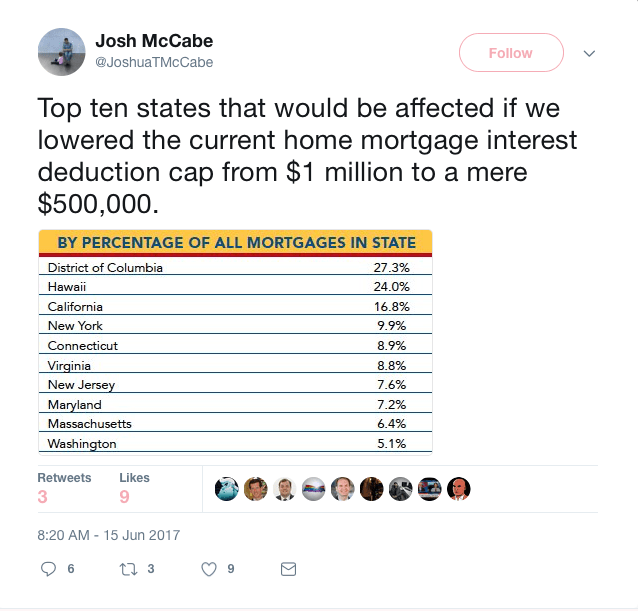
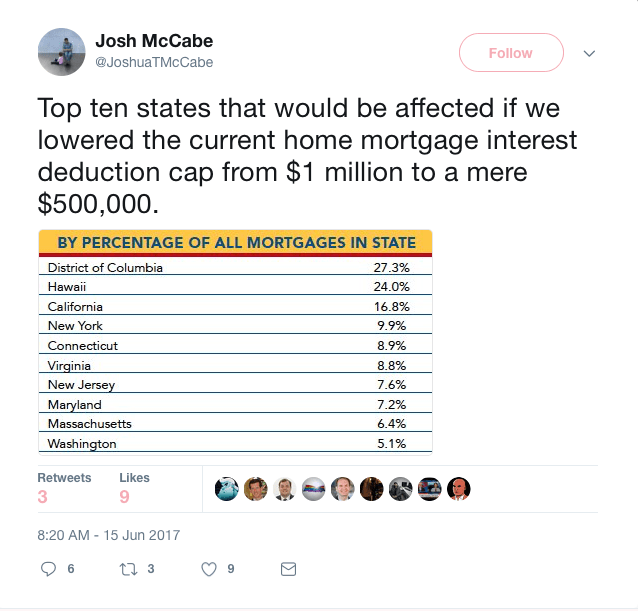
For example, the other day this chart was making its rounds on twitter.

Screen Shot 2017-06-16 at 7.42.50 AM

I have not verified the methodology of the chart or the data.  I interpret that the chart examines (in absolute numbers) how many mortgages exist at $1,000,000. The implicit conclusion of the chart is that homeowners in states like D.C., Hawai’i, California and New York have the most at stake in retaining the deduction.

Why?

Because there seems to be evidence that the mortgage interest deduction contributes to housing inflation.  Back in 2011 the Senate held hearings on incentives for homeownership. [1]  It has been suggested that the elimination of the deduction will drop home prices between 2 and 13% with significant regional differences. [2]  So, if the mortgage interest deduction is eliminated, then the aforementioned states might have numerous problems, including a smaller property tax base.

What exactly is the Mortgage Interest Deduction?

Continue reading “Mortgage Interest Deduction”

Prognosticating Estate Tax Repeal using State Interests

By: David Herzig

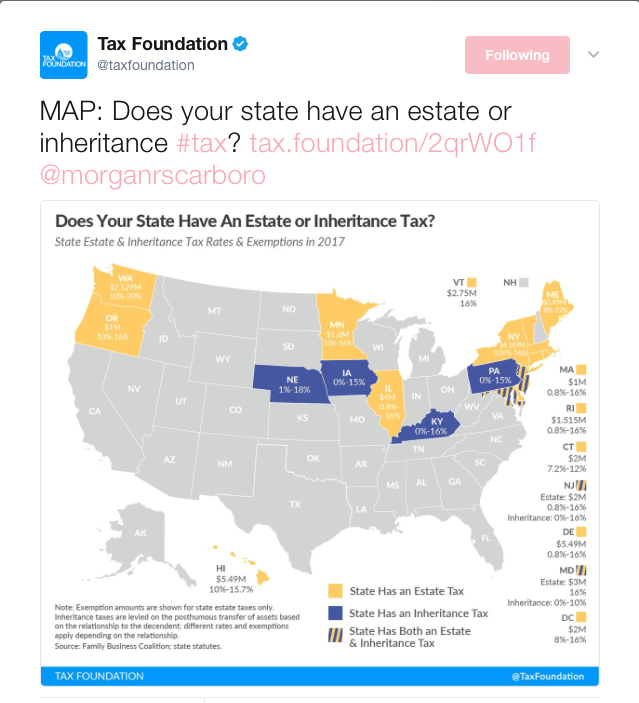
Last week Tax Foundation tweeted about the states that have either a state level estate or inheritance tax.

Screen Shot 2017-06-01 at 8.29.10 AM

The map and subsequent conversations I have had reinvigorated my interest in the prospect of an estate tax.  Briefly in this post, I wanted to say a couple things about the state level estate or inheritance tax, the map, and the effect of the Economic Growth and Tax Relief Reconciliation Act of 2001 (“EGTRAA“) on the prospects of the elimination of federal estate tax.

I’ll readily admit that it has been a while since I did an estate tax return.  So, I needed some refreshing regarding the idiosyncrasies of the interaction between the state and federal taxes.  Some recent history is not only necessary but illustrative of the prospects of permanent federal estate tax repeal.

Brief History of Switch From Credit to Deduction

Prior to the enactment of EGTRAA, the federal estate tax provided an tax credit for an amount paid because of a state level estate tax.  The mechanics of credit was essentially a revenue sharing agreement for the tax collected between the federal government and the states – essentially, up to 16% of an estate’s value.  The credit applied whether or not the state had an independent estate tax.  This tax was known as a “pick-up” or “sponge” tax.

Continue reading “Prognosticating Estate Tax Repeal using State Interests”

Under His Plan, Will Trump’s Taxes Go Up?

By Sam Brunson

Honestly, we have no way of knowing. For one thing, we don’t know how much Trump currently pays in taxes. For another, the plan he has provided is less a plan than it is a shopping list, a shopping list that’s really light on details. But we can at least make a guess. (Spoiler alert: he probably won’t.) Continue reading “Under His Plan, Will Trump’s Taxes Go Up?”

The Surly Subgroup Turns One!

Time flies when you’re having fun, I guess. Today is the one-year blogiversary of the Surly Subgroup. What started off as a group-blogging experiment hatched at last year’s Critical Tax Conference at Tulane Law School has provided quite a bit of entertainment for Surly bloggers and our guest bloggers, and hopefully for our readers as well.

It’s obviously been a big year on tax and other fronts. Since our inception, we’ve published 206 blog posts on a variety of topics. And we’ve drawn readers from 140 different countries.

Surly regulars and guest bloggers have covered various tax-related issues surrounding politics and the 2016 election—including disclosure of presidential tax returns, the Emoluments Clause, the Trump Foundation, and the Clinton Foundation. We’ve written about churches, 501(c)(3)s and the IRS treatment of non-profits. We’ve discussed the tax reform proposals of the 2016 presidential candidates and the #DBCFT. We’ve written several administrative law posts about Treasury Regulations and rulemaking.

Politics aside we’ve also covered other important issues in tax policy—including taxation and poverty, healthcare, tax policy and disabilities, tax compliance, and tax aspects of the Puerto Rico fiscal crisis. We’ve discussed several issues in international and cross-border taxes, touching on the EU state aid debate, the CCCTB, taxation and migration, the Panama Papers, tax leaks more generally, and tax evasion in China.

We hosted our first ever online Mini-Symposium on Tax Enforcement and Administration, which featured posts by ten different authors on a variety of tax administration topics. The Mini-Symposium was spearheaded by Leandra Lederman. Leandra had organized and moderated a discussion group on “The Future of Tax Administration and Enforcement” at the 2017 AALS Annual Meeting, and many of the discussion group participants contributed to the online symposium. We hope to organize future online symposia on other topics.

We’ve blogged about various conferences, workshops, and papers, both tax related and not-so-much tax related. We’ve also had lots of fun writing about taxes in popular culture – Surly bloggers and guest bloggers have written about the tax aspects of Pokémon Go, tax fiction, music-related tax issues (Jazz Fest! Prince! “Taxman”!), soccer players, dogs, Harry Potter fan fiction, Star Trek, and John Oliver. Surly bloggers even recorded a few tax podcasts!

In short, it’s been a busy year, and we’ve had a lot of fun with the Surly platform. We hope you have as well. Going forward, we’re going to keep the blog posts coming. We also hope to draw more regular and guest bloggers and to organize other online symposia.

Thanks for reading!

When a Tax Strategy Benefits a Subnational Government

2014-polo-ao5-1-million-lineBy: Leandra Lederman

Usually we think of tax shelters and other tax strategies as the province of private parties. These shelters may involve accommodation parties, even foreign government infrastructure, such as transportation systems, but we tend to think of private parties as getting the tax benefits. We may not think as often about a subnational government bolstering its tax revenues at the expense of the national government, particularly via a cooperating private party’s transaction structure. But that’s what happened a few years ago in Spain.

There is a Volkswagen (VW) plant in Pamplona, a city in the autonomous community of Navarra. From 2007-2011, Navarra reportedly collected approximately 1.5 billion Euros in value-added tax (VAT) from Volkswagen for its cars manufactured at the plant there. If VW-Navarra (which is a subsidiary of SEAT) had shipped the cars directly from Navarra to Germany, presumably Navarra would have had to refund that VAT. (Cars shipped to Germany leave Spain “clean of VAT* (translation mine)).

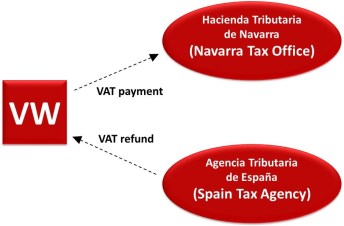
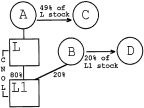
Instead, according to an interview with Prof. Fernando de la Hucha in this El Diario article, the basic structure was that VW-Navarra sold the cars (although without physically moving them there) to a related Barcelona company, VAESA (Volkswagen-Audi España S.A.), which is located in the Catalunya region, not Navarra. VAESA then sold them to SEAT with the very low mark-up of 5 Euros per car. SEAT, which is also in Catalunya, then sold them to VW-Germany—the transfer abroad triggering entitlement to a refund. But because the cars were sold from a city outside the Navarra region, VW’s refund claim did not go to Navarra. Instead, the Spanish national government was the one that issued the refund, which is how Navarra benefitted. (Catalunya did not issue the refund because, unlike Navarra, does not have a fiscal agreement with Spain that allows it to administer and collect taxes—only Navarra and the Basque regions do). The result was that Volkswagen was refunded the taxes it paid but Navarra profited at the expense of the Spanish government. (Spain has a credit-invoice VAT. Technically, the amount that Navarra retained was the VAT that VW-Navarra paid, which was the VAT on its sales to VAESA minus the VAT its suppliers had paid.)

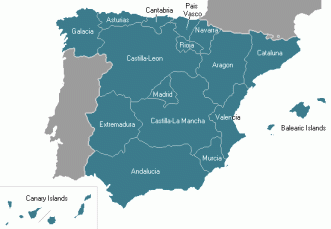
Here is a simple diagram of the transaction, along with a map of Spain’s regions. (Navarra is in the north, bordering France; Catalunya—that’s the Catalan spelling—is in the northeast, also bordering France.)
Spain Tax Blog Post Diagram--LLmap_spain

Continue reading “When a Tax Strategy Benefits a Subnational Government”

TaxSlayer: Technically Acceptable for VITA Returns?

Adam C. Mansfield
Staff Attorney, Legal Services for Students, University of Kansas

The first time I logged into the TaxSlayer training lab I knew that this tax season was going to be a problem. It became obvious when I typed “1040NR” into the form lookup box in the upper left corner of the TaxSlayer screen and the search came up empty. Next I tried “1042-S” and “8843.” Same result. Now I’m not some old fuddy-duddy that doesn’t like change.  I love working with new gadgets, software, or operating systems—as long as it does what it is supposed to do.

I work for Legal Services for Students at the University of Kansas. The main target population for our Volunteer Income Tax Assistance (VITA) grant is nonresident alien (NRA) students and scholars.  Every tax year we help hundreds of international students and researchers determine their residency status, calculate any applicable tax treaty benefits, and prepare their federal and state returns. In the past, TaxWise has worked just fine for this purpose.  I had no problem preparing a return for the student from Bangladesh who had income in both Kansas and Missouri or the Chinese student who has multiple 1042-S forms for scholarships and awards but still needs to apply treaty benefits to his or her wages. This year, TaxSlayer is just not up to the task.

I feel bad for Whitley, a member of TaxSlayer’s customer support squad, who is left with the task of informing me that they are aware of the “issue” that prevents their software from properly applying and reporting a tax treaty benefit on a nonresident alien return.  She proceeded to tell me that they could only handle “simple” state returns in conjunction with an NRA return.  This means that I can’t make any adjustments to the state return in order to properly apportion income. They are “working diligently to iron out the wrinkles.”  Not being able to prepare a pretty basic nonresident alien return is a little more than just a wrinkle. Continue reading “TaxSlayer: Technically Acceptable for VITA Returns?”

Rockefellers, Pratts and Private Cemeteries

By: David J. Herzig

The New York Times wrote about the Pratt Family burial plot. As Daniel Hemel pointed out there was also a tax story; apparently, the cemetery qualifies as a 501(c)(13) tax-exempt entity. So, when you combine tax and a Cleveland company, I was fascinated by the story. [1]

Because the cemetery is tax-exempt under section (c)(13), it can only benefit its members. This is contrary to the general rule for tax-exempts that you benefit everyone as opposed to just members. The question that the IRS had to address was how discriminatory could the cemetery be.  For example, whether both the Rockefellers and the Pratts could be buried in the cemetery. According to Daniel’s review of the rulings and regulations, “the Pratt family cemetery won’t lose its tax exempt status if it excludes the Rockefellers (or any other non-Pratts) from being buried there. But the family cemetery need not limit membership to Pratts in order to maintain its tax exemption.” All of which is true.

But, I wondered why does the family care so much about maintaining the tax exemption. I started to dig around to find the 990s of the cemetery. What if the tax-exemption were terminated? (As a certain President Elect has come to decide – sometimes the maintenance of tax-exempt entities are more trouble than they are worth).

Continue reading “Rockefellers, Pratts and Private Cemeteries”

A New Approach to Presidential Tax Disclosure [Updated]

By: Sam Brunson

I’ve written a couple times about the various presidential candidates’ tax return disclosure and nondisclosure. Ultimately, I concluded that, unless Congress mandates disclosure, it’s not going to happen.

It turns out that I may have been wrong.

No, I don’t mean that the disclosure norm is going to reassert itself. I do mean, though, that requiring presidential candidates to disclose their tax returns may not require Congressional action after all.  Continue reading “A New Approach to Presidential Tax Disclosure [Updated]”

Trump’s Emolument Tax Problem

By: David J. Herzig (photo from Vox.com)

When a businessperson who runs many active businesses runs and wins for President, clearly there would be many second order problems associated with inherent conflicts between running corporations and the country.  When President-elect Trump won the office, many of these conflicts have bubbled to the surface.

For example, to avoid a conflict of interest between benefiting one’s personal holdings and the Country’s best interests, assets of the President are placed in a blind trust.  As many have pointed out, this works only when the President does not know the nature of the holdings.  Putting existing businesses into a blind trust does not stop the President for knowing the underlying assets of the trust.  The conflict is not ameliorated by trust structure.  Nor, by the way, would it be fixed if President elect Trump divests but the family continues to own the assets.

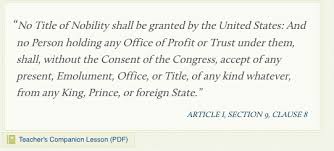
For this post, I want to consider the current discussion related to the blind trust problem called emolument.  Many prior to the election probably have not heard much about the idea of emolument.  Larry Tribe and others believe that President elect Trump’s ownership of active business assets, even in a blind trust, would violate, Article I, Section 9, Clause 8 of the Constitution which prevents the President from accepting “presents” or “Emolument” from foreign states.  Others, like Andy Grewal, do not believe that mere ownership of assets triggers the Emolument Clause.

If the solution to the blind trust and Emolument Clause problems is a divesture of President elect Trump’s assets as many advocate, this would trigger (to borrow a catch phrase of President elect Trump’s) huuuuuuge tax problem.

Continue reading “Trump’s Emolument Tax Problem”

Every Old Scam is New Again

Michael Schvo's "Sheep Station." Photo by Inhabitat. Used under a CC BY-NC-ND 2.0 licence.
“Sheep Station.” Photo by Inhabitat. Used under a CC BY-NC-ND 2.0 licence.

When I was in law school, I took a class in state and local taxation from Professor Richard Pomp. Although I don’t spend much of my professional life thinking about state taxes, I clearly remember one of the stories he told us.

A fur store in Manhattan, he told us, would ship empty boxes (or boxes filled with rocks or magazines) to an empty lot in New Jersey for customers. Why? Because nonresident purchasers didn’t have to pay New York sales tax if the purchase was shipped out of state.[fn1]

The New York Times provides more detail on the scheme: the furrier in question, Ben Thylan Furs Corporation, would allow customers to take the furs home without paying sales tax (and, with an average fur price of $8,700, the evasion of an 8.25% sales tax saved customers an average of $717.75 per fur). It would then ship a box filled with something else (or with nothing) to create a false record to back the out-of-state purchase. And, in 1985, Ben Thylan was indicted.  Continue reading “Every Old Scam is New Again”

Court Says No to Uber Class Action Settlement: What does that mean for worker classification?

By: Diane Ring

A major question in the sharing economy is the status of workers – are they employees or independent contractors? Of course, no single answer would apply across the entire sector but the debate has been most prominent in ridesharing. At the center of this debate are two litigations against Uber in California and Massachusetts (in January 2015 the Massachusetts case was transferred to the Northern District of California). The suits, brought on behalf of Uber drivers in the two states, “alleged [among other claims] that Uber misclassified its drivers as independent contractors rather than employees.” Reclassification as an employee would entitle drivers to various protections and potential compensation under state labor law. Three years into the litigation, the plaintiffs agreed on a settlement with Uber, which would provide for monetary relief of $84 million (plus an additional $16 million contingent on an initial public offering). The bulk of this payment would be split into two funds, with approximately $5-6 million for Massachusetts drivers, and approximately $56-66.9 million for California drivers.  Payouts to drivers would be based on miles driven under a formula.  Continue reading “Court Says No to Uber Class Action Settlement: What does that mean for worker classification?”

Regressivity and Cook County Property Taxes

I was listening to “The Morning Shift” on WBEZ this morning, and they started talking about property tax. Now, property tax isn’t really my thing, but the story caught my ear for a couple reasons.

First, of course, I’m a homeowner in Chicago, so the recent property tax hike is salient enough that it’s worth some of my time. Second, as my wife pointed out to me, the assessment of property values has an aspect that seems tremendously regressive and, therefore, problematic. Continue reading “Regressivity and Cook County Property Taxes”

Emerging Trend for Uber in Europe?

By: Diane Ring

Uber, one of the most prominent faces of the sharing economy, has not always been welcome in the EU. Similarly, Airbnb has experienced legal, regulatory, and public policy resistance across European countries. However, two recent developments in the EU suggest that, on balance, Europe might be staking out a regulatory path for the sharing economy that is intended to demonstrate the region’s support for the new sector. . . . Continue reading “Emerging Trend for Uber in Europe?”

The Tax Aspects of Pokémon Go

Adam Thimmesch
Assistant Professor, University of Nebraska-Lincoln College of Law

The new Pokémon Go app has already generated many discussions regarding the multiple ways that the game intersects with the law. I’ve previously opined on some of the broader issues, but, as a tax professor, my thoughts have naturally focused on that topic. Fortunately, the Surly Subgroup was nice enough to let me present those thoughts here in a guest post.

The tax issues that I’ve been thinking about stem largely from the fact that Pokémon Go is built on a freemium business model. That is, the app is free, but users can pay for certain “premium” features like additional Pokéballs, incense, and lure modules. (If these phrases mean nothing to you, here is a nice primer on the game.) Those purchases are all done through the purchase and use of an in-app currency called Pokécoins. The whole thing might sound silly, but the app is already generating over $1.5 million in daily revenue for its developer, Niantic, Inc. The company will also soon be selling “sponsored partnerships” that allow companies to be listed more prominently in the game. The potential revenue streams look plentiful at this point. So what are the tax issues?

Continue reading “The Tax Aspects of Pokémon Go”