Villanova Seeks to Hire Assistant/Associate/Full Professor of Law and Federal Tax Clinic Director

And here’s another hiring announcement:

Villanova University Charles Widger School of Law seeks an outstanding lawyer-educator to direct and teach its nationally regarded Federal Tax Clinic. The Clinic represents low-income taxpayers in controversies with the IRS. The Director oversees students working in teams on examinations, administrative appeals, collection matters, and cases before the United States Tax Court, Federal District Courts and Appeals, as well as on comments projects relating to guidance issued by the IRS or Treasury.

The Director will be either a full-time continuing non-tenure track (governed by ABA Standard 405 ( c ) ), tenure-track, or tenured member of the faculty, depending on the qualifications and aspirations of the successful candidate.

Minimum Qualifications:

• A Juris Doctor degree is required.
• Pennsylvania bar membership (or an ability to waive into the Pennsylvania bar) is required.
• Outstanding clinical teaching ability is required.
• Expertise in federal tax law is required.
• Outstanding scholarly potential is required for candidates seeking a tenure-track position. A demonstrated record of outstanding scholarship is required for candidates seeking a tenured position.

Preferred Qualifications:

• Five years of legal experience is strongly preferred, as is experience working on behalf of low-income taxpayers.
• Prior clinical teaching experience is advantageous, but not essential.

Looking Back at Maurer’s SALT-Filled 2017 Tax Policy Colloquium

By: Leandra Lederman

With classes starting again, I have been planning for the new academic year, which also entails looking back at the 2016-2017 year. I’m teaching Introduction to Income Tax this Fall, and will be teaching Corporate Tax and Tax Policy Colloquium this Spring.

I am fortunate to run our Tax Policy Colloquium. I blogged on TaxProf Blog about launching the Colloquium and reflected back on it there after its first year. From my perspective, it has consistently been a terrific experience. Spring 2017 was special, though, because many of the paper topics seemed to connect, although that was largely unplanned. Here is the list of presenters we hosted, and their paper titles:

Daniel Hemel, University of Chicago Law SchoolFederalism as a Safeguard of Progressivity

Rebecca Kysar, Brooklyn Law School, Automatic Legislation

Les Book, Villanova University School of Law & David Walker, Intuit (via Skype), Thinking About Taxpayer Rights and Social Psychology to Improve Administration of the EITC

Allison Christians, McGill University Faculty of LawHuman Rights At the Borders of Tax Sovereignty

Mildred Robinson, University of Virginia School of Law, Irreconcilable Differences?: State Income Tax Law in the Shadow of the Internal Revenue Code

Jason Oh, UCLA School of LawAre Progressive Tax Rates Progressive Policy?

David Gamage, Indiana University Maurer School of LawTax Cannibalization and State Government Tax Incentive Programs

Justin Ross, Indiana University School of Public and Environmental AffairsThe Impact of State Taxes on Pass-Through Businesses: Evidence from the 2012 Kansas Income Tax Reform

These papers got us to think both about state tax systems and about how the U.S. federal and state tax systems interact or differ. One recurring theme was how regressive U.S. state tax systems generally are (aggregating all the taxes within a state). That discussion started with Daniel Hemel’s paper; he cited 2015 ITEP data that came up repeatedly throughout the course.

The ITEP site lists Washington, Florida, Texas, South Dakota, Illinois, Pennsylvania, Tennessee, Arizona, Kansas, and Indiana as the 10 states with the most regressive tax systems. I notice that several of those don’t have state income taxes. But many, including Indiana, do. As an example, here are the stats on Indiana’s tax system in 2015, coming in at 10th most regressive in the ITEP study.

In case you’re wondering, ITEP says that the 7 states with the least regressive tax systems in 2015 were (in alphabetical order) California, Delaware, the District of Columbia, Minnesota, Montana, Oregon, and Vermont. Least regressive doesn’t mean “progressive,” though: “In each of these states, at least some low- or middle-income groups pay more of their income in state and local taxes than wealthy families. In other words, every single state and local tax system is regressive and even these states that do better than others have much room for improvement.”

I’m now looking ahead to another terrific group of Colloquium speakers in Spring 2018. Paper topics are as yet undetermined, so I don’t know if themes will emerge, but I will plan to follow up with more on the Colloquium content in the future.

The University of Pittsburgh School of Law Seeks to Hire A Tax Professor

By: Leandra Lederman

I’ve been asked to post the following announcement. I’m told that Pittsburgh would be able to hire at all levels from assistant professor to full professor.

The University of Pittsburgh School of Law invites applications for a tenure-stream position, beginning in the 2018-2019 academic year, to teach courses in the tax area. The successful candidate will become an integral part of Pitt Law’s tax program, which includes a Tax Law Concentration, a Low-Income Taxpayer Clinic, and the peer-reviewed Pittsburgh Tax Review. We anticipate hiring for this position at the rank of assistant, associate, or full professor, depending on the candidate’s qualifications. We strongly encourage applications from lateral candidates at all levels.

An interest in teaching and research in international aspects of tax law and/or in business/commercial law is desirable, as is an interest in and/or experience with incorporating experiential learning and innovative pedagogy (e.g., writing intensive, inter-professional, flipped classroom, etc.) into the classroom.

The University of Pittsburgh is an Affirmative Action, equal opportunity employer and does not discriminate on the basis of race, color, sex, veteran status, disability, national origin, creed, marital status, age, gender identity or sexual orientation in its hiring.  In furtherance of our strong institutional commitment to a diverse faculty, we particularly welcome applications from minorities, women, and others who would add diversity to our faculty.

Contact:  Harry Flechtner, Chair, Faculty Appointments Committee, University of Pittsburgh School of Law, 3900 Forbes Ave., Pittsburgh, PA 15260.  Email: law-appointments@pitt.edu.  Email submissions are preferred.  The deadline for applications is November 1, 2017.

What My Noisy New Hobby is Teaching Me about Tax

Shu Yi Oei

While Sam was out there visiting the National Parks, I went and acquired a noisy new hobby.

drums

So far, I’ve only had two drum lessons but am completely hooked. What took me so long to pick up the drums? If you love music, get a kick out of repetitive motion, and enjoy making a big noise, I highly recommend it.

Learning the drum set is a matter of first impression for me. [FN1] So the actual noise making aside, it’s given me an unexpected midsummer opportunity to revisit what it feels like to learn a new skill for the first time, which of course makes me think about the fundamentals of teaching and writing in tax.

Here are some newbie observations:

  1. Assembling the Drum Set

I went out and bought a cheap drum set so I could practice at home. What really surprised me was the amount I learnt about the drums simply by virtue of assembling the drum set. Things I know now that I didn’t know before:

  • That restaurant in New Orleans called the High Hat? Turns out it probably isn’t named after an actual hat.
  • Who knew you had to tune the drums? It’s almost as if it’s a musical instrument or something.
  • The crash cymbal and high hat sit much lower to the ground than I had ever imagined.
  • You can actually turn the snares on a snare drum on and off. Did I know that? Nope.

The experience of assembling my own drum set was so useful that it got me thinking about how one might get one’s tax students to do the equivalent of assembling a drum set. Continue reading “What My Noisy New Hobby is Teaching Me about Tax”

Ebooks and ExamSoft

By Sam Brunson

A couple weeks ago, one of my students emailed me. This semester, he bought the ebook for my BizOrg class, and didn’t bother buying a physical copy. And he wanted to know if he could use his ebook on the final.

My finals are all open-book; students can bring in and use the casebook, the statutory supplement, and any notes that they create (on their own or in their study group). So in theory, I’m totally fine with it.

In practice, though, I had to send him to our Dean of Students. Because, like many law schools (and some bar examiners), we use ExamSoft for tests.[fn1] Now. I haven’t personally used ExamSoft since I was in law school (it was fine back then, though it was apparently not Mac compatible back in those days). Basically, when I used it, it was a basic word processor that saved your work every minute and blocked access to the rest of your computer while you took the exam. Continue reading “Ebooks and ExamSoft”

A Libertarian Tip

By: David Herzig

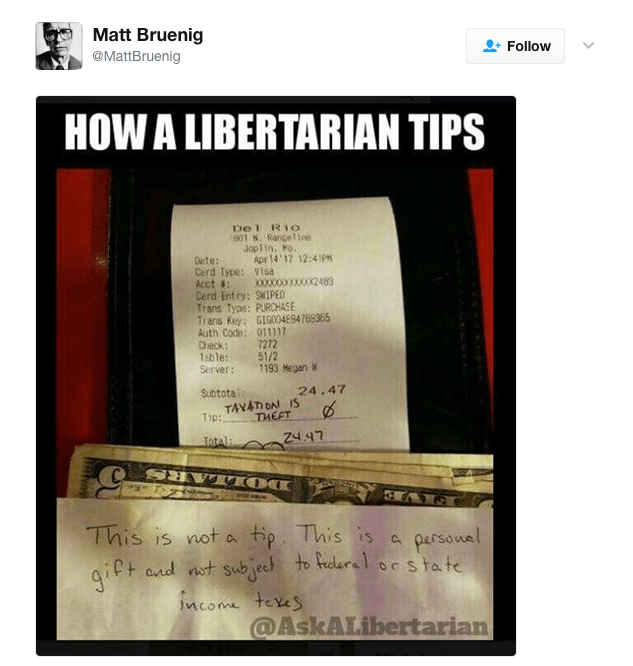
Yesterday on Twitter, Scott Greenberg (@ScottElliotG) posted the following tweet from Matt Bruenig.

Screen Shot 2017-04-20 at 7.41.36 PM

Well, David Gamage, Omri MarianAndy Grewal and I had fun in 120 characters debating the quality of the tax advice provided on both the receipt and the note.  Suffice to say: (A) this will be appearing on a number of basic income tax exams shortly;[1] and, (B) neither piece of advice provided by “Mr. Libertarian” seems to be correct.  Both David and I pointed out that the “tip” did not seem to meet the old Duberstein detached and disinterested test.  Clearly there was a quid-pro-quo; don’t spit on my food and I will give you extra money in addition to the bill.

Joking around about the gift/income distinction made me think that tipping is very tax inefficient.  Assuming that what I said is true: tips are not gifts and they are income to the recipient. This means that the payment is not deductible by the payor (just personal consumption) yet income to the recipient, i.e. the server. If it is ordinary income to the recipient, then there should be a corresponding wage deduction, right?

Let’s assume the following counterfactual.  The restaurant includes the tip as part of the bill.  The restaurant pays the employee salary including the entire tip.  Under this structure, the restaurant would receive an entire wage adjustment for the tip paid.  The customer is still does not receive a deduction for paying the employee’s wages and the employee still pays the same amount of income tax.  But the employer captures the unused deduction for wages by the customer.  Theoretically, this deduction could be shared by all the stakeholders to reduce costs to all parties.

Who cares?  Well, only economists and tax professors, probably.  Back to finals preparation!

[1] Here is David Gamage’s hypo: customer leaves $1K and says, I just won the lottery and want to share some of my winnings as a “gift”. 

The Surly Subgroup Turns One!

Time flies when you’re having fun, I guess. Today is the one-year blogiversary of the Surly Subgroup. What started off as a group-blogging experiment hatched at last year’s Critical Tax Conference at Tulane Law School has provided quite a bit of entertainment for Surly bloggers and our guest bloggers, and hopefully for our readers as well.

It’s obviously been a big year on tax and other fronts. Since our inception, we’ve published 206 blog posts on a variety of topics. And we’ve drawn readers from 140 different countries.

Surly regulars and guest bloggers have covered various tax-related issues surrounding politics and the 2016 election—including disclosure of presidential tax returns, the Emoluments Clause, the Trump Foundation, and the Clinton Foundation. We’ve written about churches, 501(c)(3)s and the IRS treatment of non-profits. We’ve discussed the tax reform proposals of the 2016 presidential candidates and the #DBCFT. We’ve written several administrative law posts about Treasury Regulations and rulemaking.

Politics aside we’ve also covered other important issues in tax policy—including taxation and poverty, healthcare, tax policy and disabilities, tax compliance, and tax aspects of the Puerto Rico fiscal crisis. We’ve discussed several issues in international and cross-border taxes, touching on the EU state aid debate, the CCCTB, taxation and migration, the Panama Papers, tax leaks more generally, and tax evasion in China.

We hosted our first ever online Mini-Symposium on Tax Enforcement and Administration, which featured posts by ten different authors on a variety of tax administration topics. The Mini-Symposium was spearheaded by Leandra Lederman. Leandra had organized and moderated a discussion group on “The Future of Tax Administration and Enforcement” at the 2017 AALS Annual Meeting, and many of the discussion group participants contributed to the online symposium. We hope to organize future online symposia on other topics.

We’ve blogged about various conferences, workshops, and papers, both tax related and not-so-much tax related. We’ve also had lots of fun writing about taxes in popular culture – Surly bloggers and guest bloggers have written about the tax aspects of Pokémon Go, tax fiction, music-related tax issues (Jazz Fest! Prince! “Taxman”!), soccer players, dogs, Harry Potter fan fiction, Star Trek, and John Oliver. Surly bloggers even recorded a few tax podcasts!

In short, it’s been a busy year, and we’ve had a lot of fun with the Surly platform. We hope you have as well. Going forward, we’re going to keep the blog posts coming. We also hope to draw more regular and guest bloggers and to organize other online symposia.

Thanks for reading!

The Games We Play

Shu-Yi Oei

I’ve been ever so slightly glum since my colleague Ann Lipton went and blogged about this game called the Unicorn Startup Simulator over at BLPB. The goal of the game is for your startup to have a billion dollar valuation by the end of the year while keeping your employees happy. You have to make a series of decisions juggling those two goals. Turns out that’s harder than one might imagine. Here is what keeps happening to me:

Screenshot 2017-04-10 23.18.32

So, I guess the message is “don’t quit your day job”?

Anyway, I was feeling grumpy about not having cool tax games to call our own but then I went hunting around and realized, WAIT, we do have tax games! Whether they’re cool or not is another story.

Here are a couple:

Continue reading “The Games We Play”

Teaching Depreciation with a #DBCFT Lurking

Shu-Yi Oei

I’m teaching depreciation in my Basic Federal Income Tax class this week. As I suspect is the case for most tax profs, our coverage of depreciation comes right after we wrap up discussion of expense taking in §§ 162 and 212 (and § 195) but before we get to § 165 losses.

Depreciation is literally my favorite topic in the entire universe to teach. I mean, if I was going to get a tattoo of a Code section on myself, it would literally be “26 U.S.C. § 168 (as amended).” No disrespect meant to 26 U.S.C. §§ 167, 179, 197 and friends. [Distraction: Here is a virtual tattoo generator. You, too, can practice getting your favorite Tax Code section inked on yourself.] I firmly believe that you can teach any number of core skills in tax class by teaching depreciation (e.g., statutory construction, policy choices, reading cross-references, political economy and legislative change, time value of money, etc.). Conversely, I also tend to think that if you can understand the depreciation statute in Basic Tax and explain it to your classmates, you can do pretty much anything in our legal profession.

Therefore, putting aside all of the reasons why cash-flow expensing may not have the effects that one might hope, I will be absolutely heartbroken if we actually end up with a cash-flow tax, because then what am I gonna talk about in tax class?

All of which brings me to today’s dilemma: Do I mention the ubiquitous #DBCFT in teaching depreciation this week? Or can I just pretend it’s not happening? If one does teach cash-flow expensing, when does one bring it up (i.e., in what order of coverage)? My inclination is to (1) explain the basics of how economic cost recovery over time works in theory; (2) talk briefly about the ACRS changes in 1981; (3) teach the Simon v. Commissioner cases (violin bows) to illustrate the policy tensions that arise once we move from true economic recovery and actual useful lives to ACRS and statutory recovery periods; (4) discuss #DBCFT as an alternative design approach, noting the possible benefits and downsides of that approach, noting that there’s some discussion in the ether right now re whether we should be doing this (and deemphasizing the border adjustment features); (5) introduce bonus depreciation concepts (§§ 168(k) and 179) as an illustration of how expensing has surreptitiously worked its way into the conversation in the guise of bonus depreciation circa financial crisis; and then (6) move right along to parsing the actual statutory elements of §§ 167 and 168 and understanding how it all stitches together.

This strikes me as a nice middle ground between (1) dorkin’ out and going #DBCFT full bore and totally losing the class, and (2) just ignoring the current debate. I’d be curious to know what other tax profs are doing with coverage here.

Tulane Seeks Fall 2017 Visitors

Here’s another hiring announcement from Tulane Law School, this time for Fall 2017 visitors:

Tulane Law School invites applications for a one-semester visiting position in the Fall of 2017. Our specific needs for the Fall 2017 semester include basic income tax and corporate tax, criminal law, and professional responsibility. Applicants must possess a J.D. from an ABA-accredited law school, strong academic credentials, and at least three years of relevant law-related experience; prior teaching experience is strongly preferred. Applicants should submit a letter of interest, CV, and the names and contact information of three references through Interfolio at https://apply.interfolio.com/40060. For additional information, please contact Onnig Dombalagian atodombala@tulane.edu.

Tulane University is an equal employment opportunity/affirmative action employer committed to excellence through diversity. All eligible candidates are invited to apply for position vacancies as appropriate.

Tulane Law School Seeks to Hire Forrester Fellow and VAP

I’m passing along this hiring announcement from Tulane Law School for two positions: (1) the Forrester Fellowship, and (2) a VAP position focusing on the regulation of economic activity, broadly defined. (Emerging scholars doing work in tax are welcome to apply for both positions.)

Tulane Law School invites applications for its Forrester Fellowship and visiting assistant professor positions, both of which are designed for promising scholars who plan to apply for tenure-track law school positions. Both positions are full-time faculty in the law school and are encouraged to participate in all aspects of the intellectual life of the school. The law school provides significant support, both formal and informal, including faculty mentors, a professional travel budget, and opportunities to present works-in-progress to other faculty workshop in various settings.

Tulane’s Forrester Fellows teach legal writing in the first-year curriculum to two sections of 25 to 30 first-year law students in a program coordinated by the Director of Legal Writing. Fellows are appointed to a one-year term with the possibility of a single one-year renewal. Applicants must have a J.D. from an ABA-accredited law school, outstanding academic credentials, and at least three years of law-related practice and/or clerkship experience. To apply, please visit the Tulane University “iRecruitment” website at http://tinyurl.com/phd53k7. If you have any questions, please contact Erin Donelon at edonelon@tulane.edu.

Tulane’s visiting assistant professor (VAP), a two-year position, is supported by the Murphy Institute at Tulane (http://murphy.tulane.edu/home/), an interdisciplinary unit specializing in political economy and ethics that draws faculty from the university’s departments of economics, philosophy, history, and political science. The position entails teaching a law school course or seminar in three of the four semesters of the professorship (presumably the last three semesters). It is designed for scholars focusing on regulation of economic activity very broadly construed (including, for example, research with a methodological or analytical focus relevant to scholars of regulation). In addition to participating in the intellectual life of the law school, they will be expected to participate in scholarly activities at the Murphy Institute. Candidates should apply through Interfolio, at apply.interfolio.com/, providing a CV identifying at least three references, post-graduate transcripts, electronic copies of any scholarship completed or in-progress, and a letter explaining your teaching interests and your research agenda. If you have any questions, please contact Adam Feibelman at afeibelm@tulane.edu

The law school aims to fill both positions by March 2017.  Tulane is an equal opportunity employer and encourages women and members of minority communities to apply.

Federal Hall and Taxes

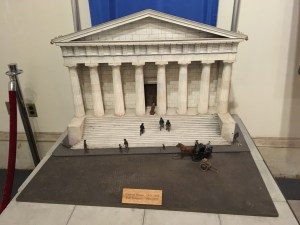
img_0082

By Sam Brunson

I spent my Thanksgiving in New York this year, ostensibly to see the Macy’s Thanksgiving Day Parade.[fn1]

Before and after Thanksgiving, my family and I went to various National Memorials in New York. (My Hamilton-obsessed kids were thrilled to make a pilgrimage to Hamilton Grange, even if they haven’t actually seen the musical yet.)

And on Friday, we went to Federal Hall.[fn2] And, like our visit to Alcatraz over the summer, I was surprised (and pleased) to find a tax connection.  Continue reading “Federal Hall and Taxes”

Letter Urging the Senate to Vote on U.S. Tax Court Nominations

Over 50 tax law professors have signed a letter (available here) urging the U.S. Senate to vote on U.S. Tax Court nominees Elizabeth Ann Copeland and Vik Edwin Stoll. Unfortunately, these nominations may not get much attention in the wake of the election. However, the signatories (myself included) are urging the Senate to schedule a vote on these nominees, both of whom were favorably reported out of the Senate Finance Committee over a year ago. Danshera Cords has more on Procedurally Taxing.

Congratulations to the Newly Elected Members of the American Law Institute!

By: Francine J. Lipman

The American Law Institute (ALI) has just announced its newly elected members. The members who join ALI from across the country will bring their diverse backgrounds and areas of legal expertise to ALI’s work. Fifteen of the 45 new members are professors, sixteen are partners (or the equivalent) in law firms, seven are judges, six are in private industry, and one is a government legal advisor.

“One of the most exciting aspects of being President of the ALI is meeting some of today’s most important and inspiring legal minds as they are elected into The American Law Institute. I look forward to having the opportunity to work alongside these new members in continuing the ALI’s efforts in clarifying the law,” said ALI President Roberta Cooper Ramo. Continue reading “Congratulations to the Newly Elected Members of the American Law Institute!”

ClassCrits IX: The New Corporatocracy and Election 2016

Surly bloggers Sam Brunson, David Herzig and I (and Leslie Book over at Procedurally Taxing) are attending the ClassCrits IX conference hosted by Loyola University Chicago School of Law today and tomorrow. From the call for papers back in March:

As the U.S. presidential election approaches, our 2016 conference will explore the role of corporate power in a political and economic system challenged by inequality and distrust as well as by new energy for transformative reform.

There are some notable tax-related panels happening at the conference, along with other interesting panels relating to corporations and democracy:

Taxation, Social Justice and Development (Friday 10/21/16)

Doron Narotzki, University of Akron Business Administration
Corporate Social Responsibility and Taxation: The Next Step of the Evolution

Rohan Grey, Binzagr Institute for Sustainable Prosperity & Nathan Tankus, Modern Money Network
Corporate Taxation in a Modern Monetary Economy: Legal History, Theory, Prospects

Karl Botchway, CUNY Technology & Jamee Moudud, Sarah Lawrence Economics
Capacity Building, Taxation and Corporate power in Africa

Martha T. McCluskey, SUNY Buffalo Law, Corporatocracy and Class in State and Local “Job-Creation” Subsidies

Distributing Wealth, Law and Power (Friday 10/21/16)

Goldburn P. Maynard, Jr., University of Louisville Law
A Plea for Courts to Abolish the Judicially Created Right of the Wealthy to Avoid Estate Taxes

Victoria J. Haneman, Concordia University Law
The Collision of Holographic Wills and the 120-Hour Rule

Doron Narotzki, University of Akron Business Administration
Dark Pools, High-Frequency Trading and the Financial Transaction Tax: A Solution or Complication?

Robert Ashford, Syracuse University Law
Why Working But Poor?

Critical Perspectives on Tax Law (Saturday 10/22/16)

Shu-Yi Oei, Tulane University Law
The Troubling Case of Offshore Tax Enforcement

Les Book, Villanova University Law
Bureaucratic Oppression and the Tax System

Samuel Brunson, Loyola University Chicago Law
Avoiding Progressivity: RICs, Pease, and the AMT

David Herzig, Valparaiso University Law
Let Prophets Be (Non) Profits