We Should be Taking President Trump’s Tax Plan Seriously

By: David J. Herzig

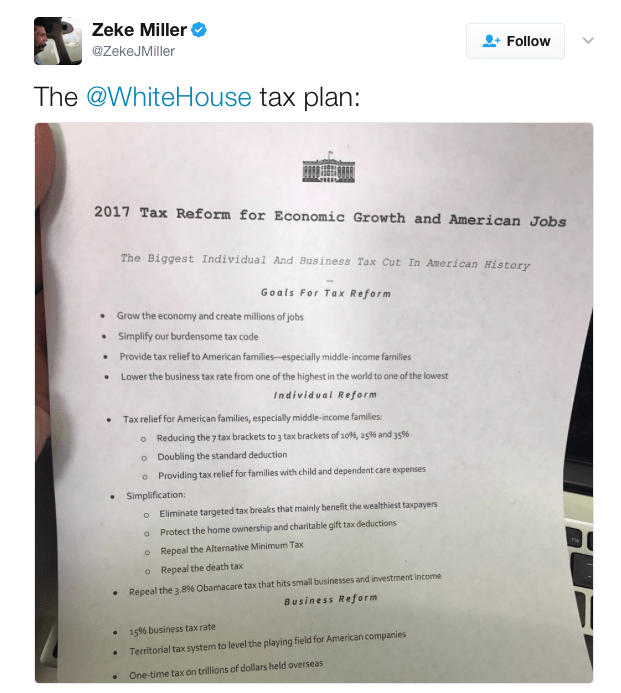
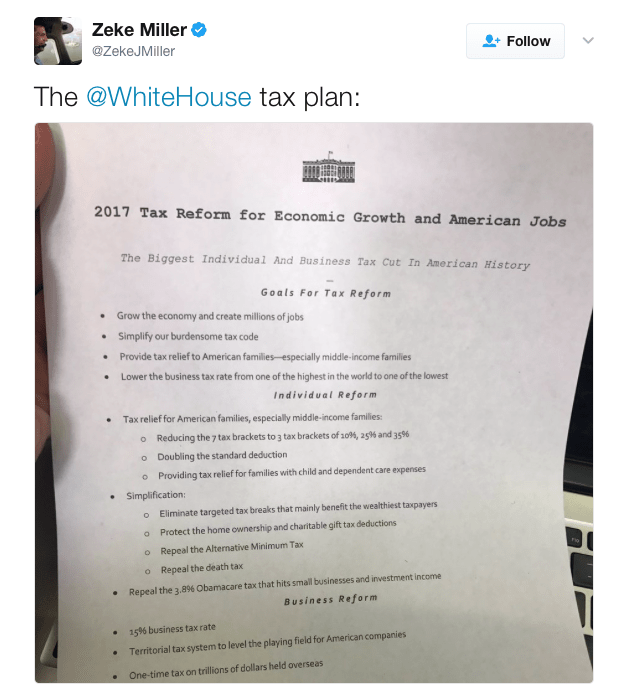
Today President Trump’s top tax advisors laid out the first details of the his tax plan. Chief economic adviser Gary Cohn and Treasury Secretary Steve Mnuchin unveiled the plan which according to Fox News, Cohn called “the most significant tax reform legislation since 1986, and one of the biggest tax cuts in American history.”

Oh, did I mention that the details of the biggest cuts were printed on a single sheet of paper?

Screen Shot 2017-04-26 at 4.22.18 PM

There has been plenty of ink (and jokes) already spilled about the plan.  For example, you can read Richard Rubin of the WSJ (here) or Alan Rappeport of the NY Times (here). The long and the short of the plan is it seems to very very costly.  The Committee for a Responsible Federal Budget guesses it could cost $3 to $7 trillion with their estimate at $5.5 trillion.  That is a lot of money!

Continue reading “We Should be Taking President Trump’s Tax Plan Seriously”

Trump’s Back-to Basics Tax Plan: It’s Tremendous!

Aren’t we all wondering what President Trump’s big tax reform announcement will be tomorrow?  Loyola Los Angeles Tax LL.M. student Anosh Ali ventured a tongue-in-cheek guess in a short memo he wrote in Katie Pratt’s Tax Policy class.  We’ll see tomorrow how good a prognosticator Anosh is. 

Until then, at least we know that his Presidential ‘voice’ is spot on


TO:         President Trump

FROM:   Anosh Ali, White House Communications Specialist

RE:         Your tax reform press conference on Wednesday

DATE:    April 25, 2017

_____________________________________________________________________________________

You have asked me to prepare talking points for your tax reform press conference tomorrow. This memo includes general talking points and responses to hostile questions you are likely to get from the liberal media. Continue reading “Trump’s Back-to Basics Tax Plan: It’s Tremendous!”

Grover and Godwin

By Sam Brunson

Over the weekend, tax opponent extraordinaire and Americans for Tax Reform founder Grover Norquist said …

Well, I’ll let him speak for himself:

In two follow-up tweets (here and here), he clarified and doubled-down on his position: essentially, he argues that (a) without the 16th Amendment, the country couldn’t have enacted an income tax, (b) without an income tax, we couldn’t have afforded to enter World War I, (c) if we hadn’t entered the war, the Versailles Treaty wouldn’t have happened,[fn1] and (d) without the Versailles Treaty, World War II, with all of its attendant evils, wouldn’t have happened.[fn2] Continue reading “Grover and Godwin”

A Libertarian Tip

By: David Herzig

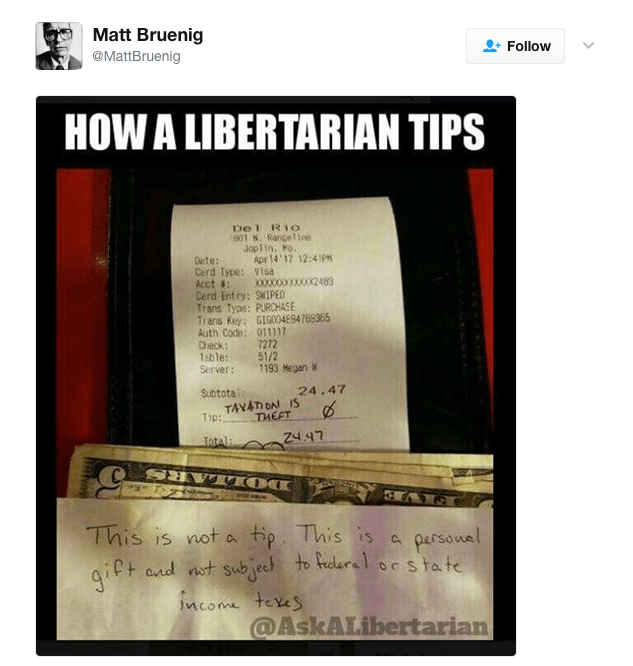
Yesterday on Twitter, Scott Greenberg (@ScottElliotG) posted the following tweet from Matt Bruenig.

Screen Shot 2017-04-20 at 7.41.36 PM

Well, David Gamage, Omri MarianAndy Grewal and I had fun in 120 characters debating the quality of the tax advice provided on both the receipt and the note.  Suffice to say: (A) this will be appearing on a number of basic income tax exams shortly;[1] and, (B) neither piece of advice provided by “Mr. Libertarian” seems to be correct.  Both David and I pointed out that the “tip” did not seem to meet the old Duberstein detached and disinterested test.  Clearly there was a quid-pro-quo; don’t spit on my food and I will give you extra money in addition to the bill.

Joking around about the gift/income distinction made me think that tipping is very tax inefficient.  Assuming that what I said is true: tips are not gifts and they are income to the recipient. This means that the payment is not deductible by the payor (just personal consumption) yet income to the recipient, i.e. the server. If it is ordinary income to the recipient, then there should be a corresponding wage deduction, right?

Let’s assume the following counterfactual.  The restaurant includes the tip as part of the bill.  The restaurant pays the employee salary including the entire tip.  Under this structure, the restaurant would receive an entire wage adjustment for the tip paid.  The customer is still does not receive a deduction for paying the employee’s wages and the employee still pays the same amount of income tax.  But the employer captures the unused deduction for wages by the customer.  Theoretically, this deduction could be shared by all the stakeholders to reduce costs to all parties.

Who cares?  Well, only economists and tax professors, probably.  Back to finals preparation!

[1] Here is David Gamage’s hypo: customer leaves $1K and says, I just won the lottery and want to share some of my winnings as a “gift”. 

The Surly Subgroup Turns One!

Time flies when you’re having fun, I guess. Today is the one-year blogiversary of the Surly Subgroup. What started off as a group-blogging experiment hatched at last year’s Critical Tax Conference at Tulane Law School has provided quite a bit of entertainment for Surly bloggers and our guest bloggers, and hopefully for our readers as well.

It’s obviously been a big year on tax and other fronts. Since our inception, we’ve published 206 blog posts on a variety of topics. And we’ve drawn readers from 140 different countries.

Surly regulars and guest bloggers have covered various tax-related issues surrounding politics and the 2016 election—including disclosure of presidential tax returns, the Emoluments Clause, the Trump Foundation, and the Clinton Foundation. We’ve written about churches, 501(c)(3)s and the IRS treatment of non-profits. We’ve discussed the tax reform proposals of the 2016 presidential candidates and the #DBCFT. We’ve written several administrative law posts about Treasury Regulations and rulemaking.

Politics aside we’ve also covered other important issues in tax policy—including taxation and poverty, healthcare, tax policy and disabilities, tax compliance, and tax aspects of the Puerto Rico fiscal crisis. We’ve discussed several issues in international and cross-border taxes, touching on the EU state aid debate, the CCCTB, taxation and migration, the Panama Papers, tax leaks more generally, and tax evasion in China.

We hosted our first ever online Mini-Symposium on Tax Enforcement and Administration, which featured posts by ten different authors on a variety of tax administration topics. The Mini-Symposium was spearheaded by Leandra Lederman. Leandra had organized and moderated a discussion group on “The Future of Tax Administration and Enforcement” at the 2017 AALS Annual Meeting, and many of the discussion group participants contributed to the online symposium. We hope to organize future online symposia on other topics.

We’ve blogged about various conferences, workshops, and papers, both tax related and not-so-much tax related. We’ve also had lots of fun writing about taxes in popular culture – Surly bloggers and guest bloggers have written about the tax aspects of Pokémon Go, tax fiction, music-related tax issues (Jazz Fest! Prince! “Taxman”!), soccer players, dogs, Harry Potter fan fiction, Star Trek, and John Oliver. Surly bloggers even recorded a few tax podcasts!

In short, it’s been a busy year, and we’ve had a lot of fun with the Surly platform. We hope you have as well. Going forward, we’re going to keep the blog posts coming. We also hope to draw more regular and guest bloggers and to organize other online symposia.

Thanks for reading!

Panama Papers: The One-Year Anniversary

By: Diane Ring

This month marks the one-year anniversary of the Panama Papers leak. In April 2016, the ICIJ announced the leak and a few weeks later (May 9, 2016) released a database that included a subset of the leaked data. The leak itself comprised over 11 million records spanning 40 years from the Panamanian law firm Mossack Fonseca. At its core, the leak revealed the true ownership of over 200,000 offshore entities, thereby raising a host of tax and political questions regarding many of the entities’ owners.

So what has happened over the past year as a result of the leak? Continue reading “Panama Papers: The One-Year Anniversary”

The Games We Play

Shu-Yi Oei

I’ve been ever so slightly glum since my colleague Ann Lipton went and blogged about this game called the Unicorn Startup Simulator over at BLPB. The goal of the game is for your startup to have a billion dollar valuation by the end of the year while keeping your employees happy. You have to make a series of decisions juggling those two goals. Turns out that’s harder than one might imagine. Here is what keeps happening to me:

Screenshot 2017-04-10 23.18.32

So, I guess the message is “don’t quit your day job”?

Anyway, I was feeling grumpy about not having cool tax games to call our own but then I went hunting around and realized, WAIT, we do have tax games! Whether they’re cool or not is another story.

Here are a couple:

Continue reading “The Games We Play”

Neil Gorsuch and the Tax Law

On Friday, the Senate confirmed Neil Gorsuch as the newest Justice on the Supreme Court, and today he was officially sworn in, taking the seat that Justice Scalia’s passing left vacant.

When Justice Scalia passed away, I looked at the tax opinions he had authored. It turns out, Justice Scalia didn’t author a whole lot of tax opinions, and those that he did author were, as I said, “workmanlike,” without the verbal pyrotechnics, wit, and flair he was known for.

I was curious whether Justice Gorsuch would bring anything different to that seat, so I looked for tax opinions he had authored.[fn1] My search terms brought up 34 hits; the vast majority were not actually cases dealing with the federal income tax.[fn2] In fact, I only saw two cases dealing with federal income tax issues, and neither of them really dealt with the tax law. Continue reading “Neil Gorsuch and the Tax Law”

Teaching Depreciation with a #DBCFT Lurking

Shu-Yi Oei

I’m teaching depreciation in my Basic Federal Income Tax class this week. As I suspect is the case for most tax profs, our coverage of depreciation comes right after we wrap up discussion of expense taking in §§ 162 and 212 (and § 195) but before we get to § 165 losses.

Depreciation is literally my favorite topic in the entire universe to teach. I mean, if I was going to get a tattoo of a Code section on myself, it would literally be “26 U.S.C. § 168 (as amended).” No disrespect meant to 26 U.S.C. §§ 167, 179, 197 and friends. [Distraction: Here is a virtual tattoo generator. You, too, can practice getting your favorite Tax Code section inked on yourself.] I firmly believe that you can teach any number of core skills in tax class by teaching depreciation (e.g., statutory construction, policy choices, reading cross-references, political economy and legislative change, time value of money, etc.). Conversely, I also tend to think that if you can understand the depreciation statute in Basic Tax and explain it to your classmates, you can do pretty much anything in our legal profession.

Therefore, putting aside all of the reasons why cash-flow expensing may not have the effects that one might hope, I will be absolutely heartbroken if we actually end up with a cash-flow tax, because then what am I gonna talk about in tax class?

All of which brings me to today’s dilemma: Do I mention the ubiquitous #DBCFT in teaching depreciation this week? Or can I just pretend it’s not happening? If one does teach cash-flow expensing, when does one bring it up (i.e., in what order of coverage)? My inclination is to (1) explain the basics of how economic cost recovery over time works in theory; (2) talk briefly about the ACRS changes in 1981; (3) teach the Simon v. Commissioner cases (violin bows) to illustrate the policy tensions that arise once we move from true economic recovery and actual useful lives to ACRS and statutory recovery periods; (4) discuss #DBCFT as an alternative design approach, noting the possible benefits and downsides of that approach, noting that there’s some discussion in the ether right now re whether we should be doing this (and deemphasizing the border adjustment features); (5) introduce bonus depreciation concepts (§§ 168(k) and 179) as an illustration of how expensing has surreptitiously worked its way into the conversation in the guise of bonus depreciation circa financial crisis; and then (6) move right along to parsing the actual statutory elements of §§ 167 and 168 and understanding how it all stitches together.

This strikes me as a nice middle ground between (1) dorkin’ out and going #DBCFT full bore and totally losing the class, and (2) just ignoring the current debate. I’d be curious to know what other tax profs are doing with coverage here.
The Strategic Case Against the Democratic Filibuster of Neil Gorsuch

Photo: Jarrad Henderson, USA TODAY

By: Daniel Hemel and David Herzig

[Note: This post is co-authored with Daniel Hemel, Assistant Professor of Law at The University of Chicago School of Law.]

The strategic case against a Democratic filibuster of Neil Gorsuch is straightforward. The argument is not that the filibuster will prevent President Trump from putting someone like Andrew Napolitano on the Court. The argument is that the filibuster may prevent President Trump from filling a future vacancy with a well-credentialed conservative who is ideologically similar to or right of Judge Gorsuch. To elaborate:

— (a) The filibuster accomplishes no work when there are fewer than 50 Senators who will support a nominee on an up-or-down vote. (Napolitano presumably falls into this category.)

— (b) The filibuster also does no work when there are 50 or more Senators who will support a nominee even if that means going nuclear. (Judge Gorsuch appears to fall into this category.)

— (c) The filibuster matters when (1) there is a nominee who would win 50 or more Senators on an up-or-down vote, but (2) fewer than 50 Senators would support the nuclear option in order to put the nominee on the Court.

Is (c) an empty set?

Continue reading “The Strategic Case Against the Democratic Filibuster of Neil Gorsuch”

Cross-Training (or, Tulane Corporate and Securities Law Roundtable)

My pal Ann Lipton–corporate governance and securities law expert and blogger extraordinaire over at BLPB–is organizing a conference at Tulane Law School today on the topic of “Navigating Federalism in Corporate and Securities Law.” It looked so interesting that I had to leave Henry Ordower and Kerry Ryan’s fabulous Critical Issues in Comparative and International Taxation: Taxation and Migration Conference a day early to crash her party! I’ve been auditing Securities Regulation and very much feeling like a little duckling in the securities/corporate world all semester, so I’m really looking forward to sitting in on an unfamiliar conversation. I always find that “cross-training” in other fields gives me fresh perspectives on my own work.

Here is the schedule. Some of these papers are really interesting!

The Problem of Large Shareholders
(Discussant: Urska Velikonja)

The Problem of Small Shareholders
(Discussant: Ann Lipton)

  • Jill Fisch (Penn), Advance Voting Instructions: Tapping the Voice of the Excluded Retail Investor
  • J.W. Verret (George Mason), Uber-ized Corporate Law

What Can States Regulate?
(Discussant: Jill Fisch)

  • Kent Greenfield (Boston College), Corporate Power and Campaign Finance
  • Summer Kim (Irvine), Corporate Long Arms

The Line Between Corporate Law and Securities Law
(Discussant: James Cox)

  • Ann Lipton (Tulane), Reviving Reliance
  • James Park (UCLA), Delaware and Santa Fe
  • Robert Thompson (Georgetown), Delaware’s Dominance: A Peculiar Illustration of American Federalism

The Operation of the SEC
(Discussant: James Park)

  • James Cox (Duke), Revolving Elites: Assessing Capture in the SEC
  • Urska Velikonja (Emory), Admissions in Public Enforcement

Taxation and Migration

By: Diane Ring
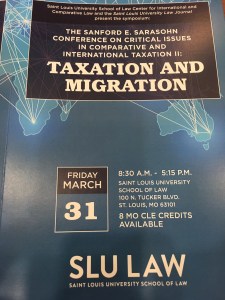
IMG_0592Today St. Louis University School of Law hosted the Sanford E. Sarasohn Conference on Critical Issues in Comparative International Taxation II: Taxation and Migration. This event offered a much needed forum to explore the intersection between international tax law and questions of migration and refugees. Topics addressed included using the tax system to remedy migration challenges (see, for example, Matthew Lister, “A Tax-Credit Approach to Addressing Brain-Drain” suggesting a tax transfer from jurisdictions on the receiving end of a brain drain to the countries losing skilled labor; and see Cristina Trenta, “Migrants and Refugees: An EU Perspective on Upholding Human Rights Through Taxation and Public Finance” advocating an EU-wide tax to finance members’ commitments to refugee human rights). Other papers considered the burdens that tax-induced migration creates for the society the migrant leaves and for some members of the jurisdiction the migrant joins (see, for example, Allison Christians, “Buying In: Citizenship and Residence by Investment”). The full set of 15 conference papers will be published in the St. Louis University Law Journal and will provide a valuable resource on the breadth of taxation and migration questions.

Call for Papers: 18th Global Conference on Environmental Taxation (Tucson, AZ, Sept. 27-29, 2017)

Here’s another call for papers:

Please plan ahead for the 18th Global Conference on Environmental Taxation! The deadline for submitting abstracts in response to the Call for Papers is May 1, 2017 and early submissions are welcome. For information about the conference and the Call for Papers, click here.

This year the conference’s focus is: Innovation Addressing Climate Change Challenges: Local and Global Perspectives

We are in a pivotal and defining time for global discourse on public/private sector response at all levels of government (national, state, indigenous, provincial, municipal, city, and local), to the impacts of climate change. And, GCET18 is well-positioned in its role as the leading global forum for innovative exchanges on principles, practices, and policies with respect to environmental taxation and market-based instruments.

The conference will explore various topics :

  • Climate change policy, biodiversity protection, environmental stewardship, pollution control, water conservation, land degradation, renewable energy, mining and rehabilitation
  • Market instruments such as carbon pricing, emissions trading schemes, other environmental taxes, subsidies, direct action or spending programs and tax concessions both positive and perverse.

Selected papers from the Global Conferences are published in Critical Issues in Environmental Taxation.

The conference this year will be hosted by the University of Arizona, James E. Rogers College of Law, and the Conference Chair is Mona Hymel. If you have questions, please contact her at law-gcet18@list.arizona.edu.

We hope to see you in Tucson!

Prof. Janet E. Milne
Director, Environmental Tax Policy Institute
Co-editor, Handbook of Research on Environmental Taxation
Vermont Law School, USA


AALS Call for Papers on The Challenges and Opportunities of Exotic Hybrids

By: Leandra Lederman


At the
2018 AALS annual meeting (San Diego, Jan. 3-6, 2018), the Section on Agency, Partnerships LLCs, and Unincorporated Associations will be co-sponsoring a program with the AALS Sections on Taxation, Securities Regulation, and Business Associations on “The Challenges and Opportunities of Exotic Hybrids—Series LLCs, Up-C’s and Master Limited Partnerships.” In addition to featuring invited speakers, speakers (and papers) will be selected from a call for papers located at this link. The submission deadline is June 15, 2017. 

PROMESAs, PROMESAs?

Shu-Yi Oei

After swearing up and down that I would blog more about Puerto Rico’s 70 billion dollar debt crisis, I of course was remiss and did not. But a new paper by Mitu Gulati and Robert Rasmussen, “Puerto Rico and the Netherworld of Sovereign Debt Restructuring” has provided me the impetus to dive into this topic again.

Recall that unlike U.S. municipalities (such as Detroit), Puerto Rico bodies and utilities aren’t considered debtors for purposes of Chapter 9 of the U.S. Bankruptcy Code and therefore don’t have access to the municipal bankruptcy process. See 11 U.S.C. § 101(52). Puerto Rico attempted to address its fiscal woes by enacting the 2014 Puerto Rico Public Corporation Debt Enforcement and Recovery Act, which created a debt restructuring mechanism analogous to Chapter 9 municipal bankruptcy. However, the U.S. Supreme Court ruled on June 13, 2016 that the Act was preempted by Section 903(1) of the U.S. Bankruptcy Code. Puerto Rico v. Franklin California Tax-Free Trust, 136 S. Ct. 1938 (2016). [Fn. 1]

After the Franklin Trust decision, Congress stepped in and passed the Puerto Rico Oversight, Management, and Economic Stability Act (PROMESA) legislation on June 30, 2016, to allow Puerto Rico to restructure without filing for Chapter 9 bankruptcy. Briefly, PROMESA establishes an independent oversight board, provides for a bankruptcy-like debt restructuring process, and requires submission of a Fiscal Plan by Puerto Rico. Puerto Rico’s required Fiscal Plan was approved by the Oversight Board on March 13, 2017; however, that plan has come under criticism from bondholders.

This all begs the question, however, of what would have happened had Congress NOT passed the PROMESA legislation. Puerto Rico would have been left in a bind in which it had no access to the U.S. municipal bankruptcy process but was preempted from enacting any analogous debt restructuring mechanism by Section 903(1) of that same Bankruptcy Code, per Franklin California Tax-Free Trust. [Fn. 2]

Gulati and Rasmussen’s paper focuses on this question, arguing that, as a constitutional matter, the United States may not prohibit Puerto Rico from enacting its own bankruptcy-like restructuring process while offering no alternative mechanism. This leaves Puerto Rico in an untenable “netherworld,” in which it has the power to issue debt without the mechanisms for dealing with financial distress on the back end.

Continue reading “PROMESAs, PROMESAs?”