Rory Van Loo Presents “Making Innovation More Competitive: The Case of FinTech” at Boston College Law School

Shu Yi Oei

Boston College Law School’s Regulation and Markets workshop series continues today. Professor Rory Van Loo (BU Law) will present “Making Innovation More Competitive: The Case of FinTech.”

Abstract:

This Article examines recent financial technology (“fintech”) developments to diagnose the federal regulatory architecture surrounding innovation. Startups offer artificially intelligent financial assistants, touchless payments, and other potentially game-changing products for individuals. Yet unlike more lightly regulated industries such as retail goods, in consumer finance barriers to entry have insulated the largest businesses from competition. Regulatory insulation helps explain why too big to fail banks have become bigger, U.S. innovation has lagged that of foreign countries, and consumers pay higher prices.

Taking an institutional lens to this problem reveals an overlooked shortcoming in financial regulation: The organizational design of the administrative agencies responsible for enforcing competition. The current framework was built in the wake of financial instability and consumer protection crises, and its organizational design reflects those priorities. Competition enforcement for consumer finance is spread across five entities, including the Department of Justice and the Federal Reserve, each of which focuses on other industries or missions. In particular, agencies whose primary goal is to prevent banks from failing have insufficient incentive to ensure those same banks face competition. As a result, no regulator is optimally structured either to develop licenses suitable for startups or to address banks’ anticompetitive conduct.

The stakes of getting innovation competition right are increasing. Effective competition enforcement could enable new entrants to reduce the size of the largest banks—providing a partial market solution to taxpayer bailouts and to a major economic stability threat. It would also force U.S. banks to prepare for an increasingly borderless financial world in which virtual currencies bypass regulators. Inept competition enforcement could bring opposite results. As Google, Microsoft, and Facebook have shown, technology firms tend to capture higher market shares than those in other industries, often well over 60 percent. If a large bank were to attain similar shares, it could destabilize the financial system. Reallocating competition authority to a motivated financial agency would better position regulators to safeguard the future of finance.

If you’re an academic in the Boston area, please feel free to join us. You can send me email for more information.

Tax Leaks: The New Normal?

By: Diane Ring

Today, the Guardian is reporting that big-four accounting firm Deloitte suffered a hack back in March, 2017. The underlying attack may have originated in the fall of 2016 and may have allowed access to Deloitte systems for several months.

Deloitte itself is not unfamiliar with cybersecurity. As stated on its website, among the services that Deloitte offers clients is Cyber Risk. However, being a victim of a hack provides a new perspective. At this point, details are scarce on exactly which clients have been affected and what specific information may have been accessed, but it has been reported that “confidential emails and plans of some of its blue-chip clients” may have been compromised. This doesn’t sound good. But it is also no surprise.

Leaks and hacks can target a wide variety of data including business plans, mergers and acquisitions, scientific developments, business forecasts, individual identities, and government records. In recent years, tax-related information has proven especially attractive to leakers and hackers. As my co-author, Shu-Yi Oei and I explored in our recent article, Leak-Drive Law studying tax leaks that have occurred over the past 10 years, tax information can be valuable and their release by leakers can have powerful impacts. Moreover, as the tax community has embraced increased reporting and transparency to the government, the number of caches of well-organized data held by corporations, tax advisers and governments increases. Such caches may be magnets for those seeking to hack into it or leak it.

As we continue to move forward in this new world, what do we know? Continue reading “Tax Leaks: The New Normal?”

Boredom and Taxes

I’ve been known to occasionally get bored at work, notwithstanding my job being the best job in the world and taxes being one of the most interesting topics in the world. For better or worse, when I’m bored, I can always turn to the internet for entertainment. Of course, as we know, that wasn’t always the case.

I’ve been looking at nineteenth-century tax assessment lists for a project I’m working on. The lists are fairly sterile, mostly a series of names, with the amount of income and various types of property that each individual had. Copying the various assessments to the formal assessment book must have been relatively mind-numbing work, especially for assistant assessors who were grossly underpaid.[fn1] Also, they were overworked:

Perhaps the most burdensome administrative tasks fell on the assessors, the workhorses of the collection staff. Their offices were kept open at all hours. They were required to issue a summons after notice to make returns had been issued, to hear appeals, examine taxable property, accept income tax returns, and audit returns for correctness.[fn2]

Continue reading “Boredom and Taxes”

So about that Robot Tax…

Shu-Yi Oei

I came across a couple of news stories recently about how South Korea is introducing the world’s first robot tax. But based on the press reports, it sounds like the so-called robot tax is actually just a reduction of the tax deductions available to businesses that invest in productivity-boosting automation. The news sources themselves concede that this “robot tax” not exactly a tax on robots but rather a tax benefit reduction for automation investment.

Talk of a “robot tax” has landed at the forefront of tax news since Bill Gates mentioned it in a Quartz interview back in February of 2017. But of course, scholarship about robots (not to mention robots themselves) has been around for quite a bit longer. There’s even a “We-Robot” robotics law and policy conference that’s been going on since 2012, which I keep meaning to crash, but then there’s always something else going on.

A lot of what seems to be driving the tax conversation is the fear that robots are taking over jobs, though there’s some uncertainty about the extent to which robots are to blame.

Personally, I’ve been having a hard time squaring the newly ascendant tax conversation about the robot tax with the broader legal scholarship on robots. In some of the news and other commentary discussing Robotaxation, my reaction has been something to the effect of “I’m not sure that word means what you think it means.” Turns out, there is something of an existing conversation about what constitutes a robot in the first place—see, for example, Richards and Smart (2013) for a nice discussion of some of the definitional issues. See also this “What is a Robot?” piece in The Atlantic. In defining “robot,” it might matter how a robot moves in the physical world, what kind of quasi-independent agency it seems to exercise (autonomous vs. semi-autonomous), how humans interact with it, and even what sorts of emotions it triggers in us mere humans. We might understand some automated machines to be robots but others to just be automated equipment. And these distinctions make sense, from the viewpoint of areas like tort law, privacy law, the law of principals and agents, and the more general regulation of robots (and of artificial intelligence as a subcategory of robots).

But in some of the tax discussions about robots that I’ve seen on the interwebs, it’s quite clear that the authors don’t necessarily mean Robot when they say Robot. Continue reading “So about that Robot Tax…”

The Tail, the Dog, and Gig Workers

By: Diane Ring

tail.dog

New legislation has just been introduced in the Senate that creates a “safe harbor” for independent contractor status. The proposed legislation provides that if a worker relationship satisfies certain criteria, then that worker can bypass the sometimes messy, multi-factor test for distinguishing between employees and independent contractors, and will be classified as an independent contractor for tax purposes. What prompted action now to address what has been a decades-old classification challenge for workers, businesses and the IRS alike? The gig economy. (Hence, the not-so-catchy title for the legislation: The New Economy Works to Guarantee Independence and Growth (NEW GIG) Act of 2017 (S. 1549).)

The legislation’s sponsor, Senate Finance Committee member John Thune, (R-S.D), described the impetus for the legislation as follows: “My legislation would provide clear rules so that these freelance style workers can work as independent contractors with the peace of mind that their tax status will be respected by the IRS.”

Is this really what gig workers are worrying about? . . . Continue reading “The Tail, the Dog, and Gig Workers”

House Appropriations Bill

By: David Herzig

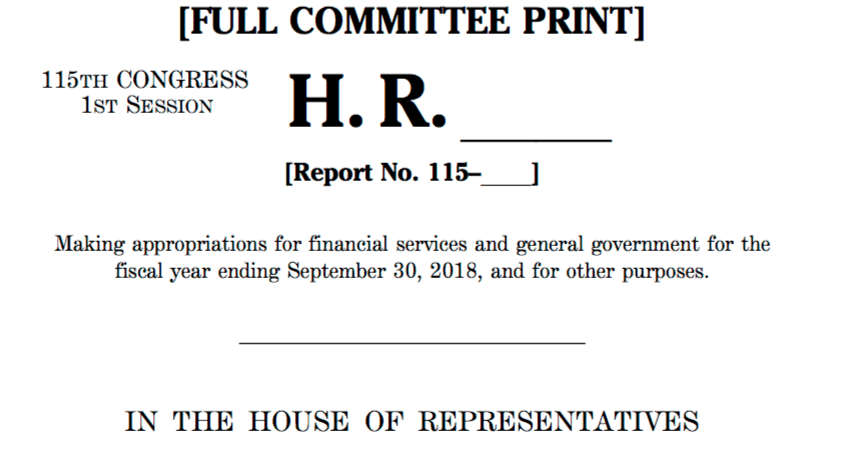
With all the diversions this week, it was easy to miss that the House Committee on Appropriations posted on June 28th the Appropriations Bill for FY 2018.  The bill seems to include a couple items that not many were expecting.  So, I thought I would highlight some of the key provisions.  Since it is Friday before a Holiday weekend, I’ll keep it short for now.  There are four main provisions I will address: (1) IRS Targeting/Johnson Amendment; (2) ACA Penalties; (3) Conservation Easements; and (4) 2704 (Estate/Gift Tax).

I. IRS Targeting/Death of Johnson Amendment

First, is a clear response to the “targeting” of groups from the Lois Lerner Administration. In three separate sections (107, 108 and 116), the bill attempts to regulate the IRS, not Continue reading “House Appropriations Bill”

Welcome to Surly, Adam Thimmesch!

Great news: Adam Thimmesch of the Nebraska College of Law has agreed to come aboard as a Surly blogger. You may remember Adam from last year, when he gave us a great (and popular!) post on Pokémon Go.

While Adam will provide a fuller introduction of himself in due time, let me say: we’ve been sadly deficient in our SALT expertise, and Adam will capably fill that slot, as well as blogging about whatever other tax issues he finds interesting. So welcome, Adam!

Mortgage Interest Deduction

By: David J. Herzig

The Trump and Republican tax plans have circled around the idea of repealing the mortgage interest deduction.  Although I’m not convinced it will happen (see e.g., Treasury Secretary Mnuchin’s remarks).  The mere threat of the repeal has garnered a fair amount of attention.

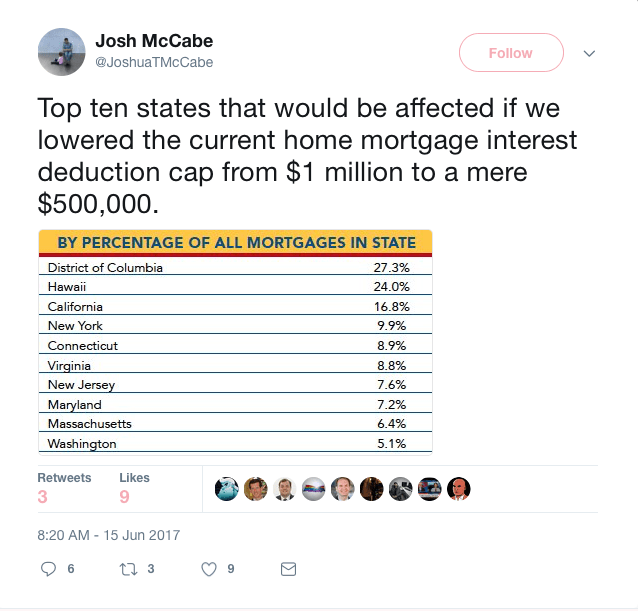
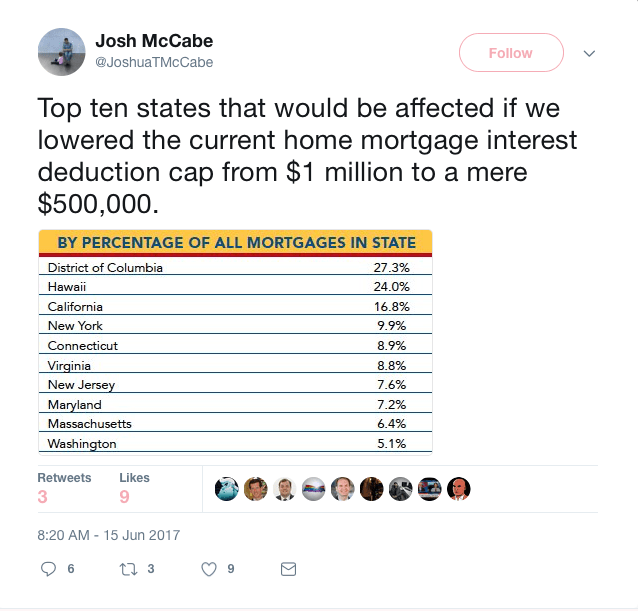
For example, the other day this chart was making its rounds on twitter.

Screen Shot 2017-06-16 at 7.42.50 AM

I have not verified the methodology of the chart or the data.  I interpret that the chart examines (in absolute numbers) how many mortgages exist at $1,000,000. The implicit conclusion of the chart is that homeowners in states like D.C., Hawai’i, California and New York have the most at stake in retaining the deduction.

Why?

Because there seems to be evidence that the mortgage interest deduction contributes to housing inflation.  Back in 2011 the Senate held hearings on incentives for homeownership. [1]  It has been suggested that the elimination of the deduction will drop home prices between 2 and 13% with significant regional differences. [2]  So, if the mortgage interest deduction is eliminated, then the aforementioned states might have numerous problems, including a smaller property tax base.

What exactly is the Mortgage Interest Deduction?

Continue reading “Mortgage Interest Deduction”

Prognosticating Estate Tax Repeal using State Interests

By: David Herzig

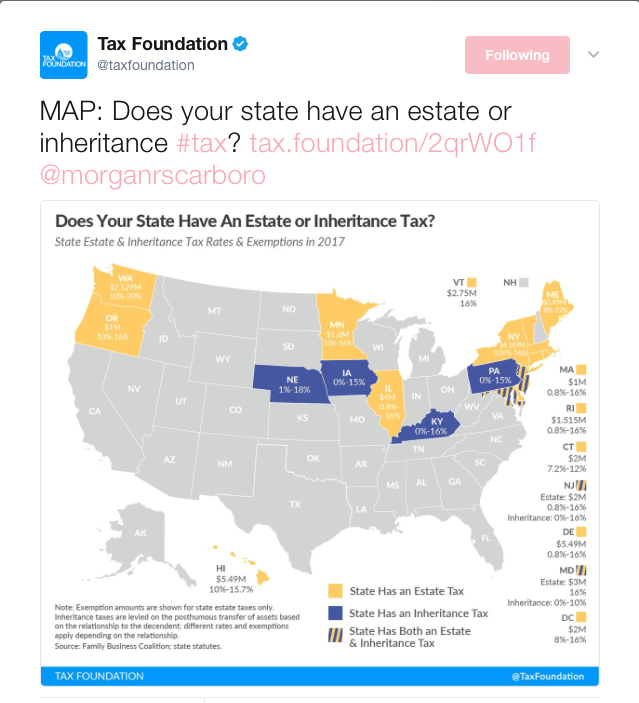
Last week Tax Foundation tweeted about the states that have either a state level estate or inheritance tax.

Screen Shot 2017-06-01 at 8.29.10 AM

The map and subsequent conversations I have had reinvigorated my interest in the prospect of an estate tax.  Briefly in this post, I wanted to say a couple things about the state level estate or inheritance tax, the map, and the effect of the Economic Growth and Tax Relief Reconciliation Act of 2001 (“EGTRAA“) on the prospects of the elimination of federal estate tax.

I’ll readily admit that it has been a while since I did an estate tax return.  So, I needed some refreshing regarding the idiosyncrasies of the interaction between the state and federal taxes.  Some recent history is not only necessary but illustrative of the prospects of permanent federal estate tax repeal.

Brief History of Switch From Credit to Deduction

Prior to the enactment of EGTRAA, the federal estate tax provided an tax credit for an amount paid because of a state level estate tax.  The mechanics of credit was essentially a revenue sharing agreement for the tax collected between the federal government and the states – essentially, up to 16% of an estate’s value.  The credit applied whether or not the state had an independent estate tax.  This tax was known as a “pick-up” or “sponge” tax.

Continue reading “Prognosticating Estate Tax Repeal using State Interests”

… and police are on their way to your house to arrest you

By Sam Brunson

Over the last couple weeks I’ve gotten at least three calls from numbers I’m not familiar with. When I pick up, a heavily-accented recorded voice tells me that I haven’t paid my taxes, the IRS has filed a lawsuit (or, in one recording, a “law-sweet”) against me, and that police are on their way to arrest me. I can get out of my problems if I call them back immediately.

I’ve called back three times. The first time, I got flustered when asked for personal information, and told the guy I knew it was a scam. The third time, the call center noises were so loud that I could barely hear the person, and eventually, she put me on hold and then the call dropped. The second, though …

The second, I told the guy on the phone that my name was Carlos Danger. (I had to spell “Danger” for him.) I gave him a fake string of 9 digits (that he read back to me, and I was lucky that I mostly remembered it. Protip: if you’re giving a fake SSN to scammers, do something memorable. David Herzig, for example, recommends 867-53-0909). He put me on hold, and checked his computer, and then told me his records showed I owed $9,700 in back taxes. Continue reading “… and police are on their way to your house to arrest you”

Macron and the Potential Future of Tax Leaks

By: Diane Ring

The French election for president—an event worthy of note in its own right (particularly on the heels of the Brexit vote)—generated a political, international relations, security and media firestorm due to a late-breaking data leak and hack. On Friday, the campaign of French centrist candidate Emmanuel Macron announced that it had been the subject of a major computer hack. At least 9GB of emails and personal and business documents from Macron’s campaign were posted to a document sharing site called Pastebin. Initial reports contended that the hack and leak were an effort to aid Macron’s far-right opponent Marine Le Pen, and may have been undertaken with Russian assistance. While Macron won the election, the potential fallout out from these leaks may have only just begun.

There’s an important tax dimension to the story, which may have been slightly overshadowed by Friday’s massive data dump. Two days before, on Wednesday, Le Pen hinted during a debate at possibility that Macron might have an offshore account in the Bahamas. Apparently, two hours before the debate, documents were anonymously posted on an internet forum that purported to include Macron’s signature and to show that he had a Bahamas bank account. During the debate, Macron responded that the claim was false and constituted “defamation.” On Thursday, Macron and his campaign outlined the spread of this offshore-account assertion on various sites and contended some were connected to “Russian interests.” On Friday, Macron lodged a complaint with the French prosecutor’s office regarding offshore account allegations made online.

Though the Friday hack and data dump have dominated the spotlight, the alleged tax leak is in fact part of the bigger and quite troubling picture of leaks in the modern cyber environment . . .

Continue reading “Macron and the Potential Future of Tax Leaks”

What is the Johnson Amendment?

By: David Herzig

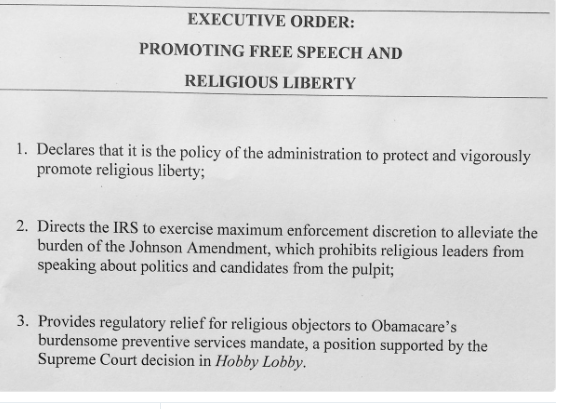
As the world braces for the upcoming Executive Order from President Trump,

Screen Shot 2017-05-04 at 8.18.56 AM

I wanted to take a minute and describe the Johnson Amendment.  Later today, after the actual Executive Order is made public, Ben Leff will be writing up a more through post.

A couple of months ago President Donald Trump told the audience at the National Prayer Breakfast that he would “get rid of and totally destroy” the Johnson Amendment. Which raises the question: what is the Johnson Amendment. Because he brought it up at the National Prayer Breakfast, it also leads to the question of how does affects churches.

In 1954, without explanation, Lyndon Johnson proposed a small amendment to the tax law governing tax-exempt organizations: forbid them from endorsing or opposing candidates for office. One of the few consistent talking points during president-elect Donald Trump’s campaign was that this so-called “Johnson Amendment” should be repealed; since comprehensive tax reform is part of Trump’s plan for his first 100 days in office, the repeal may happen immediately. Continue reading “What is the Johnson Amendment?”

We Should be Taking President Trump’s Tax Plan Seriously

By: David J. Herzig

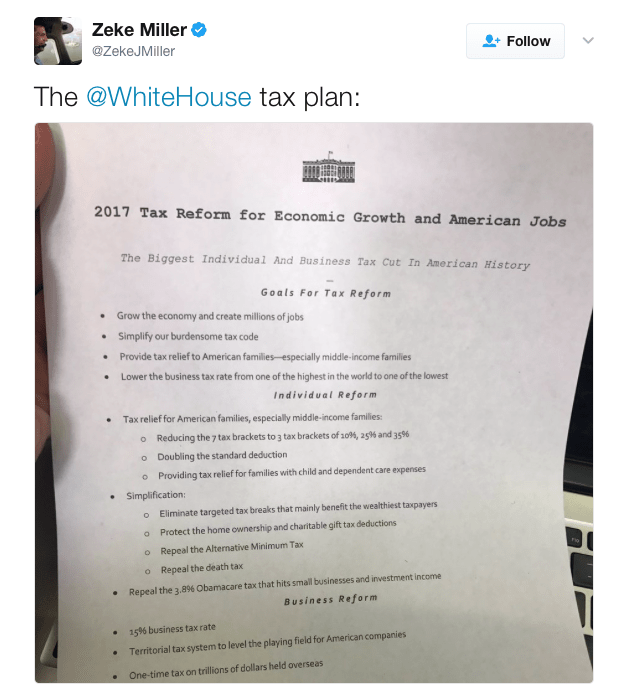
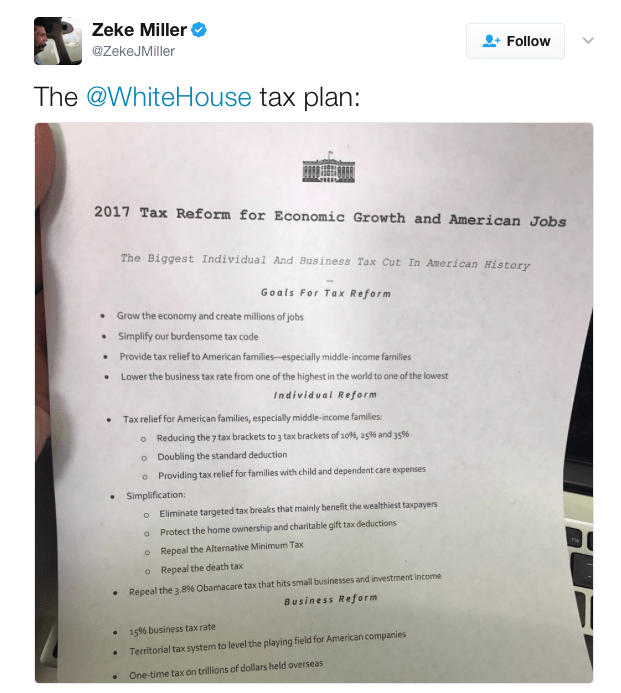
Today President Trump’s top tax advisors laid out the first details of the his tax plan. Chief economic adviser Gary Cohn and Treasury Secretary Steve Mnuchin unveiled the plan which according to Fox News, Cohn called “the most significant tax reform legislation since 1986, and one of the biggest tax cuts in American history.”

Oh, did I mention that the details of the biggest cuts were printed on a single sheet of paper?

Screen Shot 2017-04-26 at 4.22.18 PM

There has been plenty of ink (and jokes) already spilled about the plan.  For example, you can read Richard Rubin of the WSJ (here) or Alan Rappeport of the NY Times (here). The long and the short of the plan is it seems to very very costly.  The Committee for a Responsible Federal Budget guesses it could cost $3 to $7 trillion with their estimate at $5.5 trillion.  That is a lot of money!

Continue reading “We Should be Taking President Trump’s Tax Plan Seriously”

A Libertarian Tip

By: David Herzig

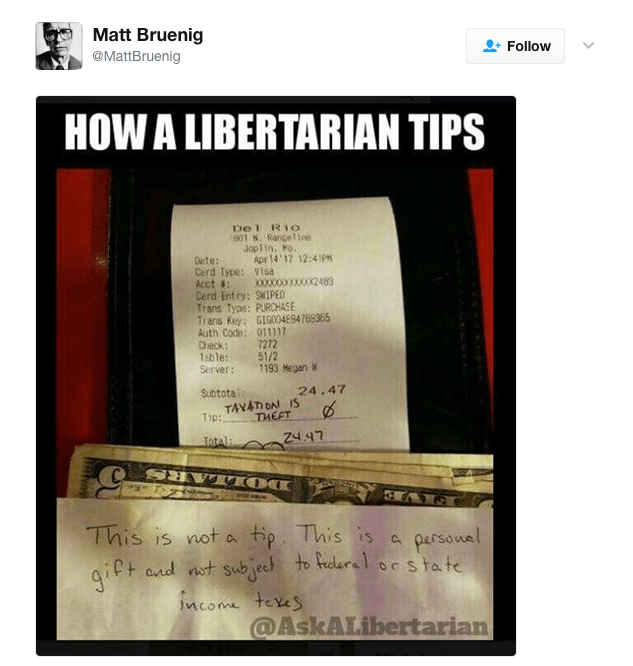
Yesterday on Twitter, Scott Greenberg (@ScottElliotG) posted the following tweet from Matt Bruenig.

Screen Shot 2017-04-20 at 7.41.36 PM

Well, David Gamage, Omri MarianAndy Grewal and I had fun in 120 characters debating the quality of the tax advice provided on both the receipt and the note.  Suffice to say: (A) this will be appearing on a number of basic income tax exams shortly;[1] and, (B) neither piece of advice provided by “Mr. Libertarian” seems to be correct.  Both David and I pointed out that the “tip” did not seem to meet the old Duberstein detached and disinterested test.  Clearly there was a quid-pro-quo; don’t spit on my food and I will give you extra money in addition to the bill.

Joking around about the gift/income distinction made me think that tipping is very tax inefficient.  Assuming that what I said is true: tips are not gifts and they are income to the recipient. This means that the payment is not deductible by the payor (just personal consumption) yet income to the recipient, i.e. the server. If it is ordinary income to the recipient, then there should be a corresponding wage deduction, right?

Let’s assume the following counterfactual.  The restaurant includes the tip as part of the bill.  The restaurant pays the employee salary including the entire tip.  Under this structure, the restaurant would receive an entire wage adjustment for the tip paid.  The customer is still does not receive a deduction for paying the employee’s wages and the employee still pays the same amount of income tax.  But the employer captures the unused deduction for wages by the customer.  Theoretically, this deduction could be shared by all the stakeholders to reduce costs to all parties.

Who cares?  Well, only economists and tax professors, probably.  Back to finals preparation!

[1] Here is David Gamage’s hypo: customer leaves $1K and says, I just won the lottery and want to share some of my winnings as a “gift”. 

Panama Papers: The One-Year Anniversary

By: Diane Ring

This month marks the one-year anniversary of the Panama Papers leak. In April 2016, the ICIJ announced the leak and a few weeks later (May 9, 2016) released a database that included a subset of the leaked data. The leak itself comprised over 11 million records spanning 40 years from the Panamanian law firm Mossack Fonseca. At its core, the leak revealed the true ownership of over 200,000 offshore entities, thereby raising a host of tax and political questions regarding many of the entities’ owners.

So what has happened over the past year as a result of the leak? Continue reading “Panama Papers: The One-Year Anniversary”