Stetson Law School Seeks a Tax Professor

Stetson Law School, Florida’s oldest law school, is looking for a tax professor, especially a lateral. Here is the ad, from TaxProf blog:

Stetson University College of Law invites applications for a full-time tenured or tenure-track faculty position for a dedicated teacher/scholar specializing in tax law. While we are particularly interested in receiving applications from experienced lateral candidates, we will consider hiring at all levels, with or without tenure.

Stetson encourages applications from women, minorities, LGBTQ candidates, persons with disabilities, and all others who will contribute to our stimulating and diverse cultural and intellectual environment. Applicants should have a strong academic record and demonstrated commitment to outstanding teaching, scholarship, and service. Confidential inquiries are welcome.

Stetson’s beautiful campuses are located in Florida’s Tampa Bay region, the nation’s eighteenth largest metropolitan area. Stetson Law, Florida’s oldest law school, is internationally known for its programs in Advocacy, Legal Writing, Elder Law, and Higher Education Law. We encourage interested applicants to visit our website at http://www.law.stetson.edu to learn more about our school, our community, and our programs.

Application review will begin by mid-August and will continue until the positions are filled. Lateral candidates may be asked initially to video conference with the Appointments Screening Committee; other interviews may occur in Washington, D.C. during the AALS 2017 Faculty Recruitment Conference.

Please submit your cover letter, resume, and contact information for professional references, and address your application to Professors Mark Bauer and Ann Piccard, Co-Chairs, Faculty Appointments Screening Committee. You may email your application to facultyappointments@law.stetson.edu. You may also apply through standard mail; please send correspondence to Jessica Zook, Stetson University College of Law, 1401 61st Street South, Gulfport, Florida 33707.

Congratulations University of Kentucky College of Law for Recognizing Professor Jennifer Bird-Pollan as …

the 2017 Duncan Teaching Award Recipient earlier this month.  As this powerhouse fellow Surly Subgroup blogger embarks upon her eighth fall with UK Law this recognition comes as no surprise for those of us who have had the good fortune of working with Professor Bird-Pollan on the many panels she organizes, populates, moderates, and participates in for various major conferences including Law & Society and the Southeastern Association of Law Schools. Continue reading “Congratulations University of Kentucky College of Law for Recognizing Professor Jennifer Bird-Pollan as …”

So about that Robot Tax…

Shu-Yi Oei

I came across a couple of news stories recently about how South Korea is introducing the world’s first robot tax. But based on the press reports, it sounds like the so-called robot tax is actually just a reduction of the tax deductions available to businesses that invest in productivity-boosting automation. The news sources themselves concede that this “robot tax” not exactly a tax on robots but rather a tax benefit reduction for automation investment.

Talk of a “robot tax” has landed at the forefront of tax news since Bill Gates mentioned it in a Quartz interview back in February of 2017. But of course, scholarship about robots (not to mention robots themselves) has been around for quite a bit longer. There’s even a “We-Robot” robotics law and policy conference that’s been going on since 2012, which I keep meaning to crash, but then there’s always something else going on.

A lot of what seems to be driving the tax conversation is the fear that robots are taking over jobs, though there’s some uncertainty about the extent to which robots are to blame.

Personally, I’ve been having a hard time squaring the newly ascendant tax conversation about the robot tax with the broader legal scholarship on robots. In some of the news and other commentary discussing Robotaxation, my reaction has been something to the effect of “I’m not sure that word means what you think it means.” Turns out, there is something of an existing conversation about what constitutes a robot in the first place—see, for example, Richards and Smart (2013) for a nice discussion of some of the definitional issues. See also this “What is a Robot?” piece in The Atlantic. In defining “robot,” it might matter how a robot moves in the physical world, what kind of quasi-independent agency it seems to exercise (autonomous vs. semi-autonomous), how humans interact with it, and even what sorts of emotions it triggers in us mere humans. We might understand some automated machines to be robots but others to just be automated equipment. And these distinctions make sense, from the viewpoint of areas like tort law, privacy law, the law of principals and agents, and the more general regulation of robots (and of artificial intelligence as a subcategory of robots).

But in some of the tax discussions about robots that I’ve seen on the interwebs, it’s quite clear that the authors don’t necessarily mean Robot when they say Robot. Continue reading “So about that Robot Tax…”

The IRS vs. the KKK

By Sam Brunson

My family’s summer vacation has already given me two posts (here and here), and it still promises a couple more, including this one.

As we drove across Alabama, we stopped by the Birmingham Civil Rights Institute. The BCRI is, in large part, a museum of the civil rights movement; it is not only interesting and informative, but it is deeply powerful and affecting to see how white Americans (mis)treated African Americans, what motivated civil rights activists, and what they faced in their activism.

I didn’t go in looking for taxes, but the Institute handed them to me anyway: Continue reading “The IRS vs. the KKK”

The Front Lines of Sharing Economy Legal Debates

By: Diane Ring

Last month I blogged about new proposed legislation in Congress that sought to provide a safe harbor for gig worker classification for tax purposes. However, as I noted, the proposal implicitly favored one side of the debate by making the safe harbor one that would ensure the “easy” ability to classify a worker as an independent contractor (rather than an employee). In that post, I suggested that having tax lead the charge in this sharing economy worker classification debate perhaps allowed the tax “tail” to lead the employment relations “dog”. There are pressing nontax issues in the sharing economy that are driving litigation and dominating worker concerns – particularly employment law issues. Just last week, we saw further evidence of serious tensions in the landscape of sharing economy labor law.

On Tuesday, July 31, 207, in Chamber of Commerce of the United States, et al.,  v. The City of Seattle, a U.S. federal judge dismissed a challenge to legislation approved by the Seattle City Council in fall 2015. Pursuant to the Seattle law, businesses that hire or contract with taxi-drivers, for-hire transportation companies and “transportation network companies” must bargain with drivers if a majority want to be represented. That is, Seattle effectively allows Uber and Lyft drivers to unionize. Not surprisingly, Uber and Lyft objected to the law . . . Continue reading “The Front Lines of Sharing Economy Legal Debates”

Villanova Seeks to Hire Assistant/Associate/Full Professor of Law and Federal Tax Clinic Director

And here’s another hiring announcement:

Villanova University Charles Widger School of Law seeks an outstanding lawyer-educator to direct and teach its nationally regarded Federal Tax Clinic. The Clinic represents low-income taxpayers in controversies with the IRS. The Director oversees students working in teams on examinations, administrative appeals, collection matters, and cases before the United States Tax Court, Federal District Courts and Appeals, as well as on comments projects relating to guidance issued by the IRS or Treasury.

The Director will be either a full-time continuing non-tenure track (governed by ABA Standard 405 ( c ) ), tenure-track, or tenured member of the faculty, depending on the qualifications and aspirations of the successful candidate.

Minimum Qualifications:

• A Juris Doctor degree is required.
• Pennsylvania bar membership (or an ability to waive into the Pennsylvania bar) is required.
• Outstanding clinical teaching ability is required.
• Expertise in federal tax law is required.
• Outstanding scholarly potential is required for candidates seeking a tenure-track position. A demonstrated record of outstanding scholarship is required for candidates seeking a tenured position.

Preferred Qualifications:

• Five years of legal experience is strongly preferred, as is experience working on behalf of low-income taxpayers.
• Prior clinical teaching experience is advantageous, but not essential.

Looking Back at Maurer’s SALT-Filled 2017 Tax Policy Colloquium

By: Leandra Lederman

With classes starting again, I have been planning for the new academic year, which also entails looking back at the 2016-2017 year. I’m teaching Introduction to Income Tax this Fall, and will be teaching Corporate Tax and Tax Policy Colloquium this Spring.

I am fortunate to run our Tax Policy Colloquium. I blogged on TaxProf Blog about launching the Colloquium and reflected back on it there after its first year. From my perspective, it has consistently been a terrific experience. Spring 2017 was special, though, because many of the paper topics seemed to connect, although that was largely unplanned. Here is the list of presenters we hosted, and their paper titles:

Daniel Hemel, University of Chicago Law SchoolFederalism as a Safeguard of Progressivity

Rebecca Kysar, Brooklyn Law School, Automatic Legislation

Les Book, Villanova University School of Law & David Walker, Intuit (via Skype), Thinking About Taxpayer Rights and Social Psychology to Improve Administration of the EITC

Allison Christians, McGill University Faculty of LawHuman Rights At the Borders of Tax Sovereignty

Mildred Robinson, University of Virginia School of Law, Irreconcilable Differences?: State Income Tax Law in the Shadow of the Internal Revenue Code

Jason Oh, UCLA School of LawAre Progressive Tax Rates Progressive Policy?

David Gamage, Indiana University Maurer School of LawTax Cannibalization and State Government Tax Incentive Programs

Justin Ross, Indiana University School of Public and Environmental AffairsThe Impact of State Taxes on Pass-Through Businesses: Evidence from the 2012 Kansas Income Tax Reform

These papers got us to think both about state tax systems and about how the U.S. federal and state tax systems interact or differ. One recurring theme was how regressive U.S. state tax systems generally are (aggregating all the taxes within a state). That discussion started with Daniel Hemel’s paper; he cited 2015 ITEP data that came up repeatedly throughout the course.

The ITEP site lists Washington, Florida, Texas, South Dakota, Illinois, Pennsylvania, Tennessee, Arizona, Kansas, and Indiana as the 10 states with the most regressive tax systems. I notice that several of those don’t have state income taxes. But many, including Indiana, do. As an example, here are the stats on Indiana’s tax system in 2015, coming in at 10th most regressive in the ITEP study.

In case you’re wondering, ITEP says that the 7 states with the least regressive tax systems in 2015 were (in alphabetical order) California, Delaware, the District of Columbia, Minnesota, Montana, Oregon, and Vermont. Least regressive doesn’t mean “progressive,” though: “In each of these states, at least some low- or middle-income groups pay more of their income in state and local taxes than wealthy families. In other words, every single state and local tax system is regressive and even these states that do better than others have much room for improvement.”

I’m now looking ahead to another terrific group of Colloquium speakers in Spring 2018. Paper topics are as yet undetermined, so I don’t know if themes will emerge, but I will plan to follow up with more on the Colloquium content in the future.

The University of Pittsburgh School of Law Seeks to Hire A Tax Professor

By: Leandra Lederman

I’ve been asked to post the following announcement. I’m told that Pittsburgh would be able to hire at all levels from assistant professor to full professor.

The University of Pittsburgh School of Law invites applications for a tenure-stream position, beginning in the 2018-2019 academic year, to teach courses in the tax area. The successful candidate will become an integral part of Pitt Law’s tax program, which includes a Tax Law Concentration, a Low-Income Taxpayer Clinic, and the peer-reviewed Pittsburgh Tax Review. We anticipate hiring for this position at the rank of assistant, associate, or full professor, depending on the candidate’s qualifications. We strongly encourage applications from lateral candidates at all levels.

An interest in teaching and research in international aspects of tax law and/or in business/commercial law is desirable, as is an interest in and/or experience with incorporating experiential learning and innovative pedagogy (e.g., writing intensive, inter-professional, flipped classroom, etc.) into the classroom.

The University of Pittsburgh is an Affirmative Action, equal opportunity employer and does not discriminate on the basis of race, color, sex, veteran status, disability, national origin, creed, marital status, age, gender identity or sexual orientation in its hiring.  In furtherance of our strong institutional commitment to a diverse faculty, we particularly welcome applications from minorities, women, and others who would add diversity to our faculty.

Contact:  Harry Flechtner, Chair, Faculty Appointments Committee, University of Pittsburgh School of Law, 3900 Forbes Ave., Pittsburgh, PA 15260.  Email: law-appointments@pitt.edu.  Email submissions are preferred.  The deadline for applications is November 1, 2017.

Tax at the National Parks: Tuskegee Airmen National Historic Site Edition

By Sam Brunson

Last week, my family and I were at the Tuskegee Airmen National Historic Site. I wasn’t terribly familiar with the Tuskegee Airmen before visiting; frankly, their story is amazing, inspiring, and shocking. Basically, Army War College study from the early twentieth century claimed that African Americans lacked intelligence, ambition, and courage, and were thus unfit for the military, and especially unfit to be airmen.

The Tuskegee Institute had an airfield where it trained African American pilots; eventually the government accepted it as a training ground for military pilots. The Tuskegee Airmen proved the Army War College study wrong with a distinguished record of military service. Still, the military in the 1940s was segregated, and these Tuskegee Airmen served in segregated units and, when they returned home, they faced continued racism. Many, tired of what they experienced, went on to join the civil rights movement. And many of them share their stories, through audio, video, pictures, and artifacts, at the NHS. Continue reading “Tax at the National Parks: Tuskegee Airmen National Historic Site Edition”

The Tail, the Dog, and Gig Workers

By: Diane Ring

tail.dog

New legislation has just been introduced in the Senate that creates a “safe harbor” for independent contractor status. The proposed legislation provides that if a worker relationship satisfies certain criteria, then that worker can bypass the sometimes messy, multi-factor test for distinguishing between employees and independent contractors, and will be classified as an independent contractor for tax purposes. What prompted action now to address what has been a decades-old classification challenge for workers, businesses and the IRS alike? The gig economy. (Hence, the not-so-catchy title for the legislation: The New Economy Works to Guarantee Independence and Growth (NEW GIG) Act of 2017 (S. 1549).)

The legislation’s sponsor, Senate Finance Committee member John Thune, (R-S.D), described the impetus for the legislation as follows: “My legislation would provide clear rules so that these freelance style workers can work as independent contractors with the peace of mind that their tax status will be respected by the IRS.”

Is this really what gig workers are worrying about? . . . Continue reading “The Tail, the Dog, and Gig Workers”

What My Noisy New Hobby is Teaching Me about Tax

Shu Yi Oei

While Sam was out there visiting the National Parks, I went and acquired a noisy new hobby.

drums

So far, I’ve only had two drum lessons but am completely hooked. What took me so long to pick up the drums? If you love music, get a kick out of repetitive motion, and enjoy making a big noise, I highly recommend it.

Learning the drum set is a matter of first impression for me. [FN1] So the actual noise making aside, it’s given me an unexpected midsummer opportunity to revisit what it feels like to learn a new skill for the first time, which of course makes me think about the fundamentals of teaching and writing in tax.

Here are some newbie observations:

  1. Assembling the Drum Set

I went out and bought a cheap drum set so I could practice at home. What really surprised me was the amount I learnt about the drums simply by virtue of assembling the drum set. Things I know now that I didn’t know before:

  • That restaurant in New Orleans called the High Hat? Turns out it probably isn’t named after an actual hat.
  • Who knew you had to tune the drums? It’s almost as if it’s a musical instrument or something.
  • The crash cymbal and high hat sit much lower to the ground than I had ever imagined.
  • You can actually turn the snares on a snare drum on and off. Did I know that? Nope.

The experience of assembling my own drum set was so useful that it got me thinking about how one might get one’s tax students to do the equivalent of assembling a drum set. Continue reading “What My Noisy New Hobby is Teaching Me about Tax”

Online Shopping and Tax Privacy

despaired-2261021_1920

By Adam Thimmesch

The privacy implications of online commerce are complicated and fascinating. On the one hand, it allows individuals to protect their privacy by shopping for sensitive items without the knowing glances of store clerks, fellow patrons, or those passing by. On the other hand, it creates a digital trail that can connect them to a particular vendor or purchase in perpetuity. This can occur with respect to items that are politically, medically, or sexually sensitive and with respect to items that they’d just prefer to keep a secret. (For example, if you forget to browse in private mode, you might find that your wife’s Facebook feed now includes ads for the items that you were searching out for her birthday. Woops. Sorry dear.)

Your online shopping habits might also soon be known to your state revenue authority. Given states’ limited jurisdiction to require online vendors to collect sales taxes from consumers, some states have taken a new approach—requiring those vendors to, instead, rat out their customers to the state. Continue reading “Online Shopping and Tax Privacy”

Tax at the National Parks: Great Smokey Mounains Edition

By Sam Brunson

This will be the third in my series of tax-in-the-National-Parks posts. (I’m as surprised as you.)[fn1]

We spent a couple days camping at Great Smoky Mountains National Park. At the Oconaluftee Visitor Center, there were a series of displays about Appalachian life.[fn2] As I was looking at the moonshine still, I noticed this sign: Continue reading “Tax at the National Parks: Great Smokey Mounains Edition”

House Appropriations Bill

By: David Herzig

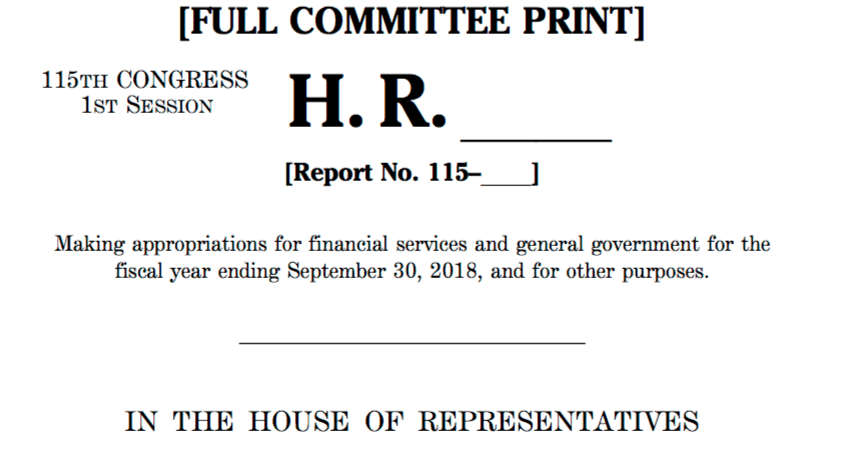
With all the diversions this week, it was easy to miss that the House Committee on Appropriations posted on June 28th the Appropriations Bill for FY 2018.  The bill seems to include a couple items that not many were expecting.  So, I thought I would highlight some of the key provisions.  Since it is Friday before a Holiday weekend, I’ll keep it short for now.  There are four main provisions I will address: (1) IRS Targeting/Johnson Amendment; (2) ACA Penalties; (3) Conservation Easements; and (4) 2704 (Estate/Gift Tax).

I. IRS Targeting/Death of Johnson Amendment

First, is a clear response to the “targeting” of groups from the Lois Lerner Administration. In three separate sections (107, 108 and 116), the bill attempts to regulate the IRS, not Continue reading “House Appropriations Bill”

President Trumpeting Marketplace Fairness?

By Adam Thimmesch

Hello everyone! I’m excited to be joining the Surly Subgroup and appreciate the opportunity to share some of my thoughts in thus forum. I’ve been at the University of Nebraska College of Law since 2012, and I teach Individual Income Tax, State and Local Tax, Corporate Tax, Corporate Finance, and Business Associations. Much of my research to date has focused on state-tax issues, though I’ve recently been spending time also thinking about how our tax systems intersect with individual privacy interests. I am looking forward to blogging about these issues—and maybe a good tax-and-soccer scandal from time to time.

This is a particularly good week to enter the blogging world as a state-tax guy. I woke up yesterday ready for a regular day of summer research and writing when this happened:

Now, I’m generally inclined to not give much attention to our current President’s tweets, but it isn’t often that state-tax issues get presidential attention, so it seemed like a good opportunity to dig into the tweet a bit more. (Plus it gave me the opportunity to use a terrible Trump pun right off the bat as a blogger.)

The Tweet

Although the President’s tweet is difficult to interpret (and that’s being gracious), it appears that he was primarily attempting to criticize The Washington Post as “fake news.” That came a day after the paper reported on the fact that several of his golf clubs had posted fake Time magazine covers on their walls. Trump made this criticism, though, through an oddly constructed reference to the paper’s relationship with Amazon and Amazon’s position with respect to “internet taxes,” which most likely is a reference to the collection of use tax on online sales. (The Washington Post and Amazon are not related, of course, except that Jeff Bezos—the founder, chairman, and CEO of Amazon—purchased the paper in 2013.)

Continue reading “President Trumpeting Marketplace Fairness?”